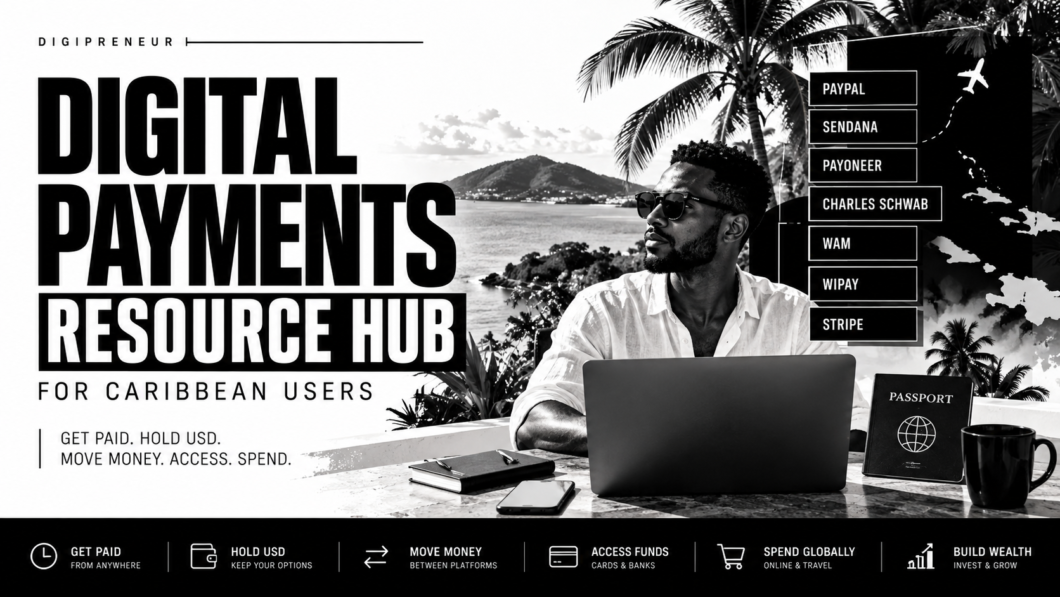
Digital Payments Resource Hub: Build Your Global Payment Stack
This Digital Payments Resource Hub helps Caribbean residents and businesses understand how to get paid, hold foreign currency, move money and spend globally.
Getting paid internationally from the Caribbean should not begin with the question, “Which payment platform is the best?”
That is the wrong way to think about it.
PayPal, Sendana, Payoneer, Charles Schwab, Wam and other financial platforms were not all designed to do the same thing. Some help you accept payments or receive transfers from companies and marketplaces. Others give you access to international accounts so you can hold and spend foreign currency. Others make it easier to move your money where you actually need it.
The real objective is to build a payment stack that gives you the flexibility to participate in the global economy.
GET PAID → HOLD → MOVE → ACCESS → SPEND
How My Payment Needs Changed
My own payment stack has evolved alongside my business and my life.
I started with platforms such as PayPal and WiPay, but as my business became more digital, my clients became more international and my life became more global, my financial infrastructure had to evolve as well.
Today, I need to be able to get paid by clients and companies around the world. That includes receiving marketplace payouts, holding international currencies and moving money between countries. I may need to send money to my daughter in Canada, pay someone through a bank transfer in Thailand, spend internationally or invest my money.
I cannot afford to discover after someone is ready to pay me that I don’t have the right account or payment method set up.
That is why I don’t look at these platforms and ask which one is “better.”
The goal isn’t to find the best payment platform. The goal is to build a payment stack where every tool has a job.
Some tools I use more frequently than others. Others provide a backup or become useful only in specific situations. And some will depend on your country, eligibility and what you need to accomplish.
But collectively, they give me something far more important: freedom and flexibility.
Where Should You Start?
For someone in the Caribbean building their payment infrastructure from scratch, my recommended starting point is:
PayPal + Sendana
Think of this as the 1–2 punch of your Caribbean payment stack.
PayPal gives you a powerful way to accept payments, send invoices, create payment links and process online transactions. Sendana gives Caribbean users another layer of international financial infrastructure for receiving and accessing those funds.
From there, you can expand your stack with tools such as Payoneer, Charles Schwab, Wam, WiPay and, for businesses with more advanced payment-processing needs, Stripe.
However, you do not need to use every account every day.
Instead, the point is to have the infrastructure established before you need it.
This Digital Payments Resource Hub will show you what each platform does, how the different tools fit together, where I personally use them, which options depend on your country or eligibility, and how to build a payment stack that supports the way you want to work, earn and live.
And if you’re not sure where to begin, the Payment Stack Concierge below will help you identify which tools are most relevant to you.
Build Your Caribbean Payment Stack
Answer a few questions. We’ll show you which payment tools fit your needs and how they can work together.
Where are you based?
Country affects platform availability and eligibility.
What are you building this payment stack for?
You don’t need to own a business to need global payment infrastructure.
How do you expect to get paid?
Different clients, companies and platforms use different payment rails.
You won’t always choose how you’re paid. A client, employer or marketplace may already have a preferred payout method.
Will customers pay you through a website?
This determines whether you need simple payments or more advanced e-commerce infrastructure.
What needs to happen after you get paid?
Receiving money is only the first step.
RECEIVE → HOLD → MOVE → ACCESS → SPEND
Do you need ACH or wire receiving capabilities?
Some companies won’t use PayPal. They may simply ask for receiving or banking details.
How do you want to access your money?
Getting paid and having practical access to your money are different problems.
Do you want investment capabilities in your stack?
Your international infrastructure can eventually do more than receive and spend money.
Charles Schwab International is a brokerage account and eligibility varies by country.
Do you need to accept cards face-to-face?
Think stores, pop-ups, deliveries and mobile businesses.
Your Caribbean Payment Stack
Based on how you expect to get paid, hold, move, access and spend money, these are the tools you should explore.
PayPal
Your payment engine for invoices, Payment Links, website checkout and online payments.
Sendana
Caribbean USD-access infrastructure with PayPal connectivity, receiving capabilities and card access.
Payoneer
Useful for marketplace payouts, global company payments and additional receiving infrastructure.
Charles Schwab International
International brokerage infrastructure that can add investing and another layer of USD financial access.
Wam
T&T infrastructure for global currency accounts, PayPal connectivity, local settlement and mobile card acceptance.
WiPay
Caribbean-built payment processing for businesses needing digital payments and supported local settlement.
Stripe
Advanced infrastructure for e-commerce, subscriptions and online card processing.
You Don’t Need One Payment Platform. You Need a Payment Stack.
One of the biggest mistakes I see people make when thinking about international payments is trying to find one platform that does everything.
That is not how the global payment ecosystem works.
Different companies, marketplaces, clients and financial platforms use different payment rails. For example, Amazon may pay you differently from a consulting client. The tool you use to invoice a customer may not be the same tool you use to access those funds, spend them internationally or invest them.
For that reason, I believe Caribbean professionals should stop asking:
“Which payment platform should I use?”
And start asking:
“Do I have the right payment infrastructure for the different ways I may need to get paid?”
Every Tool Has a Different Job
For example, look at how this works in practice.
Amazon → Payoneer
If you’re earning through Amazon or another marketplace that supports Payoneer payouts, having your Payoneer account already established gives you a payment route when you need it.
Client Invoice → PayPal
I use PayPal to invoice clients around the world and give them a professional way to pay me online.
Payment Link → PayPal
If someone simply needs an easy way to pay me, I can create a payment link and send it directly to them.
PayPal → Sendana or Wam
Receiving money into PayPal is only the beginning. You also need a way to access or move those funds. Sendana and Wam can play different roles here depending on what you’re trying to accomplish.
More Ways to Receive and Use Your Money
ACH & Wire Transfers → Sendana, Payoneer or eligible Schwab infrastructure
Sometimes a company doesn’t want to pay through PayPal at all. They may ask for banking details so they can send an ACH or wire transfer. This is another reason having multiple accounts available gives you flexibility.
Local T&T Settlement → Wam
For someone in Trinidad and Tobago who wants to move eligible funds into a local personal or business bank account, Wam can provide an important bridge between international payments and the local financial system.
Investing → Charles Schwab
For Caribbean residents who are eligible for a Charles Schwab International account, Schwab adds an entirely different capability to the stack: access to an international brokerage account and investment infrastructure.
Website Payments → PayPal or Stripe
If you’re operating an e-commerce website or selling products and services online, you need payment-processing infrastructure that allows customers to actually complete transactions on your website.
In other words, each tool solves a different part of the problem.
These platforms overlap in some areas, but they are not all doing the same job.
That is why asking whether Sendana is “better” than Charles Schwab, or whether Payoneer is “better” than PayPal, can miss the bigger picture.
You may have a reason to use both.
Build the Infrastructure Before the Opportunity Arrives
This is one of the most important lessons I can give you:
Set up your payment infrastructure before you need to get paid.
Don’t wait until Amazon needs your payout information.
Instead, be ready before an international client asks for an invoice.
Don’t wait until an employer asks for ACH or wire details.
The same applies when someone wants to send you money through PayPal.
And definitely don’t wait until the money has arrived somewhere before you start figuring out how you’re going to access it.
Many of the platforms covered in this resource can be set up without an account-opening fee. Take the time to establish the accounts you’re eligible for, complete the verification processes and understand how they work.
You may not use every account every week.
I don’t.
Some are part of my everyday business. Others are redundancy. Some exist because a particular marketplace or company may require them. Others give me capabilities that the rest of my stack doesn’t provide.
But when an opportunity comes, I don’t want figuring out how to get paid to be the thing standing between me and the opportunity.
That is what a payment stack is really about:
Options. Access. Redundancy. Flexibility.
You are building the financial infrastructure that allows you to participate in the global economy.
Digital Payments: Receive, Hold, Move, Access and Spend
One of the biggest misunderstandings I see around digital payments in the Caribbean is that we spend all of our time trying to answer one question:
“How do I get paid?”
That is important—but receiving the payment is only the beginning.
Once someone pays you, another set of questions immediately becomes important.
Where will you keep the money?
Can you keep it in USD or another international currency?
And what options do you have for moving it to another financial account?
Can you withdraw it to your local bank?
Do you have a debit card that allows you to actually use the money?
Can you spend those funds internationally without first converting everything into your local currency?
To make these choices easier, I think about the payment lifecycle as five separate stages:
RECEIVE → HOLD → MOVE → ACCESS → SPEND
If you’re building a payment stack for the global economy, you need to think about all five.
1. RECEIVE — How Will Someone Pay You?
This is the part most people think about first.
You may need to receive money from:
Clients
Customers
Employers
Marketplaces
E-commerce websites
Friends or family
International companies
Digital platforms
But they will not all necessarily pay you the same way.
One client may happily pay a PayPal invoice. Amazon may use a platform such as Payoneer for your particular payout. Another company may ask for ACH or wire-transfer details. A customer may simply want to use their debit or credit card.
Your payment stack gives you multiple ways to say yes when someone asks, “How can I pay you?”
2. HOLD — Where Will the Money Live?
Now you’ve been paid.
What happens next?
This is where the conversation becomes especially important for Caribbean users.
You may not necessarily want every US dollar you earn internationally to immediately enter a local bank account and be converted into local currency.
I certainly don’t.
Part of building my own payment stack was creating the ability to maintain access to my international earnings in international financial infrastructure, rather than automatically routing everything back into Trinidad and Tobago.
Depending on the platform, your eligibility and your account configuration, your stack can give you options for holding currencies such as USD before deciding what you want to do with the money.
Ultimately, that flexibility matters.
3. MOVE — Can You Send the Money Where It Needs to Go?
Of course, money sitting in an account is useful.
However, money that can move is far more useful.
You may need to move funds from one financial platform to another. You may need to send money internationally, transfer funds to another account, pay someone in another country or eventually bring some of your earnings into your local banking system.
This is also why connectivity between platforms matters so much.
PayPal may be where the transaction begins, for example, but that doesn’t necessarily have to be where the money stays.
Your wider financial infrastructure determines what you can do next.
4. ACCESS — Can You Actually Use Your Money?
This is where many people get stuck.
They successfully open an account.
They successfully receive the payment.
Then comes the question:
“Okay…how do I get the money?”
Receiving money and accessing money are two different problems.
Your payment stack needs to account for how you will actually access the funds once they arrive.
That could mean transferring the money to another eligible account, withdrawing to a local bank when that makes sense, or using financial infrastructure that provides you with a debit card or another mechanism for accessing the funds directly.
This is one of the reasons I place so much emphasis on setting everything up correctly from the beginning.
It’s not enough to know that a platform can receive money. You need to understand where that money can go next.
5. SPEND — Can You Use the Money Without Unnecessary Friction?
Finally, you need to be able to use what you’ve earned.
For me, this has become increasingly important as my life has become more global.
I may need to pay for something online, use a debit card internationally, send money to my daughter in Canada, pay someone in another country or make a bank transfer while living in Thailand.
I don’t want my ability to use my money to depend entirely on whether I can first move those funds back into Trinidad and Tobago.
And I don’t necessarily want every international payment converted into TTD if I intend to use that money internationally anyway.
This is where access to virtual or physical debit cards and international financial accounts can become extremely valuable.
Getting Paid and Having Access to Your Money Are Not the Same Thing
This distinction is at the heart of the Digital Payments Resource Hub: receiving a payment is only useful if you can access and use the money.
You can have a PayPal account and still not understand how you’re going to access your PayPal balance.
Similarly, a client may be ready to send you a wire transfer before you have the right account details.
You can receive international income and then discover that moving or spending those funds is far more complicated than receiving them was.
For that reason, we aren’t building this stack simply to get paid.
We are building it so that you can:
RECEIVE your money.
HOLD it in the currencies and accounts available to you.
MOVE it where it needs to go.
ACCESS it when you need it.
SPEND it wherever your life or business takes you.
Once you understand the full payment lifecycle, the purpose of having several different platforms becomes much clearer.
Each tool in the stack solves a different part of the journey.
Digital Payment Tools and Their Roles
Now that you understand the payment lifecycle, let’s look at the platforms that can help you build it.
The important thing to understand is that these tools are not necessarily substitutes for one another.
There is some overlap between them, but each platform has different strengths, features, eligibility requirements and use cases.
Therefore, my own approach is to build a stack rather than choose a single platform.
| Platform | Primary Role in the Stack |
|---|---|
| PayPal | Accept payments, send invoices, create payment links and process website transactions |
| Sendana | USD access, PayPal connectivity, ACH and wire transfers, virtual and physical debit cards |
| Payoneer | Marketplace payouts, international business payments, receiving accounts and debit card access |
| Charles Schwab | International brokerage account, USD financial infrastructure, investing and Visa debit card access for eligible countries |
| Wam | USD, EUR and GBP account access, PayPal connectivity, local T&T settlement and mobile Tap to Pay for businesses |
| WiPay | Caribbean payment processing with settlement into supported local banking infrastructure |
| Stripe | Advanced online payment processing, website checkout, card payments and e-commerce infrastructure |
Think About the Job, Not Just the Platform
The easiest way to understand this stack is to stop looking at the company names for a moment and ask:
What job do I need done?
If you need to invoice an international client, PayPal may solve that problem.
If you need an accessible starting point for connecting to PayPal, maintaining USD access and getting a debit card, Sendana may solve several parts of that problem.
For example, Payoneer becomes important when Amazon or another marketplace uses it to pay you.
If you’re eligible for a Charles Schwab International account and want access to international brokerage and investment infrastructure, Schwab adds an entirely different capability.
In Trinidad and Tobago, Wam has its own role. It offers international account access, routes for moving eligible funds to local accounts, and card acceptance through your phone.
If your business needs Caribbean payment processing with settlement into supported local banking infrastructure, WiPay becomes another option.
And if you’re building more advanced e-commerce infrastructure and need sophisticated online card processing, Stripe enters the conversation.
There Is Going to Be Some Overlap — That’s Okay
PayPal can process payments. So can Stripe.
PayPal can invoice clients. Payoneer also offers ways for businesses to request payments.
Sendana can provide international payment infrastructure. So can Payoneer and, for eligible users, Charles Schwab.
That doesn’t mean you have to pick a winner.
Different platforms can solve similar problems while still giving you different capabilities, connections and payment rails.
For me, some accounts are used constantly. Others provide redundancy. Some exist because particular companies or marketplaces may want to pay me through them. Others give me access to financial capabilities that the rest of my stack doesn’t provide.
The objective is not to force every transaction through one company.
The objective is to have options.
As we go deeper into each platform, I’ll show you what each tool does, where it fits into the wider stack, how I personally use it, and when it may—or may not—make sense for you.
PayPal — The Centre of My Payment Stack
PayPal sits at the centre of my payment stack because it is one of the tools I use most frequently to actually get paid.
For my business, PayPal is my primary website payment processor. It processes payments from customers, allows me to invoice clients around the world, gives me the ability to create and share payment links, and provides the infrastructure for me to accept payments online without having to manually coordinate every transaction.
And as my business evolves, I’m also looking at incorporating more of PayPal’s recurring payment and subscription capabilities.
How I Use PayPal
There are several ways PayPal fits into my business.
Website Payments
PayPal processes payments directly through my website. When someone purchases a product or service online, PayPal can handle the payment transaction without me having to get involved manually.
Invoices
This is one of my most frequently used PayPal features.
If I’m working with a client, I can create an invoice, specify the service, amount and currency, and send the client a professional payment request.
They receive the invoice, make the payment, and the funds arrive in my PayPal account.
Payment Links
Not every transaction needs a formal invoice.
Sometimes I simply need an easy way for someone to pay me. A payment link gives me something I can share through email, WhatsApp, social media or another digital channel.
Subscriptions and Recurring Payments
For businesses with memberships, retainers, subscriptions or other recurring-payment models, PayPal can also become part of that infrastructure.
This is an area I’m looking to use more as I continue developing my own digital products and services.
You Don’t Need a Website to Get Paid With PayPal
This is particularly important for Caribbean freelancers, consultants and small businesses.
You don’t need an e-commerce website before PayPal becomes useful.
If you provide a service, you can invoice your client.
If you need someone to make a straightforward payment, you can send them a payment link.
As a result, PayPal can become part of your payment infrastructure long before you build a sophisticated online store.
Why PayPal Works So Well Inside a Larger Stack
Another reason PayPal remains so important to me is connectivity.
PayPal doesn’t have to operate in isolation.
Depending on your country, eligibility and the financial infrastructure available to you, PayPal can connect with other accounts and services that help you move and access your money.
That is where tools such as Sendana, Wam, Wise and other eligible financial accounts become important.
Think about it this way:
Client / Customer → PayPal → Your Wider Financial Stack
PayPal can solve the first problem—getting paid—while other parts of your stack can help solve what happens next.
Opening PayPal Is Not the Same as Understanding PayPal
This is where I think many Caribbean users get stuck.
People open a PayPal account and assume the job is finished.
It isn’t.
You need to understand how to configure the account properly, how to receive payments, how to invoice clients, how to create payment links, which financial accounts can connect to PayPal, and most importantly:
How are you going to access the money once you’ve been paid?
That last question is one of the biggest reasons I built my complete PayPal guide.
How I Personally Use PayPal
My primary uses:
Website payment processing → Client invoices → Payment Links → Online payments → Expanding into recurring payments and subscriptions
PayPal is not the only tool in my payment stack, but it is one of the most important because it sits directly at the point where many of my transactions begin.
And when you combine PayPal with the right supporting financial infrastructure, it becomes significantly more useful for someone operating from the Caribbean.
Want to Set Up and Understand PayPal Properly?
I created a complete guide that walks through how PayPal works, setting up your account, getting paid, invoices, Payment Links, fees, currencies, connecting financial accounts, accessing your money and building PayPal into a wider Caribbean payment stack.
Read: Getting Paid With PayPal in the Caribbean — The Complete Guide →
https://keronrose.com/getting-paid-with-paypal-in-the-caribbean-the-complete-guide/
Sendana — The Easiest Starting Point for USD Access
If you’re starting from zero and asking me which accounts you should set up first, my recommendation is simple:
Start with PayPal + Sendana.
I consider this the 1–2 punch for Caribbean digital payments because it solves two of the most immediate problems people across the region face:
How do I get paid?
And then:
How do I actually access and use the money?
PayPal gives you the payment infrastructure. Sendana adds another layer that helps you receive, hold and access international funds.
Why Sendana Is So Important for the Caribbean
Sendana is relatively new to my own payment stack.
For me, it provides additional redundancy because I already have several pieces of international financial infrastructure established.
But for someone starting today in the Caribbean, I think its significance is much bigger.
Sendana provides Caribbean users with access to USD financial infrastructure without requiring them to build their entire financial life around a traditional local bank account.
That makes it particularly useful for freelancers, consultants, creators, remote workers, entrepreneurs and anyone else earning money internationally.
Connect PayPal to Sendana
One of the biggest reasons I recommend PayPal and Sendana together is that Sendana can provide the financial infrastructure you need to move eligible PayPal funds out of PayPal and maintain access to them in USD.
That creates a straightforward workflow:
Client / Customer → PayPal → Sendana → Access & Spend Your USD
This solves one of the most common problems I see across the Caribbean.
People figure out how to open PayPal.
They figure out how to get paid.
Then they ask:
“How do I access the money?”
Sendana gives Caribbean users another answer to that question.
Hold and Access Your Funds in USD
For me, this is one of the most important parts of building a modern Caribbean payment stack.
If I earn money in USD and intend to use that money internationally, I don’t necessarily want those funds immediately converted into local currency.
Sendana gives users the ability to maintain access to USD and then decide how they want to use those funds.
That creates significantly more flexibility for someone participating in the global digital economy.
Virtual and Physical Debit Cards
Receiving and holding money is only useful if you can actually use it.
Sendana provides access to virtual and physical debit-card options, giving users a mechanism for spending the funds available to them.
This is a critical part of the payment lifecycle we discussed earlier:
RECEIVE → HOLD → MOVE → ACCESS → SPEND
Instead of thinking only about how the money enters your financial stack, you’re also establishing a mechanism for actually using it.
ACH and Wire Transfer Capabilities
Sendana isn’t useful only because of PayPal.
It can also provide users with infrastructure for receiving international payments through methods such as ACH and wire transfers.
That becomes valuable when a client, employer or company doesn’t want to pay you through PayPal.
They may simply ask:
“Can you send us your banking details?”
This is exactly why I keep emphasizing the importance of building your payment stack before you need it.
You want to already have the appropriate infrastructure available when that question arrives.
Western Union Adds Another Payment Rail
Sendana also integrates additional ways of moving and receiving money, including functionality involving Western Union.
Again, the important thing isn’t simply collecting features.
It’s having multiple payment rails available to you.
Different people, businesses and platforms around the world use different systems. The more legitimate payment infrastructure you have established, the easier it becomes to navigate those situations.
Why I Still Have Sendana Even With Other Accounts
I already have other international financial infrastructure.
I have multiple ways to receive money, access USD and move funds internationally.
Even so, I still maintain Sendana.
Why?
Redundancy.
One of the central principles behind my payment stack is that I don’t want my ability to operate internationally dependent on one company, one account or one payment rail.
I may use certain platforms more frequently than others, but every account gives me another option.
And for someone who doesn’t already have the infrastructure I’ve built over the years, Sendana can be much more than redundancy.
It can be one of the easiest places to start building that infrastructure.
My Recommended Starting Point
If you have none of these accounts established yet, don’t overcomplicate it.
Start here:
1. Set up PayPal
2. Set up Sendana
3. Connect the two
4. Learn how money moves between them
5. Set up your debit-card access
Then continue building the rest of your payment stack.
How I Personally Use Sendana
My primary uses:
USD-access infrastructure → PayPal connectivity → Additional payment rails → Debit-card access → Redundancy
For someone starting from scratch in the Caribbean, however, I see PayPal + Sendana as something even more important:
Your starting infrastructure for getting paid globally and actually accessing the money you earn.
Want to Set Up Sendana?
I’ve created a complete guide explaining how Caribbean professionals can use Sendana, how the platform works and how it fits into your wider international payment infrastructure.
Read: How Caribbean Professionals Can Access USD Accounts With Sendana →
https://keronrose.com/how-caribbean-professionals-can-access-usd-accounts-with-sendana/
Payoneer — When the Platform Paying You Uses Payoneer
Sometimes you don’t get to decide how you’re going to be paid.
The company, marketplace or digital platform paying you may already have its preferred payout infrastructure. This is where Payoneer becomes an important part of your payment stack.
I primarily use Payoneer to receive payments from Amazon. Amazon already has its payout systems, so instead of trying to force every payment through PayPal or another platform, I have Payoneer established and ready to receive those funds.
That is exactly how I want you to think about your payment stack.
Don’t wait until a platform asks for payment information before figuring out how you’re going to get paid.
Payoneer Is Built for the Global Marketplace Economy
Payoneer is particularly useful for people earning through international marketplaces, platforms and companies.
Its infrastructure is designed around cross-border business. Payoneer currently supports receiving and sending payments across more than 190 countries and territories, with tools for freelancers, businesses, e-commerce sellers and marketplaces.
That makes it especially relevant for:
Freelancers
Remote professionals
Marketplace sellers
E-commerce businesses
Digital entrepreneurs
Service providers
Creators
People earning through international platforms
Payoneer isn’t simply another version of PayPal.
There is overlap between the platforms, but Payoneer has built a significant part of its ecosystem around helping people and businesses receive commercial payments and marketplace payouts internationally.
Receiving Account Details
One of Payoneer’s most useful features is its receiving-account infrastructure.
Payoneer currently offers receiving account details across multiple currencies, allowing eligible businesses to receive certain payments more like a local business in those markets. It also supports SWIFT wire receiving in additional currencies. Availability can vary by account and jurisdiction.
Why does this matter?
Because not every company wants to click a payment link or pay a PayPal invoice.
Sometimes the conversation is simply:
“Send us your payment details.”
Having Payoneer already established gives you another payment rail when that situation arises.
Getting Paid by Marketplaces
This is the biggest reason Payoneer exists in my own stack.
I use Payoneer primarily for Amazon.
Instead of scrambling to figure out how Amazon is going to pay me after I’ve already started earning money, my Payoneer infrastructure is already there.
And Payoneer works with a much wider ecosystem of marketplaces and platforms. Its current materials highlight integrations and relationships across companies including Amazon, Airbnb, eBay, Fiverr, Walmart and others.
This is exactly why I recommend setting the account up before you need it.
If a marketplace or company you’re working with supports Payoneer, you want to be able to say:
“I already have it.”
Payoneer Can Also Help You Get Paid Directly
Payoneer has evolved beyond marketplace payouts.
Depending on eligibility and availability, its payment tools now include Payment Requests, formal invoices, Payment Links and online Checkout, alongside its receiving-account infrastructure.
This gives you another way to collect business payments outside of the marketplaces themselves.
Again, there is overlap with PayPal.
That’s okay.
The objective of this stack isn’t to eliminate overlap. It’s to make sure you have multiple legitimate ways to get paid.
Hold, Move and Access Your Money
Payoneer also helps solve what happens after the payment arrives.
Its account infrastructure can allow eligible users to maintain multi-currency balances, convert currencies, transfer or withdraw funds, and make business payments.
That brings us back to our payment lifecycle:
RECEIVE → HOLD → MOVE → ACCESS → SPEND
Getting paid is only useful if you understand what you can do with the money afterward.
Payoneer Card Access
Payoneer also offers card functionality to eligible customers, including physical and virtual card products depending on the account and jurisdiction. However, card availability and other products depend on your eligibility and location, as Payoneer explains.
For someone who qualifies, this provides another mechanism for accessing and spending funds within their wider international payment infrastructure.
Why I Recommend Setting Up Payoneer Before You Need It
For me, Payoneer is partly a functional tool and partly redundancy.
Today, Amazon is my primary reason for using it.
Tomorrow, another marketplace, client, remote-work opportunity or international company may prefer Payoneer.
That’s the point.
I don’t need to predict every company I’m going to work with in the future.
I need the payment infrastructure ready when the opportunity arrives.
Set up the account.
Complete the verification.
Understand your receiving options.
Understand how you can access the funds.
Then, when a company or marketplace needs to pay you through Payoneer, the infrastructure is already sitting there waiting.
How I Personally Use Payoneer
My primary uses:
Amazon payouts → Marketplace readiness → Additional business-payment option → Card access → Redundancy
I may not use Payoneer for every transaction.
I don’t need to.
Its value is that it gives me another established connection into the global payment ecosystem.
And that’s exactly what we’re trying to build.
Explore Payoneer
You can explore the platform, its receiving accounts, payment tools, cards and other global business-payment features directly on Payoneer’s official website.
Charles Schwab — More Than a Way to Receive Money
Charles Schwab plays a very different role in my payment stack.
This is important: when I talk about Schwab, I’m referring to the Schwab International brokerage account. It should not be confused with simply opening a generic US bank account.
For eligible international clients, Schwab provides access to US investment infrastructure while also giving you additional tools for managing and accessing your USD.
For me, that combination makes Schwab an excellent additional layer in my global financial stack.
Start With the Brokerage Account
The foundation of the relationship is investing.
A Schwab International account gives eligible investors outside the United States access to US markets through a brokerage account, including investments such as US-listed stocks, ETFs, bonds and other available investment products.
That immediately separates Schwab from platforms such as PayPal, Sendana and Payoneer.
I’m not using Schwab primarily as a payment processor.
I’m using it as part of my USD financial infrastructure and investment strategy.
Another Layer of USD Infrastructure
Once you begin building a global payment stack, you start to appreciate having multiple legitimate pieces of financial infrastructure available to you.
Schwab can provide eligible international clients with USD account and transfer capabilities associated with their brokerage relationship.
Depending on the transaction and account capabilities available to you, this can include mechanisms for moving money into and out of your Schwab account.
This gives me another destination within my wider financial ecosystem rather than having every dollar I earn internationally dependent on a single platform.
Visa Debit Card Access
One of the features that makes Schwab particularly useful within a wider international financial stack is debit-card access.
Eligible Schwab International clients can access a Schwab Visa debit card, allowing them to use available funds for purchases and ATM withdrawals.
For someone who travels, lives internationally or operates across several countries, that can be extremely useful.
It means the account isn’t simply sitting somewhere waiting for you to invest.
It can also become another mechanism for accessing and spending your money internationally.
International Spending
This is where Schwab fits into the broader payment lifecycle we’ve been discussing:
RECEIVE → HOLD → MOVE → ACCESS → SPEND
I want my financial infrastructure to continue working regardless of where I happen to be physically located.
Whether I’m in Trinidad and Tobago, Thailand or somewhere else in the world, having multiple ways to access USD and spend internationally gives me significantly more flexibility.
Schwab adds another layer to that infrastructure.
And You Can Invest
This is the capability that really distinguishes Schwab from most of the other platforms in this resource.
Your payment stack shouldn’t only help you receive and spend money.
As your financial infrastructure develops, you should also begin thinking about what you can do with the money you’re earning.
A Schwab International brokerage account gives eligible Caribbean investors access to US investment markets.
As a result, the same account can also support your long-term investing goals.
Why I Keep Schwab in My Stack
Could I operate without Schwab?
Yes.
I already have other ways to get paid, move money and access USD.
But that misses the point of the stack.
I don’t want my financial life dependent on one platform.
Schwab gives me another layer of USD infrastructure, international access and, importantly, investment capability.
That is valuable redundancy.
If one platform doesn’t fit a particular transaction, I have alternatives. If my needs change, I already have infrastructure established.
Redundancy isn’t about creating unnecessary accounts. It’s about creating options.
Not Every Caribbean Country Is Eligible
There is one major qualification you need to understand before considering Schwab:
Schwab International is not available for new applicants in every Caribbean country.
And because financial institutions can change their country eligibility policies, I don’t think it makes sense for me to maintain a static list here that could eventually become outdated.
Instead, go directly to Charles Schwab and begin the international account-opening process.
Select your country of residence, and Schwab’s application system will indicate whether it is currently accepting applicants from your jurisdiction.
That gives you the current answer directly from Schwab rather than relying on an old eligibility list you found somewhere online.
How I Personally Use Charles Schwab
My primary uses:
USD financial infrastructure → International access → Visa debit card → Investing → Redundancy
Schwab doesn’t replace PayPal.
It doesn’t replace Sendana.
Nor does it replace Payoneer.
It does a different job.
And that’s exactly why it belongs in my payment stack.
Want to Explore the Schwab International Route?
I’ve created a complete guide explaining why I believe Caribbean entrepreneurs should understand Charles Schwab, how the international account fits into a wider financial stack, and what you need to know before getting started.
Read: Why Caribbean Entrepreneurs Need Charles Schwab →
https://keronrose.com/why-caribbean-entrepreneurs-need-charles-schwab/
Wam — A Powerful Payment Tool for Trinidad & Tobago
For people in Trinidad and Tobago, Wam deserves a much bigger conversation than simply being viewed as a way to move money out of PayPal.
Wam can play several roles within your payment stack.
It provides access to international currency accounts, gives you another route for receiving and moving global payments, can connect with PayPal, and gives businesses another very interesting capability: turning a compatible smartphone into a payment terminal.
For someone in Trinidad and Tobago, that makes Wam useful on both sides of the payment equation:
Getting paid internationally and accepting payments locally.
Access USD, EUR and GBP Accounts
Wam gives users access to account infrastructure for major international currencies, including:
USD — US Dollars
EUR — Euros
GBP — British Pounds
This becomes useful when you’re dealing with clients, companies or financial platforms outside of Trinidad and Tobago.
Instead of thinking only about receiving TTD into your traditional local bank account, you’re adding international currency infrastructure to your wider payment stack.
Receive Wire Transfers and Global Payments
Wam can also be used for receiving international payments, including wire transfers.
This matters because PayPal isn’t going to be the answer to every payment situation.
A company may ask you for banking information.
A client may want to send a wire.
You may receive income from a source that needs international account details rather than a payment link.
The objective is to have the infrastructure available before that conversation happens.
Connect Wam to PayPal
This is one of the most useful Wam workflows for Trinidad and Tobago.
Your Wam USD account can be connected with PayPal, creating another route for accessing funds you’ve received through PayPal.
The flow can look like this:
Client / Customer → PayPal → Wam USD Account → Local Bank Account
That addresses the problem we discussed earlier.
Getting paid through PayPal is one thing.
Understanding how you’re going to access those funds afterward is another.
Move International Funds Into Your Local Bank Account
This is where I think Wam becomes particularly valuable for someone whose objective differs from mine.
I generally prefer maintaining much of my international financial infrastructure outside of Trinidad and Tobago because I want flexibility to hold, move and spend money internationally.
But you may have a completely different objective.
You may want the money deposited into Trinidad and Tobago.
For example, you may have local bills to pay.
You may need TTD.
Or you may want your international business revenue deposited into your local business account.
Wam can provide a bridge between your international payment infrastructure and your local personal or business banking infrastructure.
That’s why there is no universal “best” payment platform.
The right workflow depends on what you ultimately need to do with the money.
Turn Your Phone Into a Payment Terminal
There is another side of Wam that I think Trinidad and Tobago businesses should pay attention to:
Wam Business can turn a compatible smartphone into a mobile point-of-sale terminal.
Instead of automatically thinking that accepting debit and credit cards requires getting a traditional POS terminal from a bank, businesses can use Wam’s mobile payment infrastructure to accept supported contactless card payments using their phone.
A customer arrives.
You enter the transaction.
They tap their debit or credit card against your compatible phone.
Payment accepted.
That creates some very interesting possibilities for small and mobile businesses.
Think About Pop-Ups, Deliveries and Businesses on the Move
Imagine you’re operating a booth at a pop-up event.
Instead of telling customers:
“Cash or bank transfer only.”
You can potentially accept their debit or credit card directly from your phone.
The same concept can be useful for:
Pop-up shops and events
Delivery businesses
Mobile service providers
Vendors and market businesses
Independent professionals
Small retailers
Businesses operating outside a permanent storefront
Entrepreneurs who don’t want a traditional bank POS terminal
This is exactly the type of financial technology I want Caribbean entrepreneurs to become more familiar with.
Digital payments aren’t only about getting money from somebody in another country.
They’re also about modernizing how we accept payments from customers right here at home.
Wam Has Two Very Different Jobs in the Stack
This is what makes Wam particularly interesting.
On one side:
GLOBAL MONEY
International currency accounts → Wire transfers → Global payments → PayPal connectivity → Local settlement
On the other:
LOCAL COMMERCE
Wam Business → Mobile POS → Tap to Pay → Debit and credit card acceptance
Those are very different use cases sitting inside the same wider payment ecosystem.
How I Look at Wam
For me, Wam represents another piece of payment infrastructure and another option within the stack.
But I think it can be particularly valuable for someone in Trinidad and Tobago who wants international funds to ultimately end up in their local banking system.
That distinction matters.
If your goal is to maintain USD internationally, you may build your stack one way.
If your goal is to receive USD and ultimately move some or all of it into your Trinidad and Tobago bank account, Wam may play a much more central role.
And if you’re running a local business, its mobile payment capabilities give you an entirely separate reason to explore the platform.
How Wam Fits Into the Stack
Primary uses:
USD / EUR / GBP account infrastructure → International payments → Wire transfers → PayPal connectivity → Local T&T settlement → Wam Business → Mobile POS / Tap to Pay
Wam doesn’t need to replace PayPal, Sendana or the other platforms we’ve discussed.
It gives you another route.
And for Trinidad and Tobago users in particular, it can help connect the global side of your payment stack with the local economy.
Want to Learn How Wam Works?
I’ve created a complete guide showing how Wam can be used to access international currency infrastructure, connect with PayPal and move money into Trinidad and Tobago.
Read: How to Convert TTD to USD & Euros and Spend It →
https://keronrose.com/how-to-convert-ttd-to-usd-euros-spend-it/
WiPay — A Caribbean-Built Payment Processing Option
WiPay is an important platform to include in this resource because it is not simply another international fintech company offering services to the Caribbean.
It is Caribbean-built payment infrastructure.
Founded in Trinidad and Tobago, WiPay provides payment-processing technology for individuals and businesses across the region. Its current platform includes online card processing, payment links, invoicing, QR payments, e-commerce integrations, APIs and physical POS solutions.
And WiPay was actually part of my original payment stack.
What Can You Do With WiPay?
At its core, WiPay helps Caribbean businesses accept digital payments.
You don’t necessarily need a sophisticated e-commerce website to use it.
WiPay’s current payment tools include:
Payment Links — Create a link and send it through WhatsApp, email, social media or other channels.
WiPay Me — Create a personal payment link that customers can use to pay you by card.
Digital Invoicing — Create invoices and allow customers to pay electronically.
Scan2Pay — Generate QR codes that customers can scan to make payments.
Online Payments — Accept debit and credit card payments through your website or online store.
E-commerce Integrations — WiPay provides integrations for platforms including WooCommerce/WordPress, Magento and OpenCart, with additional e-commerce support.
POS Terminals — Accept in-person card payments through physical payment terminals.
That makes WiPay particularly relevant for Caribbean businesses that need to accept payments online, remotely or in person.
Where Is WiPay Available?
WiPay’s own website currently identifies operations in Trinidad and Tobago, Jamaica, Guyana and Barbados, while its pricing information also lists St. Lucia and its site provides solutions for the wider Eastern Caribbean. Because regional availability and individual products can change, I recommend checking WiPay directly for the services currently available in your country.
WiPay Was Part of My Original Payment Stack
Before my current payment infrastructure evolved, two of the primary tools I used were:
PayPal + WiPay.
PayPal gave me one route for accepting international payments.
WiPay gave me another way to process digital payments and settle those funds into my local banking infrastructure.
And for what I needed at that stage of my business, that worked.
WiPay still supports settlement to verified local bank accounts in supported currencies and territories.
But eventually, my requirements changed.
Why I Eventually Moved Away From That Model
As my business became increasingly digital and international, I started looking differently at where my money should ultimately live.
I was earning internationally.
I was working with clients outside Trinidad and Tobago.
My life became increasingly global.
And I no longer wanted the majority of my international earnings automatically flowing back into Trinidad and Tobago’s traditional banking infrastructure.
One of my biggest concerns was foreign-exchange access.
If I earned USD internationally, moved those earnings into the local banking system and converted them into TTD, I could then find myself needing foreign currency again to pay for international services, subscriptions, travel, business expenses or simply to operate outside Trinidad and Tobago.
That didn’t make sense for the financial infrastructure I was trying to build.
So my strategy changed.
Instead of focusing primarily on:
GET PAID → SETTLE LOCALLY
I started building infrastructure that gave me more control over the entire lifecycle:
RECEIVE → HOLD → MOVE → ACCESS → SPEND
I wanted the ability to maintain international earnings internationally when that made sense.
WiPay Wasn’t Necessarily Bad. My Requirements Changed.
This distinction is extremely important.
I didn’t stop using WiPay because WiPay was necessarily a bad payment platform.
I moved away from that particular setup because the financial requirements of my business and my life changed.
And that perfectly illustrates the entire point of this resource.
There is no payment stack that everyone should use forever.
A business operating primarily in Trinidad and Tobago and wanting its revenue deposited into its local banking infrastructure may look at WiPay very differently from someone like me who now lives internationally and wants to maintain greater access to USD outside of Trinidad and Tobago.
The tool has to match the job.
And the job can change.
Where WiPay Can Fit Into Your Stack
If you’re operating a Caribbean business and your objective is to accept card payments, sell online, invoice customers, create payment links, accept QR payments or ultimately settle eligible revenue into your local banking infrastructure, WiPay is worth exploring.
Its regional focus is also significant.
We spend a lot of time discussing American and international financial technology companies, but the Caribbean also needs payment infrastructure designed around the realities of Caribbean businesses and consumers.
WiPay represents one of those options.
My Experience With WiPay
How it previously fit into my stack:
Digital payment processing → Online payments → Local bank settlement
For me, that role eventually became less important as my financial infrastructure became more international.
For another Caribbean entrepreneur, it may be exactly the infrastructure they need.
That’s the lesson.
Don’t build your payment stack around somebody else’s life. Build it around how you need to get paid, hold, move, access and spend your money.
Explore WiPay Caribbean
You can review WiPay’s current countries, payment-processing tools, payment links, invoicing, e-commerce integrations, POS solutions and account options directly through the company.
What About Stripe?
Whenever we talk about accepting payments online, one platform inevitably enters the conversation:
Stripe.
Stripe has become one of the most important pieces of payment infrastructure behind modern internet businesses.
Where PayPal is something consumers immediately recognize as a payment service, Stripe is often working behind the scenes—powering the checkout and payment infrastructure businesses use to accept money online.
What Does Stripe Actually Do?
At its core, Stripe helps businesses accept and manage payments online.
It can power:
Debit and credit card payments
Website checkout
E-commerce payments
Payment Links
Invoices
Recurring payments and subscriptions
International payments
Marketplace and platform payments
Custom payment experiences through its APIs
For that reason, Stripe becomes particularly interesting as your digital business becomes more sophisticated.
Instead of simply asking:
“How can someone send me money?”
You start asking:
“How do I build payments directly into my business?”
That’s where Stripe becomes powerful.
Why Businesses Want Stripe
Stripe gives businesses considerably more control over how payments are integrated into their websites, applications and digital products.
If you’re building an e-commerce store, SaaS product, membership platform, subscription business, marketplace or another digital business where payments are deeply integrated into the customer experience, Stripe can become part of the underlying infrastructure.
For example:
Customer → Your Website → Stripe Checkout → Payment Processed → Your Business
For subscriptions:
Customer → Subscription → Stripe → Recurring Billing
Stripe therefore belongs in a slightly different category from some of the other tools we’ve discussed.
It’s not simply somewhere to receive money.
It can become part of the technology powering your business.
The Caribbean Problem: Stripe Isn’t Directly Available Everywhere
This is where things become more complicated for Caribbean entrepreneurs.
Stripe does not currently support direct business account registration in every Caribbean jurisdiction. Stripe maintains its own global availability list, and support varies significantly by country and territory.
Rather than relying on an old blog post or outdated list, check Stripe’s current availability directly:
Check Stripe’s Global Availability →
If your country isn’t directly supported, however, that doesn’t necessarily end the conversation.
There is another legitimate route worth understanding.
Using Stripe Through a US Business
Stripe operates a service specifically designed to help founders around the world establish US companies.
It’s called Stripe Atlas.
Stripe Atlas allows founders internationally to form a company in Delaware. Atlas currently supports forming either a C Corporation or LLC, obtains the company’s US Employer Identification Number (EIN), provides the required registered-agent service, and connects the new company with Stripe’s payment infrastructure.
For a Caribbean entrepreneur, the route can therefore look something like this:
CARIBBEAN ENTREPRENEUR
↓
STRIPE ATLAS
↓
US COMPANY FORMATION
↓
EIN / US TAX ID
↓
STRIPE PAYMENT INFRASTRUCTURE
↓
ELIGIBLE US BUSINESS BANKING / FINANCIAL ACCOUNT
That is a completely different strategy from trying to pretend you live in a Stripe-supported country or entering information that doesn’t accurately represent your business.
You are establishing an actual US business entity and operating Stripe through that business.
What Stripe Atlas Actually Creates
Stripe Atlas isn’t simply a way to “unlock Stripe.”
You’re forming a real US company.
As of 2026, Atlas handles Delaware company formation, obtains the company’s EIN, provides the first year of registered-agent service, and provides access to Stripe’s payment infrastructure. Stripe currently charges US$500 for the initial Atlas setup, including government fees and the first year of registered-agent service, followed by US$100 annually for the registered-agent service after the first year if maintained through Atlas.
As a result, the company comes with legal, tax, accounting and ongoing compliance responsibilities.
So I wouldn’t recommend forming a US company simply because having a Stripe account sounds interesting.
This is the advanced business route.
It makes more sense when your business has reached the point where US business infrastructure and Stripe’s payment capabilities provide genuine strategic value.
What About the US Business Bank Account?
This needs an important distinction.
Creating your company through Atlas does not mean you should assume that every US bank will automatically approve you.
Stripe currently provides banking options within the Atlas ecosystem, including Stripe Treasury, while other banking providers have their own eligibility and onboarding requirements. Stripe itself recommends evaluating banking providers and applying according to their individual requirements.
So think about the process as:
Form the US company → Establish the company’s tax identity → Activate appropriate payment infrastructure → Apply for eligible business banking
—not as a guaranteed bank account simply because you incorporated.
Why Stripe Belongs in This Resource
Stripe isn’t going to be necessary for everybody reading this guide.
If you’re a freelancer who primarily sends invoices, PayPal may already solve most of your payment-processing needs.
For marketplace sellers, however, Payoneer may be more immediately relevant.
If you’re simply trying to establish USD access, Sendana may be the more logical starting point.
But if you’re building a serious e-commerce operation, subscription business, SaaS platform, marketplace or sophisticated digital business, Stripe becomes much more interesting.
That’s why I consider it the advanced route within this payment stack.
Where Stripe Fits Into the Stack
Primary uses:
Online card processing → E-commerce → Checkout → Payment Links → Invoicing → Subscriptions → Recurring billing → Advanced payment infrastructure
And for Caribbean entrepreneurs who cannot register for Stripe directly:
Caribbean Founder → Stripe Atlas → US Company → Stripe → US Business Financial Infrastructure
Again, this reinforces the central idea behind this entire resource:
There isn’t one payment platform that everybody needs to use in exactly the same way.
The infrastructure you build should evolve with the business you’re building.
Explore Stripe
If you’re interested in Stripe itself, start by understanding its payment platform and checking whether your country is currently supported.
If you’re considering establishing a US company specifically because your business has reached the stage where US infrastructure and Stripe make sense, explore Atlas separately.
Compare Digital Payment Platforms by the Job You Need Done
One of the most common questions I get whenever I talk about digital payments is:
“Which one is better?”
Sendana or Charles Schwab?
PayPal or Payoneer?
Wam or Sendana?
PayPal or Stripe?
The problem is that we’re often comparing platforms that were designed to do different jobs.
There may be overlap between them, but that doesn’t automatically make them competitors—and it certainly doesn’t mean you need to choose only one.
A better question is:
“What role does each platform play in my payment stack?”
Let’s break down some of the comparisons I get most often.
Sendana vs Charles Schwab
What they share: Both can become part of your international USD financial infrastructure and give eligible users ways to access and use their money internationally.
What’s different: Sendana is primarily useful within this stack as payment and USD-access infrastructure. It can connect with PayPal, provide receiving capabilities and give users access to debit-card functionality.
Charles Schwab is fundamentally different. We’re talking about a Schwab International brokerage account designed primarily around investing. For eligible international customers, it can also provide useful USD financial infrastructure and Visa debit-card access.
Why you might have both: Sendana can handle everyday payment and USD-access needs while Schwab adds investment capabilities and another layer of international financial infrastructure.
I have both because they perform different jobs and provide redundancy.
Verdict: Don’t ask Sendana or Schwab. Ask what you need each one to do.
PayPal vs Payoneer
What they share: Both can help you receive international business payments, hold funds and participate in the global digital economy.
What’s different: PayPal is central to how I accept direct payments. I use it for my website, client invoices and Payment Links, and I’m expanding into subscriptions.
Payoneer becomes particularly useful when you’re operating inside the global marketplace and platform ecosystem. My clearest example is Amazon: Amazon pays me through Payoneer.
Sometimes your customer is choosing how to pay you. Other times, the platform paying you determines the available payout infrastructure.
Why you might have both: PayPal can handle your direct customer and client payment infrastructure while Payoneer keeps you ready for marketplaces, companies and platforms that use its ecosystem.
That’s exactly why I maintain both.
Sendana vs Payoneer
What they share: Both can give eligible users access to international payment infrastructure, receiving capabilities and mechanisms for accessing and spending funds.
What’s different: I see Sendana as particularly useful for Caribbean users who need USD infrastructure and a practical way to access money received through platforms such as PayPal.
Payoneer has a much stronger role in my stack when dealing with marketplaces and global company payouts.
Why you might have both: Your client could pay you through PayPal, which you then connect into your Sendana infrastructure. At the same time, Amazon or another marketplace could pay you through Payoneer.
Two completely different payment flows.
PayPal → Sendana
and
Marketplace → Payoneer
Having one doesn’t eliminate the usefulness of the other.
Wam vs Sendana
What they share: Both can help solve one of the biggest Caribbean payment problems: what happens after you receive international money.
They can become part of your wider infrastructure for receiving, moving and accessing foreign currency.
What’s different: Sendana is the platform I would put into my broader Caribbean starting stack alongside PayPal.
Wam has a particularly interesting role for Trinidad and Tobago.
If your objective is to receive international funds and ultimately move money into your local personal or business banking infrastructure, Wam can provide that bridge. Wam Business also brings something very different to the table through its mobile POS/Tap to Pay capabilities.
Why you might have both: Sendana can provide USD-access infrastructure and another way to maintain and spend international funds, while Wam can become particularly useful when you intentionally want to connect your international payment activity with your Trinidad and Tobago banking or local business operations.
Again, the destination of the money matters.
PayPal vs Stripe
What they share: Both can process online payments. Both can be integrated into digital businesses, and both provide infrastructure for areas such as checkout and recurring payments.
What’s different: PayPal is much more immediately accessible within the payment stack I’ve built. I can use it to invoice somebody, send a Payment Link, accept payments through my website and build recurring-payment functionality.
Stripe becomes particularly powerful when payments are deeply integrated into the technology of the business itself.
Think sophisticated e-commerce, subscription businesses, SaaS platforms, marketplaces, applications and customized checkout experiences.
There is also a major Caribbean consideration: Stripe isn’t directly available for business registration in every Caribbean jurisdiction. Some entrepreneurs therefore explore establishing legitimate US business infrastructure through routes such as Stripe Atlas.
Why you might have both: Your website doesn’t necessarily need to offer customers only one payment method.
As your business becomes more sophisticated, PayPal can remain part of your payment stack while Stripe powers additional card-processing and payment infrastructure.
For the right business, this isn’t necessarily PayPal or Stripe.
It can be PayPal and Stripe.
WiPay vs PayPal
What they share: Both can help businesses accept digital payments, and there is overlap in areas such as online payments, payment links and other merchant-payment functionality.
What’s different: PayPal is a massive global payment ecosystem and remains at the centre of my international payment infrastructure.
WiPay is Caribbean-built payment infrastructure with a strong regional focus and the ability to process payments and settle eligible funds through supported local banking infrastructure.
That difference became extremely important in my own journey.
I previously used PayPal + WiPay.
As my business and life became more international, I stopped wanting the majority of my international earnings flowing back into Trinidad and Tobago’s banking system. My needs changed, so my stack changed.
Why you might have both: If you’re operating a Caribbean business that wants local settlement while also doing business internationally, the two platforms can serve different sides of your payment infrastructure.
WiPay wasn’t necessarily bad for me.
I simply reached a point where the job I needed my payment stack to perform had changed.
The Better Question to Ask
Instead of asking:
“Which platform is better?”
Start asking:
How do I need to get paid?
Who is likely to pay me?
Where do I want to hold the money?
Do I need USD access?
Will I receive marketplace payouts?
Do I want the money deposited locally?
Will customers need to pay me by card in person?
Do I need international debit-card access?
Is investing part of my plan too?
Am I building an advanced e-commerce or subscription business?
Once you answer those questions, choosing your platforms becomes much easier.
You may discover that you don’t need to choose between two platforms at all.
One platform gets you paid. Another helps you hold the money. A third may connect you to a marketplace. Another helps you access it. Another helps you spend it. Finally, an investment account lets you put it to work.
That’s the entire philosophy behind building a payment stack.
Stop looking for the winner. Build the infrastructure that gives you options.
How My Digital Payment Stack Evolved With My Life and Business
My payment stack didn’t appear overnight.
It evolved.
In the early days, my setup was much simpler:
PayPal + WiPay.
Those tools did what I needed them to do at that stage of my business. I could accept payments online, work with clients and move money into my local financial infrastructure in Trinidad and Tobago.
But then the business changed.
I became more digital.
My clients became more international.
More of my income started coming from outside Trinidad and Tobago.
The platforms and companies I worked with had different ways of paying me.
And I started thinking much more seriously about what happened to my money after I got paid.
I Didn’t Want Everything Flowing Back Into Trinidad and Tobago
As my international income increased, depositing everything back into Trinidad and Tobago became less attractive to me.
Foreign-exchange limitations were a major part of that.
If I earned money internationally in USD, brought it back into the local financial system and converted it into TTD, I could eventually find myself trying to access foreign currency again to pay for international business expenses.
That didn’t make sense for the direction my business was heading.
I needed to think beyond:
How do I get paid?
I needed to think about:
Where should I hold the money?
How do I move it?
What options do I have for accessing it?
How do I spend it internationally?
And that changed how I built my financial infrastructure.
Then My Life Became Global Too
Eventually, this stopped being only a business issue.
My life became global.
I moved to Thailand.
My daughter is in Canada.
My clients can be anywhere.
The companies and platforms paying me can be based in completely different countries.
Suddenly, the idea of building my entire financial life around one country, one bank or one payment platform made even less sense.
Today, I need financial infrastructure that works whether I’m sitting in Bangkok, Port of Spain or somewhere else entirely.
My Payment Stack Has to Let Me Get Paid Globally
A client may need to pay an invoice.
A customer may purchase something through my website.
Someone may need a Payment Link.
A marketplace may want to send me a payout through Payoneer.
A company may ask for account details to send an ACH or wire transfer.
I don’t want to figure out the infrastructure after somebody is already trying to pay me.
I want the payment rail ready.
My Payment Stack Has to Let Me Move Money Globally
Getting paid is only one side of my financial life.
I also need to move money.
I live in Thailand, so I may need to make payments here.
For example, my landlord needs to be paid.
I may need to send money to my daughter in Canada.
At other times, I need to transfer money between my own financial platforms.
I may need to pay for business services in another country.
My money needs to be able to move as internationally as I do.
My Payment Stack Has to Let Me Hold Foreign Currency
I also don’t want every dollar automatically converted into another currency simply because I’ve been paid.
If I earn USD and have future USD expenses, there can be value in maintaining access to those funds in USD.
The same principle applies to other currencies and international accounts available throughout my stack.
That flexibility gives me control over when, where and why I move or convert money.
My Payment Stack Has to Let Me Spend Internationally
Then comes access.
It’s not enough for me to look at a screen and see that money exists somewhere.
I need to be able to use it.
That’s why debit-card access and international spending capabilities matter within my stack.
Whether I’m paying for something online, travelling, handling a business expense or simply living my everyday life in Thailand, I need infrastructure that allows me to access and spend my money internationally.
My Payment Stack Also Has to Help Me Build Wealth
Eventually, the conversation has to move beyond earning and spending.
I also want to invest.
That’s one of the reasons infrastructure such as my Charles Schwab International brokerage account has a place in my wider financial ecosystem.
The money I earn shouldn’t only move from:
GET PAID → SPEND
I also want the option to move some of it toward:
GET PAID → HOLD → INVEST → BUILD WEALTH
That is a different job, which requires a different piece of infrastructure.
Every Tool Entered the Stack for a Reason
That’s why I don’t look at PayPal, Sendana, Payoneer, Schwab, Wam, Wise and the other tools I’ve established and ask which one is the “best.”
They entered my financial life at different stages and for different reasons.
Some help me get paid.
Some help me access USD.
Others connect me with particular marketplaces.
Some help me move money.
Then there are the tools that give me debit-card access.
Some provide redundancy.
Finally, some give me access to investments.
And I don’t necessarily use all of them equally.
I don’t need to.
Their collective value is the flexibility they give me.
My Payment Stack Evolved With My Business, and It Evolved With My Life
That is probably the most important lesson from my own journey.
I didn’t sit down years ago and perfectly design the financial infrastructure I use today.
My payment stack evolved with my business, and it evolved with my life.
As my business became more global, my payment infrastructure had to become more global.
As my physical life became more global, my financial infrastructure had to follow.
Today, I want to be able to:
Get paid globally.
Receive client payments.
Receive marketplace payouts.
Hold foreign currencies.
Make international transfers.
Pay my landlord in Thailand.
Send money to my daughter in Canada.
Spend internationally.
Invest.
Operate regardless of my physical location.
That is what the payment stack gives me.
Not simply another collection of fintech apps on my phone.
Freedom and flexibility to operate globally.
Why Your Digital Payment Stack Needs More Than One Platform
One of the biggest lessons I’ve learned from building my payment stack is simple:
I never want my ability to get paid, access money or operate internationally dependent on one company.
For that reason, redundancy matters.
You may find one platform that works brilliantly for you today. You may use it for the majority of your transactions.
That’s fine.
But financial platforms change.
Businesses change.
And your own needs will change.
Platforms Can Change Their Policies
Fintech companies, banks and payment processors regularly update their products, policies, supported countries, verification requirements and account features.
Something available to you today may operate differently in the future.
If your entire financial infrastructure depends on one platform, a change at that company can immediately become your problem.
Having alternatives reduces that dependency.
Eligibility Can Change
Country eligibility matters enormously when you’re operating from the Caribbean.
Different platforms support different jurisdictions, and those relationships can change over time.
That’s another reason I don’t like building everything around one provider.
More legitimate infrastructure gives you more options.
Different Companies Use Different Payment Rails
Sometimes the decision isn’t even yours.
Amazon may use Payoneer for a particular payout.
A client may prefer PayPal.
Another company may ask for ACH details.
Someone else may want to send a wire transfer.
A customer on your website may simply want to pay with their debit or credit card.
You don’t want to lose an opportunity because you only established one way to receive money.
Your Clients May Have Their Own Preferences
Payment friction works both ways.
You may love a particular platform.
Your client may hate it.
They may already have accounting systems, corporate policies or preferred payment methods that determine how they pay contractors and suppliers.
If you can offer several legitimate payment options, the conversation becomes much easier:
“How would you prefer to pay?”
Instead of:
“This is the only way I can accept your money.”
Accounts Can Be Reviewed or Restricted
Payment platforms also have compliance and risk-management systems.
Transactions can be reviewed.
Additional verification can be requested.
Accounts can sometimes face temporary limitations or restrictions.
If the platform you’re having an issue with is also your only financial infrastructure, the disruption becomes significantly more serious.
Redundancy doesn’t guarantee that you’ll never experience a problem.
It means one problem doesn’t necessarily stop everything else.
Cards Can Fail Too
Even something as simple as a debit card can become a problem.
A transaction might be declined.
A card could expire.
It could be lost or damaged.
A particular merchant or payment network may not accept it.
If you’re travelling or living internationally, having another legitimate way to access your money can become incredibly valuable.
This is one reason I like having multiple pieces of international financial infrastructure available to me.
You Don’t Have to Use Every Account Equally
This is important.
Building a payment stack does not mean forcing yourself to constantly move money through seven different platforms.
I certainly don’t.
Some accounts I use regularly.
Others I use for very specific transactions.
Some exist because a particular marketplace uses them.
Some give me access to capabilities I may only need occasionally.
And some are simply additional infrastructure I want available if circumstances change.
They don’t all need equal usage to have value.
Think about it like tools in a toolbox.
You don’t throw away the screwdriver because you use the hammer more often.
You keep the right tools available for the jobs that may eventually require them.
Redundancy Isn’t Waste. It’s Flexibility.
That’s my philosophy.
Redundancy isn’t waste. It’s flexibility.
PayPal can have a job.
Sendana can have a job.
Payoneer can have a job.
Schwab can have a job.
Wam can have a job.
WiPay can have a job.
Stripe can have a job.
Wise can have a job.
Some of those jobs overlap.
That’s perfectly fine.
Because the objective isn’t to build the smallest possible payment stack.
The objective is to build resilient financial infrastructure that gives you options.
If one route isn’t appropriate for a transaction, you have another.
You’re also ready when a client prefers another payment method.
If a marketplace uses another payout platform, you’re ready.
And when one card doesn’t work, you have another option.
If your business evolves, you don’t have to rebuild your financial infrastructure from scratch.
That’s the value of redundancy.
You aren’t collecting accounts. You’re building optionality into your financial life.
Build Your Digital Payment Stack Before You Need It
If you’re starting from zero today, don’t overcomplicate this.
You don’t need to become an expert on every payment platform before getting started.
You need to build the infrastructure first.
Most people wait until the opportunity arrives.
A client is ready to pay them.
They land a remote job.
They start selling on a marketplace.
Someone asks for their ACH details.
They receive money through PayPal and suddenly realize they don’t know how to access it.
Then the scrambling begins.
I want you to do the opposite.
Set up your payment infrastructure before you need to get paid.
STEP 1 — Set Up PayPal
Start with PayPal.
Learn how your account works.
Complete your verification.
Understand how to receive payments.
Learn how to create invoices and Payment Links.
Understand how PayPal connects with the rest of your financial infrastructure.
Most importantly, don’t stop at:
“I have a PayPal account.”
Make sure you understand what happens after somebody pays you.
STEP 2 — Set Up Sendana
Next, establish your Sendana account.
This is why I describe PayPal + Sendana as the Caribbean 1–2 punch.
PayPal gives you a powerful mechanism for getting paid.
Sendana adds USD-access infrastructure and another route for moving, accessing and spending your money.
If you’re starting from scratch, these are the first two platforms I would establish.
PayPal → Sendana → Access Your Money
Once those two pieces are working together, you already have the beginnings of a much stronger international payment stack.
STEP 3 — Set Up Payoneer
Next, establish Payoneer.
You may not need it immediately.
That’s precisely why I want you to set it up now.
If you eventually start earning through Amazon or another supported marketplace, or encounter a company that uses Payoneer for payouts, you don’t want to begin figuring out the platform while money is waiting to be sent to you.
Create the account.
Complete the required verification.
Understand your receiving options.
Then leave the infrastructure ready for when you need it.
STEP 4 — Check Your Charles Schwab Eligibility
Next, see whether you’re currently eligible for a Charles Schwab International brokerage account based on your country of residence.
Not every Caribbean jurisdiction is eligible.
Rather than relying on an old country list, begin the Schwab International application process and select your country. Schwab will indicate whether it is currently accepting new applicants from your jurisdiction.
If you’re eligible, Schwab can add another layer to your financial infrastructure while also giving you access to investing.
STEP 5 — If You’re in Trinidad & Tobago, Set Up Wam
If you’re based in Trinidad and Tobago, investigate Wam.
This becomes especially useful if you want infrastructure that connects international payments with your local financial life.
You can explore its international currency accounts, PayPal connectivity, global payment capabilities and options for moving eligible funds into local personal or business bank accounts.
And if you operate a business, investigate Wam Business and its mobile POS/Tap to Pay capabilities as well.
That can solve an entirely different problem: accepting card payments from customers locally.
STEP 6 — Consider WiPay Based on Your Business Needs
WiPay may make sense depending on how your business operates and where you ultimately want your money to go.
If you’re running a Caribbean business and need payment links, online card processing, e-commerce payments, POS capabilities or settlement into supported local banking infrastructure, investigate what WiPay currently offers in your market.
Remember the lesson from my own experience.
I used WiPay.
My business evolved, my life became more international and my requirements changed.
The question isn’t whether WiPay is good or bad. The question is whether it solves the job you need done.
STEP 7 — Investigate Stripe When Your Business Needs It
Stripe is different.
I wouldn’t tell someone starting from zero to immediately rush out and form a US company simply because they heard Stripe is good.
But if you’re building a more sophisticated e-commerce business, subscription platform, SaaS product, marketplace or digital company, Stripe may eventually become extremely valuable.
First, check whether Stripe directly supports your jurisdiction.
If it doesn’t, and your business has reached the stage where US business infrastructure makes strategic sense, then investigate Stripe Atlas and the responsibilities that come with establishing and maintaining a legitimate US company.
This is the advanced route.
Build it when the business justifies it.
Don’t Wait for the Payment
You don’t have to start using every account tomorrow.
You don’t have to move money through every platform every month.
And you certainly don’t have to force every tool into your financial life.
The objective is to establish the infrastructure you’re eligible for, understand what each account does and know which tool to reach for when the situation arises.
So take a few hours.
Set up PayPal.
Then set up Sendana.
Set up Payoneer.
Check Schwab eligibility.
If you’re in Trinidad and Tobago, explore Wam.
Consider WiPay based on your business and local-settlement needs.
Investigate Stripe and Stripe Atlas when your business reaches that stage.
Then learn how the pieces connect.
Because the worst time to start researching how you’re going to receive a payment is when somebody is already trying to pay you.
Build the infrastructure now. Let the opportunities arrive later.
Digital Payments for Personal Use and Business
When I use the term payment stack, it’s easy to assume I’m talking only to entrepreneurs.
I’m not.
You don’t need a registered business, an e-commerce website or a long list of international clients to benefit from having better payment infrastructure.
The world has become increasingly digital and global.
Your financial life needs to be able to participate in that world too.
You May Have Family Abroad
The Caribbean has an enormous diaspora.
Your children may live abroad. Perhaps your parents live abroad too. Your siblings, friends or extended family may be scattered across North America, Europe and other parts of the world.
At some point, you may need to receive money from them—or send money to them.
Having multiple legitimate ways to move and access money internationally makes those transactions considerably easier.
You May Work Remotely
You don’t have to own a business to earn internationally.
For example, a company outside your country could employ you.
You could pick up contract work.
Alternatively, you could work remotely for an international organization.
And one of the first practical questions will eventually be:
“How are we going to pay you?”
That’s a much easier conversation when you already understand your international payment options.
You May Start Freelancing on the Side
Maybe you’re not ready to become a full-time entrepreneur.
That’s fine.
You might design a logo for someone.
Build a website.
Edit a video.
Write an article.
Provide consulting.
Tutor someone online.
Manage social media.
Do one project for an international client.
The moment somebody outside your country needs to pay you, your payment infrastructure becomes relevant.
You May Become a Creator
Creator income can come from many different places.
Brand partnerships.
Digital products.
Affiliate income.
Advertising.
Subscriptions.
Donations.
Platform payouts.
You may begin creating content simply because you enjoy it and eventually discover that people are willing to pay you.
When that opportunity arrives, you want the infrastructure ready.
You May Sell Through an International Marketplace
You might sell a product through Amazon.
Offer a service through an international freelance marketplace.
Sell digital products.
Publish a book.
Create an online course.
Sell something through an e-commerce platform.
You don’t necessarily control which payout methods every platform supports.
That’s another reason having accounts such as PayPal and Payoneer established before you need them can be useful.
You May Need to Receive an International Refund
Not every international payment is income.
You could receive a refund from a company overseas.
A travel provider could owe you money.
An airline could issue a refund.
A merchant could need to return funds.
The more international your life becomes, the more situations you’ll encounter where money needs to move across borders.
You May Receive Donations or Support
Maybe you’re raising funds for a project.
Perhaps people want to support your work.
Maybe you’re collecting contributions for an initiative.
Or you might be a creator whose audience wants to support what you do.
Again, the underlying question remains:
How will you receive and access the money?
You May Simply Need to Move Money Internationally
Sometimes you’re not getting paid at all.
You just need to move your own money.
You may need to send money to another country, fund an eligible account, pay an international expense or move funds between pieces of your own financial infrastructure.
Your payment stack isn’t only about income.
It’s about access.
You May Travel or Eventually Live Abroad
This became particularly important for me when my own life became more global.
I now live in Thailand.
My financial infrastructure needs to work when I’m outside Trinidad and Tobago.
Even if you have no plans to relocate today, you may travel, study overseas, spend several months abroad or eventually decide to live somewhere else.
Having international financial infrastructure already established gives you significantly more flexibility when that happens.
So Where Do Business Accounts Become Important?
This is where we need to make a distinction.
You don’t need to own a business to need international payment infrastructure.
But once you’re operating a business, your requirements can become more sophisticated.
You may need:
Business invoices
Website checkout
Payment Links
Recurring subscriptions
E-commerce integrations
Business receiving accounts
Marketplace payouts
Card-processing infrastructure
Mobile POS / Tap to Pay
Accounting and transaction records
Business banking
Payment APIs and automation
At that point, you need to start looking at the business-specific accounts, features and requirements offered by the platforms in your stack.
Your personal payment infrastructure can help you participate in the global economy.
Your business payment infrastructure needs to help you operate professionally within it.
This Resource Is for Everybody
You could be an entrepreneur.
Perhaps you work as an employee.
You could be a freelancer.
Or you might be a creator.
You could be a student.
Perhaps you simply have family overseas.
You could be planning to travel.
Above all, you could be preparing for opportunities you don’t even know are coming yet.
In short, the point is the same:
You don’t have to wait until you become an entrepreneur to build your global payment infrastructure.
The ability to receive, hold, move, access and spend money internationally is becoming an increasingly useful part of modern financial life.
Build the infrastructure before you need it.
Because sometimes the opportunity isn’t a new business.
Sometimes it’s simply a more global life.
Digital Payment Stack Examples
We’ve covered a lot of platforms, features and payment infrastructure.
Now let’s make it practical.
Your payment stack will look different depending on how you earn money, who is paying you, where you want the money to go and what you need to do with it afterward.
Here are a few examples of what that could look like in the real world.
The Freelancer
You’re a Caribbean freelancer, consultant or service provider working with an international client.
Instead of sending banking instructions back and forth, you create a PayPal invoice.
Your client pays the invoice.
You receive the funds through PayPal.
You then move eligible funds into your Sendana infrastructure, maintain access to your USD and use your debit-card infrastructure when you need to spend.
CLIENT → PAYPAL INVOICE → PAYPAL → SENDANA → USD ACCESS & SPENDING
The important thing is that PayPal doesn’t have to solve every part of the transaction.
PayPal gets you paid. Sendana helps with what happens next.
The Amazon or Marketplace Seller
Now imagine you’re earning through Amazon or another marketplace that supports Payoneer payouts.
The payment flow changes.
You don’t need to force PayPal into the transaction simply because you already have a PayPal account.
Instead:
AMAZON / MARKETPLACE → PAYONEER → HOLD / ACCESS / SPEND / TRANSFER
This is how I personally use Payoneer with Amazon.
Payoneer has a specific job within the stack, and when a marketplace uses that payment rail, my infrastructure is already established.
The Trinidad & Tobago Small Business
Now let’s bring the transaction home.
Imagine you’re running a small business in Trinidad and Tobago.
You’re at a pop-up event and a customer wants to pay by card.
With eligible Wam Business Tap to Pay infrastructure and a compatible device, your phone can become part of your payment-acceptance setup.
Your flow could look like:
CUSTOMER → WAM TAP TO PAY → BUSINESS PAYMENT INFRASTRUCTURE → LOCAL BUSINESS ACCOUNT
This could be useful for pop-up vendors, delivery businesses, mobile service providers and other businesses that want to accept supported contactless card payments without relying solely on a traditional bank POS terminal.
Here, the objective isn’t maintaining money internationally.
The objective is accepting a customer payment and ultimately settling it into your local business infrastructure.
Different job. Different payment flow.
The International Investor
Maybe your objective goes beyond getting paid and spending money.
You want to invest part of what you earn.
If you’re eligible for a Schwab International brokerage account, your wider financial infrastructure can help you move USD toward your investment portfolio.
The flow becomes:
GLOBAL INCOME → ELIGIBLE USD INFRASTRUCTURE → CHARLES SCHWAB → INVEST
This is where the payment stack begins connecting with your longer-term financial infrastructure.
Instead of every dollar following the same path, you can intentionally decide where portions of your money need to go.
Some may be for spending.
Another portion may remain accessible in USD.
Some may move toward investing.
The E-commerce Business
Now imagine you’re building an online store or digital business selling to customers internationally.
Your customer arrives on your website, chooses a product and checks out online.
Your payment infrastructure could include PayPal, Stripe or both, depending on your business structure, jurisdiction, eligibility and technical setup.
The flow could look like:
CUSTOMER → WEBSITE → PAYPAL / STRIPE → YOUR FINANCIAL STACK
From there, the next destination depends on what you’re trying to accomplish.
You may need to cover business expenses.
Meanwhile, you may want to keep some funds abroad.
You may move money into another account.
Later, you may withdraw some locally.
You may invest part of your earnings.
The payment processor handles the transaction. Your wider financial stack determines what happens to the money afterward.
Your Stack Should Follow Your Life
Therefore, I don’t want you copying my payment stack blindly.
Use it to understand what’s possible.
A freelancer may rely heavily on PayPal + Sendana.
By comparison, a marketplace seller may rely heavily on Payoneer.
A Trinidad and Tobago small business may find Wam or WiPay particularly useful.
An eligible investor may add Charles Schwab.
A growing e-commerce company may eventually need PayPal + Stripe.
And one person could easily fit several of these profiles at the same time.
You could be employed remotely, freelance on the side, sell products online and invest part of your income.
Your stack would naturally become more sophisticated as your needs expand.
That’s the point.
There is no universal payment stack.
There is only the infrastructure that makes sense for how you get paid, where you want to hold your money, how you need to move it, how you want to access it and what you ultimately want to do with it.
RECEIVE → HOLD → MOVE → ACCESS → SPEND
Once you understand that flow, these platforms stop looking like a confusing collection of financial apps.
They become tools with specific jobs.
Caribbean Digital Payments FAQ
Can I use PayPal in the Caribbean?
Yes, PayPal is available across many Caribbean countries and territories, but the exact capabilities of your account can depend on your country.
There is an important difference between being able to open a PayPal account, send money, receive payments and withdraw or access your balance. Those capabilities are not necessarily identical in every market.
That’s why I don’t recommend stopping at simply opening an account.
Understand exactly what your country’s PayPal account allows and, most importantly, establish how you will access your money once you’ve been paid.
How do I withdraw money from PayPal in the Caribbean?
There isn’t one withdrawal method that applies universally across the Caribbean.
Your options depend on your country, PayPal account and the financial infrastructure available to you.
This is where your wider payment stack becomes important. Depending on your eligibility and location, platforms such as Sendana, Wam or Wise may provide routes for connecting with PayPal and accessing your funds.
The important lesson is:
Receiving money into PayPal and withdrawing money from PayPal are two different things.
Before accepting payments, understand your exit route.
What’s the difference between Sendana and Charles Schwab?
They perform different jobs.
Sendana can form part of your payment and USD-access infrastructure, including PayPal connectivity, receiving capabilities and debit-card access.
Charles Schwab International is fundamentally an international brokerage account. For eligible users, it provides access to US investment markets alongside useful USD financial infrastructure and debit-card functionality.
You may therefore have both.
One doesn’t necessarily replace the other.
Should I use PayPal or Payoneer?
Potentially both.
PayPal is central to my direct payment infrastructure. I use it for website payments, invoices and Payment Links.
I primarily use Payoneer for Amazon payouts, while it can also provide receiving infrastructure for supported marketplaces, companies and business payments.
Instead of asking PayPal or Payoneer, ask:
Who is paying me, and which payment method do they support?
Can I keep my money in USD?
Potentially, yes.
One of the reasons for building an international payment stack is creating legitimate ways to maintain access to foreign currency rather than automatically converting every international payment into your local currency.
Your options depend on your country, platform and eligibility.
Platforms within this resource can provide different forms of USD infrastructure, but they do not all work identically.
How can I get a USD debit card in the Caribbean?
Several international financial platforms provide physical or virtual card functionality to eligible Caribbean users.
Within the stack we’ve discussed, options can include platforms such as Sendana, Payoneer and Charles Schwab International, depending on your country and account eligibility.
Don’t choose an account solely because it advertises a card.
Look at the entire workflow:
How will money enter the account → what currency can you maintain → how can you move it → how can you access it → where can you spend it?
Can I receive ACH payments from the Caribbean?
Yes, it can be possible to establish financial infrastructure that provides eligible Caribbean users with receiving details capable of accepting certain ACH payments.
For example, platforms such as Sendana and Payoneer can provide relevant receiving capabilities depending on the account, transaction and eligibility.
This can be extremely useful when an international company asks:
“Can you send us your US payment details?”
Always confirm that your specific account supports the type of payment the sender intends to make before providing the details.
Can Caribbean businesses use Stripe?
It depends on the jurisdiction and business structure.
Stripe does not directly support business registration in every Caribbean country or territory.
If your jurisdiction is directly supported, you can investigate establishing Stripe based on its requirements there.
If it isn’t, entrepreneurs with a genuine need for more advanced payment infrastructure can investigate establishing a legitimate US company, including through Stripe Atlas.
Do not use false addresses or pretend your business operates from a supported country.
What is Stripe Atlas?
Stripe Atlas is a service from Stripe that helps founders around the world establish a US company in Delaware.
It can handle elements of the company-formation process, including forming the entity and obtaining an EIN, while helping founders establish the infrastructure needed to operate a US company and use Stripe.
This is a business-formation route, not a trick for bypassing Stripe’s country restrictions.
A US company also creates legal, tax, accounting and compliance responsibilities, so understand those obligations before establishing one.
Do I need a US company?
Not necessarily.
You certainly don’t need to create a US company simply to begin participating in the global digital economy.
Depending on your circumstances, you may already be able to build substantial international payment infrastructure using platforms such as PayPal, Sendana, Payoneer, Wam, WiPay, Wise and, where eligible, Charles Schwab International.
A US company becomes a different conversation when your business has reached the point where US corporate, banking or payment infrastructure provides a genuine strategic advantage.
Build what you need. Don’t create complexity simply because you can.
Which payment platforms should I set up first?
If you’re starting from zero in the Caribbean, my first recommendation is:
1. PayPal
2. Sendana
That’s what I consider the Caribbean 1–2 punch.
From there, establish Payoneer, check your eligibility for Charles Schwab International, investigate Wam if you’re in Trinidad and Tobago, consider WiPay based on your business and local-settlement requirements, and investigate Stripe if your business eventually needs more advanced payment infrastructure.
You don’t need to use every account constantly.
Establish the infrastructure before you need it.
Can I use these accounts personally, or do I need a business?
You don’t necessarily need to own a business to need international financial infrastructure.
You may receive money from family overseas, work remotely, freelance occasionally, travel, live abroad, receive international refunds or simply need better ways to move and access money internationally.
However, certain platforms, products and payment types have specific personal or business eligibility requirements.
Once you’re conducting commercial activity, make sure you’re using the appropriate account type and following the platform’s rules for business transactions.
How do I get paid by Amazon?
The exact payout setup depends on the Amazon program, marketplace and country involved.
In my own case, I use Payoneer to receive my Amazon payments.
That’s one reason I recommend establishing Payoneer before a marketplace opportunity arrives.
If the platform you’re joining supports Payoneer for your payout situation, you can have the account established, verified and ready rather than trying to build your payment infrastructure after you’ve already started earning.
How can a Trinidad & Tobago business accept card payments without a traditional POS machine?
One option worth investigating is Wam Business.
Its Tap to Pay/mobile POS capabilities can allow eligible businesses with compatible devices to accept supported contactless debit and credit card payments using a smartphone.
That can be particularly interesting for:
Pop-up events
Delivery businesses
Mobile businesses
Independent service providers
Small businesses without traditional bank POS terminals
Instead of automatically assuming you need a conventional countertop POS machine, investigate the newer mobile payment infrastructure now available in Trinidad and Tobago.
What Is the Best Payment Platform for the Caribbean?
There isn’t one.
And that’s probably the most important answer in this FAQ.
The better question is:
What do you need your payment infrastructure to do?
Do you need to receive client payments?
Get paid by marketplaces?
Hold USD?
Receive ACH or wire transfers?
Withdraw money locally?
Spend internationally?
Accept cards from customers?
Process website payments?
Build subscriptions?
Invest?
Different platforms solve different parts of those problems.
Don’t search for one platform to do everything. Build a payment stack where every tool has a job.
Explore the Digital Payments Resource Hub Guides
The Digital Payments Resource Hub gives you the big picture. These detailed guides help you take the next step with the platforms that fit your needs.
But once you’ve identified which platforms belong in your payment stack, the next step is understanding how to actually set them up, connect them and use them properly.
I’ve created deeper guides for the platforms I use and the financial infrastructure I’ve researched specifically for Caribbean users.
Use this section as your library.
PayPal — Complete Caribbean Guide
Learn how PayPal works in the Caribbean, how to set up your account, receive payments, send invoices, use Payment Links, accept website payments, understand fees and currencies, and—most importantly—figure out how you’re going to access your money after you’ve been paid.
Read: Getting Paid With PayPal in the Caribbean — The Complete Guide →
https://keronrose.com/getting-paid-with-paypal-in-the-caribbean-the-complete-guide/
Sendana — Complete Caribbean Guide
Learn how Sendana can provide Caribbean users with access to USD financial infrastructure, connect with PayPal, receive international payments and become part of your wider payment stack.
This is the platform I recommend pairing with PayPal when you’re starting from zero.
Read: How Caribbean Professionals Can Access USD Accounts With Sendana →
https://keronrose.com/how-caribbean-professionals-can-access-usd-accounts-with-sendana/
Payoneer — Global Payments & Marketplace Guide
Payoneer becomes particularly important when you’re earning through international marketplaces, platforms and companies.
It’s the platform I primarily use for my Amazon payments, while also giving me another layer of receiving infrastructure and redundancy.
Explore Payoneer →
Charles Schwab — Complete Caribbean Guide
For eligible Caribbean users, a Charles Schwab International brokerage account can add an entirely different layer to your stack: USD financial infrastructure, international access, debit-card functionality and access to US investment markets.
Remember, eligibility varies by country.
Read: Why Caribbean Entrepreneurs Need Charles Schwab →
https://keronrose.com/why-caribbean-entrepreneurs-need-charles-schwab/
Wam — Complete Trinidad & Tobago Guide
For Trinidad and Tobago users, Wam can provide international currency infrastructure, PayPal connectivity, international transfers and routes for moving eligible funds into local banking infrastructure.
Wam Business also adds another dimension through its mobile POS and Tap to Pay capabilities.
Read: How to Convert TTD to USD & Euros and Spend It →
https://keronrose.com/how-to-convert-ttd-to-usd-euros-spend-it/
Bonus: Wise — Complete Caribbean Guide
Wise has also been an important part of my international financial infrastructure.
Availability and functionality vary across Caribbean jurisdictions, so eligibility matters, but for people who legitimately qualify, Wise can provide another useful layer for holding, receiving, converting and moving currencies internationally.
Read: Setting Up a Wise Account in the Caribbean →
https://keronrose.com/setting-up-a-wise-account-in-the-caribbean/
Stripe — Advanced Payment Infrastructure
If you’re building a more sophisticated e-commerce business, subscription service, SaaS company or other digital business, explore Stripe’s payment infrastructure directly.
Explore Stripe →
For entrepreneurs whose countries aren’t directly supported and whose businesses justify establishing legitimate US corporate infrastructure, learn about company formation through Stripe Atlas.
Explore Stripe Atlas →
WiPay — Caribbean-Built Payment Processing
If you need Caribbean-focused payment processing, payment links, online payments, e-commerce integrations, POS infrastructure or supported local settlement, explore WiPay’s current offerings for your country.
Explore WiPay Caribbean →
Build the Stack That Fits You
You don’t need every guide because you don’t necessarily need every platform.
Start with the problem you’re trying to solve.
Need to get paid by clients? → PayPal
Need USD access and PayPal connectivity? → Sendana
Need marketplace and global-company payouts? → Payoneer
Need eligible USD investment infrastructure? → Charles Schwab
Need T&T international-account and local-payment infrastructure? → Wam
Need Caribbean payment processing and local settlement? → WiPay
Need advanced e-commerce and subscription infrastructure? → Stripe
Eligible for Wise and need additional multi-currency infrastructure? → Wise
Bookmark this page.
As the Caribbean digital-payment landscape evolves—and as I continue testing and using these platforms—this hub can remain the starting point for understanding how the pieces fit together.
Don’t just collect payment apps. Build financial infrastructure that allows you to participate in the global economy.
This Is About Access to the Global Economy
At the end of all of this, this resource isn’t really about PayPal.
It isn’t about Sendana.
It isn’t about Payoneer, Charles Schwab, Wam, WiPay, Wise or Stripe.
It’s about access.
Access to the financial infrastructure that allows you to participate in an economy that is increasingly digital, borderless and global.
Your Opportunities Shouldn’t Stop at Your Border
The internet has fundamentally changed what is possible for someone living in the Caribbean.
Your clients don’t have to be in your country.
Neither does your employer.
Your customers don’t have to be in your country.
The marketplace you sell through doesn’t have to be based in your country.
Your investments don’t have to be limited to what is available locally.
And increasingly, your financial infrastructure doesn’t have to stop at your country’s borders either.
But you have to know what’s available.
You have to understand how the platforms work.
And you have to build the infrastructure before the opportunity arrives.
This Infrastructure Has Changed How I Operate
For me, the biggest benefit of building this payment stack has been freedom and flexibility.
I can navigate the world regardless of where I am physically.
For example, I can live in Thailand while working with clients elsewhere.
I can operate my business online.
That means receiving payments from people and companies around the world.
I can move money where I need it.
At the same time, I can maintain access to international currencies.
I can spend internationally.
And I can invest.
And I can choose different financial tools depending on what I’m trying to accomplish.
That freedom didn’t come from finding one magical payment platform.
It came from building infrastructure.
That’s What I Want Caribbean People to Build
For that reason, I created this hub.
I want more Caribbean people to understand that participating in the global digital economy requires more than learning a new skill or finding an opportunity online.
You also need the infrastructure to participate financially when that opportunity arrives.
Because what happens when you land the international client but don’t know how they can pay you?
What happens when you start earning through a marketplace but don’t have the appropriate payout infrastructure?
Or what if you receive USD but don’t understand how to access it?
What happens when an international company asks for payment details you’ve never established?
Those are solvable problems.
But we need to start treating payment infrastructure as part of our preparation for the global economy.
Build Your Infrastructure Around the Life You’re Creating
Your stack doesn’t have to look exactly like mine.
It probably shouldn’t.
Build it around your life, your country, your eligibility, your business and your goals.
Maybe you only need PayPal and Sendana today.
For example, selling through marketplaces may create a need for Payoneer.
Maybe you’re eligible for Schwab and want to begin investing.
For a business in Trinidad and Tobago, Wam or WiPay may make sense instead.
Maybe you’re building a larger digital company and eventually need Stripe.
And as your life changes, your stack can change with it.
Mine did.
Remember the Payment Lifecycle
Everything in the Digital Payments Resource Hub comes back to five things:
GET PAID.
HOLD.
MOVE.
ACCESS.
SPEND.
Don’t stop at the first one.
Getting paid is the beginning.
The real objective is having enough control over your financial infrastructure to decide what happens to your money after it arrives.
The Global Economy Is Bigger Than the Caribbean
Being born or living in a small Caribbean country shouldn’t mean thinking only about a small local economy.
We now have access to global customers.
Global companies.
International marketplaces.
Global careers.
Investment opportunities abroad.
Global digital businesses.
And increasingly, global financial infrastructure.
But access only becomes useful when people know that infrastructure exists and understand how to use it.
That’s the purpose of this hub.
Give Caribbean people the knowledge.
Help them build the infrastructure.
Give them more ways to participate.
Because ultimately, this isn’t about collecting fintech accounts.
It’s about creating options, mobility, resilience and access.
GET PAID. HOLD. MOVE. ACCESS. SPEND.
Build the infrastructure. Then go participate in the global economy.