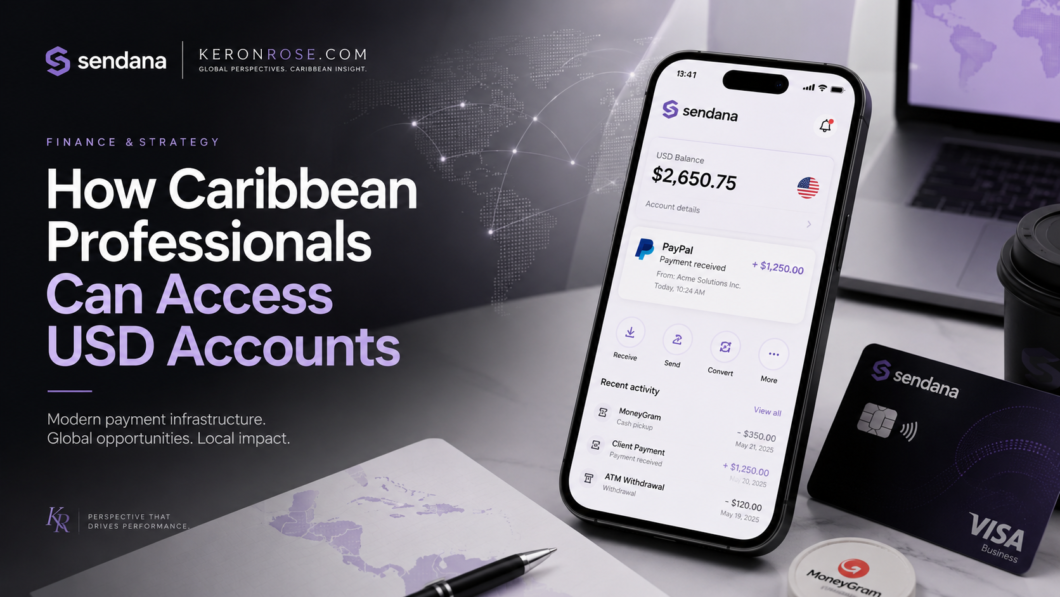
For the first time in history, Caribbean professionals can realistically participate in the global digital economy without leaving the region.
A freelancer in Jamaica can work for a startup in New York. A consultant in Trinidad and Tobago can invoice clients in London. A creator in Barbados can earn advertising revenue from audiences around the world. A remote worker in Guyana can work for companies based in Canada, Europe, or the United States.
The internet removed the geographic barriers to work.
But while work became global, much of the Caribbean’s financial infrastructure remained local.
And that disconnect is now creating one of the biggest challenges facing modern Caribbean professionals:
how do you properly receive, hold, spend, and access US dollars while operating from the region?
For years, freelancers, creators, consultants, ecommerce sellers, agencies, and remote workers across the Caribbean have had to navigate delayed international wire transfers, foreign exchange shortages, expensive intermediary banking fees, limited access to USD banking infrastructure, and outdated financial systems that were never designed for the modern digital economy.
Even something as simple as receiving a payment from an international client can become unnecessarily complicated depending on where you live in the region.
Many professionals operating online quickly discover that earning money globally and accessing that money efficiently are two very different things.
And as digital business continues to expand globally, this issue is becoming even more important.
Because modern online business increasingly depends on international payment systems.
Today’s digital professionals are not just using local banks anymore. They are using PayPal, online invoicing systems, freelance marketplaces, creator monetization platforms, digital advertising systems, ecommerce tools, subscription software, and global payment processors as part of their everyday business operations.
The modern Caribbean entrepreneur is now operating inside an international digital economy, but often with financial systems that were built for a much older version of commerce.
That is why a new generation of digital financial infrastructure platforms is beginning to emerge.
Platforms like Sendana are attempting to solve part of this problem by giving Caribbean professionals access to tools traditionally associated with international banking systems, including virtual USD accounts, international payment infrastructure, Visa debit cards, PayPal connectivity, and easier ways to move and access money globally.
And as remote work, freelancing, ecommerce, creator economies, and digital entrepreneurship continue growing across the Caribbean, understanding digital payment infrastructure is quickly becoming essential business knowledge for the region.
What Is Sendana?
Sendana is a digital financial platform designed to help people in emerging markets access modern USD payment infrastructure.
It is important to understand that Sendana is not a traditional bank. Instead, it operates as a digital financial platform that gives users access to tools commonly associated with international banking systems.
In practical terms, Sendana allows users to access:
- virtual US dollar accounts,
- ACH transfer capabilities,
- wire transfer support,
- Visa debit cards,
- and MoneyGram cash withdrawals.
For many Caribbean professionals, this creates a much easier way to participate in the global digital economy.
Once approved, users receive virtual USD banking details, including routing and account numbers, which can be used to receive international payments from clients, freelance platforms, creator platforms, and online business systems.
That means a freelancer, consultant, creator, or remote worker can potentially receive payments from international clients similarly to someone operating with a US-based banking setup.
One of the most important aspects of the platform is accessibility.
Users do not need:
- US residency,
- a US address,
- or a Social Security Number to register.
That is a major shift for many people across the Caribbean who have historically faced challenges accessing international banking infrastructure.
Sendana was specifically designed for users in emerging markets, including the Caribbean, Africa, and parts of South Asia, where traditional banking systems often create friction for digital professionals operating internationally.
The platform also connects to modern digital payment workflows that many Caribbean professionals already use every day.
For example, users can connect their PayPal accounts to Sendana, receive international payments through ACH or wire transfers, use their Visa card for global spending, and access local cash withdrawals through MoneyGram locations.
And as more Caribbean professionals continue building online businesses, working remotely, freelancing internationally, or participating in creator economies, platforms like Sendana are becoming part of a much larger shift toward digital financial infrastructure built for the modern internet economy.
Why Sendana Was Created
Sendana was founded by Jamaican technology entrepreneur Monique Powell, whose background spans both banking and digital business across the Caribbean.
Before launching Sendana, Powell worked in regional digital strategy at Scotiabank across multiple Caribbean markets before founding QuickCart, the food and grocery delivery platform that expanded across Jamaica and Trinidad and Tobago.
That combination of banking and digital commerce experience gave her direct exposure to one of the region’s biggest infrastructure gaps: Caribbean professionals and businesses increasingly operate in a global digital economy, but often without modern international payment systems designed for how digital business works today.
Today, freelancers, creators, consultants, remote workers, and digital entrepreneurs across the Caribbean can work with clients and companies anywhere in the world. But despite the internet creating global work opportunities, many professionals still face significant friction when trying to access international payment infrastructure.
Receiving USD payments, withdrawing funds, accessing digital banking tools, and operating internationally can still be far more difficult in emerging markets than in larger economies with more developed financial systems.
Sendana was created to help reduce some of that friction by giving users access to modern digital payment infrastructure designed specifically for regions like the Caribbean, Africa, and other parts of the Global South.
The company has also received backing and support from international startup and technology ecosystems including DraperU Ventures and Techstars, helping position Sendana within a growing global fintech and digital infrastructure space.
That combination of regional understanding and international startup backing is part of what makes the platform particularly relevant for Caribbean professionals navigating the realities of modern digital business.
The Core Features of Sendana
What makes Sendana particularly interesting for Caribbean professionals is that it combines multiple pieces of international payment infrastructure into a single platform.
Instead of relying entirely on traditional local banking systems, users can access a more modern digital payment workflow designed for international business, freelancing, remote work, and online income.
Here are some of the platform’s core features and why they matter.
Virtual USD Accounts
One of Sendana’s biggest features is access to a virtual US dollar account.
Once approved, users receive:
- a routing number,
- account number,
- ACH transfer capabilities,
- and wire transfer support.
In practical terms, this allows users to receive international payments similarly to someone operating with a US-based banking setup.
For freelancers, consultants, agencies, creators, and ecommerce sellers, this can make it significantly easier to receive payments from:
- international clients,
- freelance platforms,
- creator monetization systems,
- and online business tools.
Instead of relying solely on traditional local bank wires, users can now operate with digital USD infrastructure that better aligns with how modern online business functions globally.
PayPal Integration
For many Caribbean professionals, PayPal remains one of the most important tools in the digital economy.
Freelancers use it.
Consultants use it.
Creators use it.
Online businesses use it.
One of Sendana’s most useful features is that users can connect their PayPal accounts directly to the platform and withdraw PayPal funds into their Sendana USD account.
This creates a much smoother workflow for accessing USD earnings digitally.
For many professionals across the Caribbean, this can reduce some of the friction traditionally associated with moving money between international payment systems and local banking infrastructure.
And as more people across the region participate in online business, creator economies, and remote work, that kind of payment flexibility becomes increasingly important.
Visa Debit Card
Sendana also provides users with a Visa debit card that can be used internationally.
This is one of the most practical parts of the platform because it allows users to actually use their USD balances globally.
The card can be used for:
- online shopping,
- travel,
- ATM withdrawals,
- software subscriptions,
- SaaS tools,
- Meta advertising,
- Google advertising,
- and international purchases.
For digital entrepreneurs and online professionals, this matters because modern business increasingly depends on global digital tools and online spending.
Running ads, paying for cloud software, subscribing to platforms, and operating online internationally all require access to reliable digital payment infrastructure.
The Visa card helps bridge that gap.
MoneyGram Withdrawals
Another major feature is Sendana’s integration with MoneyGram.
Users can generate a MoneyGram withdrawal code directly inside the app and collect local currency through participating MoneyGram locations.
For Caribbean users, this adds another layer of flexibility between digital finance and local cash access.
Someone may want to:
- receive USD digitally,
- hold funds online,
- spend internationally,
- but still withdraw local cash when needed.
The MoneyGram integration helps support that type of workflow.
And because MoneyGram already has a large international presence, this feature can be particularly useful across multiple Caribbean countries.
Apple Pay and Google Pay Support
Sendana also supports Apple Pay and Google Pay through its Visa card integration.
This gives users access to modern mobile wallet functionality and allows them to make payments directly through their smartphones and connected devices.
While mobile wallet usage is still developing in some Caribbean markets, globally this has become a standard part of modern payment infrastructure.
And as digital commerce continues expanding, mobile-first payment systems are likely to become increasingly important for Caribbean professionals operating internationally.
Taken together, these features make Sendana more than just another payment app.
It functions as part of a growing digital financial infrastructure stack designed to help professionals in emerging markets participate more easily in the global digital economy.
Who Sendana Is Best For
One of the reasons platforms like Sendana are gaining attention across the Caribbean is because the modern digital economy no longer revolves around a single type of worker.
Today, international payment infrastructure matters to a wide range of professionals operating online.
And as more Caribbean professionals begin building businesses, careers, and income streams connected to global markets, access to USD infrastructure becomes increasingly important.
Freelancers
Freelancers are among the clearest users for platforms like Sendana.
Whether someone works in:
- graphic design,
- web development,
- video editing,
- marketing,
- copywriting,
- virtual assistance,
- or technology,
they are often working with international clients who pay in US dollars.
Having access to:
- USD accounts,
- ACH transfers,
- PayPal withdrawals,
- and Visa spending infrastructure
can make managing freelance income significantly easier.
Especially for freelancers operating across multiple platforms and clients internationally.
Remote Workers
Remote work has expanded rapidly across the Caribbean over the past few years.
Many professionals now work for companies based in:
- the United States,
- Canada,
- Europe,
- and other international markets.
But being paid internationally often introduces banking friction, foreign exchange challenges, and payment delays.
Platforms like Sendana are designed to help simplify some of that process by giving remote workers access to modern USD payment infrastructure that aligns more closely with how international employers and payroll systems operate.
Consultants
Consultants increasingly operate globally rather than locally.
A consultant based in the Caribbean may now work with clients in multiple countries simultaneously through:
- Zoom,
- digital contracts,
- online invoicing,
- and international payment systems.
That means receiving payments efficiently becomes part of running a modern consulting business.
For consultants earning internationally, having access to digital USD infrastructure can make cross-border business operations much smoother.
Agencies
Digital agencies across the Caribbean often work with international clients while also paying contractors, software subscriptions, advertising costs, and cloud tools in US dollars.
This creates a constant need for:
- international payment processing,
- USD access,
- and global spending capabilities.
Platforms like Sendana can help agencies better manage international financial workflows while operating digitally across borders.
Ecommerce Sellers
Ecommerce businesses increasingly operate across multiple countries, platforms, and payment systems.
Whether someone sells:
- digital products,
- physical products,
- online services,
- or operates through international marketplaces,
having access to USD infrastructure can become extremely important.
Many ecommerce tools, advertising systems, software platforms, and supplier relationships are built around international payments and US dollar transactions.
YouTubers and Creators
The creator economy has created entirely new income opportunities across the Caribbean.
Today, creators can earn from:
- YouTube monetization,
- sponsorships,
- affiliate partnerships,
- brand deals,
- subscriptions,
- and digital products.
But monetization systems are often tied to international payment infrastructure.
Having the ability to receive USD earnings, connect payment platforms, and access digital spending tools can make a major difference for creators building online businesses.
Digital Nomads
Digital nomads require flexible financial systems that allow them to:
- travel,
- work remotely,
- spend internationally,
- and move between countries more easily.
Traditional local banking systems are often not designed around that type of lifestyle.
Platforms like Sendana provide more flexible digital payment infrastructure that aligns better with how modern remote professionals increasingly operate globally.
Caribbean Entrepreneurs
More Caribbean entrepreneurs are now building businesses that operate online first.
That includes:
- agencies,
- ecommerce brands,
- media businesses,
- consulting firms,
- online education platforms,
- and digital service companies.
As those businesses grow internationally, financial infrastructure becomes increasingly important.
Because today, access to modern payment systems is no longer just a banking issue.
It is a business infrastructure issue.
And for many Caribbean professionals operating online, platforms like Sendana are becoming part of the broader digital payment stack needed to compete in the global digital economy.
Why Caribbean Professionals Should Care
The bigger story here is not just Sendana itself.
It is the fact that the way Caribbean professionals work, earn, and operate financially is changing rapidly.
Over the past few years, remote work, international freelancing, creator economies, ecommerce, and digital entrepreneurship have expanded dramatically across the region. More Caribbean professionals are now working with international clients, building online businesses, earning from global audiences, and participating in digital economies that operate far beyond their local borders.
And that shift changes the importance of financial infrastructure completely.
Because once your business becomes international, your payment systems also need to become international.
A freelancer working with US clients needs reliable USD payment infrastructure.
A creator earning from YouTube or sponsorships needs access to international monetization systems.
An agency running Meta and Google advertising campaigns needs global spending capabilities.
An ecommerce seller sourcing products internationally needs modern payment flexibility.
The modern digital economy is increasingly built around:
- online payments,
- digital banking infrastructure,
- global payment processors,
- creator monetization systems,
- and international financial workflows.
And that is where many traditional banking systems across the Caribbean begin showing their limitations.
Historically, local banks were designed around:
- salaries,
- local commerce,
- branch banking,
- domestic transactions,
- and traditional financial models.
They were not originally built for:
- international freelancing,
- remote work,
- creator economies,
- SaaS businesses,
- ecommerce,
- or globally distributed online businesses.
That is why modern professionals are increasingly building their own financial stacks.
Instead of relying on a single local bank account, many digital professionals now operate using combinations of:
- PayPal,
- Sendana,
- Payoneer,
- Charles Schwab,
- Wise,
- Visa debit cards,
- and digital USD infrastructure.
Each tool serves a different role inside the modern digital economy.
Some tools help receive international payments.
Some help preserve USD.
Some help with international spending.
Some help with withdrawals and transfers.
But together, they form a modern financial operating system for global digital work.
And this is becoming increasingly important across the Caribbean because the region is no longer isolated from the global digital economy.
Today, Caribbean professionals can:
- freelance globally,
- build international client bases,
- launch digital businesses,
- sell products online,
- monetize audiences,
- and work remotely from almost anywhere.
But access to global opportunities increasingly depends on access to global financial infrastructure.
That is the larger shift happening underneath platforms like Sendana.
The local bank is no longer the center of digital business infrastructure.
Instead, modern professionals are assembling flexible digital payment ecosystems that allow them to:
- receive USD,
- preserve USD,
- spend internationally,
- access digital services,
- and operate globally.
And over the next decade, understanding digital financial infrastructure may become just as important for Caribbean professionals as understanding social media, ecommerce, or digital marketing became over the past decade.
Because increasingly, financial access is becoming part of competitive advantage in the modern digital economy.
How To Sign Up for Sendana
Getting started with Sendana is designed to be relatively straightforward, especially compared to the traditional process of trying to access international banking infrastructure through conventional systems.
Users can begin the registration process directly through the Sendana platform at:
The onboarding process is completed digitally and typically only takes a few steps.
After creating an account, users are asked to verify their identity using a government-issued ID such as:
- a passport,
- national ID,
- or driver’s licence.
The platform also requires facial verification as part of its onboarding and security process. This helps confirm the identity of the account holder and is now standard across many modern fintech and digital banking platforms globally.
Once submitted, the verification process is typically completed within a short period of time, although approval timelines may vary depending on the account review process.
After approval, users receive access to their virtual USD account infrastructure, including:
- routing and account numbers,
- ACH receiving capabilities,
- wire transfer functionality,
- and access to their virtual Visa card setup.
From there, users can begin:
- connecting payment platforms like PayPal,
- receiving international payments,
- managing USD balances,
- and using the platform for global digital spending.
For many Caribbean professionals, the setup process itself reflects a larger shift already happening globally:
modern financial infrastructure is increasingly becoming digital, mobile-first, and internationally connected.
Important Things To Understand Before Signing Up
As with any financial platform, it is important for users to understand exactly what Sendana is — and what it is not.
Sendana is a fintech platform, not a traditional commercial bank.
That distinction matters because modern digital payment platforms operate differently from the banking systems many people across the Caribbean are accustomed to using.
Platforms like Sendana are built around digital financial infrastructure, international payment systems, mobile-first experiences, and global payment workflows. Their goal is to make it easier for users in emerging markets to access tools connected to the global digital economy.
But users should still take the time to understand how these systems work before relying heavily on them.
Like most international payment platforms, Sendana also has fees associated with certain services and transactions. These may include:
- transfer fees,
- currency conversion fees,
- card transaction fees,
- ATM withdrawal fees,
- and cash withdrawal fees through services like MoneyGram.
That does not necessarily make the platform expensive. In many cases, users may still find the overall experience more efficient or flexible than traditional banking workflows. However, understanding the fee structure before using any platform is always important.
It is also worth recognizing that international digital payment infrastructure is still evolving globally.
Over the past decade, the world has seen a major shift toward:
- fintech platforms,
- digital wallets,
- mobile banking,
- creator economy payment systems,
- and international digital financial tools.
That transformation is happening quickly, and platforms continue adapting as technology, regulations, and global payment systems evolve.
For Caribbean professionals, this means financial literacy is becoming increasingly important inside the digital economy.
Understanding:
- how international payments work,
- how USD infrastructure works,
- how digital wallets function,
- and how global payment systems connect together
is now becoming part of modern business knowledge.
Users should also approach all financial platforms responsibly.
As with any digital financial service, it is important to:
- research the platform,
- understand how it works,
- review fee structures,
- follow security best practices,
- and avoid storing large balances on any single platform without understanding the associated risks.
Ultimately, platforms like Sendana represent part of a larger evolution in how professionals across emerging markets access the global economy.
But like all financial tools, they work best when users understand both the opportunities and the responsibilities that come with using modern digital payment infrastructure.
The Caribbean’s Financial Infrastructure Is Quietly Changing
The Caribbean economy is becoming increasingly connected to the global digital economy.
More professionals across the region are now:
- working remotely,
- freelancing internationally,
- building online businesses,
- monetizing audiences,
- consulting globally,
- and participating in digital industries that operate far beyond their local markets.
But as work becomes more international, financial infrastructure also needs to evolve.
Modern digital business depends on:
- international payments,
- USD access,
- global spending tools,
- digital banking systems,
- and cross-border financial workflows.
And that is why platforms like Sendana are beginning to attract attention across the Caribbean.
They represent part of a much larger shift toward digital USD infrastructure designed for professionals operating inside a global internet economy rather than a purely local financial system.
Increasingly, Caribbean professionals are no longer relying solely on traditional banking systems to manage international business. Instead, they are building modern financial stacks using combinations of:
- digital USD accounts,
- payment processors,
- Visa debit cards,
- mobile wallets,
- and international payment infrastructure.
That shift is quietly changing how professionals across the region work, earn, spend, and participate in the global economy.
And over the next decade, understanding digital payments may become one of the most important forms of business literacy in the Caribbean.
Because increasingly, access to modern financial infrastructure is becoming directly connected to economic opportunity, international competitiveness, and the ability to fully participate in the future of digital business.
Need Help Setting Up PayPal in the Caribbean?
If you need help understanding how PayPal works in the Caribbean and how to properly set it up for international payments, you can read my full guide here:
How To Set up Your PayPal Account in the Caribbean
Need Help Building Your Digital Infrastructure?
If you need help setting up your digital payment systems, ecommerce strategy, or international digital business infrastructure, you can book a 1-on-1 Digital Strategy Session with me here:
What about Sendana’s customer information and asset security?
It’s understandable how the platform can eventually, become a core part of the digital financial infrastructure of the Caribbean but the security of one’s money/assets and personal information is just as important. Other than the fundamental services that the platform provides for the various digital career personnel’s, what are their reliability in terms of protection.
It’s my job to make you aware of the tools and platforms available; it is now your job to research the platform. It’s your job to contact the companies and ask all of these questions that you may have to address your concerns. Just like you wouldn’t ask me about PayPal’s security, you would visit the company’s website to learn more or contact them directly, right? Same thing: look up Sendana, contact the company themselves and ask about questions like security.