TL;DR
I analyzed 54 marketing job listings across APAC/global companies and the Caribbean to understand how both regions are designing modern marketing roles.
The findings revealed that the gap is not primarily about talent — it is about how companies structure, define, and operationalize marketing itself.
Many APAC organizations are increasingly hiring marketers as:
- growth operators
- AI-enabled strategists
- systems builders
- revenue drivers
- experimentation leaders
- and optimization specialists
Meanwhile, many Caribbean roles still focus heavily on:
- campaign coordination
- social media management
- event execution
- promotions
- general marketing support
- and brand visibility
The study found that:
- APAC roles emphasize AI, AEO/GEO, lifecycle systems, experimentation, automation, attribution, and revenue operations.
- Caribbean roles still largely reflect 2014–2018 marketing operating models centered around execution and coordination.
- The Caribbean appears roughly 6–10 years behind in marketing role design and operational maturity — not necessarily in individual talent.
The article ultimately argues that Caribbean companies do not simply need better marketers.
They need to redesign the marketing function itself for the AI era.
1) Intro – The Global Marketing Industry Has Changed
Marketing in 2026 looks very different from the version of marketing many companies originally built their organizations around.
What was once heavily centered around campaigns, social media management, graphics, promotions, and brand visibility is increasingly becoming a discipline driven by AI workflows, growth systems, automation, experimentation, attribution, search visibility, customer journeys, lifecycle marketing, and measurable business outcomes.
Globally, many modern marketing teams are no longer being structured simply to “run campaigns.”
They are increasingly being built to:
- drive pipeline and revenue
- improve conversion systems
- optimize customer acquisition
- increase AI and search visibility
- manage lifecycle retention
- build scalable content ecosystems
- automate workflows
- and continuously experiment and optimize performance
At the same time, the rise of tools and platforms such as ChatGPT, Claude, Gemini, Perplexity, and Google AI Overviews is beginning to fundamentally reshape how consumers discover businesses, products, services, and information online.
That shift is not only changing marketing strategies.
It is changing the very structure of marketing jobs themselves.
Over the past few months, I began noticing that many global marketing roles seemed fundamentally different from many of the marketing roles I continued seeing throughout the Caribbean job market.
Not just in titles.
Not just in salaries.
But in how companies were defining the role of marketing inside the business itself.
So I decided to analyze it directly.
For this study, I reviewed:
- 27 APAC/global marketing roles
- 27 Caribbean marketing roles
The roles came from:
- SaaS companies
- AI companies
- fintech
- agencies
- e-commerce brands
- media companies
- financial institutions
- FMCG organizations
- creator economy businesses
- regional corporate companies
The goal was not simply to compare jobs.
It was to understand what these job descriptions reveal about:
- digital maturity
- organizational priorities
- hiring philosophy
- operational structure
- and how different regions currently understand marketing itself
And as the analysis progressed, one thing became increasingly difficult to ignore.
The gap between APAC/global marketing roles and Caribbean marketing roles was not simply a skills gap.
It reflected a much deeper structural difference in:
- role design
- business expectations
- operational maturity
- and how marketing is positioned within modern organizations
Because while many APAC/global companies increasingly position marketers as:
- growth operators
- systems builders
- experimentation leaders
- AI-enabled strategists
- lifecycle managers
- and revenue drivers
Many Caribbean roles still largely position marketers as:
- campaign coordinators
- social media managers
- event support staff
- general marketing officers
- brand support personnel
- and broad operational executors
In other words:
This is not just a talent gap.
It is a marketing role design gap.
And in a global economy increasingly shaped by AI, automation, search evolution, and measurable growth systems, the way companies design marketing roles may ultimately determine how competitive they are in the future digital economy.
2. Methodology
How the Analysis Was Conducted
To better understand how marketing roles are evolving globally compared to the Caribbean, I conducted a comparative analysis of 54 marketing-related job listings.
The study included:
- 27 APAC/global marketing roles
- 27 Caribbean marketing roles
The APAC/global dataset included roles from companies such as:
- OpenAI
- Linktree
- Employment Hero
- ElevenLabs
- Revolut
- Envato
- Anthropic
- Digivizer
- Built In
- VaynerMedia
- Tesla
- Notion
- IKEA
- Live Nation
- Origin Energy
- Puffy
- and several other technology, SaaS, AI, media, and growth-focused organizations
The Caribbean dataset included roles from companies and organizations such as:
- Unicomer Group
- Digicel
- Republic Bank
- First Citizens Bank
- Maritime Financial Group
- Fidelity Finance
- Agglet Group Inc.
- KFC/Pizza Hut regional operations
- regional financial institutions
- Caribbean-based agencies
- regional FMCG and trade marketing organizations
- local digital marketing agencies
- content and communications companies
- media and creative production companies
- sales and customer acquisition organizations
- and multiple corporate marketing departments across Trinidad & Tobago, Jamaica, Barbados, Guyana, and the wider Caribbean region
The goal of the study was not to compare salaries or determine which region had “better marketers.”
Instead, the objective was to analyze how organizations currently define the role of marketing itself through the structure of their job descriptions.
Each role was reviewed across multiple criteria, including:
- job titles
- responsibilities
- education requirements
- required skills
- software and platform requirements
- AI-related expectations
- KPIs and performance language
- work structure (remote/hybrid flexibility/on-site)
- organizational expectations
- marketing philosophy
- and overall operational maturity
Particular attention was given to:
- how companies define success in marketing
- whether marketing is tied to revenue and growth
- the level of specialization within the role
- the integration of AI workflows
- the presence of experimentation and optimization culture
- and how modern search visibility (SEO, AEO, GEO, AI Search) appeared within hiring expectations
Another important factor analyzed was hiring philosophy itself.
Many APAC/global roles increasingly emphasized:
- measurable outcomes
- portfolio quality
- experimentation mindset
- systems thinking
- autonomy
- commercial understanding
- and AI adaptability
Meanwhile, many Caribbean roles continued to place heavier emphasis on:
- formal academic qualifications
- years of experience
- generalized responsibilities
- and traditional marketing structures
This distinction became an important signal throughout the analysis.
It is also important to clarify that this study is not intended to suggest that Caribbean marketers lack talent, creativity, or capability.
In fact, many Caribbean marketers are already operating at a globally competitive level individually.
Rather, the analysis focuses on the broader structural differences reflected in how organizations:
- design marketing roles
- define marketing responsibilities
- prioritize capabilities
- and position marketing inside the business itself
Because job descriptions matter.
They are one of the clearest indicators of what companies are actively willing to invest in.
They reveal:
- what organizations believe marketing should accomplish
- what skillsets leadership considers valuable
- how digitally mature operational systems are
- and ultimately, how prepared businesses are for the future of digital growth.
And after reviewing all 54 roles, the differences between the two datasets revealed far more than a simple regional hiring variation.
They revealed two very different understandings of what modern marketing is becoming.
3. The Title Gap
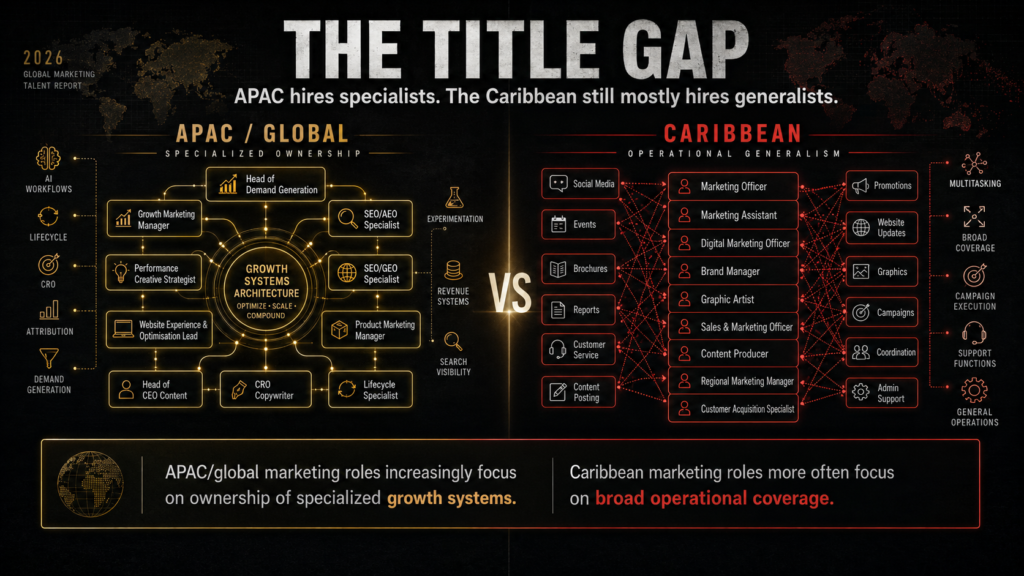
APAC Hires Specialists. The Caribbean Still Hires Generalists.
One of the clearest differences that emerged during the analysis appeared almost immediately in the job titles themselves.
The APAC/global roles increasingly reflected a marketing industry moving toward specialization, systems ownership, and highly defined operational functions.
Titles within the APAC/global dataset included:
- Head of Demand Generation
- Growth Marketing Manager (SEO/AEO)
- SEO/GEO Specialist
- Performance Creative Strategist
- Website Experience & Optimisation Lead
- Product Marketing Manager
- CRO Copywriter
- Lifecycle Specialist
- Head of CEO Content
- ANZ Communications Lead
- SEM Growth Strategist
- Performance Marketing Specialist
These titles are important because they reveal how modern organizations are increasingly breaking marketing into highly specialized growth functions.
In many of these companies, marketing is no longer viewed as one broad department where a single person handles “everything digital.”
Instead, different parts of the customer acquisition and retention process are being separated into dedicated operational systems with clear ownership.
For example:
- one person owns lifecycle retention
- another owns SEO/AEO visibility
- another owns experimentation and CRO
- another owns demand generation
- another owns executive thought leadership
- another owns website optimization
- another owns paid media attribution
- another owns performance creative strategy
These are not simply “marketing tasks.”
They are specialized business growth functions tied directly to measurable outcomes.
Even the language within the titles reflected this shift:
- growth
- optimization
- lifecycle
- performance
- demand generation
- experimentation
- conversion
- attribution
- GEO
- AEO
The Caribbean dataset looked very different.
Many of the Caribbean roles still relied heavily on broad, generalized marketing titles such as:
- Marketing Officer
- Marketing Assistant
- Digital Marketing Officer
- Brand Manager
- Graphic Artist
- Sales & Marketing Officer
- Content Producer
- Regional Marketing Manager
- Customer Acquisition Specialist
- Communications Officer
- Marketing Coordinator
These titles often bundled multiple responsibilities together under one role.
A single Caribbean marketing position would frequently include combinations of:
- social media management
- event coordination
- customer service
- campaign execution
- graphic design
- reporting
- website updates
- sales support
- brochure development
- public relations
- content creation
- and administrative coordination
Rather than separating marketing into specialized growth functions, many Caribbean organizations still appear to structure marketing around broad operational coverage.
In practice, this means many Caribbean marketers are expected to become multi-purpose generalists responsible for maintaining day-to-day marketing activity across several areas simultaneously.
The contrast reveals a deeper operational difference between the two regions.
The APAC/global roles were often designed around:
ownership of systems
While many Caribbean roles were designed around:
management of activities
That distinction matters.
Because when companies build specialized marketing functions, they create:
- deeper expertise
- clearer KPIs
- stronger optimization culture
- better operational scalability
- more measurable performance systems
Meanwhile, when marketing remains heavily generalized, teams often become more execution-focused and less strategically specialized.
This does not mean Caribbean marketers lack capability.
In many cases, Caribbean marketers are forced to become highly adaptable because organizations expect one person to handle multiple functions simultaneously.
However, the structure itself reveals a major difference in organizational maturity.
Many APAC/global companies increasingly design marketing roles around:
- customer acquisition systems
- lifecycle systems
- experimentation systems
- AI visibility systems
- revenue systems
- optimization systems
Many Caribbean companies still largely design marketing roles around:
- campaign execution
- communications support
- social media management
- graphic design
- event coordination
- and broad operational marketing coverage
In simple terms:
APAC companies increasingly hire marketers to own growth systems.
Caribbean companies still often hire marketers to manage marketing activities.
4. The Role Design Gap
One Function vs Many Functions
Beyond the difference in titles, one of the most revealing patterns throughout the analysis was how differently organizations structure marketing responsibilities themselves.
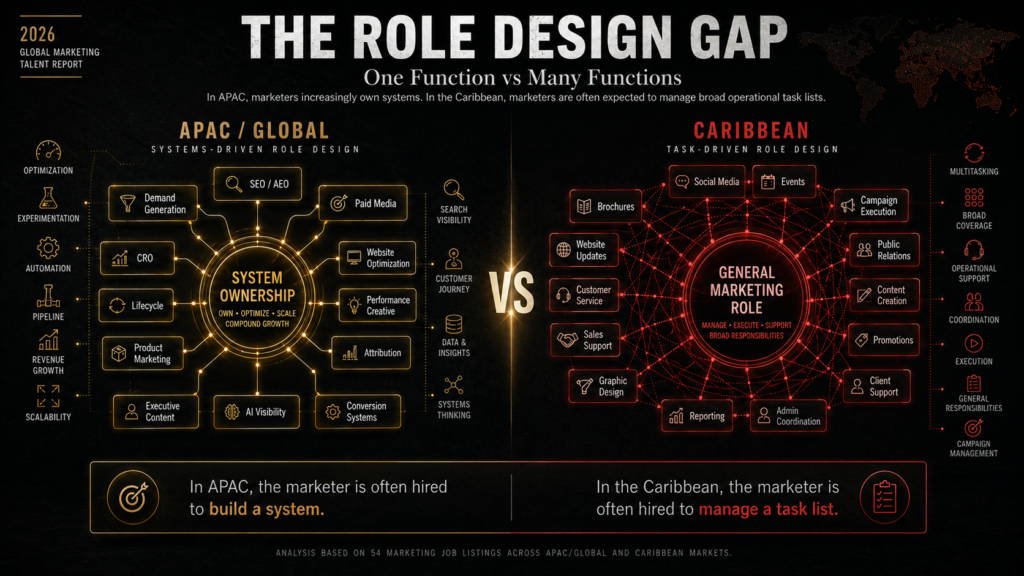
The APAC roles were typically designed around deep ownership of a specific growth function.
In many cases, companies were not simply hiring “a marketer.”
They were hiring someone to own and continuously improve a very specific operational system within the business.
For example, individual roles were often responsible for:
- SEO/AEO strategy
- demand generation
- CRO and experimentation
- lifecycle marketing
- paid media optimization
- product marketing
- executive thought leadership
- website optimization
- AI visibility
- performance creative systems
- attribution and analytics
- conversion architecture
These responsibilities were usually tied to highly specific outcomes:
- pipeline growth
- conversion improvements
- retention
- CAC efficiency
- search visibility
- revenue impact
- experimentation velocity
- user acquisition
- customer lifecycle performance
In many APAC organizations, the marketer is increasingly expected to function almost like a systems operator.
Their role is not simply to “execute marketing.”
Their role is to:
- build systems
- optimize systems
- scale systems
- automate systems
- measure systems
- and continuously improve systems over time
That distinction fundamentally changes how the role operates.
The Caribbean roles looked very different structurally.
Many Caribbean marketing jobs bundled a wide range of unrelated operational tasks into a single role.
A single job description would frequently include responsibilities such as:
- social media management
- event coordination
- brochure development
- website updates
- customer service support
- sales support
- graphic design
- campaign execution
- reporting
- admin coordination
- content creation
- public relations
- and general office marketing support
Rather than creating specialized ownership structures, many organizations appeared to centralize numerous operational marketing activities under one generalized position.
The result is that many Caribbean marketers are expected to become highly adaptable multi-purpose operators.
In practice, this often means:
- switching constantly between tasks
- handling execution across unrelated functions
- operating reactively
- supporting multiple departments simultaneously
- no clear KPI’s
- messy outputs that don’t drive growth or revenue
- and managing operational workload rather than optimizing strategic systems
This creates a very different type of marketing environment.
The APAC roles were often designed to create:
- depth
- specialization
- optimization
- experimentation
- scalability
- and measurable operational ownership
Many Caribbean roles were designed to create:
- flexibility
- broad support coverage
- operational execution
- campaign coordination
- and general marketing assistance
That difference matters because the structure of a role directly influences:
- how marketers spend their time
- how expertise develops
- what gets measured
- what gets prioritized
- and ultimately, how mature the marketing operation becomes over time
A marketer responsible for:
- lifecycle retention systems
- experimentation frameworks
- AI visibility optimization
- or demand generation
…develops a very different skillset than a marketer responsible for:
- managing social pages
- organizing events
- updating brochures
- coordinating reports
- and handling customer support requests
Neither role is inherently “easy.”
But they are fundamentally different operational models.
And this became one of the clearest structural divides throughout the entire analysis.
In APAC, the marketer is often hired to build a system.
In the Caribbean, the marketer is often hired to manage a task list.
5. The Business Philosophy Gap
APAC Treats Marketing as Growth Infrastructure
One of the most important differences revealed throughout the analysis was not simply the structure of the roles themselves, but the underlying business philosophy behind how marketing is viewed inside the organization.
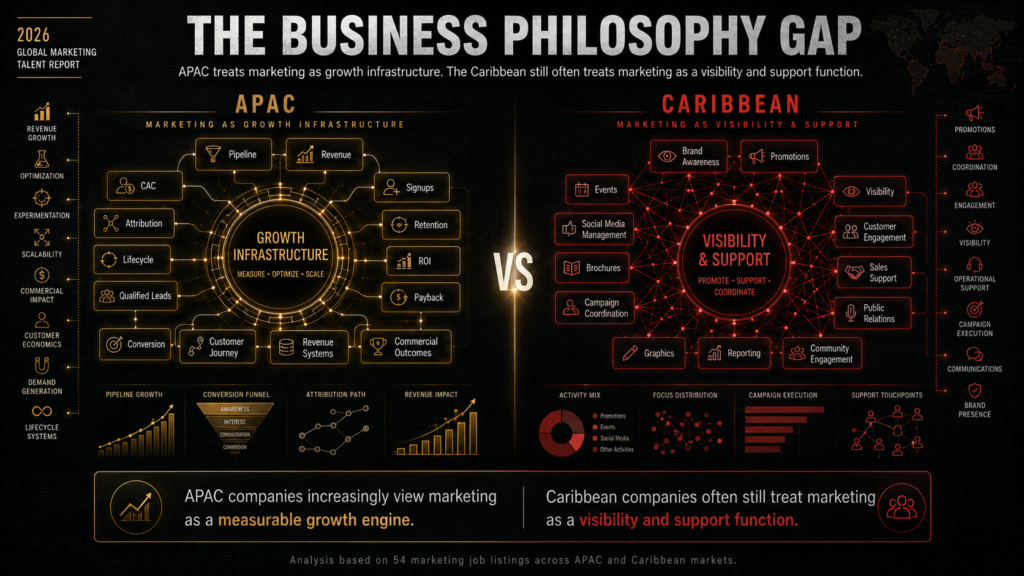
The APAC roles consistently framed marketing as a measurable business growth function directly tied to commercial performance.
Across many of the job descriptions, marketing was repeatedly connected to concepts such as:
- pipeline
- revenue
- CAC (Customer Acquisition Cost)
- attribution
- lifecycle performance
- qualified leads
- signups
- retention
- ROI
- payback periods
- conversion
- experimentation
- customer acquisition efficiency
- and commercial outcomes
The language itself revealed that marketing is increasingly being treated as part of the company’s operational growth engine.
In many APAC organizations, marketers are no longer evaluated simply by:
- campaign completion
- social engagement
- impressions
- or “brand presence”
Instead, marketing teams are increasingly expected to influence:
- revenue growth
- acquisition efficiency
- retention performance
- conversion optimization
- sales pipeline quality
- customer lifetime value
- and scalable business growth
This changes the role of marketing fundamentally.
Marketing becomes less about communication alone and more about:
- growth systems
- customer economics
- measurable business impact
- and operational scalability
Many of the APAC roles reflected this shift very clearly.
For example:
- demand generation roles were tied directly to pipeline contribution
- lifecycle roles focused on retention and customer value
- CRO roles centered around conversion performance
- SEO/AEO roles were tied to search visibility and acquisition
- performance marketing roles focused on efficiency and attribution
- product marketing roles aligned closely with adoption and revenue growth
The overall pattern suggested that many APAC companies increasingly see marketing as:
growth infrastructure
The Caribbean dataset reflected a noticeably different philosophy.
Many Caribbean roles were more commonly centered around:
- brand awareness
- promotions
- events
- social media management
- brochures
- campaign coordination
- visibility
- customer engagement
- public relations
- and sales support
The emphasis was often on maintaining marketing activity and supporting broader business operations rather than directly owning measurable growth systems.
This does not mean Caribbean companies do not care about revenue.
Of course they do.
However, the job descriptions themselves revealed that marketing is still frequently positioned as:
- a communications support function
- a visibility function
- a promotional function
- or an operational support department
rather than a deeply integrated commercial growth engine.
This difference becomes especially important when looking at how organizations measure marketing success.
Many APAC roles explicitly referenced:
- KPIs
- attribution
- experimentation
- pipeline influence
- revenue impact
- customer acquisition efficiency
- lifecycle optimization
- and commercial performance
Many Caribbean roles focused more heavily on:
- execution
- coordination
- social media engagement
- awareness
- office support
- and campaign activity
The contrast reflects two different stages of marketing maturity.
In many APAC organizations:
marketing is increasingly viewed as a business growth system.
In many Caribbean organizations:
marketing is still often viewed as a business support function.
That philosophical difference affects everything:
- hiring
- budgets
- KPIs
- organizational structure
- tooling
- team specialization
- and long-term digital competitiveness
Because companies that view marketing as growth infrastructure tend to:
- invest differently
- structure teams differently
- measure success differently
- and build capabilities differently
And over time, those differences compound operationally.
This became one of the clearest patterns throughout the entire study.
APAC companies increasingly hire marketers to help grow the business.
Many Caribbean companies still largely hire marketers to help promote the business.
6. The Education & Hiring Philosophy Gap
Credentials vs Capability
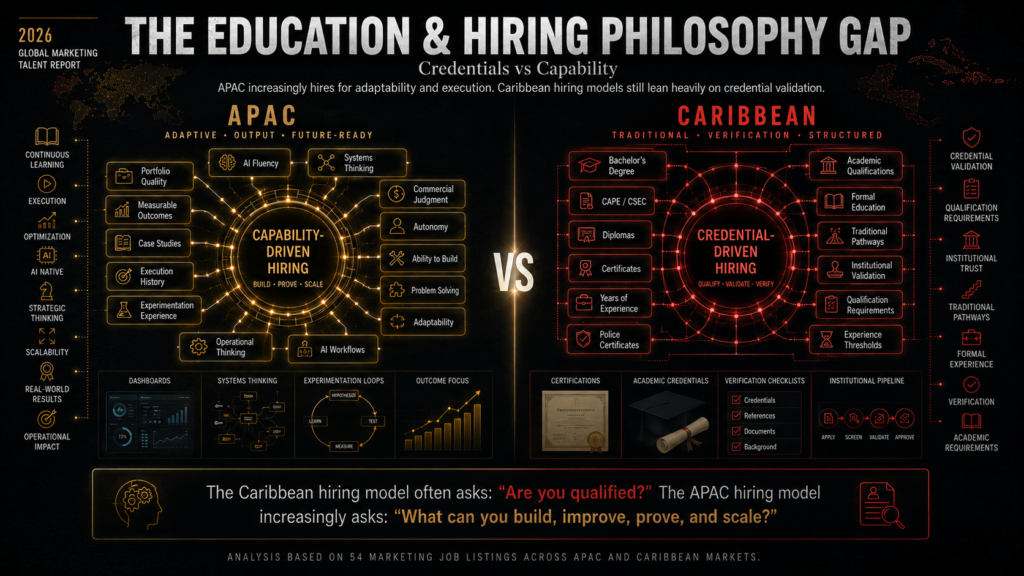
Another major difference that emerged throughout the analysis was not simply what skills companies were hiring for, but how organizations evaluated credibility and readiness in the first place.
Many Caribbean roles still leaned heavily on traditional credential validation as a primary hiring filter.
Across numerous job descriptions, there was strong emphasis on:
- Bachelor’s degrees
- CAPE/CSEC requirements
- diplomas
- certificates
- years of experience
- formal academic qualifications
- police certificates
- and traditional educational pathways
In several cases, the educational requirements occupied a larger portion of the job description than the actual operational expectations of the role itself.
Some Caribbean listings even specified:
- minimum CSEC subjects
- CAPE passes
- degree classifications
- formal certification pathways
- or traditional institutional requirements before discussing measurable marketing capability
The APAC roles reflected a noticeably different hiring philosophy.
While education was still acknowledged in some positions, many of the roles placed far greater emphasis on:
- portfolio quality
- measurable outcomes
- case studies
- execution history
- experimentation experience
- AI fluency
- systems thinking
- commercial judgment
- autonomy
- strategic thinking
- operational ownership
- and the ability to build scalable systems
Several APAC listings explicitly stated variations of:
- “portfolio matters more than where you worked”
- “show us what you’ve built”
- “demonstrate measurable outcomes”
- “prove your experimentation mindset”
- “ability to operate autonomously”
- or “daily use of AI tools is a qualifying criterion”
That distinction is extremely important because it reveals two very different hiring philosophies.
Many Caribbean organizations still appear to evaluate marketers primarily through:
credential validation
Many APAC organizations increasingly evaluate marketers through:
demonstrated capability
The contrast can be simplified into two very different questions.
The Caribbean hiring model often asks:
“Are you qualified?”
The APAC hiring model increasingly asks:
“What can you build, improve, prove, and scale?”
That difference may sound subtle, but operationally it changes everything.
Because modern marketing is evolving at an extremely rapid pace.
The rise of:
- AI workflows
- AEO/GEO
- AI search
- automation systems
- lifecycle marketing
- attribution modeling
- experimentation culture
- and conversion optimization
is moving significantly faster than most traditional educational institutions can realistically update curriculum structures.
As a result, many of the most valuable modern marketing capabilities are increasingly being developed through:
- hands-on experimentation
- real-world execution
- self-learning
- AI-assisted workflows
- online ecosystems
- creator economies
- independent projects
- and operational problem solving
rather than traditional academic pathways alone.
This does not mean education is useless.
Formal education still provides:
- foundational thinking
- communication skills
- research capability
- discipline
- business understanding
- and theoretical frameworks
But the analysis suggests that many APAC organizations increasingly recognize that:
adaptability may now matter more than static qualification pathways.
In many of the APAC roles, companies appeared more interested in whether a marketer could:
- adapt quickly
- learn continuously
- build systems
- experiment effectively
- leverage AI tools
- solve operational problems
- and generate measurable business outcomes
than whether they followed a perfectly traditional educational route.
Meanwhile, many Caribbean organizations still appear to place heavier trust in:
- formal validation
- institutional credentials
- traditional experience structures
- and linear qualification pathways
This difference likely reflects broader structural realities as well.
Smaller and more traditional business environments often use credentials as a risk-management mechanism.
Larger, faster-moving digital ecosystems increasingly prioritize:
- speed
- adaptability
- experimentation
- and operational output
because the market itself changes too quickly for static knowledge alone to remain sufficient.
This became one of the clearest philosophical differences throughout the study.
APAC roles increasingly hire for adaptability.
Caribbean roles still lean heavily on credential validation.
7. The AI Gap
APAC Is Operationalizing AI. The Caribbean Is Mostly Experimenting With It.
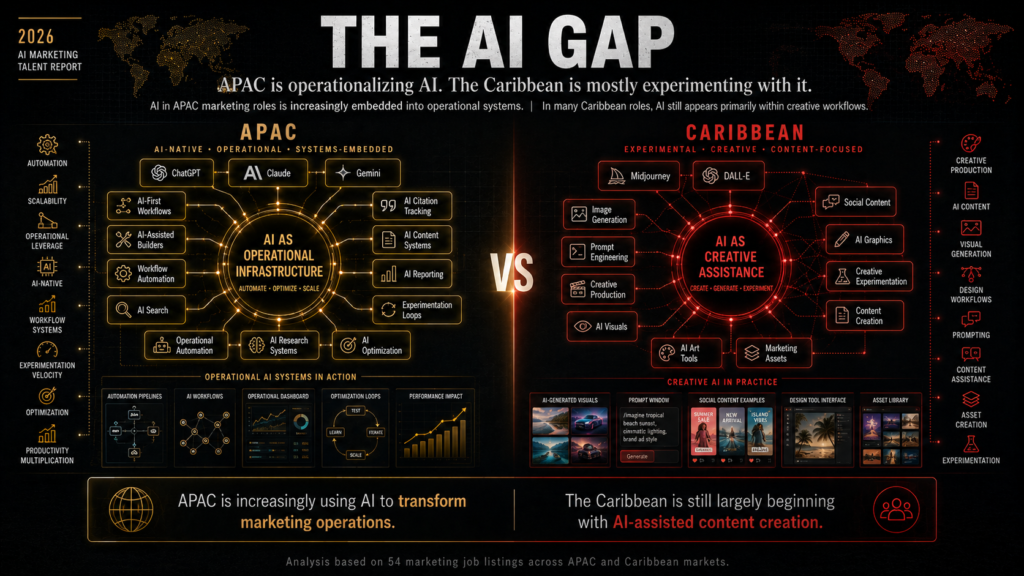
Perhaps the most revealing difference across the entire analysis was how differently AI appeared within the marketing roles themselves.
The APAC roles did not simply mention AI as a trend or optional skill.
In many cases, AI was embedded directly into the operational expectations of the role.
Across numerous APAC job descriptions, companies explicitly referenced:
- ChatGPT
- Claude
- Gemini
- AI-first workflows
- AI-assisted builders
- AI-powered automation
- AI search
- AI citation tracking
- AI content systems
- workflow automation
- AI-generated experimentation
- AI-enhanced reporting
- AI-assisted optimization
- and AI-integrated operational systems
Several organizations even described themselves as:
- “AI-first”
- “AI-native”
- or explicitly stated that daily AI usage was expected as part of normal workflow execution
In many cases, AI was not framed as an isolated tool.
It was framed as operational infrastructure.
The APAC roles increasingly positioned AI as something used to:
- improve speed
- reduce manual workload
- increase experimentation velocity
- automate repetitive tasks
- accelerate research
- enhance optimization
- improve reporting
- assist strategic decision making
- scale content systems
- and improve commercial efficiency
Some roles specifically referenced building:
- repeatable AI workflows
- AI-assisted growth systems
- AI-driven operational pipelines
- AI-enhanced experimentation loops
- and AI-supported customer acquisition infrastructure
This reflected a major shift in how AI is being integrated into modern marketing organizations.
In many APAC companies, AI is no longer being treated as:
a creative novelty
It is increasingly being treated as:
operational leverage
The Caribbean roles looked very different.
AI was mentioned far less frequently across the Caribbean dataset overall.
And when it did appear, it was usually framed around:
- Midjourney
- DALL-E
- image generation
- prompt engineering
- creative production
- content creation
- and visual asset generation
The emphasis was far more creative than operational.
In other words, AI within many Caribbean roles still appears to exist primarily within:
- design workflows
- content creation
- social media production
- and creative experimentation
rather than broader business infrastructure.
This distinction matters because it reflects two very different stages of AI maturity.
The APAC organizations increasingly appear focused on:
- operational AI integration
- workflow transformation
- productivity scaling
- automation systems
- and AI-assisted business optimization
Meanwhile, many Caribbean organizations still appear to be in the earlier phase of:
- AI experimentation
- AI-assisted creativity
- and content-generation exploration
Neither phase is inherently “wrong.”
In fact, many organizations globally first encountered AI through:
- image generation
- social content tools
- copy generation
- and creative experimentation
However, the APAC roles revealed that many companies have already moved beyond the novelty phase and are now integrating AI directly into operational infrastructure.
This changes the role of marketing significantly.
Because once AI becomes operational infrastructure, marketers increasingly shift from:
- manual executors
to:
- workflow orchestrators
- systems operators
- experimentation managers
- automation architects
- and AI-assisted growth strategists
That transition represents a major evolution in marketing itself.
And the difference became highly visible throughout the job descriptions.
Many APAC companies increasingly expect marketers to:
- actively build AI-assisted workflows
- integrate AI into operational systems
- automate repetitive processes
- improve efficiency using AI
- and continuously experiment with AI-native execution
Many Caribbean companies still largely appear to view AI as:
- a creative enhancement tool
- a design aid
- or a content-production accelerator
rather than a full operational layer inside the business.
That gap may become one of the most important competitive differences moving forward.
Because companies that operationalize AI effectively do not simply create content faster.
They:
- reduce operational friction
- improve scalability
- accelerate experimentation
- lower production costs
- improve optimization speed
- and compound learning faster over time
Which ultimately means AI becomes:
a business infrastructure advantage
not just a creative tool.
This became one of the clearest signals throughout the entire study.
APAC is increasingly using AI to transform marketing operations.
The Caribbean is still largely beginning with AI-assisted content creation.
8. The AEO/GEO Gap
The Global Market Is Already Hiring for AI Search
One of the clearest future-facing differences across the analysis was the emergence of entirely new search-related marketing roles and responsibilities within the APAC dataset.
Several APAC roles no longer framed search purely through the lens of traditional SEO.
Instead, many organizations were already explicitly referencing concepts tied to:
- AEO (Answer Engine Optimization)
- GEO (Generative Engine Optimization)
- AI Search
- LLM search behavior
- entity optimization
- AI citation visibility
- answer-first content structures
- AI search discoverability
- AI-assisted search experiences
- and conversational search systems
Some roles directly referenced:
- Perplexity
- Google AI Overviews
- AI-native search behavior
- and the growing importance of visibility inside AI-generated responses
This represents a major shift in how modern search visibility is being understood globally.
Traditional SEO was primarily designed around:
- ranking webpages
- generating clicks
- optimizing metadata
- and competing for positions inside search engine results pages
But AI search changes the structure of discovery itself.
Instead of users simply browsing links, AI systems increasingly:
- summarize information
- recommend sources
- synthesize answers
- extract entities
- generate responses directly
- and cite content selectively
That fundamentally changes what visibility means.
The APAC roles reflected growing awareness that companies now need content and digital infrastructure designed not just for:
search engines
but increasingly for:
AI answer systems
This changes how marketers think about:
- content structure
- authority
- entity recognition
- semantic clarity
- citation likelihood
- structured information
- topical depth
- and digital discoverability itself
Several APAC roles specifically emphasized:
- answer-first content
- AI discoverability
- entity optimization
- conversational search visibility
- and AI citation presence
In other words:
many companies are already preparing for a world where customers increasingly interact with:
- ChatGPT
- Gemini
- Claude
- Perplexity
- and AI-generated summaries
instead of only traditional search results.
The Caribbean roles looked significantly earlier-stage by comparison.
Most Caribbean listings that referenced search still framed SEO primarily through traditional models such as:
- keyword research
- on-page SEO
- rankings
- metadata
- website updates
- backlinks
- and Google Analytics
These are still important foundational SEO practices.
But there was very little evidence across the Caribbean dataset that organizations are yet structurally preparing for:
- AI search behavior
- AI-generated discovery
- entity optimization
- answer-engine visibility
- or citation-based search ecosystems
That gap is important because AI search is already beginning to reshape how information is discovered globally.
Increasingly, users are not simply asking:
“What website ranks first?”
They are asking:
- ChatGPT for recommendations
- Gemini for comparisons
- Perplexity for research summaries
- AI systems for product decisions
- and conversational interfaces for answers
This creates an entirely new visibility layer.
In many ways, traditional SEO optimized for:
being found
AEO/GEO increasingly optimizes for:
being referenced
That distinction is extremely important.
Because in AI-driven search environments:
- the click is no longer always the primary outcome
- the citation itself becomes visibility
- and entity recognition becomes infrastructure
The APAC roles suggest many organizations are already beginning to operationalize this shift.
Meanwhile, many Caribbean organizations still appear primarily focused on:
- traditional rankings
- webpage optimization
- social visibility
- and classic SEO execution
This does not mean traditional SEO is obsolete.
Far from it.
Traditional SEO still provides critical foundational infrastructure.
But globally, search itself is evolving into a hybrid ecosystem involving:
- traditional search engines
- AI-generated summaries
- conversational discovery
- answer engines
- recommendation systems
- and entity-driven retrieval
The job descriptions revealed that some APAC organizations are already adapting to that future operationally.
The Caribbean market, by comparison, still appears to be largely operating within the earlier search paradigm.
This became one of the clearest future-readiness signals throughout the study.
The Caribbean is still largely optimizing for traditional search.
Parts of the global market are already optimizing for AI-generated answers.
8. The AEO/GEO Gap
The Global Market Is Already Hiring for AI Search
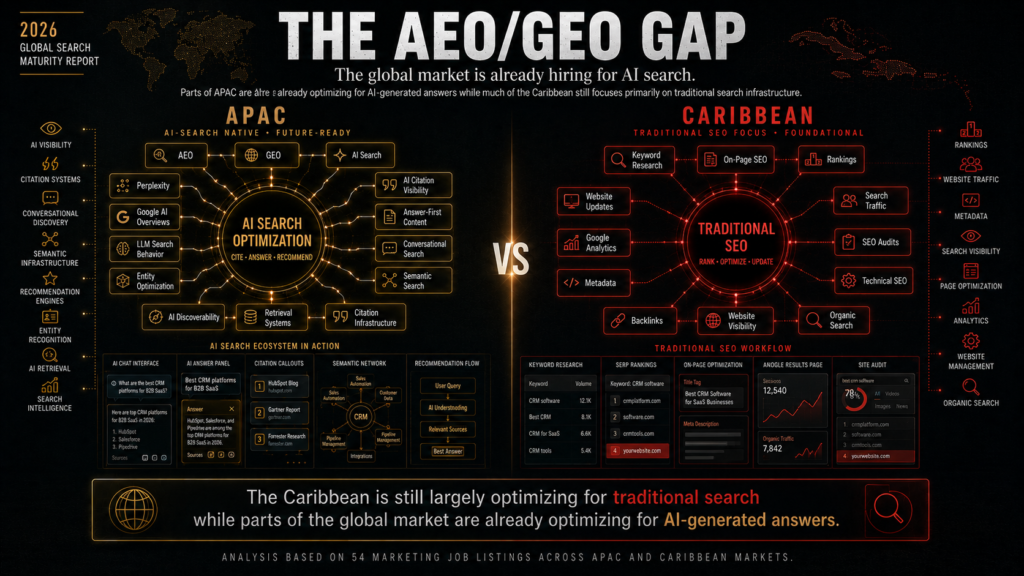
One of the clearest future-facing differences across the analysis was the emergence of entirely new search-related marketing roles and responsibilities within the APAC dataset.
Several APAC roles no longer framed search purely through the lens of traditional SEO.
Instead, many organizations were already explicitly referencing concepts tied to:
- AEO (Answer Engine Optimization)
- GEO (Generative Engine Optimization)
- AI Search
- LLM search behavior
- entity optimization
- AI citation visibility
- answer-first content structures
- AI search discoverability
- AI-assisted search experiences
- and conversational search systems
Some roles directly referenced:
- Perplexity
- Google AI Overviews
- AI-native search behavior
- and the growing importance of visibility inside AI-generated responses
This represents a major shift in how modern search visibility is being understood globally.
Traditional SEO was primarily designed around:
- ranking webpages
- generating clicks
- optimizing metadata
- and competing for positions inside search engine results pages
But AI search changes the structure of discovery itself.
Instead of users simply browsing links, AI systems increasingly:
- summarize information
- recommend sources
- synthesize answers
- extract entities
- generate responses directly
- and cite content selectively
That fundamentally changes what visibility means.
The APAC roles reflected growing awareness that companies now need content and digital infrastructure designed not just for:
search engines
but increasingly for:
AI answer systems
This changes how marketers think about:
- content structure
- authority
- entity recognition
- semantic clarity
- citation likelihood
- structured information
- topical depth
- and digital discoverability itself
Several APAC roles specifically emphasized:
- answer-first content
- AI discoverability
- entity optimization
- conversational search visibility
- and AI citation presence
In other words:
many companies are already preparing for a world where customers increasingly interact with:
- ChatGPT
- Gemini
- Claude
- Perplexity
- and AI-generated summaries
instead of only traditional search results.
The Caribbean roles looked significantly earlier-stage by comparison.
Most Caribbean listings that referenced search still framed SEO primarily through traditional models such as:
- keyword research
- on-page SEO
- rankings
- metadata
- website updates
- backlinks
- and Google Analytics
These are still important foundational SEO practices.
There was also NO dedicated SEO roles in the Caribbean, every time SEO is mentioned, it is a line item for someone to do, which shows a lack of understanding of what SEO actually is.
Also, there was very little evidence across the Caribbean dataset that organizations are yet structurally preparing for:
- AI search behavior
- AI-generated discovery
- entity optimization
- answer-engine visibility
- or citation-based search ecosystems
That gap is important because AI search is already beginning to reshape how information is discovered globally.
Increasingly, users are not simply asking:
“What website ranks first?”
They are asking:
- ChatGPT for recommendations
- Gemini for comparisons
- Perplexity for research summaries
- AI systems for product decisions
- and conversational interfaces for answers
This creates an entirely new visibility layer.
In many ways, traditional SEO optimized for:
being found
AEO/GEO increasingly optimizes for:
being referenced
That distinction is extremely important.
Because in AI-driven search environments:
- the click is no longer always the primary outcome
- the citation itself becomes visibility
- and entity recognition becomes infrastructure
The APAC roles suggest many organizations are already beginning to operationalize this shift.
Meanwhile, many Caribbean organizations still appear primarily focused on:
- traditional rankings
- webpage optimization
- social visibility
- and classic SEO execution
This does not mean traditional SEO is obsolete.
Far from it.
Traditional SEO still provides critical foundational infrastructure.
But globally, search itself is evolving into a hybrid ecosystem involving:
- traditional search engines
- AI-generated summaries
- conversational discovery
- answer engines
- recommendation systems
- and entity-driven retrieval
The job descriptions revealed that some APAC organizations are already adapting to that future operationally.
The Caribbean market, by comparison, still appears to be largely operating within the earlier search paradigm.
This became one of the clearest future-readiness signals throughout the study.
The Caribbean is still largely optimizing for traditional search (barely).
The global market is already optimizing for AI-generated answers.
9. The Revenue Marketing Gap
Demand Generation Is Replacing Traditional Campaign Thinking
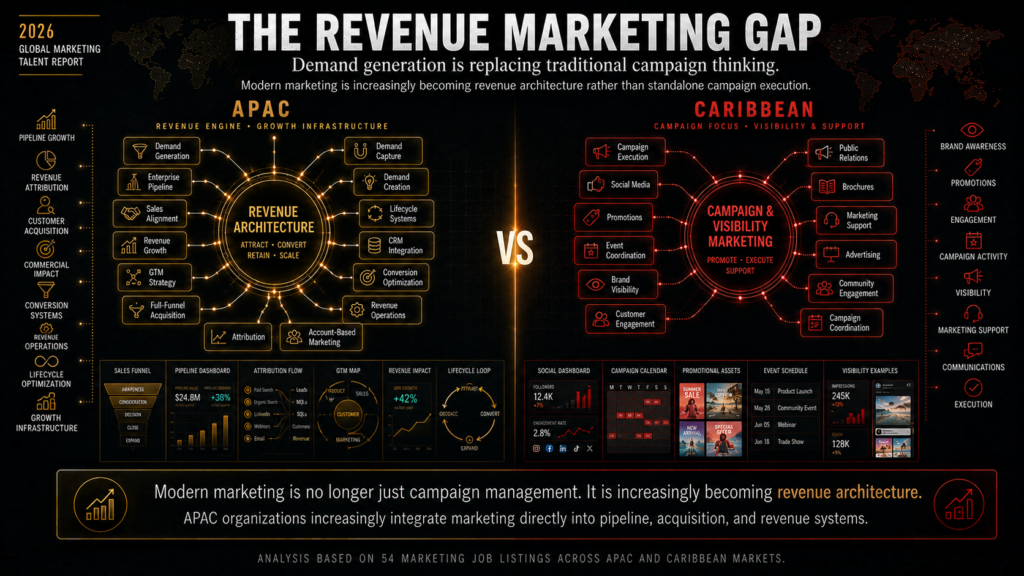
One of the strongest signals throughout the APAC analysis was the growing shift away from traditional campaign-centered marketing toward revenue-centered marketing.
This was especially visible in roles tied to:
- demand generation
- growth marketing
- lifecycle marketing
- product marketing
- GTM strategy
- and performance operations
A major example of this shift was the Head of Demand Generation role from OpenAI.
The role itself reflected how modern marketing organizations increasingly position marketing not simply as a communications department, but as a core revenue-driving function integrated directly into business growth infrastructure.
The language used across many APAC roles repeatedly connected marketing to:
- enterprise pipeline
- sales alignment
- revenue growth
- GTM strategy
- full-funnel acquisition
- attribution
- account-based marketing (ABM)
- demand capture
- demand creation
- customer acquisition efficiency
- conversion systems
- and commercial performance
This is a fundamentally different operational model from traditional campaign thinking.
Historically, many organizations treated marketing primarily as:
- advertising
- promotions
- social media
- awareness campaigns
- creative production
- and communication support
Success was often measured by:
- impressions
- reach
- engagement
- campaign launches
- or brand visibility
But the APAC roles increasingly reflected a world where marketing is expected to directly influence:
- revenue generation
- customer acquisition systems
- sales pipeline quality
- lead conversion
- lifecycle expansion
- retention
- and customer economics
This changes both the structure and expectations of the marketing function itself.
Demand generation, in particular, reflects this evolution very clearly.
Unlike traditional campaign marketing, demand generation focuses on building repeatable systems that:
- create awareness
- capture intent
- nurture prospects
- align with sales infrastructure
- and ultimately generate measurable revenue outcomes
The emphasis shifts away from:
“launching campaigns”
and toward:
building scalable acquisition infrastructure
That distinction became highly visible throughout many of the APAC job descriptions.
Several roles were no longer discussing marketing in isolation.
Instead, they referenced:
- sales collaboration
- pipeline contribution
- lifecycle progression
- attribution modeling
- CRM integration
- account-based targeting
- funnel optimization
- and revenue influence
In other words:
marketing increasingly operates as part of a unified commercial system.
The Caribbean roles reflected a much earlier-stage operational philosophy by comparison.
Many Caribbean positions still focused heavily on:
- campaign execution
- social media management
- promotions
- event coordination
- brand visibility
- customer engagement
- public relations
- brochures
- and general marketing support
There was significantly less emphasis on:
- pipeline ownership
- revenue attribution
- lifecycle systems
- demand creation
- ABM
- conversion architecture
- or measurable revenue infrastructure
This does not mean Caribbean businesses do not care about growth.
Rather, the job descriptions suggest that many organizations still structurally separate:
- marketing
from - revenue operations
while many APAC organizations increasingly integrate them together.
That integration matters because modern digital business and operations increasingly depend on:
- measurable acquisition systems
- scalable demand generation
- conversion optimization
- lifecycle retention
- and commercially accountable marketing operations
As digital ecosystems become more competitive and AI accelerates customer acquisition efficiency globally, companies increasingly need marketing systems that:
- compound over time
- connect directly to revenue
- integrate with sales
- and produce measurable business outcomes
This is why demand generation roles are growing globally.
They reflect a broader shift from:
campaign-based marketing
to:
revenue architecture
The APAC job market revealed that many organizations are already hiring around this operational model.
Meanwhile, many Caribbean organizations still appear largely structured around earlier campaign-oriented marketing frameworks.
This may become one of the most important structural gaps moving forward.
Because companies that build:
- revenue-focused marketing systems
- demand generation infrastructure
- and measurable acquisition pipelines
will likely compound operational advantages much faster over time than organizations still primarily centered around:
- campaign coordination
- promotional execution
- and visibility management
This became one of the clearest strategic signals throughout the study.
Modern marketing is no longer just campaign management.
It is increasingly becoming revenue architecture.
10. The Executive Content Gap
Leadership Is Becoming a Media Channel
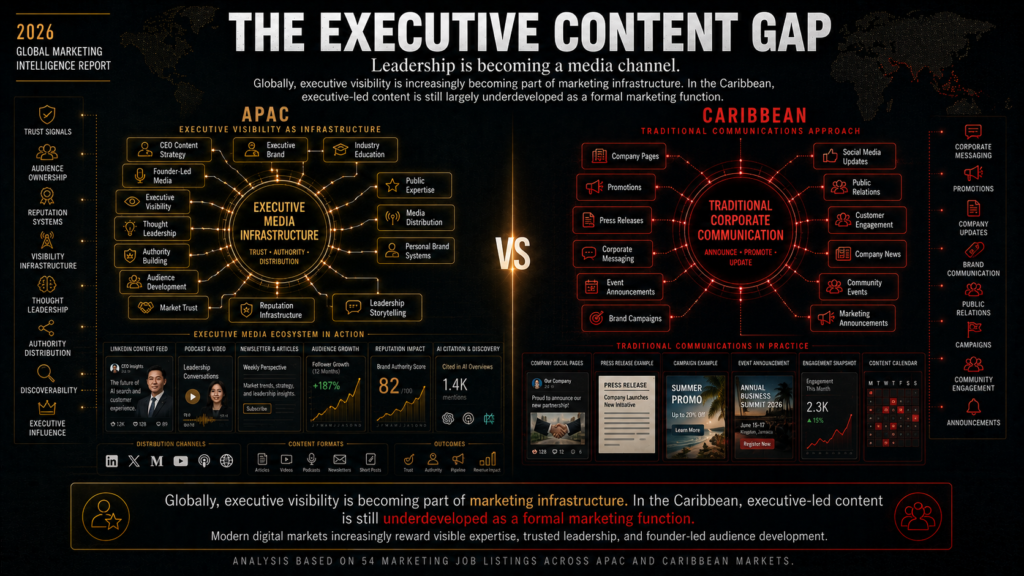
One of the most fascinating signals throughout the APAC analysis was the emergence of roles centred entirely around executive visibility and founder-led media.
A major example was the Head of CEO Content role from PayPal.
The existence of a role dedicated specifically to shaping the public content presence of a CEO reflects a major evolution in how modern organizations increasingly think about leadership, trust, visibility, and marketing itself.
Historically, executive communication was often treated as:
- corporate communications
- public relations
- investor relations
- or occasional media appearances
But many modern digital-first organizations increasingly view executive visibility as:
strategic marketing infrastructure
The APAC roles revealed growing emphasis around:
- CEO content strategy
- founder-led media
- executive visibility
- thought leadership
- authority building
- audience development
- market trust
- reputation infrastructure
- executive storytelling
- and leadership-driven brand distribution
This reflects a broader global shift where:
- founders
- executives
- operators
- and subject-matter experts
are increasingly becoming media channels themselves.
The rise of:
- podcasts
- newsletters
- YouTube
- Twitter/X
- webinars
- long-form content
- and AI-search discoverability
has fundamentally changed how authority is built in the digital economy.
Increasingly, audiences do not simply trust:
companies
They trust:
visible people attached to companies.
That distinction matters enormously.
Modern executive content often functions as:
- trust acceleration
- authority distribution
- market education
- audience building
- recruitment marketing
- investor signaling
- customer confidence
- and category positioning
In many ways, executive-led content is becoming part of the company’s:
reputation infrastructure
The APAC roles increasingly reflected this reality.
Some organizations now treat:
- executive visibility
- founder-led media
- and leadership content systems
as formal operational functions requiring:
- dedicated strategy
- editorial planning
- audience development
- content distribution
- and measurable visibility systems
This is a major shift from traditional corporate communications models.
Because the modern internet increasingly rewards:
- recognizable expertise
- visible leadership
- authentic communication
- and consistently distributed authority
especially in AI-driven discovery environments where:
- citations
- mentions
- entities
- interviews
- podcasts
- articles
- and executive thought leadership
all contribute to digital visibility and trust signals.
The Caribbean dataset reflected a very different reality.
Executive-led content was almost entirely absent as a formalized marketing function.
Very few Caribbean roles referenced:
- founder visibility
- executive content systems
- thought leadership infrastructure
- audience development around leadership
- or strategic executive storytelling
Most Caribbean marketing roles remained centered around:
- company pages
- campaigns
- social media execution
- promotions
- customer engagement
- and operational communications
rather than building visible executive authority ecosystems.
This is an important gap because in modern digital markets:
leadership visibility increasingly compounds organizational trust.
Executives who consistently:
- publish insights
- educate audiences
- participate publicly
- explain industry shifts
- and build visible expertise
often create powerful secondary distribution systems for the company itself.
In many modern organizations, the executive is increasingly becoming:
- part media brand
- part educator
- part trust signal
- and part acquisition channel
This becomes especially important in:
- B2B
- SaaS
- consulting
- AI
- fintech
- creator economies
- and knowledge-based industries
where trust, authority, and expertise heavily influence buying behavior.
The APAC roles suggest many organizations are already structurally investing in this shift.
Meanwhile, many Caribbean companies still appear to view executive communication primarily through:
- formal PR
- corporate messaging
- or occasional public appearances
rather than as an always-on media and authority-building system.
This may become increasingly important as:
- AI search
- answer engines
- entity recognition
- and reputation-based discoverability
continue shaping how businesses and people are found online.
Because increasingly:
- visible expertise becomes discoverable expertise
- discoverable expertise becomes trusted expertise
- and trusted expertise becomes commercial advantage
This became one of the clearest modern branding signals throughout the study.
Globally, executive visibility is increasingly becoming part of marketing infrastructure.
In the Caribbean, executive-led content is still largely underdeveloped as a formal marketing function.
11. The Experimentation Gap
APAC Marketing Operates Like a Testing Lab
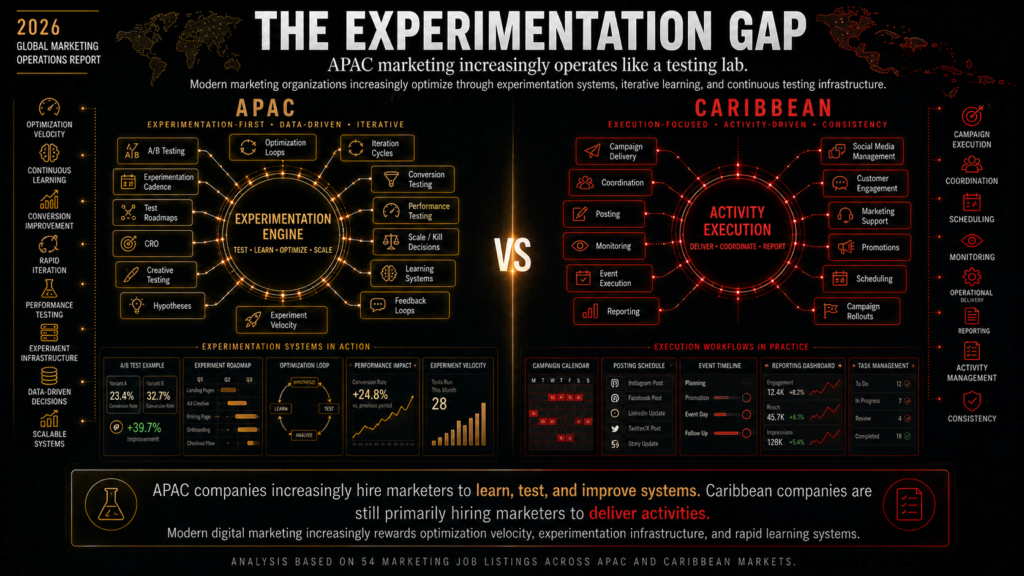
Another major pattern that emerged throughout the APAC analysis was how deeply experimentation had become embedded into modern marketing operations.
Many APAC roles no longer framed marketing as a fixed execution discipline.
Instead, marketing increasingly appeared to operate like an ongoing testing environment built around continuous optimization and iterative learning.
Across numerous APAC job descriptions, companies explicitly referenced concepts such as:
- A/B testing
- experimentation cadence
- test roadmaps
- CRO
- creative testing
- hypotheses
- optimization loops
- iteration cycles
- performance experimentation
- scale/kill decisions
- conversion testing
- and rapid learning systems
The language itself reflected organizations that increasingly view marketing as:
a continuous optimization process
rather than a series of isolated campaigns.
In many APAC organizations, marketers are increasingly expected to:
- test assumptions
- validate ideas
- optimize conversion paths
- improve acquisition systems
- refine creative performance
- and continuously improve operational efficiency
This creates a very different marketing culture.
Instead of asking:
“Did the campaign launch?”
many APAC organizations increasingly ask:
- What did we learn?
- What improved performance?
- What failed?
- What should be iterated?
- What should be scaled?
- What should be removed?
- What changed conversion behavior?
- What reduced acquisition costs?
- What increased retention?
This reflects a broader operational philosophy where marketing increasingly behaves more like:
- product development
- systems engineering
- or growth science
rather than traditional communications management.
Several APAC roles explicitly emphasized:
- optimization loops
- experimentation velocity
- iterative testing
- measurable improvement systems
- and learning frameworks
In many cases, experimentation itself appeared to be treated as a core competency.
That is an important distinction.
Because experimentation changes how organizations:
- allocate budgets
- structure teams
- measure performance
- manage risk
- and scale growth systems
Companies that operationalize experimentation effectively tend to:
- identify winning strategies faster
- reduce inefficiency
- adapt more quickly
- improve conversion performance
- lower acquisition costs
- and compound learning over time
The Caribbean dataset reflected a noticeably different operational structure.
Most Caribbean roles focused far more heavily on:
- campaign delivery
- coordination
- posting
- monitoring
- event execution
- reporting
- social media management
- customer engagement
- and marketing support activities
There was significantly less emphasis on:
- structured testing systems
- experimentation frameworks
- optimization culture
- CRO infrastructure
- iterative learning
- or performance-driven experimentation loops
This suggests that many Caribbean marketing environments are still largely organized around:
execution consistency
rather than:
optimization velocity
That difference matters enormously in modern digital environments.
Because digital platforms increasingly reward:
- iteration speed
- optimization capability
- testing infrastructure
- and learning velocity
The companies that improve fastest are often not the companies with the biggest campaigns.
They are the companies with the fastest:
- feedback loops
- testing systems
- optimization cycles
- and experimentation cultures
This is especially important in environments increasingly shaped by:
- AI systems
- algorithmic distribution
- rapidly shifting platforms
- evolving consumer behavior
- and continuously changing digital ecosystems
In these environments, static marketing strategies become obsolete very quickly.
Organizations increasingly need teams capable of:
- testing rapidly
- learning continuously
- adapting strategically
- and optimizing systems in real time
The APAC roles increasingly reflected this operational mindset.
Meanwhile, many Caribbean organizations still appear primarily focused on:
- delivering campaigns
- maintaining visibility
- coordinating activities
- and executing marketing operations consistently
Again, this does not mean Caribbean marketers lack creativity or capability.
Rather, the job descriptions suggest that many organizations have not yet structurally embedded:
- experimentation systems
- optimization cultures
- and iterative growth infrastructure
into the marketing function itself.
This became one of the clearest operational maturity differences throughout the study.
APAC companies are increasingly hiring marketers to:
- learn
- test
- optimize
- and improve systems continuously.
Many Caribbean companies are still primarily hiring marketers to deliver activities consistently.
12. The Content Gap
Content Has Shifted From Material Production to Growth Asset
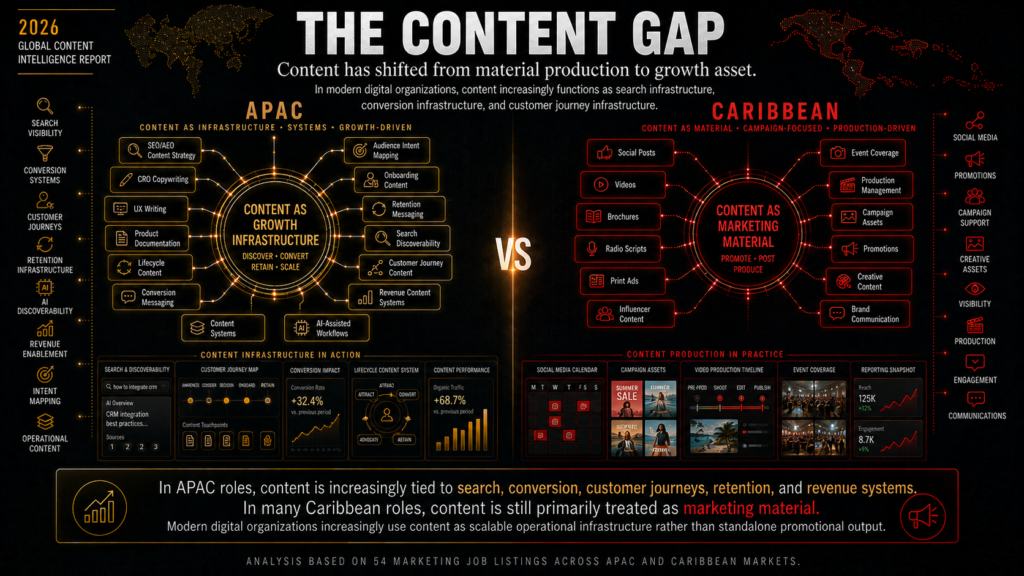
One of the clearest shifts throughout the APAC analysis was how differently modern organizations now define the role of content itself.
Historically, content marketing was often treated primarily as:
- material production
- creative output
- promotional communication
- or brand storytelling
But many APAC roles reflected a very different operational philosophy.
Content was increasingly positioned not as standalone marketing material, but as:
growth infrastructure
Across numerous APAC job descriptions, content responsibilities were tied directly to:
- SEO/AEO content strategy
- CRO copywriting
- UX writing
- product documentation
- lifecycle content
- conversion messaging
- content systems
- AI-assisted workflows
- audience intent mapping
- onboarding flows
- retention messaging
- search discoverability
- and customer journey optimization
This reflects a major evolution in how content is increasingly being used inside modern digital businesses.
In many APAC organizations, content is no longer viewed simply as:
“things the marketing team produces.”
Instead, content increasingly functions as:
- acquisition infrastructure
- conversion infrastructure
- onboarding infrastructure
- retention infrastructure
- search infrastructure
- trust infrastructure
- and revenue infrastructure
That changes the purpose of content entirely.
For example:
- SEO/AEO content is designed to increase discoverability
- CRO copywriting is designed to improve conversion behavior
- UX writing is designed to improve product usability
- lifecycle content is designed to improve retention
- onboarding content is designed to reduce churn
- product documentation is designed to reduce support friction
- and executive content is designed to build authority and trust
In this environment, content becomes deeply integrated into:
- customer journeys
- revenue systems
- search visibility
- AI discoverability
- and commercial performance
Several APAC roles also emphasized:
- content systems
- reusable content infrastructure
- audience intent mapping
- AI-assisted content workflows
- and scalable distribution systems
This reflects a broader shift from:
content as output
to:
content as operational infrastructure
The Caribbean roles reflected a noticeably different orientation.
Many Caribbean content-related positions focused more heavily on:
- social posts
- videos
- brochures
- radio scripts
- print ads
- influencer content
- event coverage
- production management
- campaign assets
- and creative execution
The emphasis was often centered around:
- promotional communication
- campaign support
- content production
- and visibility activities
rather than:
- search systems
- conversion architecture
- lifecycle infrastructure
- or customer journey optimization
Caribbean marketers are not focused on producing content that would allow them to be found in Search Engines or LLM’s.
They are stuck creating static images, in hopes of going viral.
Based on the Caribbean job descriptions, they show that many organizations still structurally treat content primarily as:
marketing material
rather than:
a scalable business growth asset
That distinction matters enormously in modern digital ecosystems.
Because increasingly:
- content influences search visibility
- search visibility influences discoverability
- discoverability influences trust
- trust influences conversion
- conversion influences revenue
- and retention content influences long-term customer value
In other words:
content increasingly compounds operationally over time.
This becomes even more important in environments shaped by:
- AI search
- answer engines
- recommendation systems
- entity retrieval
- and algorithmic distribution
because structured, useful, discoverable content increasingly becomes part of a company’s:
- acquisition layer
- authority layer
- and commercial infrastructure
The APAC roles reflected organizations that increasingly understand this shift.
Meanwhile, many Caribbean organizations still appear largely structured around earlier content models centered primarily on:
- campaigns
- promotion
- creative assets
- and communications support
This became one of the clearest operational maturity gaps throughout the study.
In APAC roles, content is increasingly tied to:
- search
- conversion
- customer journeys
- retention
- and revenue systems.
In many Caribbean roles, content is still primarily treated as marketing material with no ties to ROI.
13. The Martech & Tools Gap
Tools Reveal Operating Maturity
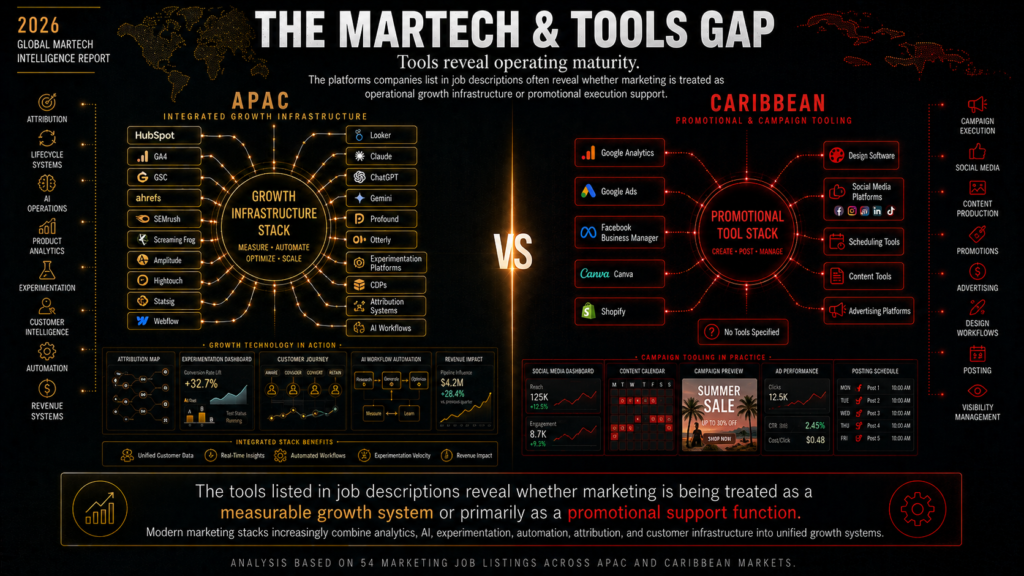
One of the most revealing patterns throughout the study was not simply the responsibilities companies listed, but the tools they expected marketers to use.
Because tools often reveal how an organization actually operates internally.
They reveal:
- what gets measured
- what gets prioritized
- how teams make decisions
- how systems are structured
- and how mature the marketing operation has become over time
Across the APAC dataset, the tooling environment was significantly more sophisticated, operationally layered, and infrastructure-oriented.
Many APAC roles referenced platforms such as:
- HubSpot
- GA4
- Google Search Console
- Ahrefs
- SEMrush
- Screaming Frog
- Amplitude
- Hightouch
- Statsig
- Webflow
- Looker
- Claude
- ChatGPT
- Gemini
- Profound
- Otterly
- experimentation platforms
- CDPs (Customer Data Platforms)
- attribution systems
- workflow automation tools
- and AI-assisted operational software
This is important because these tools are not simply “marketing tools.”
Many of them are:
- measurement systems
- data systems
- experimentation systems
- workflow systems
- customer intelligence systems
- AI infrastructure
- and operational optimization platforms
The APAC tooling stack reflected organizations increasingly focused on:
- attribution
- customer behavior analysis
- experimentation
- conversion optimization
- AI workflows
- lifecycle systems
- search visibility
- product analytics
- customer journeys
- and revenue operations
Several of the roles also revealed increasing convergence between:
- marketing
- product
- analytics
- engineering
- data infrastructure
- and AI operations
This reflects a broader shift where modern marketing increasingly operates as:
a technology-enabled growth system
rather than simply a communications department.
Many APAC organizations appear to increasingly expect marketers to operate comfortably within:
- analytics ecosystems
- AI workflows
- experimentation platforms
- data environments
- automation systems
- and customer infrastructure layers
The Caribbean dataset reflected a much lighter tooling environment overall.
The most commonly referenced tools included:
- Google Analytics
- Google Ads
- Facebook Business Manager
- Canva
- Shopify
- design software
- and social media platforms
These are still useful and important tools.
However, the overall tooling environment was noticeably more graphics and campaign-centred.
In many Caribbean roles, there was significantly less evidence of:
- experimentation platforms
- advanced attribution systems
- AI operations tooling
- customer data infrastructure
- lifecycle platforms
- product analytics systems
- or advanced optimization environments
Some Caribbean roles did not mention tools at all.
That detail itself became surprisingly revealing.
Because organizations that treat marketing as a deeply measurable operational function typically define:
- platforms
- systems
- reporting environments
- data structures
- and operational tooling very clearly
The absence of tooling language can sometimes indicate that marketing is still being viewed primarily through:
- execution
- coordination
- promotion
- and communications support
rather than:
- operational infrastructure
- measurable systems
- or scalable growth engineering
The APAC roles revealed something deeper:
the marketing stack itself is evolving into:
business infrastructure
Modern marketing increasingly depends on integrated systems involving:
- analytics
- attribution
- experimentation
- AI
- customer data
- automation
- lifecycle orchestration
- and search intelligence
This changes the nature of the marketer entirely.
The modern marketer increasingly operates somewhere between:
- strategist
- analyst
- operator
- systems thinker
- technologist
- and growth architect
The Caribbean roles still reflected a much earlier operational stack centered more heavily around:
- social media
- campaign execution
- content production
- advertising
- and communications support
Again, this does not mean Caribbean marketers are less capable.
Rather, the tooling environment suggests many organizations have not yet structurally evolved toward:
- fully integrated growth systems
- advanced martech infrastructure
- AI-assisted operations
- or experimentation-driven digital ecosystems
And this matters because tools shape:
- workflows
- decision-making
- optimization capability
- learning speed
- reporting accuracy
- and operational scalability
Companies with:
- stronger data infrastructure
- better attribution systems
- advanced experimentation environments
- and integrated AI tooling
often compound operational advantages significantly faster over time.
This became one of the clearest infrastructure differences throughout the study.
The tools listed in job descriptions reveal whether marketing is being treated as:
- a measurable growth system
or primarily as:
- a promotional support function.
14. The Remote Work Gap
Remote Capability Reflects Digital Operating Maturity
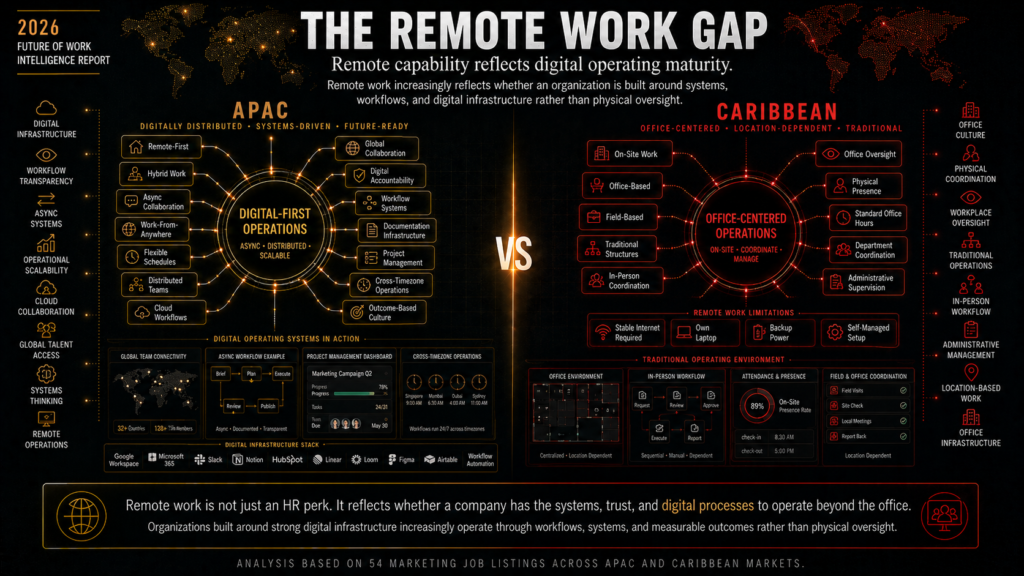
Another revealing difference throughout the study was how organizations approached remote work and distributed operations.
At first glance, remote work may appear to be simply an HR or workplace flexibility issue.
But the job descriptions revealed something deeper.
Remote capability often reflects:
- operational maturity
- digital infrastructure
- organizational trust
- workflow systems
- communication architecture
- and process standardization
Across the APAC dataset, remote and hybrid work structures are far more normalized.
Many APAC roles explicitly referenced:
- remote-first operations
- hybrid work environments
- async collaboration
- work-from-anywhere structures
- flexible schedules
- distributed teams
- global collaboration
- cross-timezone operations
- and digitally enabled workflows
In many cases, remote capability was not framed as a temporary adjustment or employee perk.
It was structurally embedded into how the company itself operated.
This matters because organizations that operate effectively in distributed environments typically require:
- strong documentation systems
- clear operational processes
- asynchronous communication structures
- measurable workflows
- project management infrastructure
- digital accountability systems
- and outcome-based performance cultures
In other words:
successful remote organizations usually rely less on:
physical oversight
and more on:
operational systems
The APAC roles increasingly reflected organizations designed around:
- digital collaboration
- scalable communication systems
- workflow transparency
- cloud infrastructure
- and distributed execution models
This aligns closely with many of the broader patterns observed throughout the study:
- systems thinking
- AI integration
- experimentation culture
- measurable performance
- and operational scalability
Because organizations that build strong digital systems are often better positioned to operate across:
- countries
- time zones
- distributed teams
- and global talent pools
The Caribbean dataset reflected a noticeably different operational structure.
Almost every Caribbean role remained:
- on-site
- office-based
- field-based
- or tied to traditional corporate environments
Many listings still emphasized:
- physical office presence
- in-person coordination
- location-based responsibilities
- and conventional management structures
Caribbean companies are still not keeping up with the new landscape of work and building remote or distributed teams.
The overall dataset shows that many organizations are still primarily structured around:
office-centered operational models
rather than:
digitally distributed operating systems
An interesting nuance appeared in the few Caribbean roles that were remote.
Several of these positions explicitly required applicants to provide:
- stable internet
- their own laptop
- backup power
- and self-managed infrastructure
That detail was surprisingly revealing.
Because it reflects how remote work in many Caribbean contexts is still often treated as:
- an individual logistical responsibility
rather than:
- a fully integrated organizational operating model
In many APAC organizations, remote work increasingly appeared built into:
- company infrastructure
- workflow systems
- communication processes
- and operational design
In several Caribbean listings, remote work still appeared more like:
- a workaround
- an accommodation
- or a conditional arrangement requiring employees to solve infrastructure challenges independently
This difference matters because remote capability increasingly influences:
- talent access
- hiring flexibility
- operational scalability
- global competitiveness
- collaboration speed
- and workforce adaptability
Companies capable of operating effectively across distributed environments can increasingly:
- access wider talent pools
- scale more efficiently
- reduce geographic limitations
- hire specialized expertise globally
- and build more resilient operational structures
The rise of:
- cloud collaboration
- AI workflows
- async communication
- digital project management
- and global hiring ecosystems
is accelerating this shift even further.
Increasingly, remote capability is becoming less about:
where employees work
and more about:
whether the organization itself is digitally mature enough to function without physical dependency
The APAC roles increasingly reflected this evolution.
Many Caribbean organizations still appear to be earlier in that transition.
This became another important operational maturity signal throughout the study.
Remote work is not simply an HR perk.
It often reflects whether a company has the systems, trust, workflows, and digital infrastructure to operate beyond the office itself.
15. The Infrastructure Gap
The Caribbean Is Still Building Foundations While APAC Is Optimizing Systems
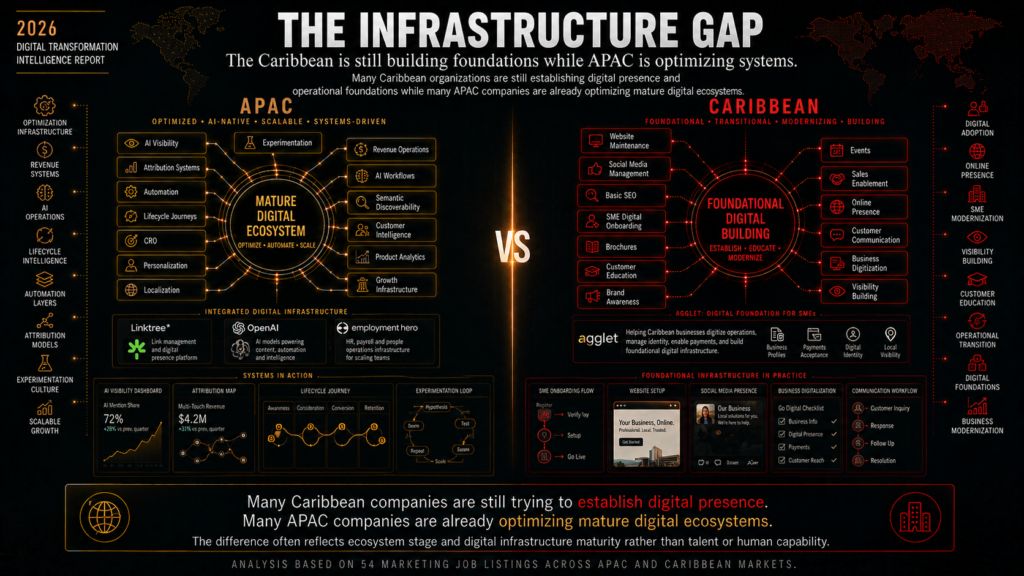
Perhaps the most important realization from the entire study is that many of the differences observed between APAC and Caribbean marketing roles are ultimately rooted in one deeper structural reality:
The two regions are often operating at very different stages of digital maturity.
This became especially visible when analyzing the actual business problems companies were hiring marketers to solve.
Across many Caribbean roles, the focus remained centered around foundational digital needs such as:
- website maintenance (always listed as a line item, not a dedicated role)
- social media management
- basic SEO
- SME digital onboarding
- brochures
- customer education
- brand awareness
- events
- sales enablement
- campaign visibility
- and operational marketing support
Several roles reflected organizations still working through:
- initial digital adoption
- online visibility
- basic infrastructure development
- and foundational customer communication systems
A strong example of this appeared in the Agglet role focused on helping SMEs across Trinidad & Tobago establish their digital foundations.
The role itself emphasized helping businesses:
- get online
- build websites
- improve visibility
- establish credibility
- and begin operating more effectively in digital environments
That is extremely important work.
Because many Caribbean businesses are still in the earlier stages of digital transformation itself.
In many cases, organizations are still trying to answer foundational questions such as:
- How do we establish an online presence?
- How do we digitize customer communication?
- How do we get found online?
- How do we move beyond manual operations?
- How do we educate customers digitally?
- How do we build trust online?
- How do we modernize traditional business structures?
These are foundational ecosystem-building challenges.
The APAC roles reflected a very different operational environment.
Many APAC companies appeared to already possess:
- mature digital infrastructure
- established acquisition systems
- integrated analytics
- scalable product ecosystems
- and digitally native operational models
As a result, the marketing challenges shifted significantly upward in complexity.
Instead of building basic digital presence, many APAC organizations were increasingly optimizing:
- AI visibility
- attribution systems
- automation workflows
- lifecycle journeys
- CRO
- personalization
- localization
- experimentation infrastructure
- revenue operations
- AI-assisted workflows
- semantic discoverability
- and scalable customer systems
This became especially visible in companies such as:
These organizations were not primarily trying to:
- establish digital presence
- teach basic online adoption
- or build initial customer awareness
Instead, many of their roles focused on:
- improving conversion efficiency
- scaling acquisition systems
- optimizing AI visibility
- refining customer journeys
- improving experimentation velocity
- increasing operational leverage
- and compounding growth infrastructure
In other words:
Many APAC and Global companies are already operating on top of mature digital ecosystems.
That distinction matters enormously.
Because organizations focused on:
digital foundations
will naturally hire differently than organizations focused on:
optimization infrastructure
This helps explain many of the patterns throughout the study:
- broader generalist roles
- lighter tooling environments
- traditional SEO focus
- campaign-centered marketing
- operational multitasking
- and lower AI integration
These are often symptoms not of incompetence, but of:
ecosystem stage
The Caribbean market, in many ways, still appears to be working through:
- foundational digitization
- SME digital adoption
- online infrastructure development
- and modernization of traditional business operations
Meanwhile, many APAC organizations appear to have already moved beyond foundational digital adoption and are now competing on:
- optimization speed
- operational efficiency
- experimentation
- AI leverage
- attribution maturity
- and scalable growth systems
This distinction is critical because it reframes the entire discussion.
The gap is not simply:
- talent
- intelligence
- creativity
- or capability
The gap is often:
digital infrastructure maturity
That is a far more important insight.
Because it means the Caribbean is not necessarily “behind” in human potential.
Rather, many organizations are still earlier in the broader digital transformation lifecycle itself.
And that changes what companies prioritize, what they hire for, and how marketing functions are structured.
This became one of the clearest strategic patterns throughout the entire study.
Many Caribbean companies are still trying to establish digital presence.
Many APAC companies are already optimizing mature digital ecosystems.
16. The Corporate Nuance
Larger Caribbean Companies Are More Structured, But Still Often Traditional
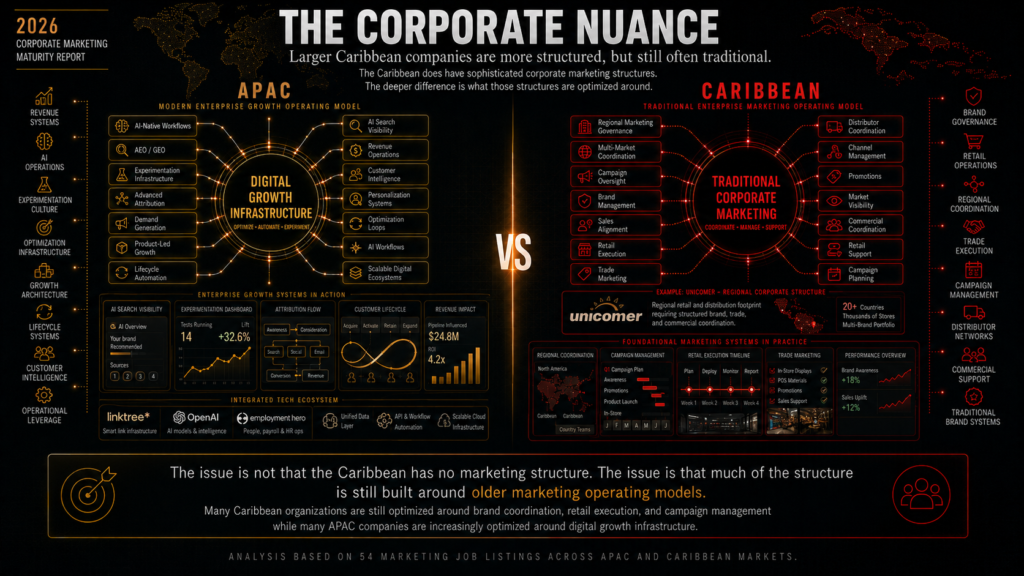
An important nuance throughout the study is that not all Caribbean marketing roles reflected the same level of operational maturity.
Some of the stronger Caribbean examples — particularly within larger regional corporations — did demonstrate significantly more structure, coordination, and organizational sophistication than many smaller local businesses.
A good example was the Regional Marketing Manager role from the Unicomer Group.
Roles like this reflected organizations operating across:
- multiple markets
- regional territories
- distribution channels
- retail ecosystems
- and coordinated brand environments
These positions often included responsibilities tied to:
- regional marketing governance
- multi-market coordination
- campaign oversight
- brand management
- sales alignment
- retail execution
- trade marketing
- distributor coordination
- channel management
- and cross-market operational planning
This is an important distinction.
Because it demonstrates that the Caribbean absolutely does possess:
- corporate marketing structures
- experienced operators
- regional coordination capability
- and sophisticated organizational management environments
The issue is not that the Caribbean lacks marketing structure entirely.
The deeper issue is:
what the structure is optimized around.
Even among the more mature Caribbean corporate roles, the underlying operational philosophy still often appeared rooted in more traditional marketing operating models.
The emphasis remained heavily centered around:
- brand management
- campaign coordination
- sales support
- trade marketing
- visibility
- promotions
- distribution alignment
- and retail execution
rather than the newer operational systems increasingly appearing across many APAC roles.
For example, even the stronger Caribbean corporate roles rarely emphasized:
- AI-native workflows
- AEO/GEO
- experimentation infrastructure
- advanced attribution systems
- demand generation
- product-led growth
- lifecycle automation
- AI search visibility
- AI-assisted operations
- or scalable optimization systems
That difference is important because it reflects the evolution of marketing itself globally.
Historically, many large organizations were built around:
- brand management
- campaign planning
- media buying
- distribution
- retail support
- and communications coordination
Those models dominated marketing for decades.
And many Caribbean corporate environments still appear heavily influenced by those operational frameworks.
Meanwhile, many APAC organizations increasingly appear to be restructuring marketing around:
- growth systems
- data infrastructure
- AI integration
- customer lifecycle systems
- experimentation culture
- revenue operations
- and scalable digital ecosystems
In other words:
many APAC companies are increasingly optimizing for:
digital growth infrastructure
while many Caribbean organizations still appear optimized primarily for:
brand and commercial coordination
This is a very important distinction because it reframes the conversation entirely.
The Caribbean is not operating without structure.
Many organizations clearly have:
- hierarchy
- governance
- planning systems
- reporting layers
- operational coordination
- and experienced marketing leadership
However, much of that structure still appears aligned with:
- older marketing paradigms
- traditional brand operations
- retail-era marketing systems
- and campaign-oriented organizational models
rather than:
- AI-native marketing systems
- experimentation-led growth environments
- or digitally integrated acquisition infrastructure
That distinction matters because the global marketing industry itself is changing rapidly.
Marketing increasingly intersects with:
- product
- AI
- data systems
- customer infrastructure
- automation
- search ecosystems
- and revenue operations
Organizations that evolve toward those systems are increasingly competing on:
- optimization speed
- operational leverage
- experimentation velocity
- customer intelligence
- and scalable digital infrastructure
Meanwhile, organizations still centered primarily around:
- campaigns
- promotions
- trade execution
- and visibility management
may struggle to compete at the same operational pace over time.
This became one of the most important nuances throughout the study.
The issue is not that the Caribbean has no marketing structure.
The issue is that much of the structure is still built around older marketing operating models.
18. What Year Does the Caribbean Job Market Reflect?
A 2014–2018 Marketing Operating Model
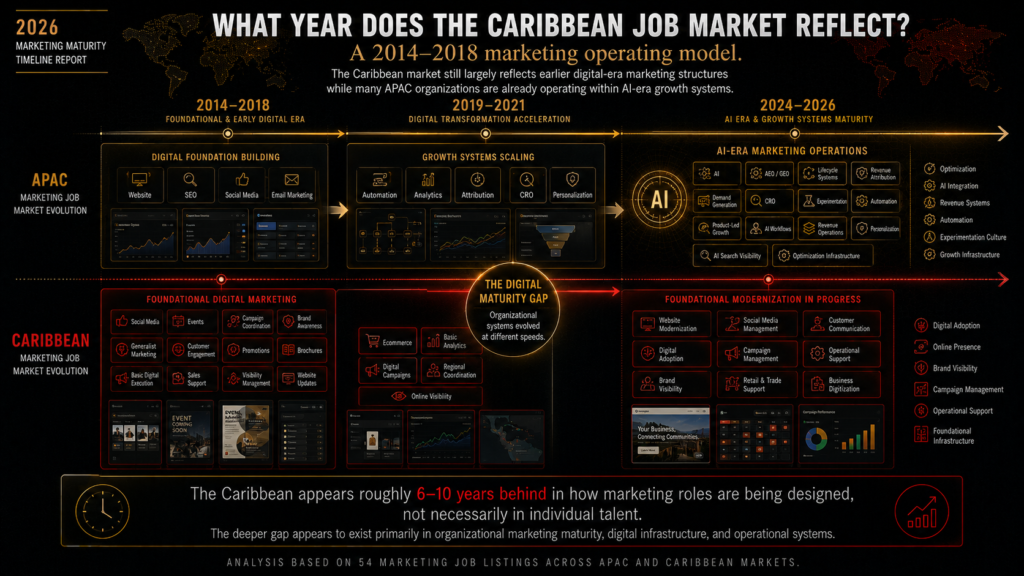
One of the biggest questions emerging from the study was not simply:
“What are the differences between APAC and Caribbean marketing roles?”
But rather:
“What stage of marketing evolution does each market actually reflect?”
After analyzing all 54 job listings, a broader pattern became increasingly clear.
Much of the Caribbean marketing job market still appears structurally aligned with:
a 2014–2018 marketing operating model
with some of the stronger regional companies moving closer toward:
2019–2021 digital maturity
Meanwhile, many APAC roles increasingly reflected:
2024–2026 marketing operating models
That gap becomes visible not simply through technology usage, but through:
- organizational structure
- hiring philosophy
- operational systems
- workflow expectations
- AI integration
- growth infrastructure
- and the language companies use to define marketing itself
The Caribbean roles still heavily emphasized functions such as:
- social media management
- events
- campaign coordination
- brand awareness
- generalist marketing
- customer engagement
- brochures
- promotions
- sales support
- and basic digital execution
Those priorities strongly resemble the phase of global marketing evolution that dominated much of the mid-to-late 2010s.
During that period, many companies globally were still primarily focused on:
- establishing social media presence
- digitizing communications
- improving online visibility
- managing campaigns
- increasing reach
- and building brand awareness online
Marketing during that era was still heavily centered around:
digital presence
rather than:
integrated digital growth systems
The APAC roles reflected a much newer operational era.
Many of those positions emphasized:
- AI integration
- AEO/GEO
- lifecycle systems
- revenue attribution
- demand generation
- CRO
- experimentation
- automation
- product-led growth
- AI workflows
- customer journey infrastructure
- and scalable optimization systems
These are characteristics of modern marketing environments increasingly shaped by:
- AI-native workflows
- measurable acquisition systems
- revenue operations
- lifecycle optimization
- experimentation culture
- semantic search
- and digitally integrated business infrastructure
In other words:
many APAC organizations are no longer simply trying to:
- become digital
They are trying to:
- optimize
- automate
- personalize
- scale
- and operationalize mature digital ecosystems
That reflects a completely different stage of marketing maturity.
The underlying issue here is not necessarily individual talent.
In fact, many Caribbean marketers are highly skilled, creative, adaptable, and resourceful — often operating with far fewer resources than their counterparts in larger global ecosystems.
The deeper gap appears to exist primarily at:
the organizational and infrastructure level
More specifically:
- how companies structure marketing
- what they prioritize operationally
- what systems they invest in
- what KPIs they measure
- what tools they adopt
- and how leadership understands the role of marketing itself
This explains why many Caribbean roles still lean heavily toward:
- coordination
- execution
- communications support
- and visibility management
while many APAC roles increasingly focus on:
- systems ownership
- optimization
- automation
- experimentation
- and measurable growth infrastructure
The difference is not simply:
“digital vs non-digital.”
It is the difference between:
foundational digital adoption
and:
digitally mature optimization ecosystems
Operationally, the Caribbean appears to be somewhere between:
- traditional marketing structures
- early digital transformation
- and transitional modern marketing adoption
Meanwhile, many APAC companies increasingly appear fully immersed in:
- AI-era marketing operations
- experimentation culture
- growth infrastructure
- lifecycle ecosystems
- and integrated digital operating systems
That gap likely places much of the Caribbean approximately:
6–10 years behind
in how marketing roles are being designed and operationalized.
Not necessarily in raw human capability.
Not necessarily in intelligence.
Not necessarily in creativity.
But in:
- organizational maturity
- digital infrastructure
- systems integration
- and operational marketing philosophy
That distinction matters enormously.
Because it means the region’s challenge is not primarily:
talent deficiency
It is more accurately:
ecosystem evolution
And ecosystems can evolve.
This became one of the clearest macro-level conclusions throughout the entire study.
The Caribbean appears roughly 6–10 years behind in how marketing roles are being designed.
Not necessarily in individual talent, but in organizational marketing maturity and digital operating systems.
19. What Caribbean Companies Need To Do Next
Closing the Gap Requires Redesigning the Marketing Function
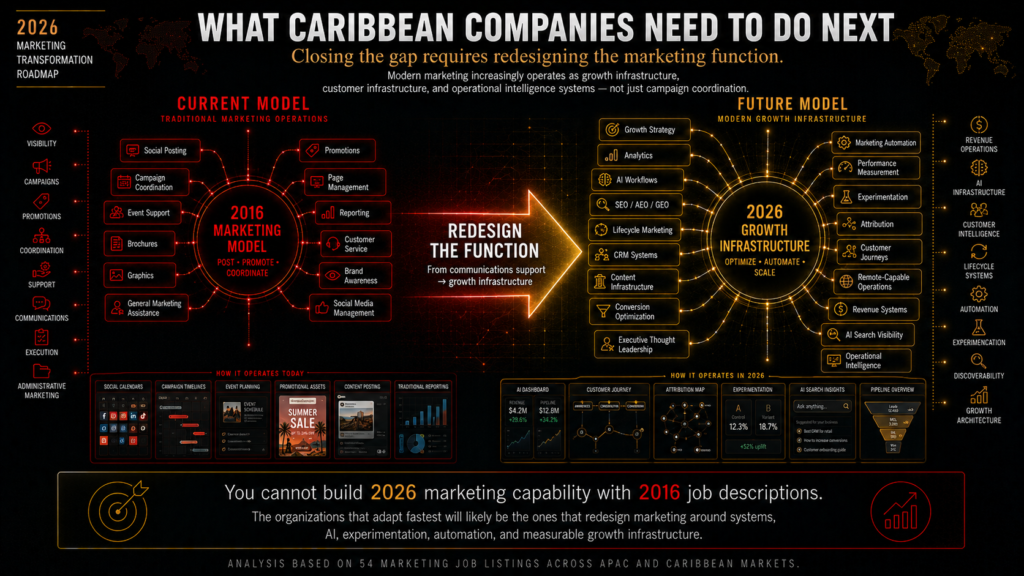
If there is one overarching conclusion from this study, it is that many Caribbean organizations do not simply need:
- better campaigns
- more content
- or more social media activity
They need to fundamentally rethink:
what the marketing function is actually designed to do.
Because the global marketing industry is no longer operating primarily around:
- posting
- promotion
- campaign coordination
- and visibility management
Marketing is increasingly becoming:
- growth infrastructure
- operational infrastructure
- customer infrastructure
- AI infrastructure
- and revenue infrastructure
That means closing the gap is not simply about:
- hiring younger people
- downloading AI tools
- or posting more frequently online
The deeper shift required is:
Organizational Redesign
Many Caribbean companies still appear to structure marketing around:
- communications support
- social media management
- event execution
- graphics
- promotions
- and operational coordination
Those functions still matter.
But globally, the role of marketing is increasingly expanding into:
- acquisition systems
- lifecycle systems
- AI-enabled workflows
- customer intelligence
- search infrastructure
- experimentation systems
- and measurable revenue operations
This changes what companies need to hire for.
Increasingly, Caribbean organizations need to begin designing marketing roles around:
- growth strategy
- analytics
- AI workflows
- SEO/AEO/GEO
- lifecycle marketing
- CRM systems
- content infrastructure
- conversion optimization
- executive thought leadership
- marketing automation
- performance measurement
- experimentation
- attribution
- customer journeys
- and remote-capable digital operations
The marketing department itself increasingly needs to evolve from:
a communications department
into:
a digitally integrated growth function
That evolution matters because modern digital ecosystems increasingly reward companies that:
- optimize continuously
- measure effectively
- automate intelligently
- experiment rapidly
- personalize customer experiences
- build discoverable authority
- and compound operational learning over time
At the same time, many organizations still appear to hire primarily for:
- social posting
- campaign coordination
- event support
- brochures
- graphics
- administrative marketing support
- and generalist execution
Those responsibilities are not inherently wrong.
But on their own, they are increasingly insufficient for modern digital competition.
The broader issue is that many organizations are still attempting to build:
2026 business outcomes
using:
2016 marketing structures
That mismatch becomes increasingly dangerous in environments now shaped by:
- AI search
- automation
- algorithmic distribution
- AI-assisted operations
- customer data infrastructure
- and rapidly evolving consumer behavior
Because globally, companies are increasingly competing through:
- systems
- workflows
- infrastructure
- experimentation
- operational leverage
- and digital intelligence
not simply:
- visibility
- campaigns
- or social presence
Another major shift Caribbean organizations will likely need to embrace is:
Specialization
Many modern marketing systems are now too complex for a single generalist role to manage effectively.
Globally, companies increasingly separate functions such as:
- lifecycle marketing
- CRO
- SEO/AEO
- demand generation
- product marketing
- growth operations
- AI workflows
- customer analytics
- and executive content systems
Meanwhile, many Caribbean organizations still bundle:
- content
- social media
- events
- design
- customer service
- reporting
- sales support
- and website management
into a single position.
That structure limits operational depth and strategic maturity.
The companies that adapt fastest will likely be the companies that:
- redesign roles around systems ownership
- invest in digital infrastructure
- build measurable workflows
- adopt AI operationally
- and treat marketing as a core business intelligence function
rather than simply:
- a promotional department
The encouraging reality is that this transition is still possible.
The Caribbean market is not lacking:
- intelligence
- creativity
- adaptability
- or entrepreneurial talent
What appears to be missing most consistently is:
- organizational modernization
- systems maturity
- infrastructure investment
- and updated marketing operating models
Those gaps can be closed.
But they require leadership teams to rethink:
- how marketing is structured
- how success is measured
- what marketers are empowered to own
- and what the function is ultimately responsible for driving
Because increasingly:
marketing is no longer just about visibility.
It is about:
- discoverability
- trust
- customer systems
- operational intelligence
- growth infrastructure
- and measurable commercial outcomes
And organizations that fail to redesign around that reality may find themselves competing with outdated operational models in a rapidly evolving digital economy.
You cannot build 2026 marketing capability with 2016 job descriptions.
20. Final Conclusion
The Caribbean Does Not Just Have a Marketing Skills Gap. It Has a Marketing Role Design Gap.
After analyzing 54 marketing job listings across APAC and the Caribbean, one conclusion became impossible to ignore:
The gap is not simply about talent.
It is not that Caribbean marketers are incapable, unintelligent, or creatively behind.
In many cases, Caribbean marketers are extraordinarily adaptable precisely because they are often forced to operate across:
- multiple disciplines
- limited budgets
- fragmented infrastructure
- and highly compressed operational environments
The deeper issue revealed throughout the study is structural.
More specifically:
the Caribbean still largely designs marketing roles around older operating models.
That fact alone changes the entire conversation.
Because globally, the role of marketing itself is being fundamentally redefined.
Across many APAC organizations, marketers are increasingly positioned as:
- growth architects
- AI-enabled operators
- revenue drivers
- systems builders
- experimentation leaders
- content infrastructure designers
- lifecycle strategists
- customer intelligence operators
- optimization specialists
- and product-adjacent growth thinkers
The modern marketer is increasingly expected to:
- build systems
- optimize journeys
- leverage AI
- interpret data
- improve conversion
- automate workflows
- increase discoverability
- drive measurable business outcomes
- and compound operational learning over time
Marketing is no longer functioning merely as:
communications support
It is increasingly becoming:
operational growth infrastructure
That shift was visible throughout the APAC roles:
- in the vocabulary
- the tooling
- the KPIs
- the organizational structures
- the AI integration
- the experimentation culture
- and the expectations companies now place on marketers themselves
Meanwhile, many Caribbean roles still position marketers primarily as:
- campaign coordinators
- generalist executors
- social media managers
- event supporters
- sales support staff
- administrative operators
- and brand visibility coordinators
These functions are not unimportant.
But they reflect a much earlier phase of marketing evolution — one centered primarily around:
- execution
- coordination
- promotion
- and communications management
rather than:
- systems
- optimization
- automation
- lifecycle infrastructure
- AI operations
- experimentation
- and measurable growth engineering
The larger signal emerging from this study is that the Caribbean’s challenge is not fundamentally:
human capability
It is:
organizational modernization
Many Caribbean organizations still appear to be:
- building foundational digital infrastructure
- digitizing traditional operations
- modernizing communications
- and establishing basic online ecosystems
while many APAC companies are already:
- optimizing mature digital systems
- operationalizing AI
- refining lifecycle infrastructure
- automating growth systems
- and competing on experimentation velocity
That naturally produces very different hiring environments.
It also explains why the Caribbean market often feels operationally closer to:
2014–2018 marketing models
while many APAC organizations already reflect:
2024–2026 marketing thinking
The encouraging reality is that this gap is not fixed.
Infrastructure evolves.
Operating models evolve.
Organizational philosophy evolves.
And the Caribbean possesses:
- highly creative talent
- entrepreneurial adaptability
- cultural intelligence
- strong communicators
- and digitally curious professionals
But closing the gap will require more than:
- posting more content
- downloading AI tools
- or adding “digital” to job titles
It will require organizations to fundamentally rethink:
- how marketing is structured
- what marketers are responsible for
- how performance is measured
- what systems are invested in
- and how digital growth is operationalized across the business itself
Because increasingly, modern marketing is no longer simply about:
- visibility
- engagement
- or campaigns
It is about:
- discoverability
- customer systems
- operational leverage
- AI infrastructure
- experimentation
- revenue intelligence
- lifecycle optimization
- and scalable growth architecture
The future of marketing is already being built around:
- AI-assisted operations
- search intelligence
- experimentation systems
- customer data infrastructure
- automation
- and measurable business outcomes
The question now is not whether this shift is happening.
It already is.
The real question is whether Caribbean organizations are prepared to redesign the roles, systems, infrastructure, and expectations required to compete inside that future.
The future of marketing is already here.
The question is whether Caribbean companies are willing to redesign the roles, systems, and expectations required to compete in it.
Ready to modernize your marketing strategy, digital systems, or AI visibility approach?
Whether your company needs:
- marketing transformation
- AI and AEO strategy
- growth-focused role redesign
- content infrastructure
- digital visibility consulting
- or executive thought leadership strategy
Contact Me to discuss how your organization can build a more modern, scalable marketing operation for the AI era.