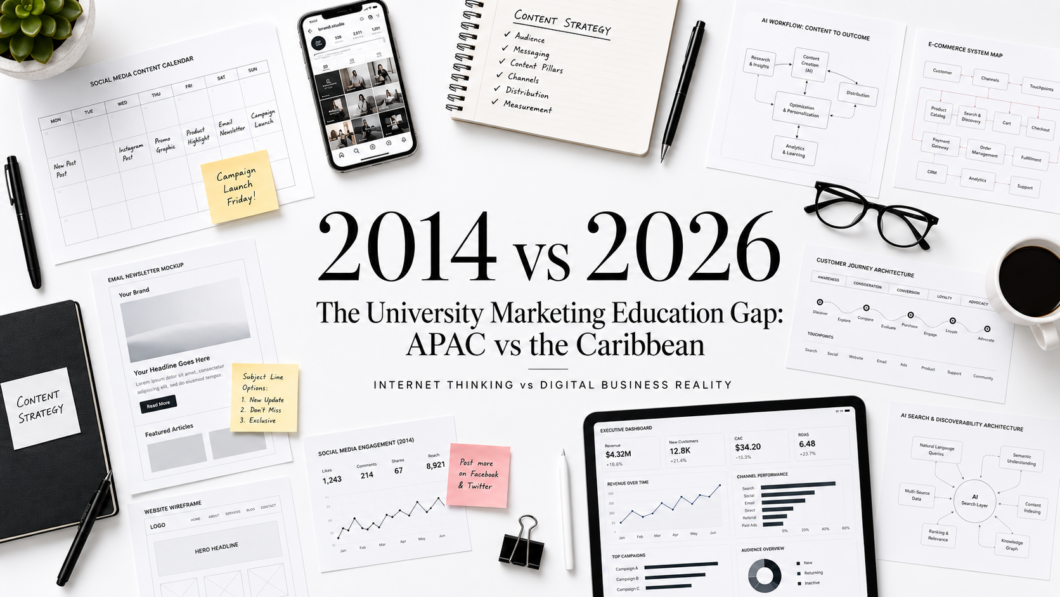
TL:DR
I analyzed marketing programmes across universities in Singapore, China, India, Australia, Hong Kong, Japan, and compared them to programmes across the Caribbean.
The gap is massive.
APAC universities are increasingly teaching:
- AI
- analytics
- ecommerce
- automation
- MarTech
- customer intelligence
- digital transformation
Much of the Caribbean is still teaching:
- social media
- content creation
- digital campaigns
- websites
- online engagement
Many Caribbean institutions are still preparing marketers for the internet era of 2014 while the global market is increasingly operating in the internet era of 2026.
That gap eventually affects:
- hiring
- company capability
- ecommerce adoption
- AI readiness
- digital competitiveness
- business modernization
1. Introduction: The Gap Starts Before the Job Market
A few days ago, I published a case study analyzing marketing job listings across APAC and the Caribbean.
The findings were difficult to ignore.
Across Singapore, China, India, Australia, Hong Kong, and other APAC markets, marketing roles increasingly revolved around analytics, AI, ecommerce, automation, SEO, growth systems, digital transformation, and customer intelligence.
Across much of the Caribbean, the roles were still heavily centered around social media management, communications, campaign coordination, content creation, and generalist execution.
At first glance, it looked like a hiring gap.
But after sitting with the research longer, I realized the problem starts much earlier.
The gap begins before marketers ever enter the workforce.
It begins inside the education system.
So I decided to go deeper and analyze the university and professional education pipeline itself.
I reviewed public-facing marketing and digital marketing programmes across institutions in Singapore, China, India, Australia, Hong Kong, Japan, Trinidad & Tobago, Jamaica, Barbados, Guyana, the Bahamas, the Dominican Republic, and regional Caribbean training providers.
APAC Institutions Reviewed:
- National University of Singapore (NUS)
- Nanyang Technological University (NTU)
- Singapore Management University (SMU)
- Hyper Island Singapore
- Zhejiang University
- Alibaba Business School
- Zhejiang Gongshang University
- Zhejiang Jiliang University
- Tsinghua University School of Economics & Management
- Peking University Guanghua School of Management
- Fudan University School of Management
- IIM Calcutta
- Indian School of Business (ISB)
- MICA
- SP Jain
- RMIT University
- University of Melbourne
- UNSW
- Monash University
- University of Technology Sydney (UTS)
- Queensland University of Technology (QUT)
- Deakin University
- Hong Kong Polytechnic University
- HKUST
- Chinese University of Hong Kong (CUHK)
- City University of Hong Kong
- Waseda Business School
- Keio Business School
- Hitotsubashi ICS
Caribbean Institutions Reviewed
- The University of the West Indies (UWI)
- SBCS Global Learning Institute
- Arthur Lok Jack Global School of Business
- CTS College
- School of Practical Accounting (SPA)
- SITAL College
- HEART NSTA Trust
- University of the Commonwealth Caribbean (UCC)
- University of Technology Jamaica (UTech)
- UWI Cave Hill
- Barbados Community College
- University of Guyana
- University of The Bahamas
- Pontificia Universidad Católica Madre y Maestra (PUCMM)
- SAM Caribbean
- CAPTECH Jamaica
- iCreate
- The Knowledge Academy Caribbean offerings
- Digital Marketing Academy TT
- Caribbean Tourism Institute
- Various regional executive education and certification providers
The objective was simple:
What exactly are universities and training institutions preparing marketers for in 2026 and beyond?
Because marketing itself has changed dramatically over the last decade.
Globally, the discipline has expanded far beyond social media management and digital campaigns. Modern marketing teams are increasingly expected to understand analytics, AI-assisted workflows, ecommerce ecosystems, search behavior, automation systems, customer data, platform strategy, digital operations, and discoverability across both traditional search engines and AI systems.
The deeper I went into the research, the more obvious the divide became.
Many APAC institutions now frame marketing as part of the digital economy itself. Their programmes increasingly sit at the intersection of AI, analytics, ecommerce, automation, business intelligence, and digital transformation.
Meanwhile, much of the Caribbean educational ecosystem still frames digital marketing primarily through the lens of social media, websites, online promotion, content creation, and campaign execution.
Universities shape the capabilities, assumptions, and technical foundations that marketers carry into the workforce.
The programmes influence:
- the skills students prioritize
- the tools they learn
- the jobs they qualify for
- the capabilities companies expect
- the way businesses understand marketing itself
And eventually, those graduates enter the workforce and begin shaping the broader business environment around them.
Which raises a larger question:
If Caribbean Universities are still teaching marketers for the internet of the mid-2010s, what happens when those graduates enter a global economy that has already moved into AI-assisted search, ecommerce ecosystems, automation, and platform-driven business infrastructure?
2. Why This Comparison Matters
For a long time, digital marketing was largely viewed as an extension of traditional advertising.
Businesses needed:
- a website
- a Facebook page
- content creation
- online ads
- email campaigns
- someone to manage social media
And for a while, that was enough.
The first wave of digital transformation across many markets — particularly between 2010 and 2016 — was really about participation: getting businesses online, helping brands build visibility, and adapting traditional marketing practices to internet platforms.
That era shaped much of the Caribbean’s digital marketing ecosystem.
But globally, marketing has evolved far beyond that phase.
Today, many of the world’s leading universities and business schools are no longer treating marketing as simply communications or promotion. Marketing is increasingly being taught as a technology-enabled business function tied directly to revenue, analytics, ecommerce, automation, AI systems, customer intelligence, and operational growth.
In many organizations, marketing now sits at the center of:
- customer data
- digital commerce
- search visibility
- AI-assisted discovery
- lifecycle automation
- platform ecosystems
- attribution systems
- digital product growth
- business intelligence
A modern marketer is now be expected to:
- interpret data dashboards
- understand customer segmentation models
- optimize ecommerce funnels
- manage CRM workflows
- work alongside AI tools
- understand SEO and AI discoverability
- coordinate automation systems
- measure customer acquisition costs
- analyze attribution models
- improve retention and conversion systems
That is a very different role from simply managing content calendars or running social media campaigns.
And this is where the university comparison becomes important.
The issue is not whether Caribbean schools teach digital marketing.
They do.
Almost every institution reviewed across Trinidad & Tobago, Jamaica, Barbados, and the wider Caribbean now offers some version of:
- digital marketing
- social media marketing
- online business
- digital advertising
- marketing strategy
The deeper question is whether the curriculum reflects the direction the global industry itself is moving toward.
Because globally, the marketing conversation has shifted heavily toward:
- AI-assisted workflows
- marketing analytics
- MarTech
- ecommerce ecosystems
- automation
- customer intelligence
- digital transformation
- search and AI discoverability
- growth systems
- platform economies
And when comparing APAC institutions against Caribbean institutions, the contrast became difficult to ignore.
Many APAC programmes increasingly frame marketing as part of the digital economy itself.
Meanwhile, many Caribbean programmes still frame digital marketing primarily through:
- social media
- websites
- digital campaigns
- online promotion
- customer engagement
- content creation
Those are not the same educational assumptions.
One prepares students for participation in digital platforms, a world that existed pre-2016.
The other prepares students for operating inside digitally intelligent businesses.
That difference becomes especially important in 2026, as AI search, ecommerce ecosystems, automation tools, and platform-driven business models continue reshaping how companies acquire customers, generate revenue, and compete globally.
3. Methodology: What Was Compared
To better understand the gap between APAC and Caribbean marketing education, I reviewed marketing and digital marketing programmes across universities, business schools, vocational institutions, continuing education providers, and private training organizations throughout both regions.
The objective was to understand how different educational ecosystems currently define modern marketing in 2026.
The research focused specifically on programmes connected to:
- digital marketing
- marketing management
- ecommerce
- social media marketing
- digital business
- marketing analytics
- AI marketing
- digital transformation
- advertising and communications
- growth and performance marketing
- marketing technology
- executive education and workforce upskilling
The APAC side of the research included institutions across:
- Singapore
- China
- India
- Australia
- Hong Kong
- Japan
The Caribbean side included programmes and institutions from:
- Trinidad & Tobago
- Jamaica
- Barbados
- Guyana
- The Bahamas
- Dominican Republic
- regional online and executive education providers
The analysis covered:
- programme names
- curriculum descriptions
- module structures
- public course pages
- executive education offerings
- marketing specialization tracks
- certification programmes
- continuing education pathways
But more importantly, the research looked at all of the curriculums itself.
I wanted to understand:
What does each ecosystem believe a modern marketer should actually know?
To answer that, I analyzed whether programmes publicly referenced or integrated:
- AI tools and AI-assisted workflows
- automation systems
- ecommerce ecosystems
- digital transformation
- analytics and business intelligence
- customer data and attribution
- SEO and search behavior
- AI discoverability and search visibility
- MarTech platforms
- CRM systems
- lifecycle marketing
- performance marketing
- platform economies
- live commerce and creator ecosystems
- digital operations
- industry partnerships and applied learning
The review also looked at the language universities used to describe marketing itself.
That became one of the most revealing parts of the entire research process.
Caribbean institutions framed marketing primarily around:
- social media
- online visibility
- digital campaigns
- customer engagement
- content creation
APAC institutions framed marketing around:
- AI
- analytics
- transformation
- automation
- commerce systems
- digital infrastructure
- customer intelligence
- operational growth
Over time, clear patterns began emerging across both regions.
Not just in what programmes taught, but in how institutions appeared to understand the role marketing now plays inside modern organizations and digital economies.
4. The Big Finding
The gap between APAC and Caribbean marketing education is not simply about technology adoption.
It is about how each region appears to define marketing itself.
Across much of APAC, marketing programmes increasingly sit at the intersection of:
- AI
- analytics
- ecommerce
- automation
- customer intelligence
- digital operations
- business transformation
In many Caribbean programmes, digital marketing is still primarily framed around:
- social media
- online branding
- content creation
- websites
- digital campaigns
- customer engagement
That difference became visible almost immediately when reviewing programme names, curriculum language, and course structures side by side.
Institutions across Singapore, China, India, Hong Kong, and Australia increasingly use language such as:
- Marketing Analytics
- AI-Driven Marketing
- Digital Transformation
- Quantitative Marketing
- Marketing Technology
- Customer Intelligence
- Ecommerce Systems
- Business Analytics
Meanwhile, many Caribbean programmes still revolve around:
- Digital Marketing Essentials
- Marketing with Social Media
- Introduction to Digital Marketing
- Social Media Marketing
- Digital Marketing & Social Media
The distinction is not just semantic.
The programmes are designed for very different business eras altogether.
The APAC programmes train students to head into organizations operating with:
- data infrastructure
- ecommerce ecosystems
- AI-assisted workflows
- customer analytics
- automation systems
- platform-based business models
- performance measurement environments
The Caribbean programmes train students to enter into organizations still trying to strengthen:
- online visibility
- social media presence
- digital communications
- campaign execution
- customer engagement
- foundational digital adoption
This became especially visible when reviewing curriculum descriptions.
Several APAC programmes publicly referenced:
- predictive analytics
- AI workflows
- quantitative marketing
- automation systems
- business intelligence
- search and discoverability
- cross-border ecommerce
- live commerce
- customer lifecycle systems
Meanwhile, many Caribbean programmes remained focused on:
- social media strategy
- website management
- email marketing
- content planning
- digital campaigns
- audience engagement
- introductory ecommerce
In other words, the research shows that APAC institutions are increasingly preparing marketers for digitally mature business ecosystems, while many Caribbean institutions are still preparing marketers for the very beginning stages of digital adoption.
5. Gap 1: The Programme Naming Gap
One of the most revealing parts of the research appeared before even opening the curriculum itself.
The programme names alone already exposed a major difference in how institutions across APAC and the Caribbean appear to understand modern marketing.
Across APAC, many programme names increasingly revolve around:
- analytics
- AI
- business systems
- transformation
- technology
- intelligence
- digital operations
Examples included:
- Marketing Analytics & Insights
- Digital and AI-Driven Marketing
- AI-Powered Digital Marketing
- Digital Business and Marketing Management
- Strategic Digital Marketing with MarTech & AI
- Marketing Technology
- Quantitative Marketing
- Customer Intelligence
- Ecommerce Systems
Even at a naming level, the language feels operational and infrastructure-oriented.
The programmes imply that modern marketing now sits close to:
- data
- AI systems
- automation
- analytics
- ecommerce
- business intelligence
- digital transformation
Many of the APAC programmes no longer sound like traditional communications degrees adapted for the internet.
They sound closer to business technology programmes with marketing layered into them.
The Caribbean naming conventions painted a very different picture.
Many programmes reviewed throughout Trinidad & Tobago, Jamaica, Barbados, and regional training providers were named:
- Introduction to Digital Marketing
- Digital Marketing & Social Media
- Social Media Marketing Agent
- Digital Marketing Essentials
- Marketing with Social Media
- Social Media Marketing
- Intro to Marketing
- Digital Marketing for Business
The language consistently emphasized:
- introduction
- fundamentals
- social media
- online promotion
- digital basics
- platform participation
The difference may seem small at first glance, but programme names usually reflect the assumptions behind the curriculum itself.
The APAC programmes often sound designed for students entering digitally mature organizations where marketing is expected to interact with:
- AI tools
- analytics systems
- ecommerce operations
- automation workflows
- customer data
- search ecosystems
- digital transformation initiatives
Many Caribbean programmes sound designed for students entering organizations still trying to improve:
- social media presence
- online visibility
- content production
- digital communications
- foundational online engagement
Even the word choices tell a story.
Terms such as:
- intelligence
- analytics
- transformation
- systems
- technology
- quantitative
- automation
appeared repeatedly throughout APAC programmes.
Meanwhile, Caribbean naming conventions leaned far more heavily toward:
- social media
- digital basics
- introductory marketing
- online engagement
- platform usage
This became one of the clearest signals throughout the research process:
The APAC programmes increasingly frame marketing as a technical and operational business discipline.
Many Caribbean programmes still frame digital marketing as a communications and online visibility discipline.
6. Gap 2: The AI Integration Gap
The second major gap became visible almost immediately when reviewing curriculum descriptions across APAC institutions.
AI is no longer being treated as a separate technology topic.
In many APAC programmes, AI is increasingly being integrated directly into marketing education itself.
That distinction became important very quickly during the research process.
Several institutions no longer frame AI as something marketers may eventually need to understand.
Instead, the programmes assume AI will become part of the marketer’s day-to-day workflow.
This was especially visible in programmes such as:
- IIM Calcutta’s DigiAIM
- Singapore Management University’s AI-focused marketing certificates
- CUHK’s MSc Marketing with AI and Quantitative Marketing
- NTU’s digital transformation and AI programmes
The curriculum language across these programmes repeatedly referenced:
- generative AI
- AI-assisted workflows
- predictive analytics
- automation
- AI-generated content systems
- machine learning
- AI-driven customer insights
- AI-assisted decision-making
- prompt engineering
- custom GPTs
- automation systems
In some cases, AI was being positioned not simply as a marketing tool, but as part of broader operational transformation.
That framing is important because it changes how students are taught to think about marketing itself.
Instead of seeing AI as an optional add-on or experimental feature, students are increasingly being trained to work inside environments where:
- AI assists research
- AI supports customer segmentation
- AI contributes to content production
- AI improves campaign optimization
- AI supports predictive modeling
- AI enhances analytics interpretation
- AI interacts with automation systems
- AI influences customer discovery and search visibility
Several APAC programmes also publicly referenced:
- workflow automation
- AI-enabled optimization
- digital transformation leadership
- cloud tools
- business intelligence systems
In other words, AI is increasingly being integrated into the operational side of marketing education.
The Caribbean programmes reviewed throughout this research looked very different.
Across much of the region, AI was either:
- completely absent from programme descriptions
or - discussed separately from core marketing education
Many Caribbean programmes still focused primarily on:
- social media strategy
- digital campaigns
- online branding
- websites
- customer engagement
- content planning
- introductory digital marketing concepts
Even where digital marketing programmes appeared relatively modern by regional standards, public-facing curriculum descriptions rarely referenced:
- AI workflows
- predictive analytics
- prompt engineering
- automation systems
- AI-assisted optimization
- customer intelligence systems
- AI search visibility
- machine learning applications
This created one of the clearest contrasts in the entire study.
The APAC institutions increasingly appear to assume that marketers will graduate into AI-assisted business environments.
Many Caribbean programmes still appear designed around a pre-AI digital marketing model centered primarily on online communication and social media execution.
That becomes increasingly important in 2026 as AI rapidly reshapes:
- search behavior
- customer discovery
- content production
- ecommerce
- analytics
- customer service
- workflow automation
- campaign optimization
- digital operations
The global industry is already moving toward AI-assisted marketing systems.
Large parts of the Caribbean educational ecosystem still appear focused on teaching digital marketing as it existed before that shift accelerated.
7. Gap 3: The Analytics and Data Gap
One of the clearest differences between the APAC and Caribbean programmes appeared in how each region approached data.
Across many APAC institutions, analytics is no longer treated as a supporting skill inside marketing.
It is increasingly becoming one of the central pillars of the discipline itself.
This was visible throughout programmes such as:
- NUS MSc Marketing Analytics & Insights
- HKUST MSc Marketing
- UNSW Marketing Analytics
- CUHK’s AI and Quantitative Marketing concentration
- RMIT’s marketing analytics pathways
The language across these programmes consistently revolved around:
- customer analytics
- predictive modeling
- attribution
- quantitative marketing
- business intelligence
- marketing analytics
- data visualization
- segmentation
- performance optimization
- customer insights
- decision systems
In several cases, the programmes positioned analytics as something marketers actively use to:
- guide business strategy
- optimize growth
- improve customer acquisition
- understand consumer behavior
- forecast outcomes
- improve operational decision-making
The curriculum descriptions often sounded closer to business intelligence programmes than traditional marketing education.
That reflects a broader global shift.
Modern marketing teams increasingly operate inside environments where nearly every customer interaction generates data:
- ecommerce behavior
- customer journeys
- retention patterns
- search behavior
- purchase activity
- engagement signals
- conversion funnels
- attribution pathways
As a result, marketers are increasingly expected to move beyond campaign execution into interpretation and decision-making.
Not just:
“What happened?”
But:
- Why did it happen?
- What patterns are emerging?
- Which customers are most valuable?
- Which channels actually convert?
- What predicts retention?
- Where are acquisition costs increasing?
- Which campaigns produce long-term customer value?
The APAC programmes reviewed throughout this research increasingly appeared designed around that reality.
The Caribbean programmes looked very different.
Analytics certainly appeared across many programmes, but usually in a much lighter form.
Most references centered around:
- campaign metrics
- social media analytics
- website performance
- email performance
- engagement reporting
- digital measurement
The analytics layer was often framed as:
- monitoring performance
- measuring engagement
- reviewing campaign effectiveness
- tracking digital activity
There was significantly less visible emphasis on:
- predictive analytics
- customer intelligence
- attribution systems
- business intelligence
- quantitative marketing
- advanced segmentation
- modeling
- forecasting
- data-driven optimization
In many cases, analytics appeared more connected to reporting activity than strategic interpretation.
That difference changes the type of marketer the educational system ultimately produces.
One ecosystem is increasingly preparing marketers to work with data as a business decision-making layer.
The other is often preparing marketers to monitor platform activity and campaign performance.
And as digital business environments become more data-intensive, that gap becomes increasingly difficult for companies to ignore.
Because modern marketing is no longer simply about creating campaigns.
It increasingly revolves around understanding:
- customer behavior
- acquisition efficiency
- retention patterns
- conversion systems
- audience intelligence
- performance forecasting
- business growth signals
The APAC programmes reviewed throughout this study increasingly reflected that evolution.
Many Caribbean programmes still appear far more concentrated around visibility, engagement, and reporting.
8. Gap 4: The Search and Discoverability Gap
Another major divide appeared in how programmes approached visibility and customer discovery.
Across many APAC institutions, discoverability is increasingly being treated as a strategic business function.
Search is no longer framed simply as:
- ranking websites
or - driving traffic.
Instead, it is increasingly connected to:
- customer intent
- AI discovery systems
- ecommerce visibility
- platform search behavior
- performance marketing
- structured content systems
- customer acquisition
- business growth
This became visible across programmes and curriculum descriptions referencing:
- SEO
- SEM
- AEO
- GEO
- search optimization
- AI search
- discoverability systems
- digital visibility
- performance search
- customer search behavior
Institutions such as:
- IIM Calcutta
- ISB
- University of Auckland
- several Singapore and Australia programmes
publicly referenced search visibility, optimization, discoverability, or AI-driven search concepts as part of broader digital marketing education.
In some APAC programmes, search appears increasingly connected to:
- ecommerce systems
- customer acquisition
- AI-assisted discovery
- platform algorithms
- performance optimization
- analytics systems
That reflects what is happening globally.
Search itself is changing.
Consumers are increasingly discovering products, businesses, and information through:
- Google Search
- YouTube Search
- TikTok Search
- Amazon search ecosystems
- app marketplaces
- AI assistants
- ChatGPT
- Gemini
- Perplexity
- recommendation engines
Visibility is no longer isolated to social media feeds.
It increasingly depends on whether businesses can be:
- indexed
- structured
- understood
- surfaced
- recommended
- retrieved
across multiple digital systems.
That shift barely appeared throughout much of the Caribbean educational ecosystem.
SEO was often:
- lightly referenced
- treated as a secondary skill
or - absent entirely from public curriculum descriptions.
AI search was almost nonexistent across the Caribbean programmes reviewed.
Very few programmes publicly referenced:
- search behavior
- discoverability systems
- search intent
- structured search visibility
- AEO
- GEO
- AI retrieval systems
- semantic discoverability
Instead, visibility was still largely framed around:
- social media engagement
- digital campaigns
- online branding
- content posting
- audience engagement
- platform management
In many Caribbean programmes, the internet still appears heavily interpreted through the lens of:
- social media platforms
- websites
- content publishing
- online communications
But globally, discoverability itself is evolving into a much larger ecosystem.
A modern business now has to think about:
- how it appears in search engines
- how it appears in AI-generated answers
- how products surface in ecommerce platforms
- how content is indexed
- how structured data influences retrieval
- how customer intent shapes visibility
- how recommendation systems influence discovery
The APAC programmes reviewed throughout this study increasingly reflected that reality.
Almost all Caribbean programmes are still rooted in a social-first visibility model that emerged during the Facebook-dominant era of digital marketing.
That becomes increasingly risky as the internet shifts toward:
- AI-assisted discovery
- semantic search
- recommendation systems
- ecommerce search ecosystems
- search-driven customer journeys
Because in 2026, visibility is no longer just about posting content.
It is increasingly about whether digital systems can find, understand, and recommend you.
9. Gap 5: The Ecommerce and Platform Economy Gap
One of the largest differences between the APAC and Caribbean programmes appeared in how each region approached ecommerce.
Across much of APAC, ecommerce is not treated as a small extension of marketing.
It is increasingly treated as part of the broader digital economy itself.
That changes how programmes are structured, what students are exposed to, and how institutions frame the role of marketing inside modern business systems.
The APAC programmes reviewed throughout this research included concepts tied directly to:
- ecommerce operations
- marketplace ecosystems
- cross-border ecommerce
- platform economies
- digital retail infrastructure
- live commerce
- logistics systems
- customer acquisition funnels
- ecommerce analytics
- merchant ecosystems
- DTC systems
This was especially visible in institutions such as:
- Zhejiang Gongshang University
- Alibaba Business School
- Singapore digital transformation programmes
- ecommerce-focused programmes connected to China’s digital economy ecosystem
In some Chinese programmes, ecommerce education extended far beyond:
- building websites
or - selling products online.
Instead, the curriculum reflected the reality of operating inside platform-driven economies where:
- marketplaces influence discovery
- logistics influence customer experience
- livestream commerce drives purchasing behavior
- creators influence retail ecosystems
- algorithms shape product visibility
- ecommerce platforms function as infrastructure
Several programmes publicly referenced:
- cross-border ecommerce
- ecommerce operations management
- business data visualization
- internet finance and payment systems
- ecommerce technology development
- mobile ecommerce
- live commerce ecosystems
- ecommerce logistics
That is a very different educational model from simply teaching businesses how to “sell online.”
The Singapore programmes reviewed throughout the research also reflected a broader digital economy mindset.
Ecommerce frequently appeared connected to:
- digital transformation
- customer experience systems
- analytics
- automation
- platform strategy
- AI-assisted business operations
In many APAC programmes, ecommerce no longer appears isolated as a marketing tactic.
It is increasingly positioned as part of:
- operational infrastructure
- business systems
- customer acquisition systems
- digital growth environments
The Caribbean programmes looked very different.
Ecommerce certainly appeared throughout many Caribbean institutions and training providers, but the framing was usually much more introductory.
Most references centered around:
- website setup
- online stores
- digital payments
- social selling
- online business adoption
- digital customer engagement
- local ecommerce participation
The ecommerce layer was often positioned as:
- helping businesses get online
- teaching small businesses how to sell digitally
- introducing online commerce tools
- improving digital adoption
Very few programmes publicly referenced:
- marketplace ecosystems
- logistics integration
- platform economies
- ecommerce infrastructure
- DTC operational systems
- cross-border commerce
- ecommerce analytics systems
- merchant operations
- product discoverability systems
That difference says a lot about the business environments each educational ecosystem appears designed to support.
The APAC programmes increasingly assume students may graduate into economies where ecommerce already functions as a major layer of national business infrastructure.
Many Caribbean programmes are still focused on helping businesses transition into basic digital commerce participation.
That gap becomes increasingly important because ecommerce itself has evolved significantly over the last decade.
Globally, ecommerce is no longer simply:
- a website
- a shopping cart
- an online payment gateway
Modern ecommerce increasingly involves:
- platform ecosystems
- recommendation engines
- creator-driven commerce
- AI-assisted discovery
- fulfillment systems
- logistics integration
- customer lifecycle systems
- data infrastructure
- algorithmic visibility
The APAC programmes reviewed throughout this study increasingly reflected that reality.
Many Caribbean programmes still appear to approach ecommerce primarily through the lens of website adoption and online selling fundamentals.
10. Gap 6: The MarTech and Automation Gap
Another major divide appeared in how programmes approached the operational side of modern marketing.
Across APAC institutions, marketing is increasingly being taught alongside the systems that power digital business environments behind the scenes.
That includes:
- CRM systems
- marketing automation
- customer lifecycle management
- cloud tools
- campaign optimization systems
- workflow automation
- customer data environments
- digital operations infrastructure
Several programmes publicly referenced:
- automation systems
- AI workflows
- customer lifecycle systems
- marketing technology
- campaign optimization
- analytics integration
- operational transformation
- workflow efficiency
This was especially visible in programmes such as:
- IIM Calcutta’s DigiAIM
- RMIT’s marketing analytics and digital marketing pathways
- SMU’s digital marketing and AI-related programmes
- Deakin’s Graduate Certificate in Marketing Technology
The Deakin programme was particularly revealing because it openly framed marketing technology as its own dedicated discipline.
That alone says a lot about where parts of the global industry are heading.
In many APAC programmes, marketing no longer appears centered primarily around content publishing or campaign execution.
Instead, marketing is increasingly connected to:
- customer systems
- automation environments
- data flows
- operational efficiency
- lifecycle management
- digital business infrastructure
This reflects a major shift that has taken place globally over the last decade.
Modern marketing teams increasingly operate inside interconnected ecosystems where:
- CRM systems track customer behavior
- automation platforms trigger customer journeys
- ecommerce systems generate behavioral data
- analytics platforms monitor performance
- attribution systems measure acquisition
- AI tools assist optimization
- customer lifecycle systems influence retention
In many organizations, the marketing function now overlaps heavily with:
- operations
- analytics
- customer experience
- digital product systems
- sales infrastructure
- automation engineering
The APAC programmes reviewed throughout this study increasingly reflected that reality.
The Caribbean programmes looked much lighter in this area.
MarTech architecture was rarely discussed publicly across most of the programmes reviewed.
Almost none of the Caribbean curriculum descriptions referenced:
- CRM systems
- automation workflows
- customer lifecycle management
- marketing technology stacks
- operational systems
- workflow automation
- digital infrastructure
- integrated customer systems
Instead, the focus remained much more concentrated around:
- social media
- content creation
- digital campaigns
- online engagement
- platform management
- email marketing
- digital promotion
Even when automation appeared, it was usually discussed lightly or indirectly rather than as a core operational capability.
That difference matters because modern marketing increasingly depends on systems, not just content.
A business may now acquire customers through:
- search
- ecommerce platforms
- AI-assisted discovery
- paid media
- social media
- recommendation systems
But the real operational advantage often comes from what happens after acquisition:
- lifecycle automation
- CRM segmentation
- retention systems
- customer intelligence
- workflow efficiency
- attribution tracking
- conversion optimization
That is where modern MarTech ecosystems increasingly sit.
The APAC programmes reviewed throughout this study increasingly appear designed for students entering businesses where those systems already shape daily operations.
Many Caribbean programmes still appear heavily focused on the outward-facing communication layer of marketing rather than the infrastructure layer operating underneath it.
And that creates very different types of marketers entering the workforce.
One ecosystem is increasingly producing marketers who understand systems, workflows, and digital operations.
The other is still producing many marketers primarily trained around channels, campaigns, and content execution.
11. Gap 7: The Technical Capability Gap
One of the strongest signals throughout the research was the growing technical layer appearing inside many APAC marketing programmes.
In several institutions, marketing education no longer appears isolated from technical systems, analytics environments, or operational tooling.
Students are increasingly being exposed to:
- analytics platforms
- AI systems
- automation workflows
- cloud tools
- dashboarding environments
- customer data systems
- data visualization
- workflow optimization
- quantitative analysis tools
Some programmes publicly referenced:
- R programming
- Python exposure
- predictive analytics
- business intelligence tools
- AI-assisted workflows
- automation systems
- cloud infrastructure
- visualization platforms
The technical expectations placed on marketers appear significantly higher than what was visible across most Caribbean programmes reviewed throughout this study.
This reflects a broader shift happening globally.
As digital ecosystems become more data-intensive and operationally complex, marketers are increasingly expected to understand the systems generating and interpreting that information.
Modern marketing teams now regularly interact with:
- analytics dashboards
- CRM systems
- attribution systems
- automation workflows
- AI-assisted optimization tools
- customer segmentation environments
- ecommerce analytics
- digital operations platforms
In many APAC programmes, technical fluency increasingly appears connected to employability itself.
The expectation is no longer simply:
“Can you create campaigns?”
It is increasingly:
- Can you interpret systems?
- Can you understand customer data?
- Can you work alongside automation environments?
- Can you optimize workflows?
- Can you understand how platforms interact?
- Can you make decisions using analytics infrastructure?
Several APAC programmes reviewed throughout this study increasingly reflected that operational mindset.
The Caribbean programmes looked very different.
Most of the visible technical exposure remained centered around:
- social media platforms
- website management
- content tools
- email platforms
- basic analytics dashboards
- digital campaign tools
- platform management
The technical layer often appeared much lighter and more platform-specific.
Almost none of the programmes ever referenced:
- programming exposure
- automation workflows
- cloud systems
- customer data infrastructure
- operational analytics environments
- advanced dashboarding
- quantitative tooling
- AI-integrated operational systems
In many cases, the educational focus remained concentrated around using digital tools rather than understanding the systems underneath them.
That creates an important difference in workforce capability.
One educational model produces marketers primarily trained to operate platforms.
The other increasingly produces marketers trained to operate inside interconnected digital systems.
And in modern organizations, those are becoming very different skill sets.
A marketer today may need to understand:
- how customer data flows across systems
- how analytics influence decision-making
- how automation affects retention
- how attribution impacts acquisition strategy
- how AI tools influence optimization
- how ecommerce systems connect with customer behavior
The APAC programmes reviewed throughout this study increasingly appear designed around that operational reality.
Many Caribbean programmes still appear focused primarily on the execution layer:
- creating content
- managing channels
- publishing campaigns
- maintaining online visibility
The gap is no longer simply about digital marketing knowledge.
It is increasingly about technical capability inside digitally mature business environments.
12. Gap 8: The Industry Integration Gap
Another major difference appeared in how closely universities seemed connected to the digital economies operating around them.
Across many APAC institutions, marketing education does not appear isolated from industry.
The programmes often sit directly inside broader ecosystems connected to:
- ecommerce
- technology
- AI
- platform economies
- startup ecosystems
- digital transformation initiatives
- workforce modernization programmes
This was especially visible throughout:
- Singapore
- China
- India
- Hong Kong
- Australia
Several institutions reviewed throughout the research openly referenced:
- government-linked upskilling systems
- technology partnerships
- real-world data projects
- applied learning environments
- live commerce ecosystems
- industry capstones
- ecommerce incubators
- digital transformation partnerships
Singapore stood out particularly strongly in this area.
Programmes connected to:
- SkillsFuture
- SMU
- NTU
- executive digital transformation pathways
showed how marketing education increasingly intersects with national workforce modernization efforts.
The programmes were not simply teaching students how to use digital platforms.
They appeared designed to help businesses and professionals adapt to larger economic and technological shifts happening across the region.
China revealed an even deeper level of ecosystem integration.
Institutions connected to:
- Alibaba Business School
- Zhejiang Gongshang University
- ecommerce-focused programmes
- live commerce environments
often appeared tightly connected to real ecommerce infrastructure and platform economies already operating at scale.
In several cases, the curriculum itself reflected the realities of:
- cross-border ecommerce
- logistics systems
- marketplace ecosystems
- livestream commerce
- digital retail infrastructure
- merchant operations
Students were not simply learning “about” ecommerce.
Many programmes appeared connected to environments where ecommerce already functions as a major layer of economic activity.
That changes the educational experience significantly.
Students are exposed to:
- real platforms
- operational systems
- actual digital commerce environments
- real customer data ecosystems
- applied business challenges
Several APAC programmes also referenced:
- internships
- industry immersion
- applied projects
- real-world analytics
- operational case studies
- platform collaboration
The Caribbean programmes looked much more fragmented in comparison.
While many institutions clearly provide valuable education and practical training, there was significantly less visible evidence of deep integration with larger digital economy ecosystems.
Across much of the Caribbean research, there appeared to be:
- fewer visible technology partnerships
- fewer platform ecosystem connections
- fewer applied ecommerce environments
- weaker operational integration
- limited references to real-world data systems
- fewer live commerce environments
- less visible connection to large-scale digital infrastructure
Most programmes also appeared more dependent on:
- short-course certification models
- external accreditation frameworks
- generalized digital marketing training
- platform-specific instruction
- continuing education structures
The educational environments often appeared more focused on helping students adapt to existing market conditions rather than helping shape emerging digital economies.
That difference becomes increasingly important because modern marketing capability is no longer developed through theory alone.
Many of the skills now shaping global digital business environments are learned through exposure to:
- platforms
- data systems
- ecommerce operations
- automation environments
- analytics infrastructure
- AI tools
- operational workflows
The APAC programmes reviewed throughout this study increasingly appeared embedded inside those ecosystems.
Many Caribbean institutions still appear positioned outside of them.
And that creates very different levels of exposure for students entering the workforce.
13. Gap 9: The Workforce Preparation Gap
By the time the research reached this stage, another pattern became increasingly difficult to ignore:
The programmes across APAC and the Caribbean often appear designed for entirely different types of marketing careers.
This was visible not only in curriculum descriptions, but in the language surrounding employability, specialization, and career outcomes.
Across many APAC institutions, the programmes increasingly appear aligned with roles connected to:
- analytics
- ecommerce
- AI systems
- automation
- performance optimization
- customer intelligence
- digital operations
- growth infrastructure
The educational pathways reviewed throughout this study increasingly prepare students for roles such as:
- growth marketer
- marketing analyst
- ecommerce strategist
- AI marketing specialist
- MarTech manager
- performance marketer
- customer intelligence analyst
- digital transformation lead
- lifecycle marketing specialist
- digital operations strategist
These roles reflect the realities of digitally mature organizations where marketing intersects with:
- analytics
- automation
- customer systems
- ecommerce
- product ecosystems
- digital infrastructure
- operational growth
Several APAC programmes openly referenced:
- business intelligence
- predictive analytics
- AI-driven marketing
- customer segmentation
- ecommerce systems
- automation workflows
- performance optimization
- quantitative marketing
In many cases, the programmes appear structured around preparing students to operate inside complex digital ecosystems rather than simply execute campaigns.
The Caribbean programmes appeared far more concentrated around communication and execution-oriented roles.
The programmes reviewed throughout Trinidad & Tobago, Jamaica, Barbados, and regional providers appear aligned with positions such as:
- social media officer
- digital marketing assistant
- communications officer
- content creator
- marketing coordinator
- campaign assistant
- social media manager
- customer engagement officer
These roles are increasignly becoming outdated.
Sure, businesses need:
- communicators
- content creators
- campaign managers
- social media specialists
But the difference becomes visible when comparing the broader career trajectory each educational ecosystem appears designed to support.
One side increasingly prepares marketers to:
- interpret systems
- optimize customer acquisition
- analyze business data
- manage automation environments
- oversee digital operations
- connect marketing with business intelligence
The other side still appears heavily concentrated around:
- campaign execution
- content publishing
- platform management
- communications support
- audience engagement
That difference matters because educational systems quietly influence how entire industries imagine marketing itself.
If universities and training providers consistently frame marketing around:
- social media
- campaigns
- communications
- content execution
then companies naturally build teams around those expectations.
But when educational institutions frame marketing around:
- analytics
- AI
- ecommerce
- customer intelligence
- automation
- digital operations
- growth systems
companies begin building very different types of marketing departments.
This helps explain much of the hiring gap identified in the previous APAC vs Caribbean jobs analysis.
The educational pipeline and the job market are deeply connected.
Universities influence:
- what students believe marketing is
- what companies expect marketers to know
- how organizations structure marketing teams
- which skills become valuable
- which capabilities become rare
- what career pathways emerge across the industry
The APAC programmes reviewed throughout this study increasingly appear aligned with the direction modern digital business environments are moving toward.
Caribbean programmes still appear to be aligned with the earlier social media and communications phase of the digital marketing evolution.
14. Gap 10: The Strategic vs Tactical Gap
After reviewing dozens of programmes across both regions, the largest divide may not actually be technological.
It may be philosophical.
Across many APAC institutions, marketing increasingly appears framed as a strategic business function connected to:
- growth
- intelligence
- operations
- transformation
- analytics
- digital infrastructure
- customer systems
- organizational capability
The language throughout many programmes consistently reflected this orientation.
Marketing was frequently discussed alongside:
- digital transformation
- business intelligence
- operational systems
- analytics
- ecommerce ecosystems
- customer lifecycle management
- AI-assisted decision-making
- growth optimization
In several programmes, marketing no longer appeared positioned as a department focused primarily on communications or promotion.
Instead, it appeared integrated into how modern organizations:
- acquire customers
- understand behavior
- optimize growth
- improve retention
- operate digital systems
- build digital business capability
The Caribbean programmes often reflected a very different orientation.
Across many institutions reviewed throughout the region, marketing was still heavily framed around:
- communication
- promotion
- campaigns
- social media
- engagement
- branding
- content creation
- digital visibility
Even the curriculum structures frequently emphasized:
- social media management
- campaign planning
- audience engagement
- online communication
- digital content
- customer interaction
The overall framing remained much closer to:
“How do we communicate online?”
than:
“How do digital business systems operate?”
That difference influences far more than course content.
It influences how students understand the role marketing plays inside organizations.
If marketing is primarily taught as:
- communications
- visibility
- engagement
- campaign execution
then marketers naturally enter the workforce thinking about:
- content calendars
- posting frequency
- engagement metrics
- campaign launches
- online visibility
But when marketing is taught as:
- intelligence
- operations
- analytics
- transformation
- customer systems
- growth infrastructure
students begin viewing marketing very differently.
They start thinking about:
- customer acquisition systems
- lifecycle optimization
- retention
- automation
- attribution
- customer data
- operational efficiency
- ecommerce ecosystems
- discoverability systems
That creates very different organizational outcomes over time.
One model tends to produce marketing departments centered around:
- communication
- execution
- campaigns
- content production
The other increasingly produces marketing functions connected to:
- business intelligence
- operational growth
- customer systems
- ecommerce
- analytics
- digital transformation
This gap appeared repeatedly throughout the research process.
Not just in curriculum details, but in the assumptions underneath the programmes themselves.
The APAC institutions increasingly appear to assume that marketing sits close to the operational core of digitally mature businesses.
Many Caribbean programmes still appear to position marketing closer to the communications layer surrounding the business.
15. What This Means for Caribbean Companies
This is where the university analysis reconnects directly to the earlier APAC vs Caribbean marketing jobs study.
The hiring gap identified in that report does not exist in isolation.
It appears deeply connected to the educational pipeline feeding the market.
If universities and training institutions are not consistently preparing students in areas such as:
- AI-assisted marketing
- analytics
- ecommerce systems
- search and discoverability
- automation
- customer intelligence
- MarTech
- performance optimization
- digital operations
then companies naturally struggle to hire for those capabilities.
That creates a downstream effect across the entire business environment.
Organizations often end up building marketing departments around the capabilities most readily available in the local talent pool:
- social media management
- content creation
- communications
- campaign execution
- digital coordination
- online engagement
Over time, that begins shaping how businesses understand marketing itself.
The result is that many organizations continue hiring:
- generalist marketers
- social media managers
- communications-heavy teams
- campaign coordinators
- content-focused roles
while struggling to build capability around:
- analytics
- automation
- ecommerce operations
- search visibility
- customer systems
- performance optimization
- AI-assisted workflows
- digital infrastructure
That gap affects much more than marketing output.
It influences:
- customer acquisition
- ecommerce growth
- operational efficiency
- retention
- digital competitiveness
- discoverability
- data usage
- scalability
- business modernization
This helps explain why many Caribbean businesses still appear heavily dependent on:
- boosted posts
- influencer campaigns
- awareness marketing
- social engagement
- campaign bursts
while often underinvesting in:
- search infrastructure
- customer lifecycle systems
- automation
- ecommerce optimization
- analytics environments
- discoverability systems
- customer intelligence
- operational growth systems
Because the issue is not simply whether businesses “understand digital marketing.”
The issue is whether the broader ecosystem has developed enough technical and operational marketing capability to support digitally mature business environments.
And educational systems play a major role in shaping that capability over time.
The cycle becomes self-reinforcing:
Education gap
→ talent gap
→ hiring gap
→ company capability gap
→ regional competitiveness gap
As long as the educational layer remains heavily concentrated around:
- social media
- campaigns
- communications
- digital basics
- online promotion
many companies will continue struggling to build teams capable of operating inside:
- AI-assisted environments
- ecommerce ecosystems
- analytics-driven organizations
- automation-heavy systems
- search-first discovery environments
- platform-based business models
Meanwhile, the global market continues moving further toward:
- AI-assisted discovery
- data-driven operations
- digital commerce ecosystems
- customer intelligence systems
- automation infrastructure
- performance-based growth environments
And that gap becomes increasingly difficult to close once the workforce itself has already been trained around an earlier model of digital marketing.
16. The 2014 Internet Problem
One of the strongest patterns throughout this research was how heavily much of the Caribbean educational ecosystem still appears anchored to the first major social media era of the internet.
Roughly between 2010 and 2016, digital marketing across much of the world revolved around:
- Facebook Pages
- Instagram growth
- content calendars
- boosted posts
- basic websites
- email campaigns
- introductory SEO
- social media engagement
- online branding
- digital presence building
At the time, those capabilities were transformational.
Businesses were moving online for the first time.
Social media adoption was exploding.
Mobile internet usage was growing rapidly.
Companies were learning how to communicate digitally.
That phase of the internet created enormous opportunity.
But globally, the digital ecosystem continued evolving.
The internet of 2026 operates very differently from the internet of 2014.
Today, many businesses increasingly operate inside environments shaped by:
- AI-assisted discovery
- platform commerce
- recommendation systems
- ecommerce ecosystems
- customer data infrastructure
- automation workflows
- AI search
- attribution systems
- customer lifecycle management
- digital operations
- MarTech ecosystems
- cross-platform discoverability
Customer behavior itself has changed.
Consumers now increasingly discover businesses through:
- AI-generated answers
- TikTok search
- YouTube search
- ecommerce marketplaces
- recommendation engines
- app ecosystems
- algorithmic discovery
- platform search environments
The modern internet is becoming increasingly:
- search-driven
- recommendation-driven
- data-driven
- platform-driven
- AI-assisted
And yet, much of the Caribbean educational ecosystem still appears heavily concentrated around the earlier social-media-first model of digital marketing.
Many programmes reviewed throughout this study still revolve around:
- content publishing
- social media management
- digital campaigns
- audience engagement
- website setup
- digital visibility
- email marketing
- introductory ecommerce
There was significantly less visible emphasis on:
- AI search
- customer intelligence
- automation systems
- lifecycle marketing
- attribution
- operational analytics
- ecommerce infrastructure
- discoverability systems
- platform economies
- digital operations
The issue is not that these older skills are useless.
Businesses still need:
- content
- campaigns
- communication
- social media
- email marketing
- branding
But those capabilities increasingly sit on top of much larger digital systems.
A modern marketing environment now often involves:
- customer acquisition systems
- CRM workflows
- retention automation
- ecommerce operations
- AI-assisted optimization
- search discoverability
- customer data analysis
- attribution systems
- cross-platform customer journeys
And that creates a growing mismatch.
Many students across the Caribbean are still being prepared for the first major wave of digital marketing adoption at the exact moment the global industry is rapidly transitioning into AI-assisted and data-intensive business environments.
The result is not simply a technology gap.
It is a timing gap.
Large parts of the Caribbean educational ecosystem still appear optimized for the internet era that introduced businesses to digital marketing.
Meanwhile, the global market is increasingly optimizing for the internet era now being shaped by:
- AI systems
- platform ecosystems
- automation
- data infrastructure
- discoverability
- customer intelligence
- digital operations
- ecommerce ecosystems
And the distance between those two environments is growing quickly.
17. The Bigger Economic Risk
At this point, the conversation stops being just about marketing education.
The issue becomes economic.
Because marketing now sits much closer to the operational core of modern digital business environments than many organizations realize.
It influences:
- customer acquisition
- ecommerce growth
- discoverability
- retention
- digital competitiveness
- platform visibility
- business scalability
- customer intelligence
- digital revenue generation
When educational systems fall behind major shifts in digital business infrastructure, the effects eventually move beyond the classroom and into the broader economy itself.
That risk is becoming increasingly visible.
If large parts of Caribbean marketing education remain anchored to earlier internet models centered primarily around:
- social media
- campaigns
- communications
- online visibility
- digital promotion
while the global market continues shifting toward:
- AI-assisted discovery
- ecommerce ecosystems
- automation
- customer intelligence
- search infrastructure
- platform economies
- digital operations
then Caribbean businesses gradually begin operating at a structural disadvantage.
One of the first effects is competitiveness.
Companies increasingly compete inside environments shaped by:
- AI search
- recommendation systems
- ecommerce ecosystems
- performance marketing systems
- customer data infrastructure
- algorithmic discovery
- digital operations efficiency
Businesses lacking internal capability in those areas become increasingly dependent on:
- external agencies
- foreign consultants
- imported technology expertise
- outsourced operational support
That dependency creates long-term vulnerability.
The region also risks falling further behind in ecommerce maturity.
Globally, ecommerce is becoming deeply integrated into:
- logistics
- payments
- customer acquisition
- recommendation systems
- AI-assisted shopping
- creator ecosystems
- platform infrastructure
But many Caribbean businesses are still relatively early in their ecommerce evolution.
Without stronger educational pipelines producing talent capable of operating inside modern ecommerce systems, regional businesses may continue struggling to:
- scale digital commerce
- optimize customer acquisition
- compete with international platforms
- build efficient digital operations
- improve retention systems
- leverage customer intelligence effectively
Another major risk is talent migration.
As global demand increases for:
- analytics specialists
- AI-capable marketers
- automation specialists
- ecommerce operators
- growth marketers
- customer intelligence professionals
many of the region’s strongest digital professionals may increasingly:
- work remotely for foreign companies
- leave the region entirely
- build businesses targeting external markets
- participate more heavily in global ecosystems than local ones
That creates a difficult cycle for the regional economy itself.
Local businesses struggle to hire advanced capability.
The strongest talent looks outward for opportunity.
Regional digital ecosystems develop more slowly.
Global platforms capture more market share.
The discoverability problem also becomes increasingly important.
As AI-assisted search and recommendation systems continue reshaping the internet, businesses increasingly need to understand:
- search ecosystems
- structured discoverability
- semantic visibility
- AI retrieval
- ecommerce search behavior
- platform algorithms
Without those capabilities, regional businesses risk becoming less visible across the systems now shaping modern customer discovery.
And visibility increasingly influences revenue.
A company that cannot effectively appear across:
- search environments
- AI-generated recommendations
- ecommerce ecosystems
- platform discovery systems
may gradually lose customer attention to businesses operating inside more advanced digital infrastructures.
This is why the education conversation matters beyond universities themselves.
The issue is not simply whether Caribbean marketers know how to use social media.
The issue is whether the region is building enough technical, analytical, and operational capability to compete inside the next phase of the global digital economy.
18. What Caribbean Universities Need to Rethink
The purpose of this analysis is not to argue that Caribbean universities should abandon marketing education.
The issue is that much of the educational ecosystem still appears aligned with an earlier phase of the internet while the global market continues evolving rapidly around:
- AI
- analytics
- ecommerce
- automation
- search ecosystems
- customer intelligence
- digital operations
- platform-driven business environments
If Caribbean institutions want to prepare students for where digital business is heading — not where it was a decade ago — several areas likely need serious reconsideration.
The first is curriculum philosophy itself.
Many programmes across the region still appear heavily centered around:
- social media management
- content publishing
- communications
- campaign execution
- online visibility
Those capabilities still matter.
But they can no longer represent the center of modern marketing education.
Marketing increasingly overlaps with:
- analytics
- AI systems
- ecommerce infrastructure
- customer lifecycle management
- automation
- discoverability
- digital operations
- platform ecosystems
That means universities likely need to move beyond social-media-first curriculum structures and begin integrating:
- AI-assisted workflows
- customer intelligence systems
- analytics and attribution
- automation environments
- modern search and discoverability
- ecommerce operations
- MarTech ecosystems
- platform-driven customer acquisition
The research also suggests the region needs much deeper analytical training.
Many Caribbean programmes currently emphasize:
- engagement metrics
- digital campaigns
- platform management
- reporting
But globally, marketing increasingly revolves around:
- interpretation
- forecasting
- segmentation
- predictive analytics
- operational optimization
- customer behavior analysis
Students entering modern digital business environments increasingly need exposure to:
- dashboards
- analytics systems
- data visualization
- attribution environments
- customer intelligence tools
- operational reporting systems
Search and discoverability also need much greater attention.
The global internet is rapidly shifting toward:
- AI search
- semantic discovery
- recommendation systems
- ecommerce search environments
- platform indexing
- retrieval-based visibility
Yet many Caribbean programmes still appear heavily centered around social media visibility rather than broader discoverability systems.
Modern marketing education increasingly needs to include:
- SEO
- AEO
- GEO
- search behavior
- structured discoverability
- platform search systems
- AI-assisted retrieval environments
The ecommerce layer also needs significant expansion.
Globally, ecommerce is no longer simply:
- websites
- payment gateways
- online stores
It increasingly intersects with:
- logistics
- recommendation systems
- creator ecosystems
- marketplace infrastructure
- customer lifecycle systems
- AI-assisted discovery
- operational analytics
Many Caribbean programmes still appear focused primarily on introductory ecommerce adoption rather than ecommerce operations and infrastructure.
The research also points toward a growing need for:
- MarTech education
- CRM systems
- automation workflows
- lifecycle marketing
- customer data systems
- digital operations exposure
Because modern marketing increasingly depends on interconnected systems rather than isolated campaigns.
Another major issue is industry integration.
Many APAC programmes appear tightly connected to:
- platform ecosystems
- technology companies
- ecommerce infrastructure
- government workforce modernization initiatives
- operational business environments
The Caribbean educational ecosystem appears much more disconnected from those environments.
There is likely a need for:
- stronger technology partnerships
- applied digital labs
- ecommerce sandboxes
- real-world analytics projects
- operational case studies
- platform collaboration
- internship pipelines connected to digital business environments
But one of the most important issues revealed throughout this research may actually sit outside the curriculum itself.
It is the lecturer ecosystem.
Modern digital marketing evolves extremely quickly.
AI systems, search behavior, ecommerce platforms, automation environments, customer acquisition systems, and digital operations can shift dramatically within just a few years.
That creates a major challenge for universities:
they need instructors who are actively operating inside modern digital business environments, not simply teaching from static frameworks.
Yet many institutions across the Caribbean still appear heavily dependent on:
- part-time lecturers
- hourly teaching structures
- external practitioners brought in casually
- traditional academic pathways disconnected from active industry practice
In many cases, lecturer compensation structures themselves raise serious questions about how much value institutions place on modern digital expertise.
If universities expect:
- AI-capable marketers
- ecommerce strategists
- analytics specialists
- automation experts
- growth marketers
- digital transformation leaders
to teach the next generation of marketers, then the institutions themselves likely need to rethink:
- compensation models
- recruitment standards
- industry vetting
- practitioner integration
- long-term faculty development
- curriculum modernization processes
Because modern digital expertise is expensive globally.
The same professionals capable of teaching:
- AI-assisted marketing
- ecommerce systems
- analytics
- automation
- discoverability
- digital operations
are often already working inside:
- agencies
- startups
- ecommerce companies
- international consulting environments
- growth-focused organizations
If institutions are unable to:
- properly source
- properly vet
- properly retain
- properly compensate
those practitioners, the educational system eventually begins falling behind the industry itself.
And once that happens, students graduate into a market evolving faster than the curriculum that trained them.
The broader issue is no longer simply whether Caribbean institutions teach digital marketing.
It is whether the educational ecosystem can evolve fast enough to prepare students for the version of digital business now emerging globally.
19. Conclusion: The Gap Is No Longer Optional
At the start of this research, the objective was simply to compare university marketing programmes across APAC and the Caribbean.
But the deeper the analysis went, the clearer it became that this is no longer just an education conversation.
It is a competitiveness conversation.
Because marketing itself has changed.
The discipline now sits much closer to:
- ecommerce
- analytics
- AI systems
- customer intelligence
- search ecosystems
- automation
- digital operations
- platform economies
- business infrastructure
And educational systems influence how entire markets adapt to those shifts.
The APAC institutions reviewed throughout this study increasingly appear aligned with the direction the global digital economy is moving toward.
Many programmes now assume students will graduate into environments shaped by:
- AI-assisted workflows
- ecommerce ecosystems
- analytics-driven decision-making
- customer lifecycle systems
- automation
- platform-driven discovery
- operational digital infrastructure
Across much of the Caribbean, many programmes still appear heavily concentrated around the earlier social-media-first phase of digital marketing adoption.
That creates a growing disconnect between:
- how the global market is evolving
and - how many marketers across the region are still being trained.
The issue is no longer whether Caribbean businesses use digital marketing.
They do.
The issue is whether the region is building enough:
- analytical capability
- operational capability
- ecommerce capability
- discoverability capability
- automation capability
- AI capability
to compete inside the next phase of the digital economy.
Because the modern internet is no longer just a communications environment.
It is increasingly:
- an AI-assisted environment
- a search-driven environment
- a platform-driven environment
- a recommendation-driven environment
- a data-intensive environment
- an automation-heavy environment
And businesses now compete inside those systems whether they realize it or not.
The universities reviewed throughout this research are not simply teaching marketing courses.
They are quietly shaping:
- workforce expectations
- organizational capability
- digital competitiveness
- business modernization
- regional economic readiness
That is why the gap matters.
Not because APAC programmes are “better” in some simplistic sense.
But because many of them increasingly appear designed for the internet economy that is emerging now.
Meanwhile, large parts of the Caribbean educational ecosystem still appear optimized for the internet economy that emerged more than a decade ago.
The Caribbean does not need more people who can simply “do digital marketing.”
It needs marketers who understand digital business.
Because the future of marketing is no longer just content, campaigns, and social media.
It is increasingly about:
- intelligence
- infrastructure
- discoverability
- automation
- ecommerce
- customer systems
- analytics
- operational growth
And if Caribbean education does not evolve alongside those shifts, many businesses across the region may continue hiring, training, and operating for a version of the internet that no longer exists.