
The Caribbean Is Fueling Something Bigger
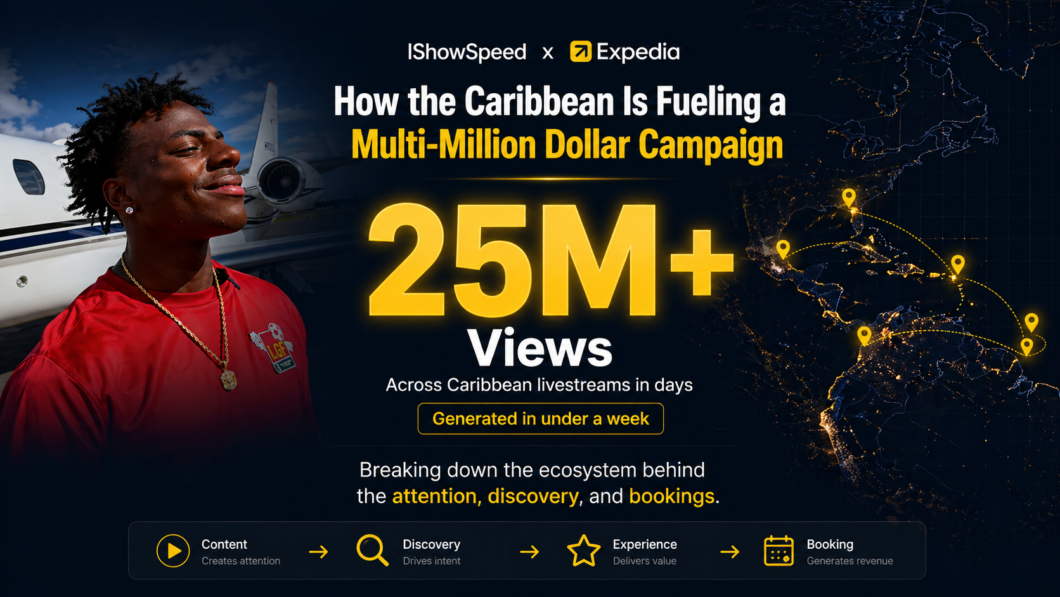
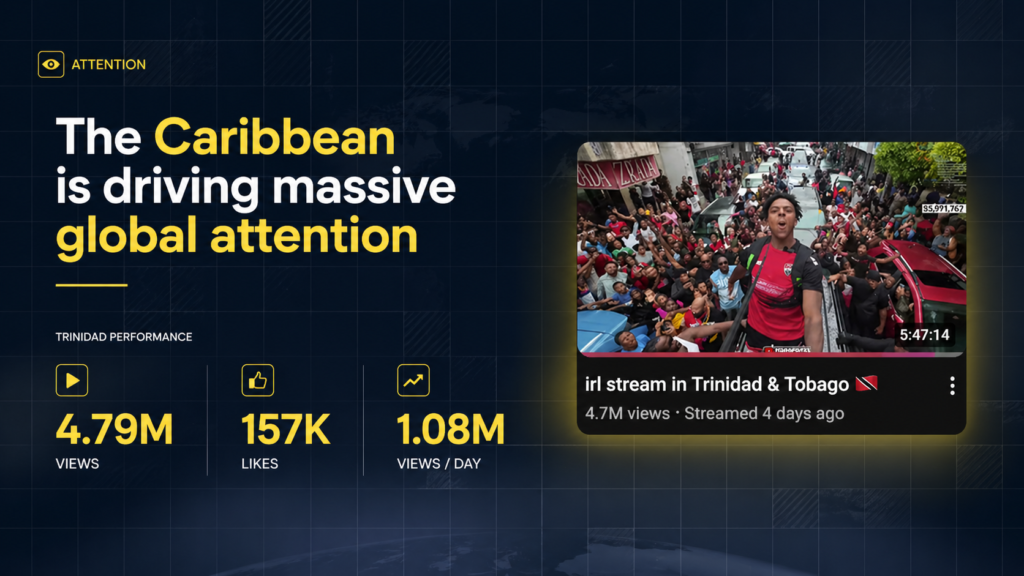
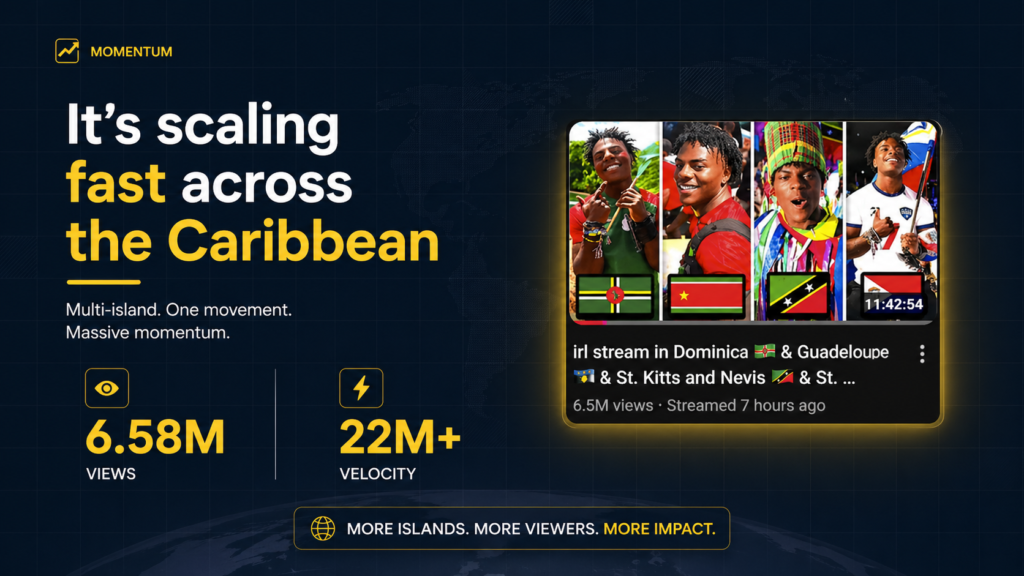
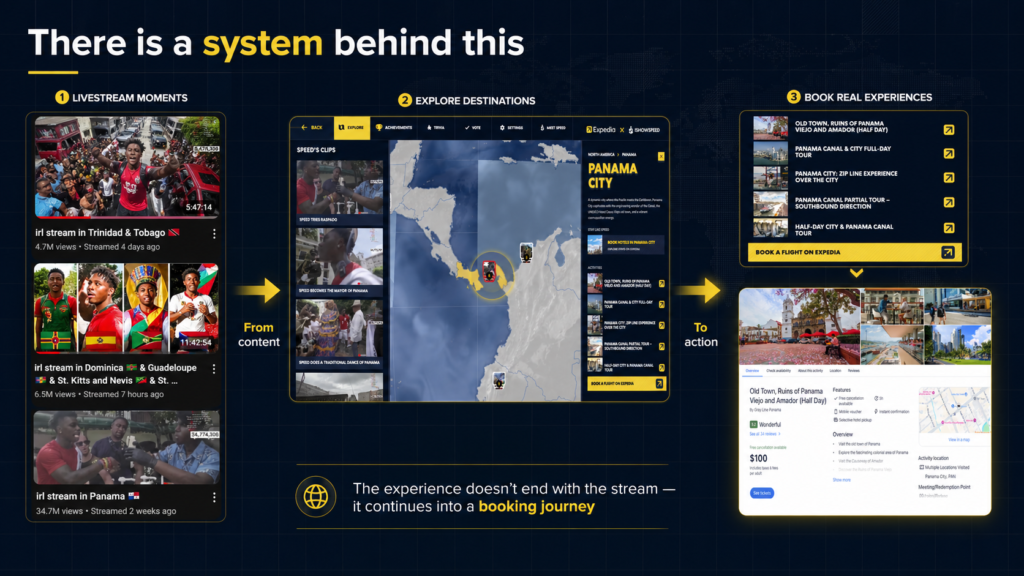
In just a few days, IShowSpeed has already pulled 4.7 million views in Trinidad, 4.2 million in Grenada, and over 6.5 million across Dominica, St. Kitts, and St. Maarten. That is tens of millions of people watching the Caribbean in real time.
This is not just a tour. It is a coordinated campaign between IShowSpeed and Expedia.
And the key point is this: the Caribbean is fueling it.
Every stream, every crowd, every cultural moment is generating the attention that powers this campaign. The region is not just the backdrop. It is the content engine driving the reach.
But what makes this different is what happens next.
Those moments are not left on social media. They are captured, mapped, and connected to a system built by Expedia. Viewers watch, get curious, and are guided toward destinations, activities, and booking pathways tied directly to what they just saw.
That is the shift.
What looks like exposure is actually input into a larger system. The Caribbean creates the demand. The campaign turns that demand into something structured, searchable, and ultimately monetizable.
That is what we are going to break down.
The Attention Layer: What the Numbers Actually Show
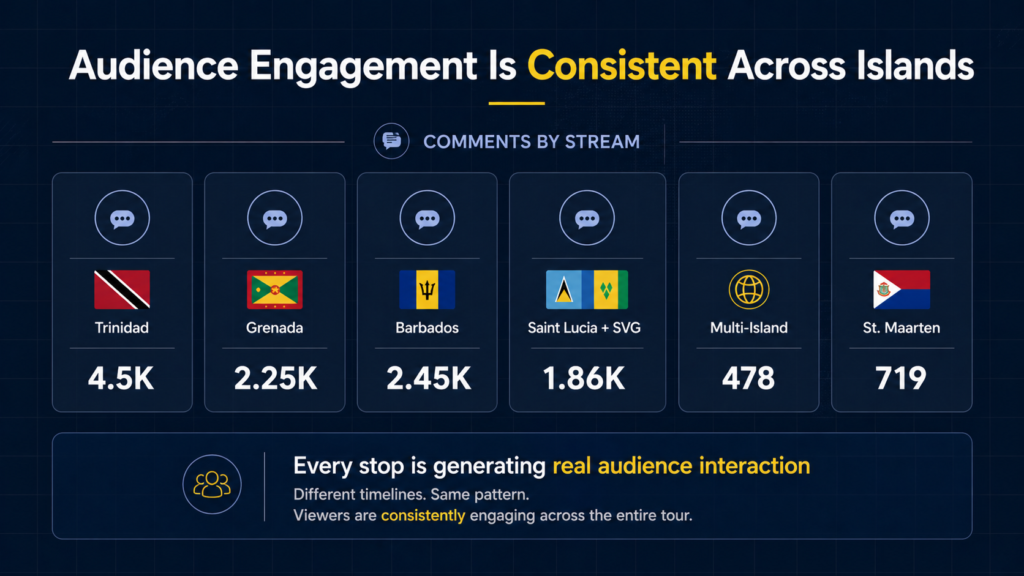
Between April 26th and April 30th, this campaign produced millions of views across multiple Caribbean islands — not from one video, but from a sequence of livestreams.
Here’s what that looks like when you line it up:
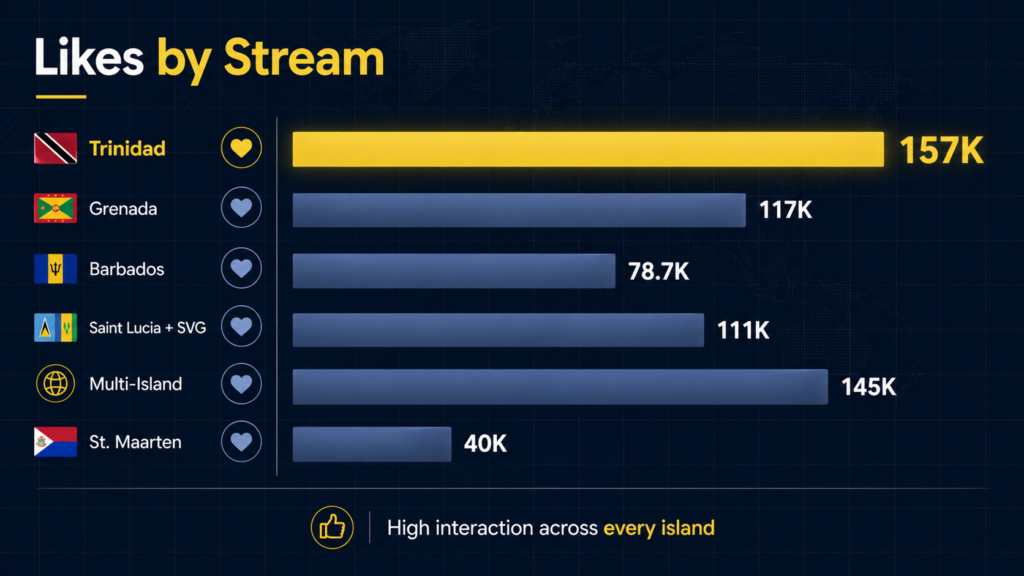
- Trinidad & Tobago: 4.79M views | 157K likes | 4.5K comments
- Grenada: 4.25M views | 117K likes | 2.25K comments
- Barbados: 3.03M views | 78.7K likes | 2.45K comments
- Saint Lucia & SVG: 4.79M views | 111K likes | 1.86K comments
- Multi-island stream: 6.57M views | 146K likes | 554 comments
- St. Maarten & St. Martin: 1.49M views | 40K likes | 719 comments
This is not one standout video.
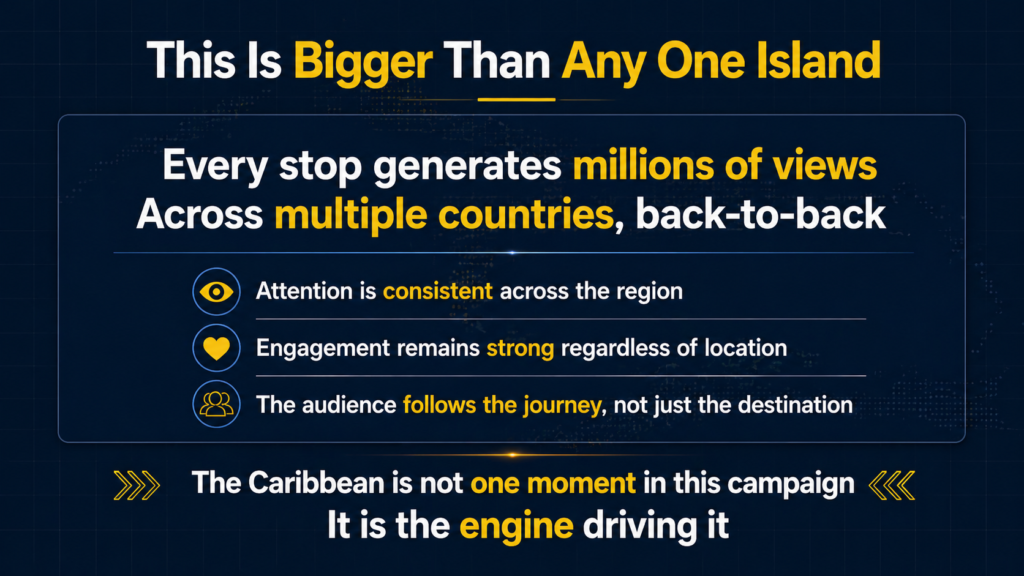
Every stop on the tour is pulling millions of views.
If you total just these streams, you’re already looking at over 24 million views in under a week — and that’s only counting the main livestreams, not clips, reposts, or algorithm distribution after.
Views Are High — But Engagement Confirms It
Views alone don’t tell the full story. People can click and leave.
So the next layer is engagement — likes and comments.
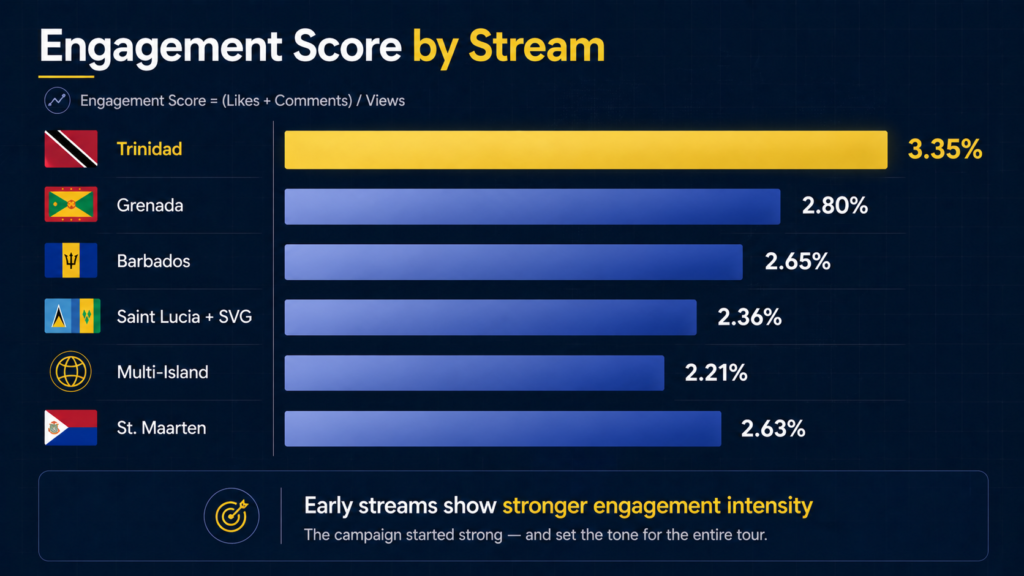
Across these streams, engagement stays within a tight range:
- Trinidad: 3.35% engagement score
- Grenada: 2.80%
- Barbados: 2.65%
- St. Maarten: 2.63%
- Saint Lucia: 2.36%
- Multi-island: 2.21%
That range matters.
It shows that no matter which island the stream is in, people are reacting at a similar rate.
This is not a situation where one country “carried” the campaign.
The audience response is consistent across the region.
Each Stream Plays a Different Role
Not every stream behaves the same way — and that’s by design.
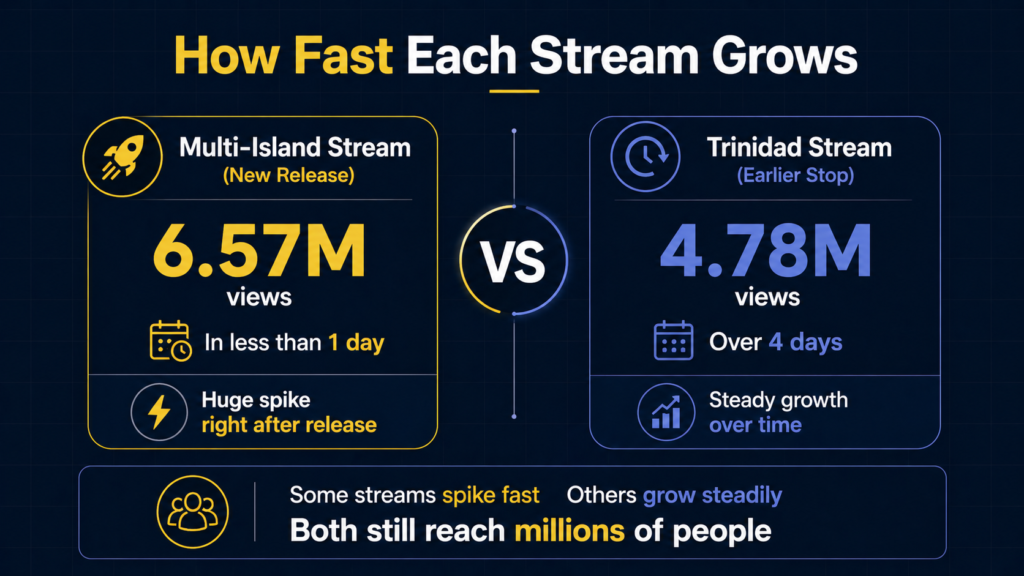
Some streams spike quickly.
- The multi-island stream passed 6.5M views in less than a day
Others build over time.
- Trinidad is sitting at 4.79M views after several days, continuing to grow
This tells you something important.
These streams are not competing with each other.
They are stacked.
A new stream brings in fresh attention.
Older streams continue accumulating views in the background.
So instead of one peak, the campaign creates a rolling wave of visibility.
One Post Shows How Deep This Goes
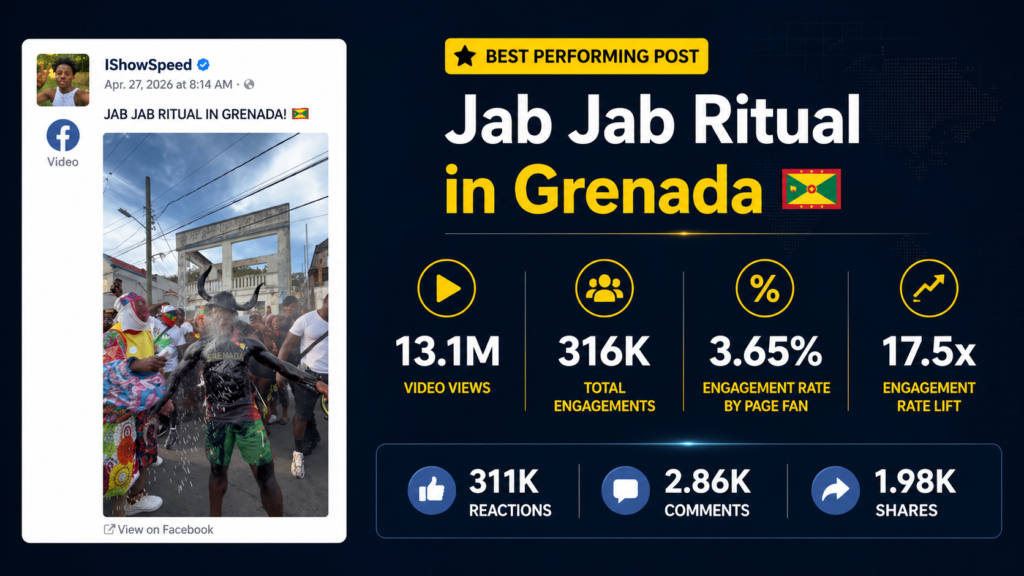
Beyond the livestreams, the clips coming out of them are doing serious numbers on their own.
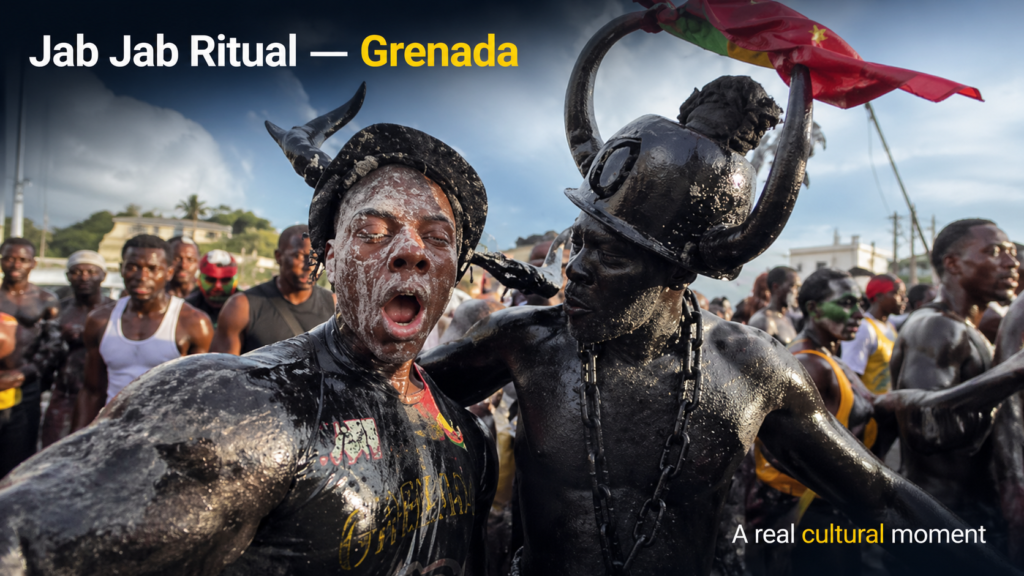
The Jab Jab ritual video from Grenada is the clearest example.
That one clip pulled 13.1 million views and generated 316,000 total engagements. That means hundreds of thousands of people didn’t just watch it—they reacted, commented, and shared.
Now look at the engagement rate: 3.65%.
At this level of reach, engagement usually drops. So holding above 3% at 13 million views tells you people stayed with the content and interacted with it.
The strongest signal is the 17.5x engagement lift.
That means this post performed over seventeen times better than what is normally expected from the page. That’s not average performance. That’s breakout.
And it came from a real moment. No production. No scripting. Just culture playing out in real time.
That’s the point.
This is one clip, from one island.
Now multiply that across multiple stops and multiple moments, and you start to see why the overall campaign is performing the way it is.
The livestream brings people in.
The clips push the strongest moments further.
And the moments that travel the furthest are the ones people can feel.
Platform Distribution Matters Too
Looking at total engagement across platforms:
- 1.38M total engagements
- YouTube: 1,049,897
- Facebook: 327,240
- Twitter: minimal
- Instagram/TikTok: not driving tracked engagement here
This shows where the audience is actually interacting.
YouTube is driving the core performance.
Facebook is amplifying it.
What This Section Actually Shows
When you step back and look at everything together:
- Multiple streams, each pulling millions of views
- Engagement rates staying consistent across countries
- Individual clips hitting double-digit millions
- Strong performance concentrated on specific platforms
This is not random.
The attention is steady, repeatable, and spread across multiple islands.
The Caribbean is producing the content, the reactions, and the moments people are watching.
The next question is where that attention goes once it leaves the stream.
The Content Layer: Why This Is Actually Working
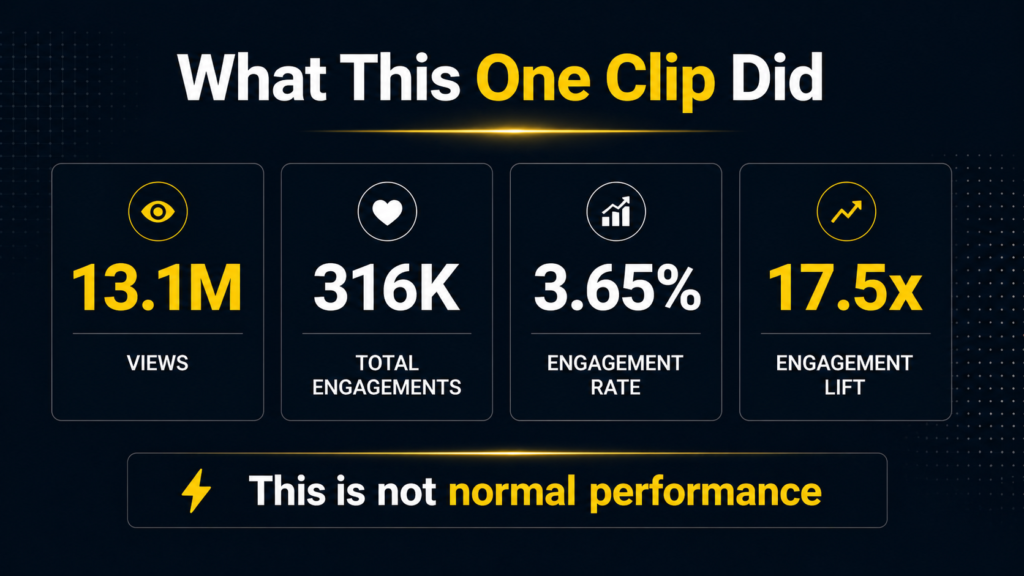
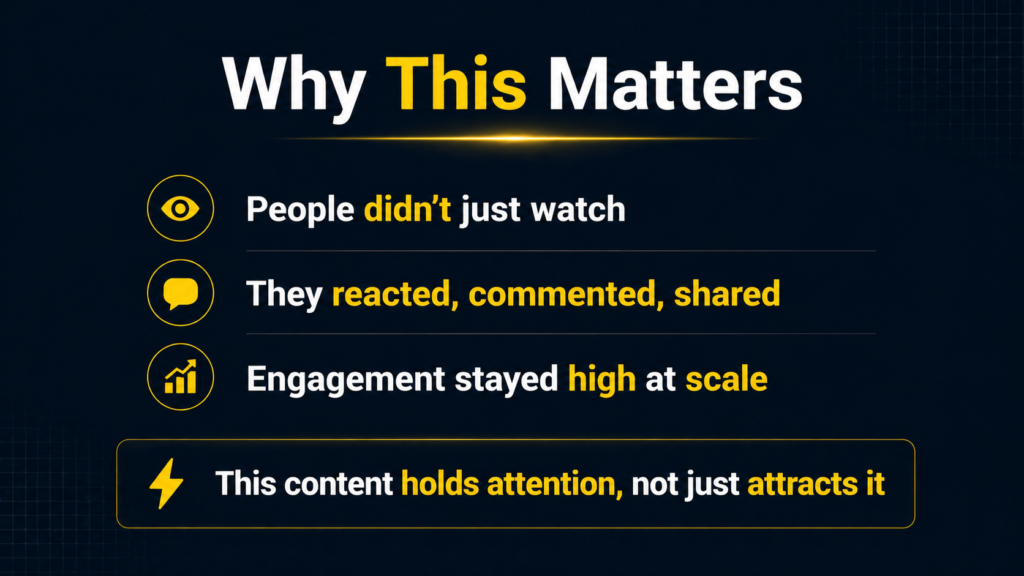
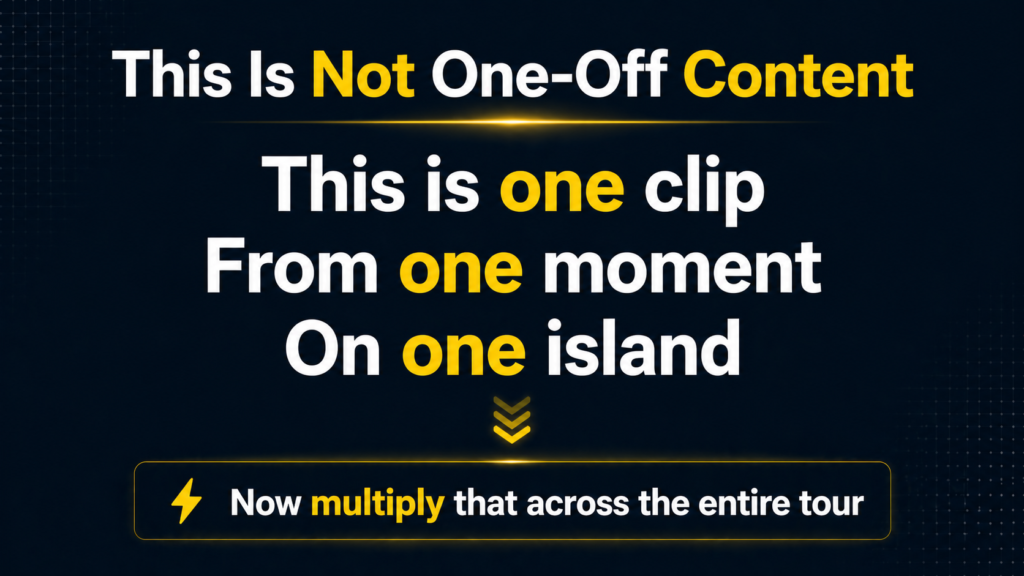
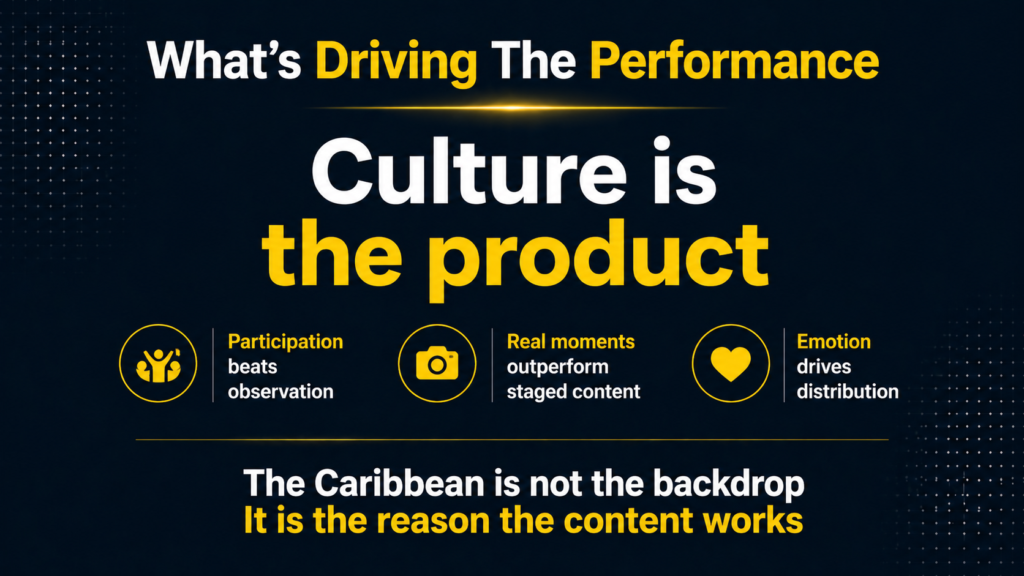
The performance of the Jab Jab video is strong on paper.
13.1 million views
316,000 interactions
3.65% engagement rate
17.5x lift over normal performance
But those numbers only tell part of the story.
The real signal is in the comments.
Scroll through them and a pattern shows up immediately.
People are not reacting like they are watching a travel video.
They are reacting like they are inside the moment.
The Comments
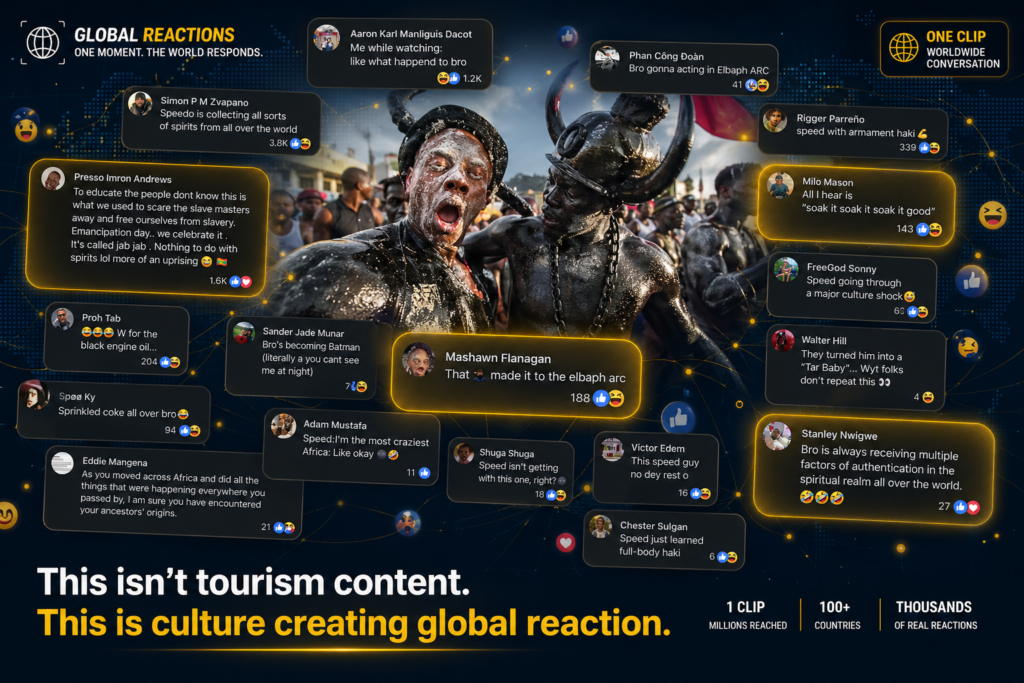
You see comments like:
“the raw experience”
“bro is going through a culture shock”
“they turned him into Batman”
“Speed just learned full-body haki”
“bro is oiled up”
Some are jokes.
Some are confusion.
Some are cultural references.
But all of them have one thing in common.
They are reacting to what is happening, not just where it is happening.
That matters.
Because most tourism content is built around location.
Beaches. Hotels. Landmarks.
This is built around experience.
Even the more serious comments point to the same thing.
People are trying to interpret what they are seeing.
They are referencing spirituality, rituals, African connections, Caribbean identity.
They are asking questions, making assumptions, debating in real time.
That level of response doesn’t happen with passive content.
It only happens when people feel like they are witnessing something unfamiliar, intense, or real.
And that is why this performs the way it does.
The engagement is not coming from production quality.
It is coming from cultural friction.
Speed is not positioned as a tourist.
He is positioned as a participant.
He is reacting in real time.
The crowd is reacting to him.
The audience is reacting to both.
That creates a loop.
Moment → Reaction → Amplification
And once that loop starts, the content moves on its own.
That is why one clip from one island can generate over 300,000 interactions.
Not because it was designed to perform.
But because it captured something people could not ignore.
And when you step back and look at the entire tour, the pattern becomes clear.
The strongest moments are not the cleanest ones.
They are the loudest, messiest, most culturally dense moments.
That is the product.
Not the destination.
Not the itinerary.
The moment.
And once that moment is captured, everything else in the system can start working.
That is what the next section is about.
out exact numbers.
It’s about how the system works.
A moment is created.
That moment gets turned into a product.
That product gets indexed.
And then it keeps getting discovered.
This is why the campaign doesn’t stop when the stream ends.
Because the infrastructure keeps running.
People who never watched IShowSpeed will still find that page.
They’ll still see the experience.
And some of them will still book.
That’s where the real value sits.
Not just in the attention.
But in what happens after.
The Expedia System: From Attention to Infrastructure
This Is Not a Landing Page
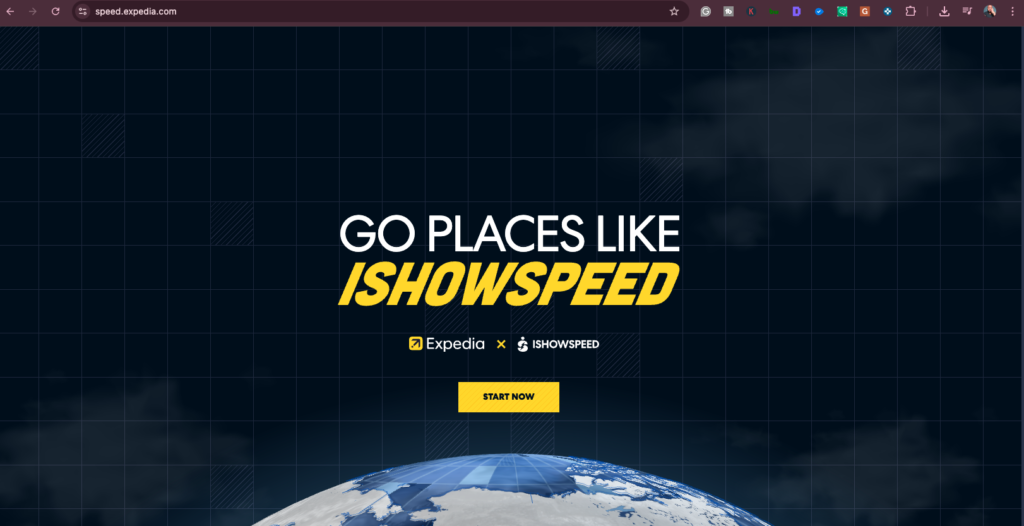
At first glance, speed.expedia.com looks like a campaign page. A place to watch clips, see where Speed has been, and explore destinations.
But once you move through it, it becomes clear this is not a typical landing page.
It’s a system designed to hold attention, organize it, and guide it somewhere.
Most campaigns push users outward. Watch the video, click a link, go somewhere else. This one does the opposite. It pulls everything inward and keeps the user inside one environment.
The Entry Point: Experience First, Not Search
The way users enter this system is different from traditional travel platforms.
Instead of starting with a search bar, the experience starts with the creator.
“Go Places Like IShowSpeed” reframes discovery. Users are not asking where to go. They are following where Speed has already been.
That shift removes friction. The journey is already curated.
You don’t need to think. You just explore.
The Discovery Engine: The Interactive Globe
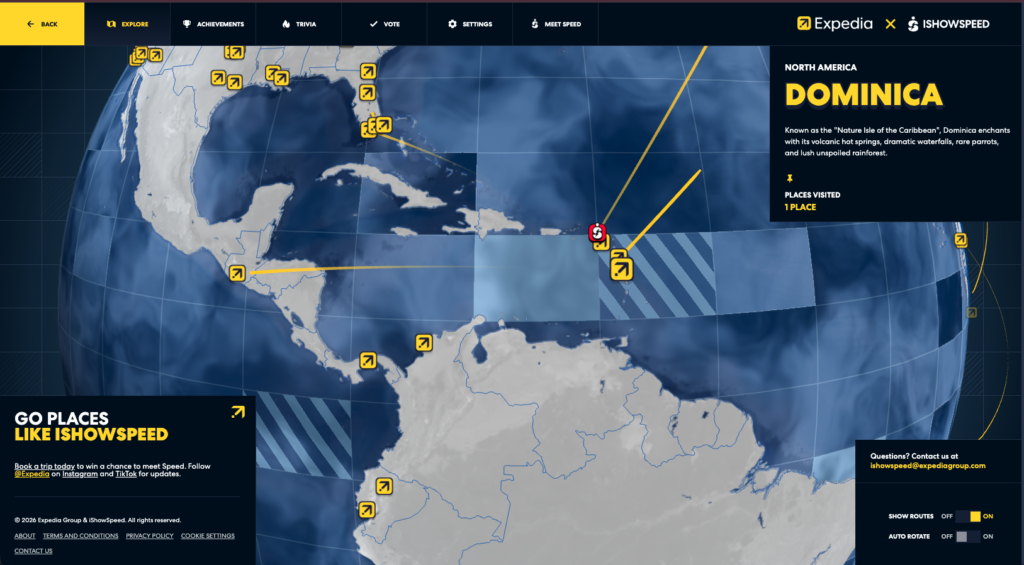
The interactive globe is where that exploration comes to life.
Instead of typing destinations, users move through them visually. Each pin represents a place Speed visited, turning geography into something interactive and intuitive.
This replaces traditional search behavior with guided discovery.
From Chaos to Structure: Destination Pages
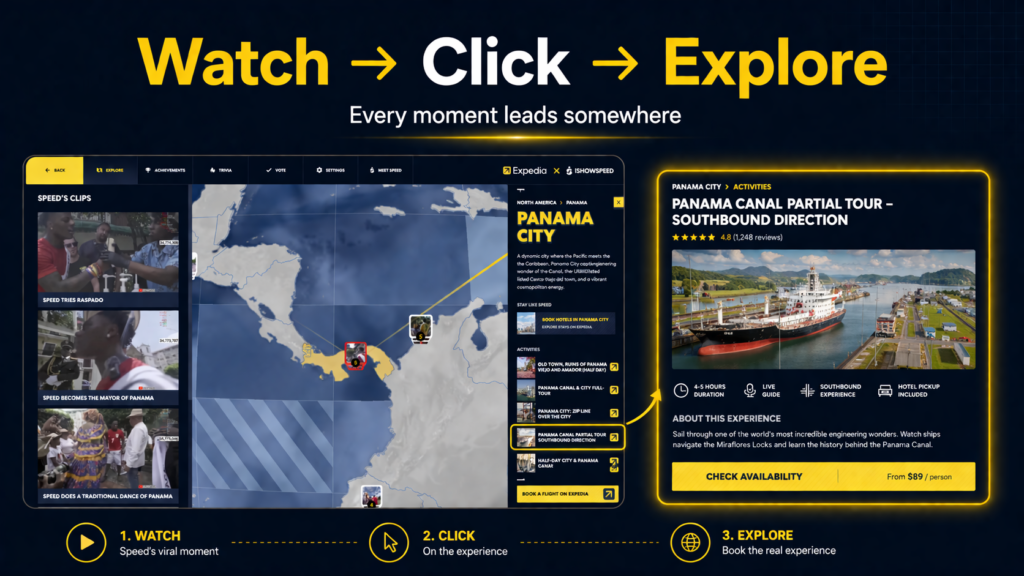
The livestream is fast, chaotic, and emotional. It’s not built for clarity.
The platform fixes that.
Once you click into a destination, everything becomes structured.
Clips are organized.
Locations are defined.
Experiences are grouped together.
What was a raw moment is now something you can understand and navigate.
Keeping Users Inside the System
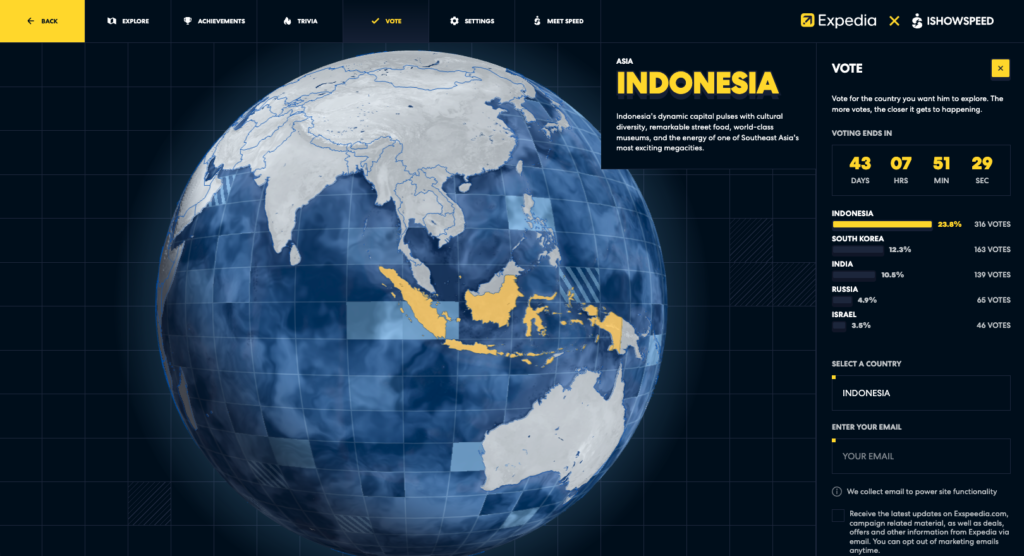
This is not just about showing content. It’s about holding attention.
Features like voting, trivia, and achievements are layered into the experience to keep users interacting.
Voting lets users influence where Speed goes next.
Trivia keeps them engaged with the destination.
Achievements add a sense of progression.
These features are not random additions. They increase time on site and deepen the user’s connection to the journey.
The Bridge to Action: Activities and Experiences
Then comes the most important transition.
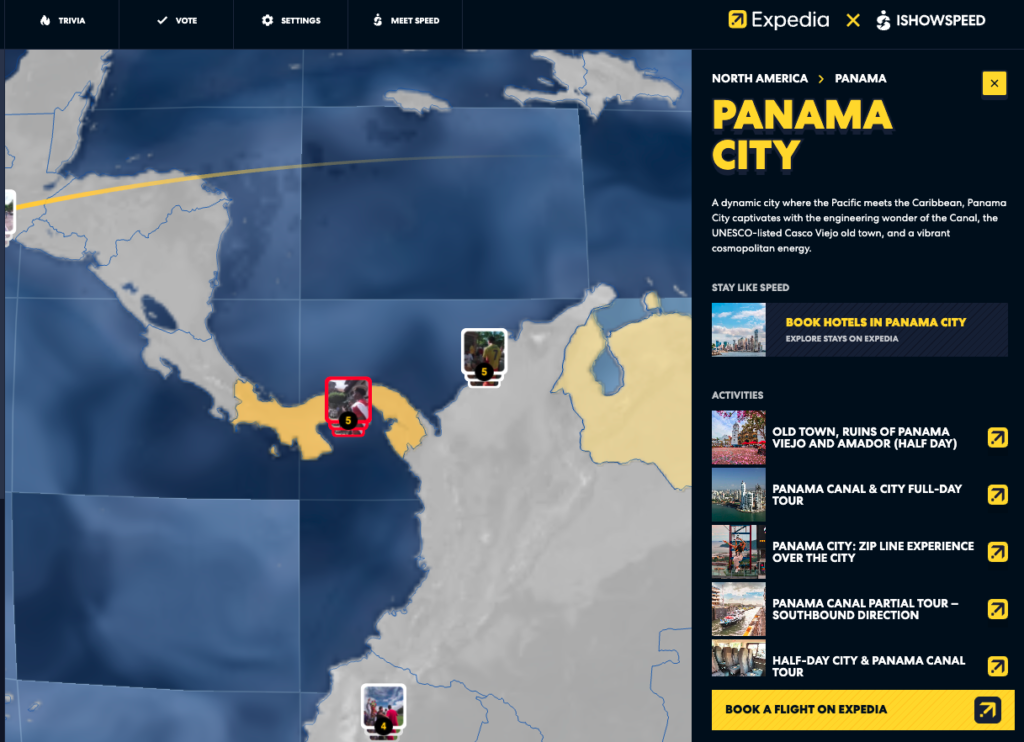
Under each destination, users are shown activities.
These are not generic listings. They are tied to the places and moments from the stream.
The experience you just watched becomes something you can do.
This is where content starts to move toward action.
Where It Becomes Real: The Experience Layer
This is where the system becomes tangible.
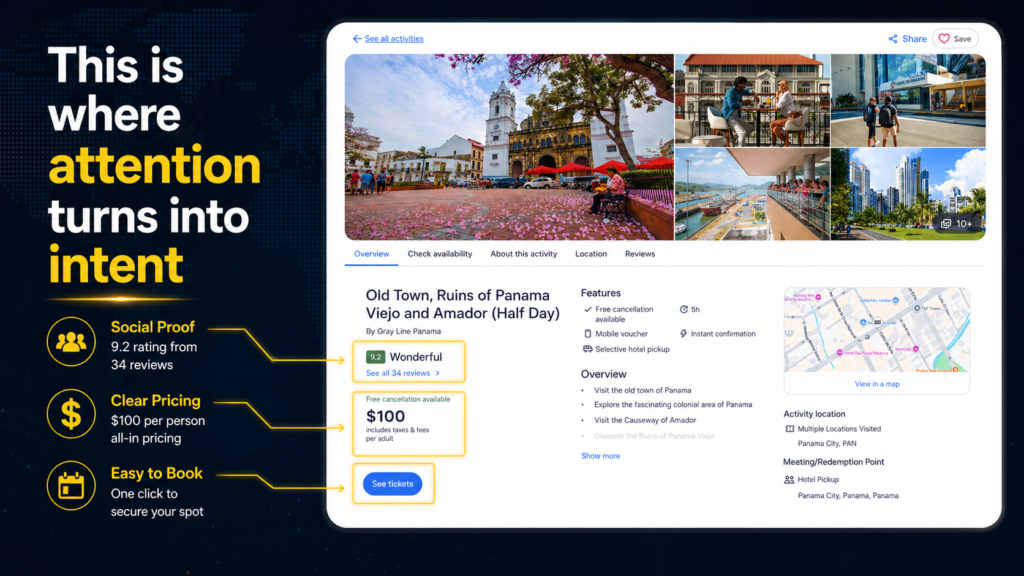
When you click into a specific activity, you leave the content layer and enter a decision layer.
Now you see:
- The exact experience
- The price
- The reviews
- The booking option
The moment you watched is now a product.
The Funnel: How a Livestream Becomes a Booking
The Old Travel Funnel vs What’s Happening Now
Traditionally, travel worked in steps.
You searched for a destination.
Compared options across multiple websites.
Read reviews.
Then eventually booked.
It was slow, fragmented, and required effort from the user.
What Expedia has done here is remove most of that friction.
The funnel has been compressed.
Step 1: Awareness — The Livestream
Everything starts with the livestream.
Speed is in the destination, interacting with people, experiencing culture, and reacting in real time. That creates the initial spark.
This is not polished content. It’s raw, unpredictable, and emotional. That’s why it works.
People are not just watching. They are reacting.
Step 2: Interest — The Microsite
Once attention is captured, the next step is not Google.
It’s the Expedia microsite.
Instead of leaving the experience and searching, users are pulled directly into a structured environment built around the stream.
They can:
- Rewatch moments
- Explore destinations
- Follow the journey
The interest is still emotional, but now it is contained.
Step 3: Consideration — Destination & Activities
From there, the user starts to explore more intentionally.
Destinations are mapped.
Experiences are grouped.
Activities are listed.
At this stage, the user is no longer just watching.
They are thinking:
“What would I actually do if I went there?”
This is where curiosity turns into consideration.
Step 4: Conversion — The Booking Page
This is where the shift becomes clear.
When a user clicks into an experience, they move into a buying environment.
Now they see:
- The price
- The reviews
- The booking button
Everything needed to make a decision is in front of them.
The emotional moment has now been packaged into a product.
Step 5: Retention — The System Doesn’t End at Booking
In most cases, booking would be the end.
Here, it’s just another step.
Once a user books through Expedia, the platform retains the relationship.
Through:
- Accounts
- Loyalty systems (OneKey)
- Future recommendations
The system doesn’t just capture one transaction.
It sets up the next one.
What This Funnel Actually Does
This funnel works because it removes the gaps.
There is no moment where the user has to stop and figure things out.
They don’t need to:
- Open new tabs
- Compare platforms
- Search manually
Everything is connected.
From Watching to Booking — In One Flow
If you step back, the journey is simple:
- Watch the moment
- Feel the experience
- Click into the system
- Explore the destination
- Choose the activity
- Book instantly
All inside one connected flow.
Why This Is So Powerful
The key difference is not just speed.
It’s continuity.
The emotional moment is never lost.
It carries all the way through to the booking.
That is what makes this funnel so effective.
The Vendor Layer: Why Local Businesses Should Be Paying Attention
Where the System Connects to the Real World
Up to this point, everything has been digital.
The livestream.
The content.
The platform.
The funnel.
But none of it matters unless it connects to something real.
That connection happens at the experience level.
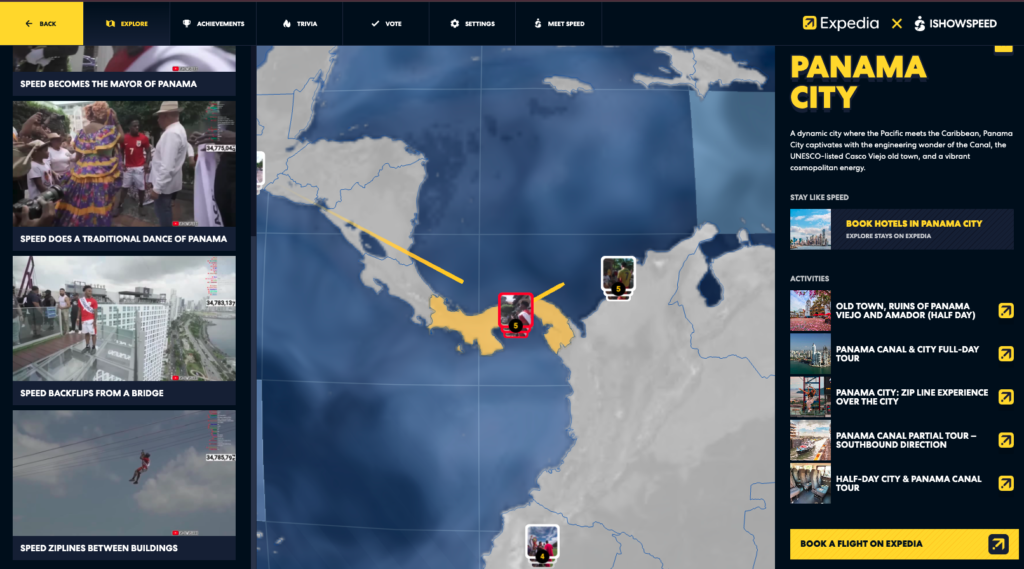
Check This Out: This is where demand is being directed. This is no longer about exploration — this is about where attention is landing geographically.
This Is the Layer Most People Miss
Most people watching this campaign see two players.
The creator driving attention.
The platform organizing it.
But there is a third layer sitting inside this system.
The vendor.
These are the businesses behind the experiences. Tour operators, guides, activity providers.
They are the ones fulfilling what gets booked.
From a Moment to a Product
When a user clicks deeper into the system, they stop browsing and start evaluating.
They are no longer watching what Speed did.
They are looking at something they can buy.
That’s the shift.
A moment from the livestream becomes a product inside the platform.
Where It Becomes Real: The Experience Page
This is the point where everything connects.
When you open a specific activity, you see:
- The exact experience
- The price
- The reviews
- The booking option
And most importantly, who is providing it.
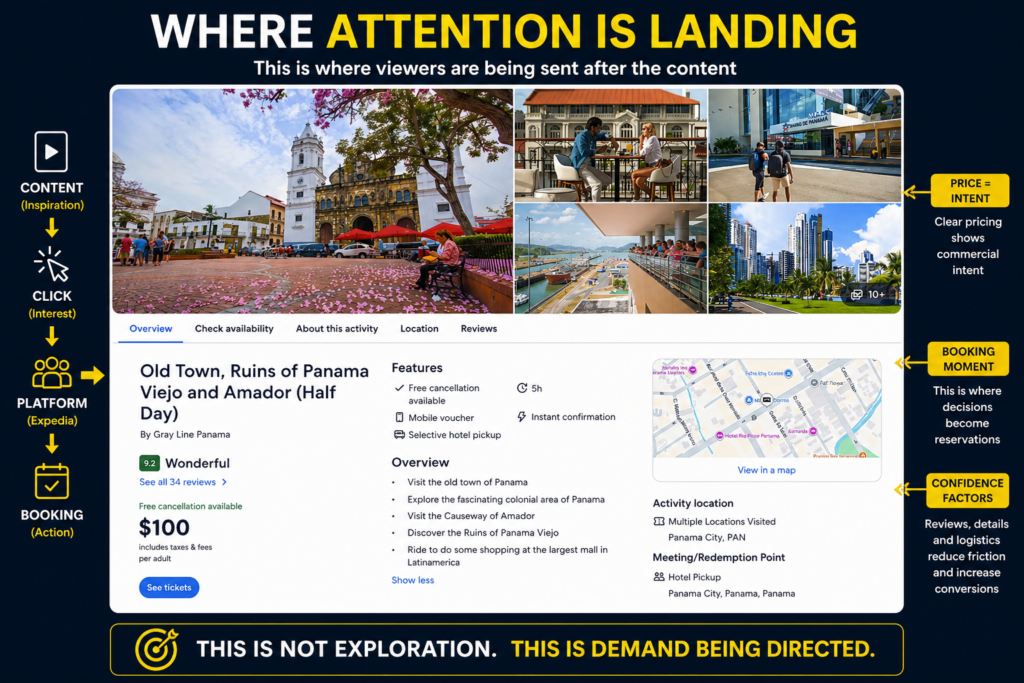
Purpose: There is a real business behind the listing. This is where attention turns into revenue for someone specific.
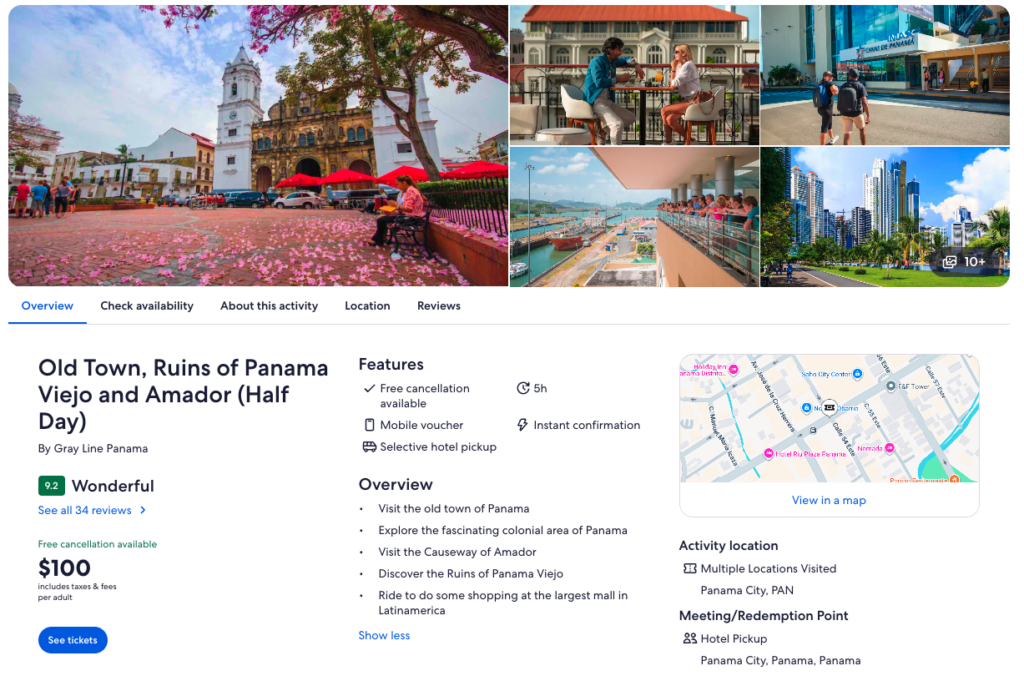
The Panama Example
Take one of the experiences listed under Panama.
Old Town, Ruins of Panama Viejo and Amador (Half Day)
It’s priced at around $100 and operated by Gray Line Panama.
That means every booking tied to that listing is not just a platform interaction.
It is money going to a specific operator.
A real business fulfilling a real experience.
What This Actually Changes
This is where the model shifts.
Businesses are no longer just competing for visibility on:
- Social media
- Walk-in traffic
They are now part of a structured system where demand is already being created.
The attention is not something they have to generate.
It is something they can position themselves inside of.
The New Supply Chain
What this campaign has built is a new flow:
The creator generates attention.
The platform captures and organizes it.
The vendor fulfills the demand.
If you are not inside that flow, you are not benefiting from it.
The Real Opportunity
The businesses listed are not guessing.
They are placed directly between:
👉 Attention → Action
That is where value is created.
Not at the content level.
Not at the awareness stage.
At the point where someone decides to book.
The Key Realization
Every viral moment has the potential to become a product.
But only for the businesses that are positioned to capture it.
7. Revenue Modeling: What Could One Experience Be Worth?
Turning Attention Into Numbers
By now, we’ve seen the full journey.
Millions of people watch the livestream.
A portion of them click into the Expedia system.
Some explore destinations.
Some land on specific experiences.
And a smaller group takes the final step.
They book.
Start With One Real Example
Let’s make this tangible.
From the Panama section of the campaign, one of the featured experiences is:
Old Town, Ruins of Panama Viejo and Amador (Half Day)
- Priced at around $100 per person
- Operated by Gray Line Panama
This is not a hypothetical product.
It is a real listing, tied directly to the campaign, inside the system.
What We Know From the Data
We don’t need to guess blindly.
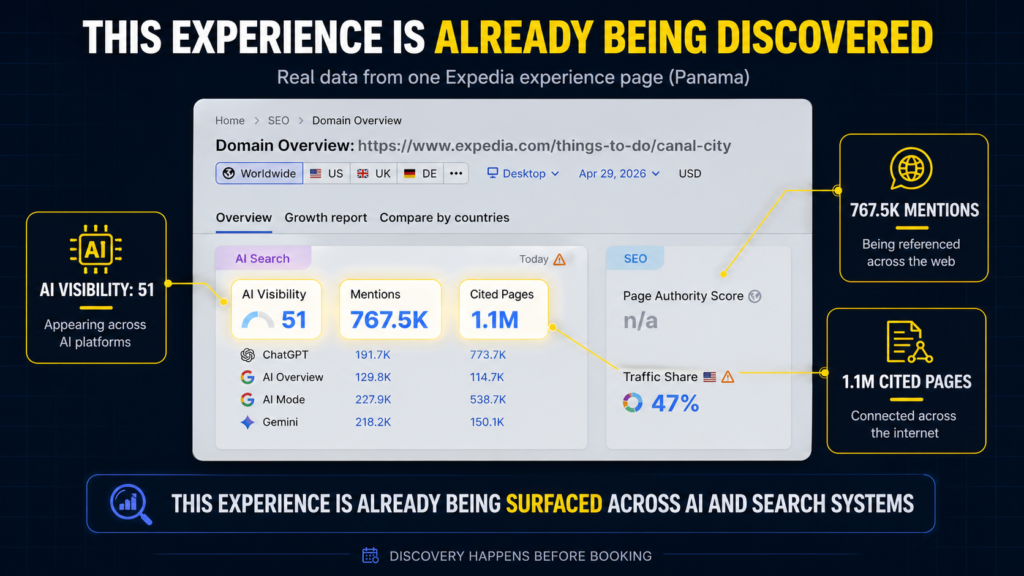
We already have signals from the page:
- AI Search Visibility: 51
- Mentions: 767.5K
- Cited Pages: 1.1M
This tells us one thing clearly.
Modeling Conservative Scenarios
Instead of starting with random booking numbers, let’s anchor the model to the actual discovery data.
For the Panama experience page, SEMrush shows:
- 767,500 mentions
- 1.1M cited pages
- AI Visibility score: 51
That does not mean 767,500 people visited the page. Mentions are not the same as traffic.
But it does tell us that this experience is showing up across AI and search discovery systems. So the question becomes: what happens if even a tiny fraction of that discovery turns into visits?
For this model, we’ll keep the assumptions conservative. We’ll assume only 0.25% to 1% of those mentions translate into visits to the experience page.
Scenario 1: Very Conservative
If 0.25% of 767,500 mentions turn into visits:
767,500 × 0.25% = 1,919 visits
If 1% of those visitors book:
1,919 × 1% = 19 bookings
At $100 per ticket:
19 bookings × $100 = $1,900
This is the low-end case. Even with a tiny click-through estimate and a low booking rate, the page still creates revenue from discovery.
Scenario 2: Conservative
If 0.5% of mentions turn into visits:
767,500 × 0.5% = 3,838 visits
If 2% of visitors book:
3,838 × 2% = 77 bookings
At $100 per ticket:
77 bookings × $100 = $7,700
This is still conservative. A 2% conversion rate is not wild for a travel booking environment, especially when the user is already looking at a specific experience.
Scenario 3: Strong but Still Believable
If 1% of mentions turn into visits:
767,500 × 1% = 7,675 visits
If 3% of visitors book:
7,675 × 3% = 230 bookings
At $100 per ticket:
230 bookings × $100 = $23,000
This is not a fantasy number. It uses a small click-through assumption and a conversion rate still within normal travel booking ranges.
What This Shows
The point is not that this exact experience made these exact amounts.
The point is that the system has a clear revenue path.
A cultural moment creates attention. Expedia turns that attention into a structured page. AI and search systems surface that page. A small percentage of people click. A smaller percentage book.
That is how discovery becomes money.
And this is only one page, for one experience, in one destination. Now imagine the same model across multiple experiences, multiple cities, multiple islands, and multiple months.
8. AI Search + SEO Layer: The Long-Term Value
This Doesn’t End When the Campaign Ends
Most campaigns have a lifespan.
They launch.
They trend.
They fade.
Once the content stops being pushed, the attention drops off.
But this campaign is built differently.
Because every destination, every clip, and every experience is being placed inside a system that search engines and AI tools can access, index, and surface over time.
From Content to Searchable Assets
Every stop on Speed’s journey is not just content.
It becomes:
- A destination page
- A set of experiences
- A group of indexed listings
- A network of references across the web
This is what turns a moment into something that lasts.
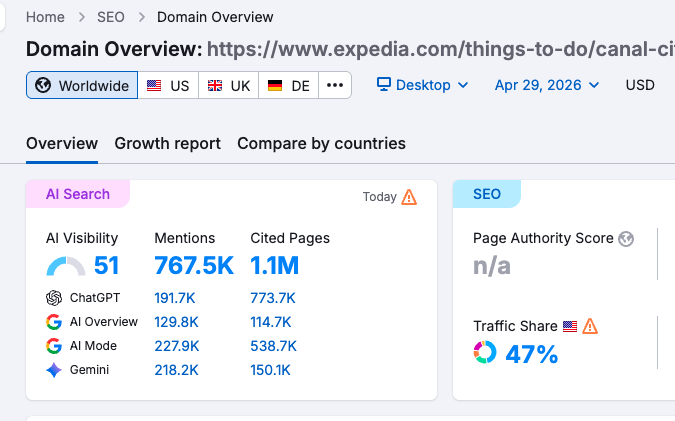
👉 Insert Image Here: SEMrush screenshot (AI Visibility, Mentions, Cited Pages)
Purpose: Show that the experience page is already being surfaced across AI and search systems.
What AI Search Changes
Traditional SEO was about ranking on Google.
Now, discovery is happening across:
- ChatGPT
- Google AI Overviews
- Gemini
- Other AI assistants
These systems don’t just list links.
They pull, summarize, and recommend.
And they pull from pages that are:
- Structured
- Referenced
- Connected across the web
That’s exactly what Expedia has built.
Why This Matters for This Campaign
When someone asks:
- “What to do in Panama?”
- “Best experiences in the Caribbean”
- “Things to do like IShowSpeed”
AI systems are now capable of pulling from pages like these.
That means the experience is no longer tied to the livestream.
It becomes part of ongoing discovery.
The Compounding Effect
This is where the real value sits.
The livestream creates the spike.
But search and AI create the tail.
The page:
- Stays indexed
- Continues to get referenced
- Remains discoverable over time
That means traffic doesn’t stop.
It shifts from:
👉 real-time attention
to
👉 ongoing discovery
From Campaign to Infrastructure
This is the difference between:
Running a campaign
and
building something that compounds
Expedia is not just capturing attention in the moment.
They are turning it into searchable infrastructure that continues to generate value.
Why Most Businesses Miss This
Most businesses focus on the front end:
- Posting content
- Getting views
- Driving engagement
But they don’t think about where that content lives after it’s posted.
If it’s not structured, indexed, and connected…
It disappears.
The Key Shift
The real advantage is not just in creating attention.
It’s in making sure that attention can be found again.
What This Section Proves
The value of this campaign is not just in its reach.
It’s in its durability.
The content is not just being consumed.
It is being stored, referenced, and resurfaced across AI and search systems.
9. The Caribbean Value Gap: Attention Without Ownership
The Attention Is Real
Across this campaign, one thing is clear.
The Caribbean can command global attention.
Millions of people are watching.
Engaging.
Reacting to the culture, the energy, the moments.
That part is not in question.
But Attention Is Not Ownership
Attention feels powerful.
But on its own, it does not create value.
Value is created when attention is:
- Captured
- Structured
- Positioned
- Converted
That is where the shift happens.
Who Creates the Moment
The culture is coming from the Caribbean.
The people.
The rituals.
The music.
The energy in the streets.
That is what drives the content.
That is what makes the livestreams work.
Who Captures the Value
But when you follow the journey past the moment, the structure changes.
The platform organizes the experience.
The listings sit inside their system.
The discovery happens through their infrastructure.
And the bookings flow through their ecosystem.
Where the Gap Exists
This is where the value gap shows up.
The Caribbean is generating the attention.
But it does not control:
- The platform
- The discovery layer
- The booking system
- The data behind the transactions
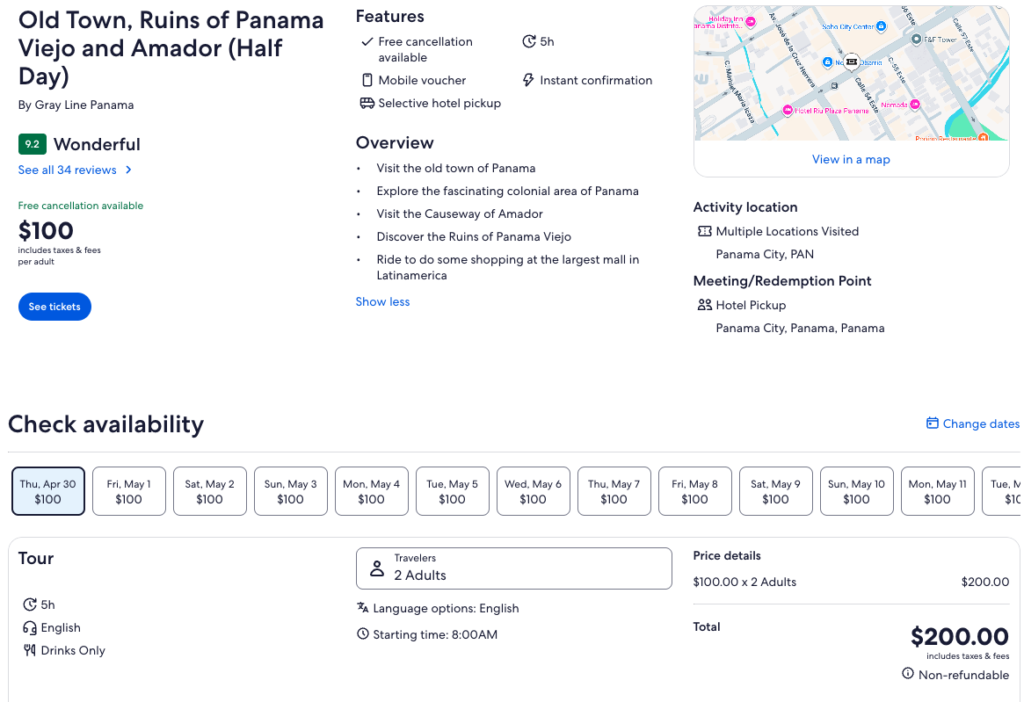
The transaction is happening inside a platform-owned environment.
Why This Matters
When a user books an experience, the revenue does not just flow to the vendor.
It flows through the platform.
That means:
- The platform captures the customer
- The platform owns the data
- The platform controls the distribution
Even when the experience itself is local.
The System Is Designed This Way
This is not a mistake.
It is how modern digital ecosystems are built.
The entity that owns:
- Discovery
- Distribution
- Transactions
captures the majority of the long-term value.
What This Means for the Caribbean
The region is not lacking in culture or demand.
It is lacking in ownership of the systems that capture that demand.
Without that ownership:
- Attention becomes temporary
- Value leaks outward
- Opportunities are missed
The Real Shift
This is not about stopping platforms.
It’s about understanding where value is created.
And deciding where to participate.
The Key Realization
The Caribbean is not just being seen.
It is fueling a system.
But the system is owned elsewhere.
10. The Immediate Playbook: What Caribbean Businesses Should Do Now
The Opportunity Is Already Here
You don’t need to wait for another campaign.
The demand already exists.
The platforms are already built.
The discovery systems are already working.
People are watching.
People are searching.
People are booking.
The only question is whether your business shows up when that happens.
Step 1: Get Inside the Booking Platforms
If your experience is not listed, it does not exist at the moment of decision.
You need to be present where transactions happen:
- Expedia
- GetYourGuide
- Viator
- Airbnb Experiences
This is where users go from interest to booking.
If you’re not there, you’re invisible when it matters most.
Step 2: Build Experiences That Match Demand
The content already showed us what performs.
Not generic tours. Not passive sightseeing.
What works:
- Cultural participation
- Street-level interaction
- Food, music, real moments
- Energy people can feel
If your experience doesn’t translate into something engaging and shareable, it won’t benefit from this type of demand.
Step 3: Become Feature-Worthy
Being listed is not enough.
The platform decides who gets seen.
That comes down to:
- High-quality images
- Strong reviews
- Clear descriptions
- Reliable operations
This is what determines ranking and visibility inside the platform.
Step 4: Capture Your Own Content
Do not rely on creators to tell your story.
You need your own content layer.
Document:
- Real experiences
- Real people
- Real interactions
This feeds:
- Social platforms
- Search engines
- AI systems
The more your experience exists online, the more discoverable it becomes.
Step 5: Own Your Discovery Layer (Maps + Search + AI)
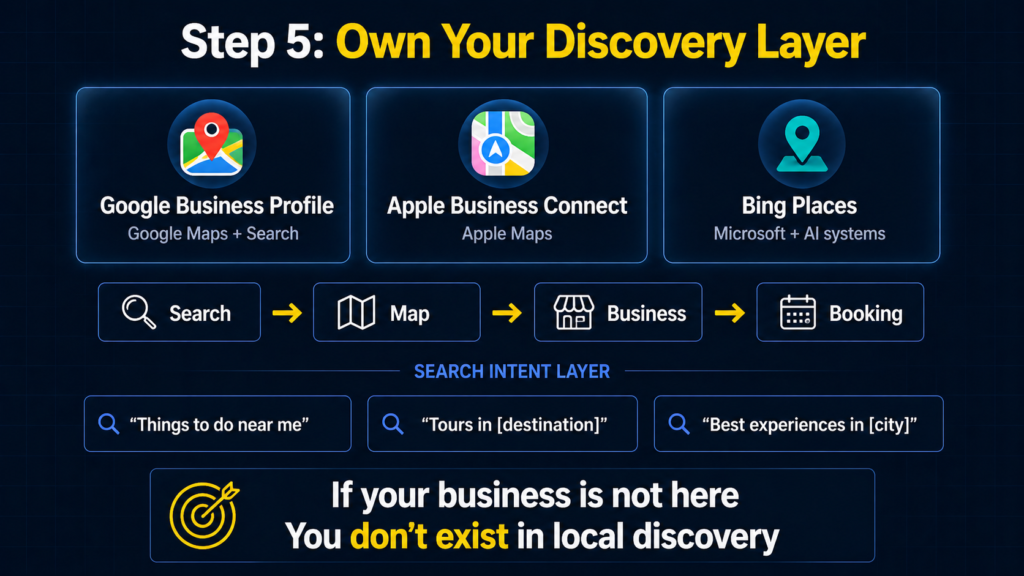
This is where most businesses fall apart.
Even if you’re on booking platforms, you also need to show up in search and maps.
That means setting up and optimizing:
- Google Business Profile (Google Maps + Search)
- Apple Business Connect (Apple Maps)
- Bing Places (Microsoft ecosystem + AI tools)
These are not optional.
They are where people go when they search:
- “Things to do near me”
- “Tours in [destination]”
- “Best experiences in [city]”
If your business is not there, you don’t exist in local discovery.
What You Need to Get Right
- Accurate business name and category
- Clear description of your experience
- Updated photos and videos
- Reviews and ratings
- Location properly pinned
This is what feeds:
👉 Google results
👉 Map results
👉 AI-generated answers
Why This Matters Now
AI tools are pulling from these sources.
If your business is not structured inside:
- Apple Maps
- Bing
Then you won’t appear in:
- AI recommendations
- Search summaries
- “Top things to do” results
Step 6: Think Beyond the Moment
A viral moment creates a spike.
But structured discovery creates consistency.
When your experience is:
- Listed on platforms
- Indexed in search
- Present in maps
- Referenced across the web
It continues to generate demand over time.
What This Playbook Really Means
You do not need to build the system.
You need to position yourself inside it.
The Shift
From:
- Waiting for customers
- Relying on foot traffic
- Hoping for exposure
To:
- Being searchable
- Being visible
- Being bookable
The Final Takeaway
The Caribbean is already driving attention.
The businesses that benefit will be the ones that:
👉 show up in the right systems
👉 meet the platform standards
👉 and are ready when demand arrives
11. What Tourism Boards Should Learn
This Is a Blueprint — But You Have to Understand the Build
It’s easy to say tourism boards should “think like Expedia.”
But that only works if we actually understand what Expedia built.
Because this is not just a campaign page.
It is a structured system made up of specific components that guide the user from content to booking.
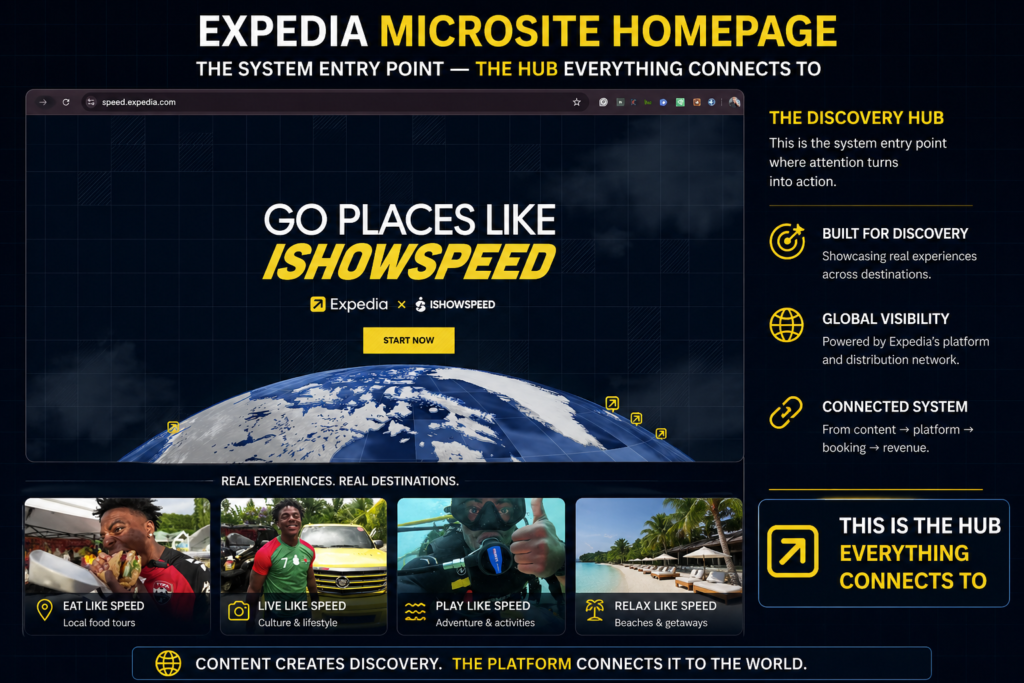
This is the entry point to the system — this is the “hub” everything connects to.
The Homepage Is the Entry Point
The first thing you notice is how the journey starts.
Not with a search bar.
Not with filters.
But with:
👉 “Go Places Like IShowSpeed”
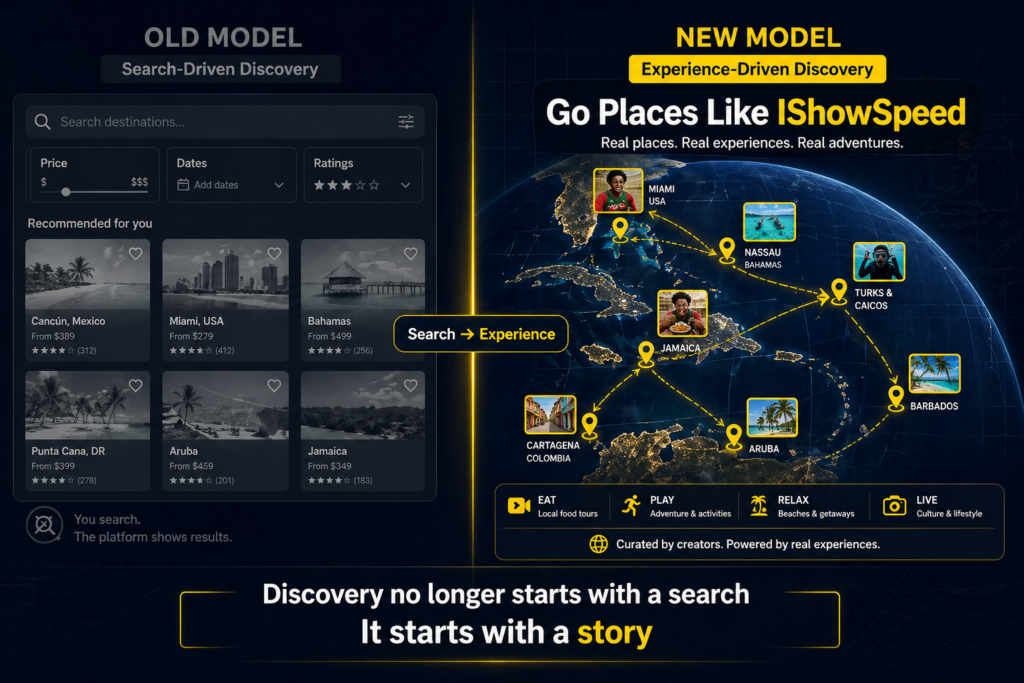
The creator is the entry point.
This immediately shifts discovery from:
Search-driven → Experience-driven
Tourism boards can replicate this by:
- Centering real experiences
- Leading with story, not just location
The Globe Turns Travel Into Exploration
One of the most important features of the microsite is the interactive globe.
This is not just design.
It changes behavior.
Instead of typing:
“Things to do in Barbados”
Users click, explore, and follow the journey visually.
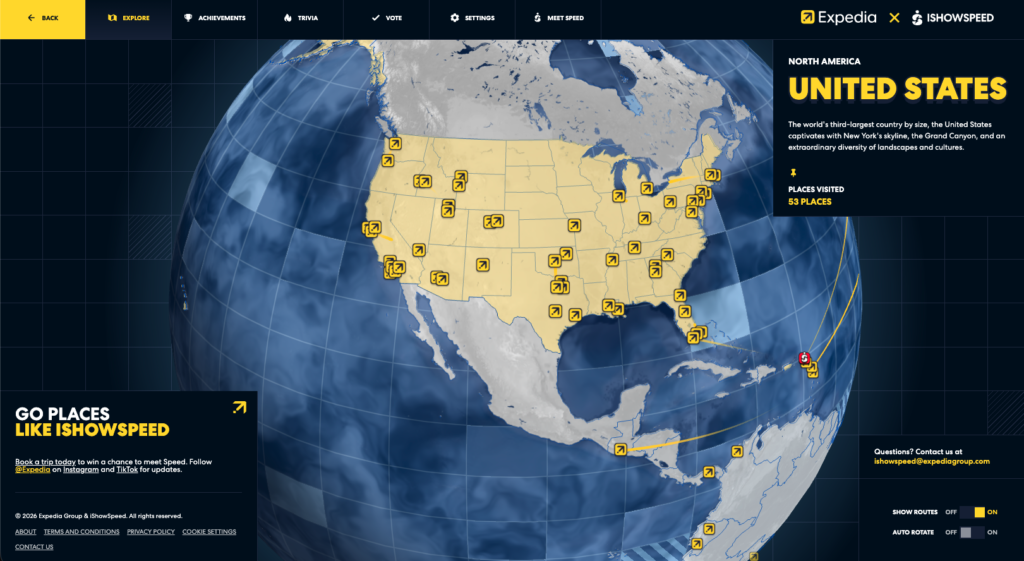
👉 Insert Image Here: Interactive globe with multiple pins
Purpose: Show how discovery is happening through navigation, not search.
Destination Pages Organize the Chaos
Once you click into a destination, everything becomes structured.
The livestream content is broken down into:
- Specific locations
- Moments
- Experiences
What was chaotic on stream becomes:
👉 Clear, organized, and navigable
This is critical.
Because users can now understand what they saw.
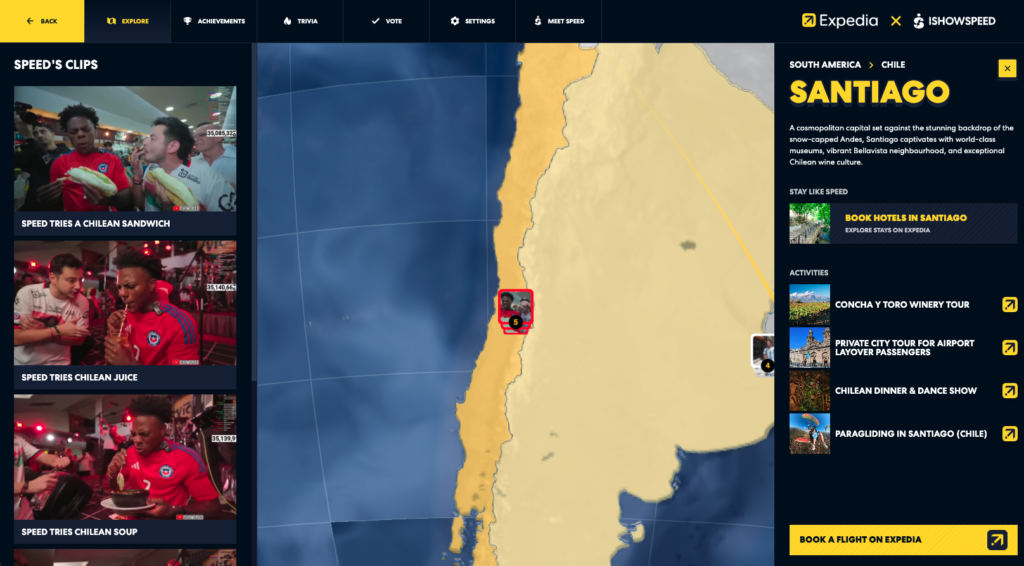
The destination page (clips + map + layout visible).
Do you see how raw content is turned into structured information?
The Content Is Embedded — Not External
Another key detail:
The content does not live outside the platform.
It is embedded directly into the experience.
Users can:
- Watch clips
- Revisit moments
- Stay inside the system
There is no need to leave and search elsewhere.
That’s intentional.
Engagement Features Keep Users Inside
The microsite doesn’t just show content.
It makes users interact with it.
Features include:
- Voting on where Speed should go next
- Trivia about destinations
- Achievement-style interactions
These are not random.
They are designed to:
👉 Increase time on site
👉 Build emotional connection
👉 Keep users engaged longer
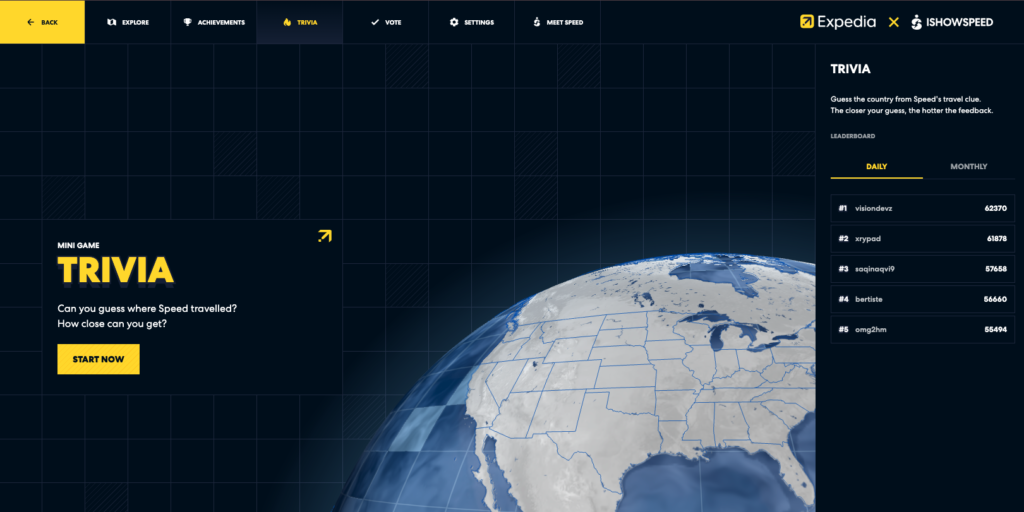
Show this is interactive, not passive browsing.
Experiences Are Integrated Directly Into the Journey
Under each destination, users are shown experiences.
Not generic ones.
Experiences tied to:
👉 What Speed did
👉 Where he went
👉 What people reacted to
This is where the system transitions from:
Content → Action
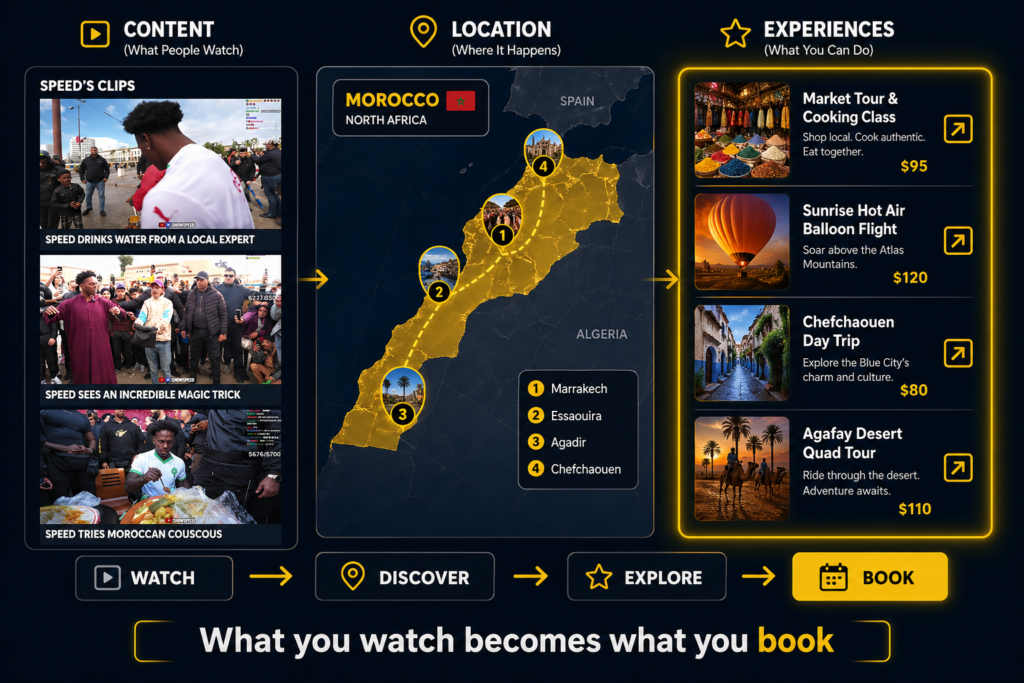
👉 Insert Image Here: Experience listing (tied to destination)
Purpose: Show how content is directly linked to bookable activities.
This Is the Real Lesson
Tourism boards don’t need to copy Expedia.
But they need to understand this structure.
Because what Expedia built is not just a campaign.
It is a system that:
- Captures attention
- Organizes it
- Keeps users engaged
- Connects it to booking
What Tourism Boards Should Actually Do
Instead of just running campaigns, they should be building:
1. A Content Hub
- Central place for creator-led experiences
2. A Discovery Layer
- Interactive, visual, easy to explore
3. A Structured Experience Layer
- Clear, organized listings of what to do
4. A Conversion Layer
- Direct paths to booking
The Opportunity for the Caribbean
The region already has what matters:
👉 Culture
👉 Energy
👉 Experiences people want
What’s missing is this:
👉 Structure
The ability to take those moments and turn them into something:
- Discoverable
- Organized
- Bookable
The Key Realization
Tourism boards don’t need to guess what to do.
They just need to understand what has already been built.
Conclusion: The Future of Travel Is Creator-Led, Searchable, and Bookable
This Is Where Travel Is Going
What we’ve just walked through is not a one-off campaign.
It’s a signal.
A shift in how travel is discovered, experienced, and ultimately purchased.
The old model separated everything.
Content lived on social media.
Discovery happened on search engines.
Booking happened on travel platforms.
Users had to move between all three.
That friction is disappearing.
The New Model Is Connected
In this new model, everything sits inside one flow.
A creator drives attention.
A platform captures and structures it.
Experiences are organized around that attention.
Bookings happen without breaking the journey.
Nothing is disconnected.
The moment you watch becomes the moment you consider.
And the moment you consider becomes the moment you act.
Creator-Led Discovery
Discovery is no longer starting with search.
It’s starting with people.
Creators are now:
- The entry point
- The filter
- The curator of experiences
People are not asking “Where should I go?”
They are asking:
👉 “Where did they go?”
👉 “What did they do?”
👉 “How can I do the same thing?”
That changes everything.
Searchable Infrastructure
But attention alone is not enough.
What makes this model powerful is what happens after the moment.
Every experience is:
- Structured
- Indexed
- Referenced
- Discoverable across AI and search systems
That means the value doesn’t disappear when the content ends.
It compounds.
Bookable by Design
This is the final layer.
Everything in the system is designed to lead to one outcome:
👉 Booking
Not indirectly. Not eventually.
Directly.
- Experiences are clearly defined
- Prices are visible
- Booking is immediate
There is no gap between interest and action.
What This Means for the Caribbean
The Caribbean does not have an attention problem.
It has a structure problem.
The culture is there.
The experiences are there.
The demand is clearly there.
What’s missing is the system that connects it all.
The Opportunity
This is not about competing with Expedia.
It’s about understanding the model.
And deciding how to position within it.
Because the future will not reward:
- The most content
- The most views
- The most noise
It will reward:
👉 The best structured experiences
👉 The most discoverable systems
👉 The businesses ready to capture demand
The Final Thought
Travel is no longer just about where you go.
It’s about how you discover it.
And increasingly, that discovery is:
👉 Creator-led
👉 Searchable
👉 Bookable
All at once.
If you’re looking at this and realizing your business isn’t part of the system yet, that’s the gap we fix.
I help businesses move from content and visibility to structured discovery and real bookings.
Book a Digital Strategy Session:
1 on 1 Digital Strategy Session