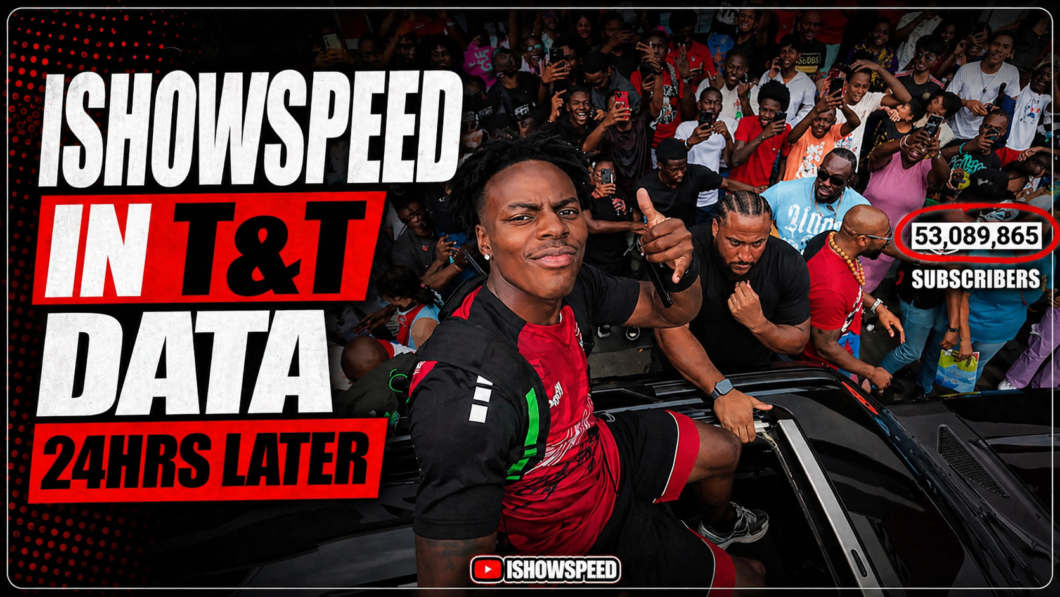
When moments like this happen, I pay attention.
Not to the noise. To the signals.
One of the biggest content creators in the world, IShowSpeed, just kicked off his Caribbean tour in Trinidad & Tobago. Millions tuned in, timelines lit up, and for a global audience, this may have been their first real exposure to the country.
That visibility matters.
But attention alone is surface level.
The real question is what people do next.
Do they go to Google?
Do they ask questions in ChatGPT or Gemini?
Do they try to understand the country they just saw on screen?
That is what I wanted to look at.
This article is not a critique. It is not a takedown. And it is definitely not dismissing the scale of what just happened.
This is simply me doing what I always do in my own time…
looking at the data when big moments happen and studying the digital behavior that follows.
So in this breakdown, we are going to walk through:
- The actual performance of the livestream
- What people searched for in the first 24 hours
- How discovery played out across Google and AI platforms
- And what this tells us about attention vs intent
Because awareness is one thing.
But what people do next is where the real story lives.
If you haven’t checked out the stream and would like too, here you go:
Now, let’s get into the data.
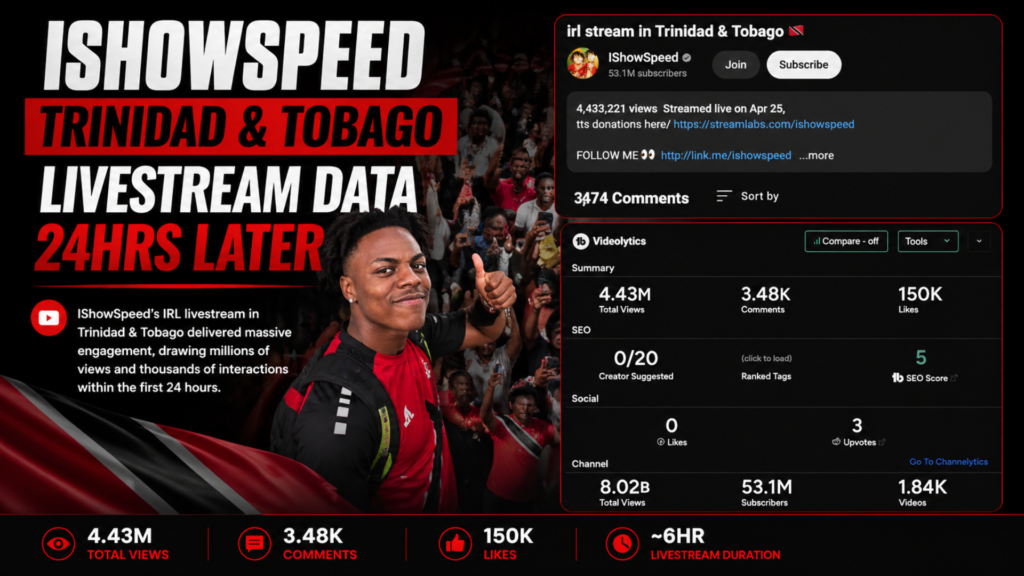
The Livestream Performance After 24 Hours
Before looking at search behaviour, we need to start with the livestream itself.
The YouTube stream, titled “irl stream in Trinidad & Tobago”, pulled roughly 4.43 million views within the first 24 hours. It also generated around 150,000 likes and 3,480 comments.
For context, this was not a short clip or a quick viral post. This was an almost six-hour livestream. That means people were not just seeing a moment on their feed and moving on. A large audience spent time watching Speed move through Trinidad in real time.
The channel size matters too. IShowSpeed has more than 53 million subscribers and over 8 billion total channel views, so the audience base behind the stream was already massive before he arrived.
This section of the data tells us one thing clearly: the content performed extremely well.
The stream got attention.
The audience showed up.
People watched, liked, and commented.
That is the starting point for the rest of the analysis.
From Watching… to Searching
The bigger question is what happened after that attention. And locally, the reaction was immediate.
If you were on social media in Trinidad that day, you saw it everywhere:
“Speed… who’s that?”
“Speed… dais somebody?”
“What he does even do?”
People were watching the stream, but at the same time trying to understand who this person is. And when that happens, people leave the timeline and go to Google.
So instead of guessing, we can look directly at what Trinidad & Tobago searched for in the first 24 hours.
What Trinidad & Tobago Actually Searched
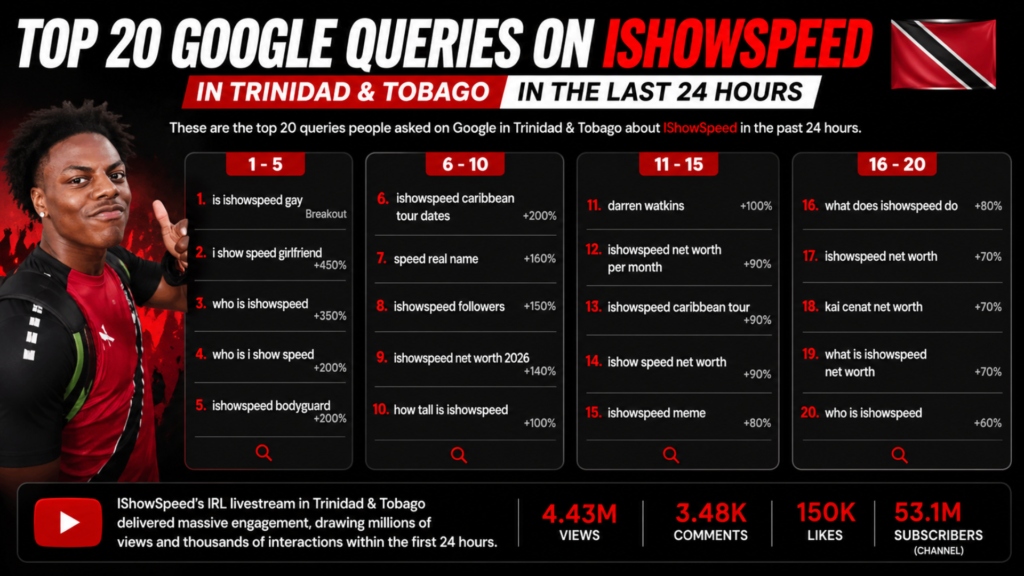
Looking at the top 20 Google queries tied to IShowSpeed in Trinidad & Tobago, the behaviour is very clear.
1. People were trying to figure him out
The most searched queries were:
- “who is ishowspeed”
- “who is i show speed”
- “what does ishowspeed do”
That lines up exactly with what we saw on social media.
People did not know him, so they went to search to get context.
2. The curiosity quickly became personal
After that, the searches shifted into:
- “i show speed girlfriend”
- “is ishowspeed gay”
- “ishowspeed bodyguard”
This is standard behaviour with large creators.
Once people understand someone is popular, they start digging into the person, not just the content.
3. People wanted to understand how big he is
There was also a strong set of searches around:
- “ishowspeed net worth 2026”
- “ishowspeed followers”
- “ishowspeed net worth per month”
This is validation behaviour.
People are trying to gauge his level by looking at money, audience size, and reach.
4. A small signal of regional interest
There were a few searches like:
- “ishowspeed caribbean tour”
- “ishowspeed caribbean tour dates”
This shows some awareness that he is moving through the region, but it is not the dominant behaviour.
From Google… to AI Search Behaviour
What people searched on Google tells us how they reacted in the moment.
But that is only half the picture.
Because in 2026, people are not just going to search engines anymore. They are going directly into tools like ChatGPT and Gemini to ask questions and get answers.
So alongside Google searches, we can also look at what people in Trinidad & Tobago were asking inside these AI platforms in the same 24-hour window.
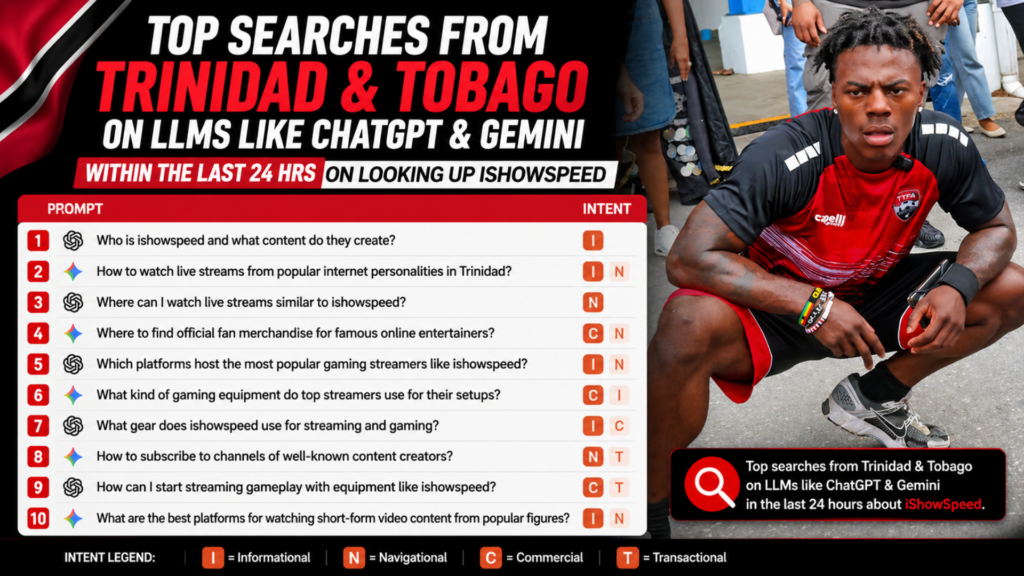
From Google… to AI Search Behaviour
We got to take a look at the top searches people asked on Google, now we shift gears into what they are asking inside of the LLMs like Chat GPT and Google Gemini.
AI platforms show us how people ask when they want a full answer.
So alongside Google, we can look at what people in Trinidad & Tobago were asking inside ChatGPT and Gemini in that same 24-hour window.
What Trinidad & Tobago Asked on AI Platforms
This dataset is simple.
These are not global queries.
These are people in Trinidad & Tobago using Chat GPT and Google Gemini to ask about IShowSpeed.
And the behaviour is very consistent.
1. People used AI to understand who he is
Prompts like:
- “Who is ishowspeed and what content do they create?”
This mirrors Google, but with more depth.
Instead of typing a short phrase, they are asking full questions because they expect a full explanation back.
2. They wanted to know how to watch him
Prompts like:
- “How to watch live streams from popular internet personalities in Trinidad?”
- “Where can I watch live streams similar to ishowspeed?”
This is practical behaviour.
They saw the stream and wanted to know:
how do I access this consistently?
3. Interest expanded into the space around him
Prompts like:
- “Which platforms host the most popular gaming streamers?”
- “What are the best platforms for watching short-form video content?”
This is no longer just about Speed.
People are trying to understand:
- where creators operate
- what platforms matter
- how this world works
4. Some people started thinking about doing it themselves
Prompts like:
- “What kind of gaming equipment do top streamers use?”
- “What gear does ishowspeed use for streaming and gaming?”
- “How can I start streaming gameplay with equipment like ishowspeed?”
This is the shift from viewer to potential creator.
It does not mean they will act on it, but the thought is there.
5. There is light action intent
Prompts like:
- “Where to find official fan merchandise for famous online entertainers?”
- “How to subscribe to channels of well-known content creators?”
These are small signals, but they show people are moving from curiosity into action around the creator.
What This Section Tells Us
When people in Trinidad & Tobago used AI tools, they were focused on one thing:
Understanding IShowSpeed and the world around him.
They were:
- asking better questions
- looking for clearer explanations
- and in some cases exploring how to engage or participate
This is local curiosity, just expressed through a different tool.
Where the Searches Were Coming From
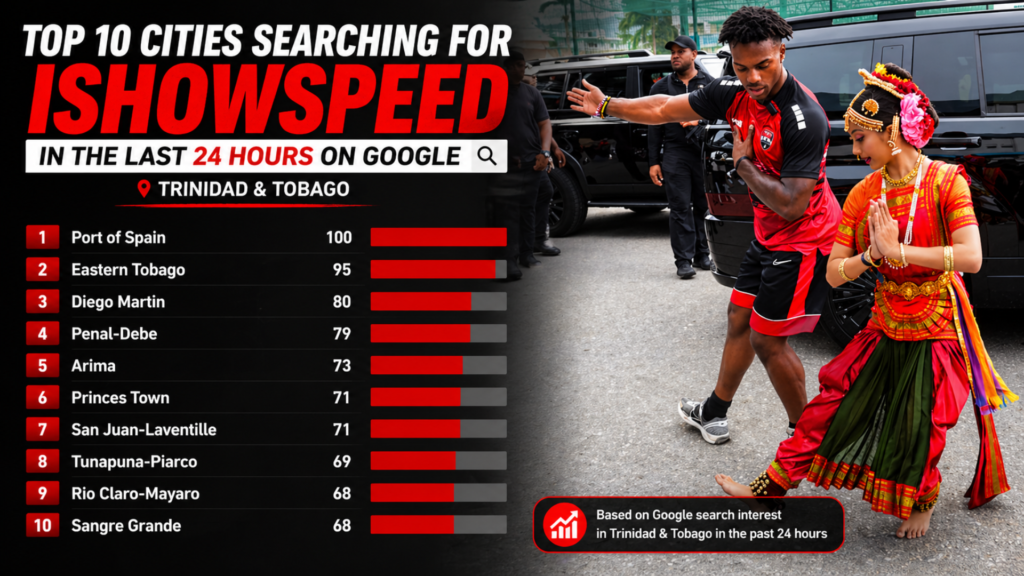
Looking at the data across Trinidad & Tobago, the search activity was not concentrated in one area. It was spread across the country.
The top cities searching for IShowSpeed in the first 24 hours were:
- Port of Spain
- Eastern Tobago
- Diego Martin
- Penal-Debe
- Arima
- Princes Town
- San Juan-Laventille
- Tunapuna-Piarco
- Rio Claro-Mayaro
- Sangre Grande
Port of Spain leads, which makes sense. That is where most of the action was happening. Speed was moving through the city, drawing crowds, stopping traffic, and creating a scene.
If you were anywhere near that, you did not need context. You saw it live. A man rolling through the streets like a head of state with a full crowd behind him.
And naturally, people pulled out their phones and went straight to Google to figure out who he is and why this was happening.
What stands out though is what happens after Port of Spain.
The interest does not drop off sharply. It spreads across:
- Tobago
- central regions
- southern communities
This tells us the moment was not isolated to one location. It travelled.
People across the country were either:
- watching the livestream
- seeing clips circulate
- or hearing about it in real time
And then doing the same thing. Searching.
So while the event itself was physically centered in Port of Spain, the curiosity it created was national.
That consistency across regions reinforces what we saw earlier. The attention was widespread, and people across Trinidad & Tobago were actively trying to understand what they were seeing.
Global Search Behaviour 24 Hours Later
Up to this point, we have been looking at what happened inside Trinidad & Tobago.
This is where we zoom out.
Because one of the things you typically see when a creator of this size lands in a new country is a spillover effect. People outside of that country start searching.
Simple things like:
- where is Trinidad & Tobago
- what country is this
- what is there to do there
That is usually the first layer of global curiosity.
What the Data Shows
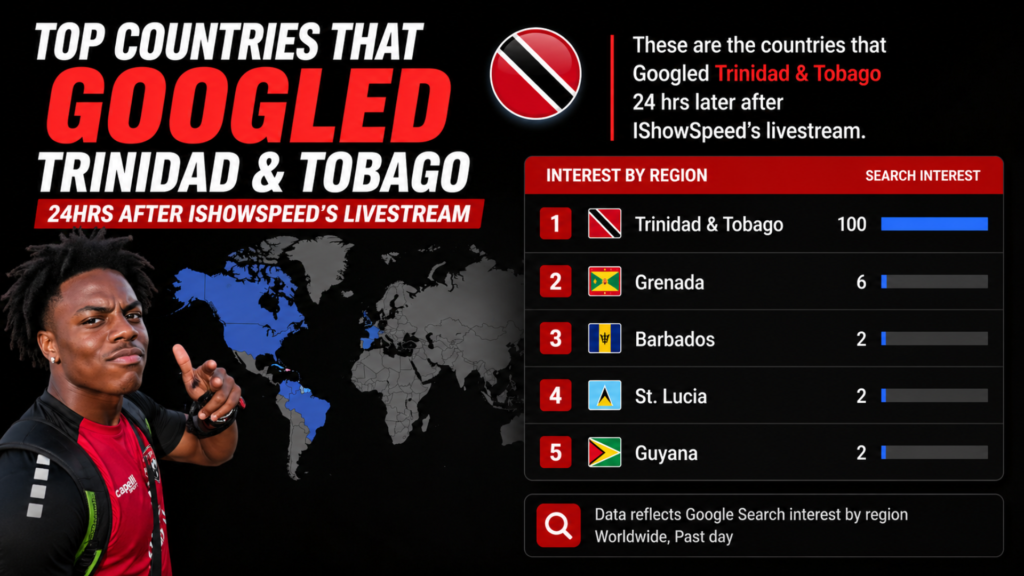
Looking at global search interest for Trinidad & Tobago in the first 24 hours after the livestream, the activity is very limited.
The top countries searching were:
- Trinidad & Tobago
- Grenada
- Barbados
- St. Lucia
- Guyana
These are all within the Caribbean.
There is no meaningful spike coming from larger international markets in that initial 24-hour window.
What This Means
This is not unusual to point out, but it is important to be clear about what we are seeing.
The global audience showed up for the content.
But within the first 24 hours, that attention did not translate into global search behaviour around the country itself.
That immediate spillover effect, which you sometimes see with major creators in other regions, did not show up here in the same way, at least not yet.
Why This Still Matters
This is not a negative. It is simply a checkpoint.
Because this is one of the key indicators to watch as the tour continues.
As IShowSpeed moves through other Caribbean islands, the opportunity is to track:
- which countries outside the region begin searching
- when those spikes happen
- and which destinations generate the most curiosity
That data becomes extremely valuable.
It tells you:
- where the audience is coming from
- which markets are paying attention
- and where there may be real tourism interest building
The Real Opportunity
If you start to see consistent search activity from specific countries, that is signal.
That is where:
- targeted campaigns can be built
- messaging can be refined
- and even physical tourism efforts can be focused
Not based on assumptions, but based on actual behaviour.
Final Thought on This Section
So while we did not see a global spike in the first 24 hours, this is not the end of the story.
This is the baseline.
And as the tour progresses across the Caribbean, this is exactly the type of data that should be tracked closely to understand where attention turns into real interest.
Let’s Pay Attention Together
So while we did not see a global spike in the first 24 hours, this is not the end of the story.
This is the baseline.
And as the tour moves across the Caribbean, this is exactly the type of data that needs to be tracked in real time to understand where attention starts turning into genuine interest.
Because that is the real opportunity here.
Not just the moment.
But what happens after the moment.
I will be tracking the data from the other islands as well. I am interested in seeing how search, discovery, and audience behavior evolves as the tour progresses across the region.
As the insights come in, I will share them.
Let’s see what we can all learn from this together.
If you are serious about building your marketing around real audience behavior, and not guesswork, then take a look at how I approach data-driven strategy:
That is where we turn insights like this into actual marketing advantage.