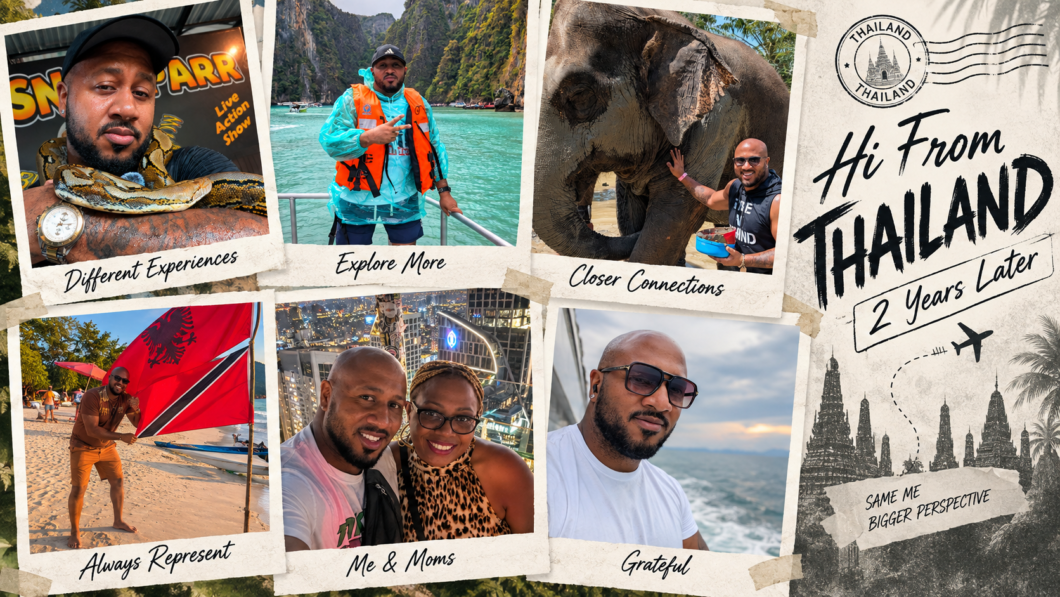
Two Years in Thailand
On September 19, 2024, I landed in Bangkok and started a new chapter of my life.
I was born in Trinidad and Tobago, but my family migrated to Canada when I was only a few months old. I spent the next 28 years there before moving back to Trinidad and Tobago, where I lived for another decade and built much of the business, experience and perspective that shaped the work I do today.
By the time I moved to Thailand, I had already spent years building digitally. I had worked in technology from a young age, launched businesses, built an audience and learned how to operate across e-commerce, digital marketing and online business.
What I wanted next was a new environment.
I wanted to place myself somewhere that would expose me to stronger ecosystems, new technologies, different ways of doing business and a region that was moving quickly across innovation, infrastructure and digital adoption.
The lower cost of living was part of the decision, but it was never the whole reason. I wanted to be somewhere that could pour back into me, professionally and personally, while giving me more room to build.
Two years later, the biggest lesson is simple: digital skills created portability, and portability created optionality.
Why I Chose Thailand
Once I knew I wanted my next chapter to be in Asia, the question became where I could build a real life while staying close to the things I wanted to learn from.
For most of my life, the benchmarks around technology, business and career success came from North America. That made sense. I grew up in Canada, worked in the smartphone and technology industry from the time I was 19, and spent years around companies such as Apple, TELUS and Rogers. Even after moving back to Trinidad and Tobago, the United States and Canada remained the markets we naturally watched when discussing technology, e-commerce, digital business and new consumer behaviour.
Over time, that started to feel incomplete.
Asia was becoming impossible for me to ignore. China, Singapore, Japan, South Korea, Vietnam and other markets were influencing manufacturing, consumer electronics, payments, e-commerce, logistics, tourism and digital infrastructure at a scale that deserved far more of my attention. I wanted to understand what was happening here without filtering everything through a North American lens.
China played a big role in changing that perspective for me. Spending time there made me reassess some of the assumptions I had about where the most interesting developments in technology were happening and what I should be using as a benchmark for my own knowledge. It pushed me to start looking at Asia differently, not simply as another region to visit, but as somewhere I needed to study much more seriously.
This is where I would embed the Short. It works naturally here because the video becomes supporting evidence for the shift you are describing. The reader first understands why your benchmark began changing, then they can watch you explain that China experience in your own words before continuing into why Thailand became the place you eventually chose to live.
What I wanted from Asia was exposure. I wanted to see how technology was being used in ordinary life, how people paid for things, how businesses communicated with customers, how public infrastructure worked, how tourism was built around local culture and how digital services were reducing friction for consumers.
Those things interest me professionally, but they also affect how a place feels to live in.
Thailand started standing out because it gave me a combination I was struggling to find elsewhere.
Bangkok is a major regional city with excellent internet and mobile connectivity, a huge international population, modern public transportation, strong healthcare, an enormous food and hospitality industry and access to technology, startup and creator communities. At the same time, I could live here without carrying the cost structure that often comes with living in a large international city.
I was never searching for the cheapest country I could find. I wanted somewhere that allowed me to reduce my expenses while improving the environment around me.
Bangkok gave me that.
The digital infrastructure was immediately noticeable. QR payments are part of everyday life, including at small roadside vendors. Food delivery, ride-hailing, banking, communication and shopping are deeply integrated into mobile services. You very quickly become accustomed to doing almost everything from your phone.
For someone who has spent years working in digital strategy, e-commerce and payments, everyday life here constantly gives me something to observe.
I can talk about digital adoption and then walk downstairs and see it happening.
I can discuss cashless commerce and then buy a coconut from a vendor after a morning run by scanning a QR code.
I can study consumer behaviour and then experience that behaviour myself as a customer.
Bangkok also gave me access to environments where I could continue learning. I now live within walking distance of True Digital Park and Cloud 11, two ecosystems that regularly expose me to technology, business, creators, events and workshops.
That proximity has become part of my routine rather than something I have to plan an international trip around.
Thailand also made sense because I wanted Asia to become accessible beyond the country where I lived.
From the Caribbean, travelling across this side of the world takes planning, money and usually a very long journey. From Bangkok, much of Southeast Asia is only a few hours away.
Vietnam, Malaysia, Singapore, Cambodia, Laos, Indonesia and the Philippines are all within relatively easy reach. China, Japan, South Korea and India are dramatically more accessible from Bangkok than they were from Trinidad and Tobago.
That changes what travel can be used for.
A trip no longer has to be a major once-a-year event. It can be a few days somewhere new, an opportunity to experience another city, see how another market works and then come home to Bangkok.
Thailand’s tourism infrastructure helped make the move easier as well. This is a country that has spent decades receiving people from around the world, so many of the systems a foreigner needs are already well developed. Airports, transportation, accommodation, restaurants, healthcare and international communities are all easy to access.
I could arrive without knowing everything and still find my footing quickly.
The financial equation eventually sealed it for me. I could lower my housing, transportation and food costs without feeling as though I was sacrificing the things that made life enjoyable or productive. Instead, reducing those fixed costs created more room for travel, health, learning, business investment and rest.
That is the version of affordability I was interested in.
Not simply spending less money, but getting more life from the money I was already earning.
Two years later, Thailand has become much more than the place I initially selected from a list of possible destinations. It has become my home base, while Asia has become part of my classroom.
And that is probably the best way to explain why Thailand won.
It gave me somewhere I could settle down without disconnecting from everything I had moved across the world to experience.
Why I Needed an Environment That Could “Pour Back Into Me”
When I talk about wanting to live somewhere that could “pour back into me,” I’m really talking about the role environment has played throughout my career.
Canada gave me my first real exposure to technology at scale. I was already working in the smartphone and tech industry by 19, including time with Apple, TELUS and Rogers. I got to watch the smartphone revolution unfold from inside companies that were helping introduce these products and services to millions of consumers. Those years taught me about devices, telecoms, customer behaviour, retail, product launches and what happens when a new piece of technology fundamentally changes the way people live.
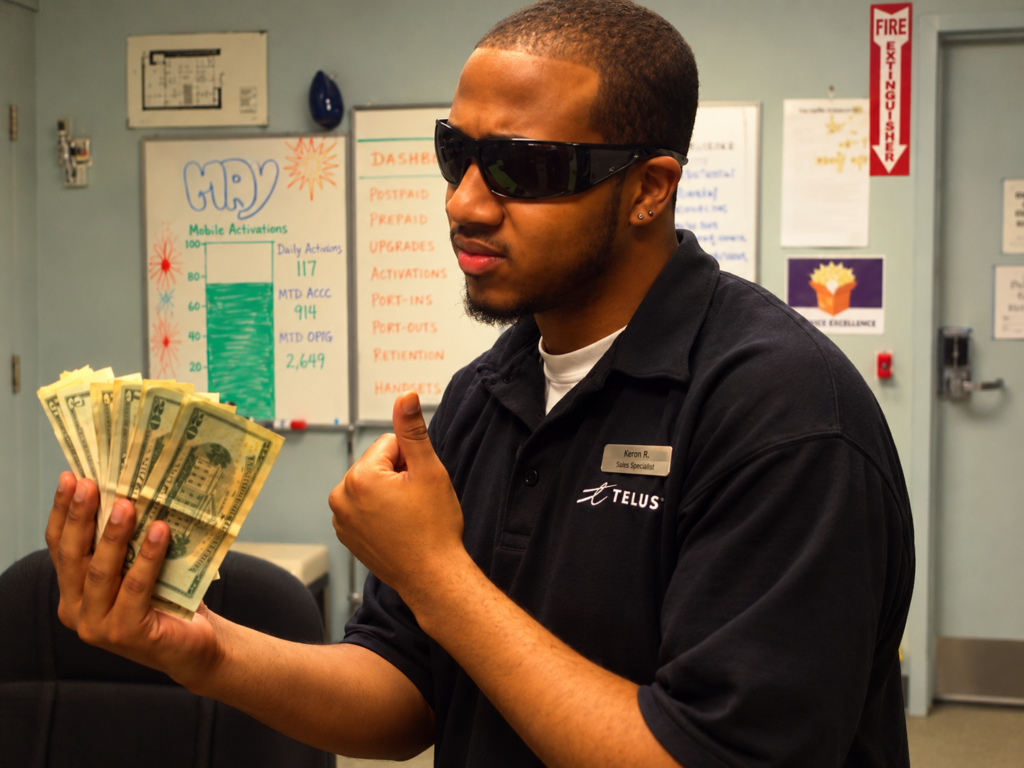
When I eventually moved back to Trinidad and Tobago, the environment changed completely, and so did the lessons.
The Caribbean gave me problems to solve.
I could see gaps in access to technology, e-commerce, payments, digital education and the way businesses were using the internet. Instead of looking at those gaps only as frustrations, I started building around them. Droid Island, my first e-commerce business, came out of that environment in 2016. Building it forced me to understand what selling online actually looked like in the Caribbean, from getting paid and moving money to sourcing products, building trust and convincing consumers that buying online from a local company could work.
That experience eventually expanded far beyond smartphones. I moved deeper into e-commerce, digital marketing and strategy, while documenting what I was learning through content, workshops, media and speaking. Digipreneur grew out of that journey as my focus shifted toward helping Caribbean businesses and professionals understand how the digital economy was changing the opportunities available to them.
For roughly a decade, there was always another Caribbean problem for me to investigate.
But eventually I started noticing something about my own development. I was spending a lot of time researching, teaching, consulting and helping other people catch up, while feeling increasingly removed from the environments producing many of the technologies and business models I was talking about.
I needed to become the student again.
I wanted to walk into rooms where I did not automatically know everything being discussed. I wanted to hear conversations that would send me home with a list of things to research. I wanted to interact with companies, products and technologies that would force me to question whether my own knowledge was current enough.
That is part of what Bangkok has given me.
I now live a few minutes from True Digital Park, which describes itself as Southeast Asia’s largest tech and startup hub. The space brings together startups, established technology companies, investors, government agencies, academies, workspaces and event facilities, with workshops and seminars built into the ecosystem. True Digital Park
For me, the value is the proximity.
If there is a technology workshop, industry discussion or event I want to attend, I am not planning an international trip around it. In many cases, I can walk there.
That changes how learning fits into my life. It becomes something I can do on a random weekday because I saw an interesting event, rather than something requiring months of planning and a flight.
Then there is Cloud 11, another project within walking distance of my home. Its focus is different. Cloud 11 is being developed around Bangkok’s creator and content industries, bringing together production spaces, creative businesses, education, entertainment and communities built for people working in media and culture. Cloud 11 Bangkok
That is equally relevant to me because my business no longer sits neatly inside one category. I work in digital strategy, but I am also a writer, broadcaster, podcaster, content creator, speaker and educator. Being close to environments built around both technology and creativity exposes me to different sides of the work I already do.
Sometimes the learning is formal. I attend a class, workshop or event.
Other times, it is simply observation.
I pay attention to the products companies are launching, how businesses communicate, what creators are experimenting with, how consumers use their phones, how people pay for things and what technologies become normal here before they become normal elsewhere.
Those observations eventually make their way back into my work.
They influence the questions I ask when I am consulting. They influence what I write about. They give me ideas for radio and podcast discussions. They also give me a much tougher benchmark for my own skill set because I am constantly seeing how much more there is to learn.
That was what I felt I was missing before the move.
Canada had poured into me early in my career. The Caribbean then gave me an environment where I could take that knowledge, solve different problems and build something of my own.
After a decade of doing that, I wanted another cycle of learning.
Bangkok has given me one.
My Definition of a Digital Nomad Has Changed
Before moving to Thailand, the phrase “digital nomad” usually made me think of somebody constantly moving. One month in Bali, a few weeks in Lisbon, then off to another city with a laptop and a suitcase.
That is not how I live.
Bangkok is home.
I have a neighbourhood. I know where I like to eat, where I train, where I go for walks, which parks I enjoy, which cafés I like working from and which parts of the city I naturally gravitate towards. I have friends here. I have routines. I have a condo that feels like mine, a gym I use regularly and a business that I run from the same base every day.
There is very little about my normal week that feels transient.
Most days are actually quite ordinary. I work, exercise, order food, handle meetings, do errands, spend time with friends and continue building the same business I have been developing for years. The difference is that all of this now happens in Bangkok instead of Trinidad and Tobago.
That shift changed how I think about the term digital nomad.
For me, the modern digital nomad is not necessarily someone who is constantly travelling. The person can be settled. They can have a home, a community and a routine. What makes the lifestyle portable is not how often they move. It is the fact that their livelihood is not locked to one place.
That is the part that matters most to me.
My income does not depend on being physically located in the Caribbean. My clients can be in Trinidad and Tobago, Jamaica, Canada, the United States or somewhere else entirely. My meetings happen online. My content is produced digitally. My consulting work, writing, media work and digital products can all continue regardless of where I am sitting.
The business moved because I could move.
That has changed how I think about freedom as well.
Freedom is not necessarily waking up every week in a new country. I actually prefer having a home base. I like knowing where my groceries come from, having familiar people around me and being able to build a normal life.
What I value is knowing that I have a choice.
If I want to stay in Bangkok for the next several years, I can build around that. If I decide later that another city, country or region makes more sense for the next phase of my life, the move does not automatically mean starting my career from scratch.
My income can move with me.
That portability is the result of years of building digital skills before I ever moved to Thailand. E-commerce, digital marketing, consulting, content creation, online payments, remote communication and understanding how to serve clients across borders were already part of my business model.
Thailand simply forced me to see the full value of what I had built.
When I was living in Trinidad and Tobago, I was already working digitally, but I was still operating inside a familiar environment. My family was nearby. I understood the systems. I knew how everything worked.
Moving to the other side of the world removed that familiarity.
Suddenly, I had to prove to myself that the business really was portable. Could I still get paid? Could I still serve clients? Could I keep my media commitments? Could I work across an 11-hour time difference? Could I continue building an audience in one region while living in another?
Two years later, the answer has been yes.
That has given me more confidence in the model than anything I could have learned from reading about remote work.
I am living it.
It has also made me think differently about the people who might want this kind of life. You do not necessarily need to dream about travelling full-time. You may simply want the option to spend a few years somewhere else, live closer to family for a period, move somewhere with a lower cost of living, take advantage of a new professional opportunity or experience another part of the world without your income collapsing the moment you leave home.
That is a much broader idea than the old stereotype of the digital nomad.
You can have roots and still be portable.
You can build a home somewhere without becoming permanently tied to it.
You can live a very normal life while still having access to an unusually wide range of options.
That is what the term means to me now.
The goal is not to keep moving.
The goal is to know that you can.
My Bangkok Cost of Living After Two Years
One of the biggest differences between my first and second year in Thailand is that I now understand Bangkok well enough to make much better decisions about where I live and what I actually need.
When I first arrived, my priority was not finding the absolute best deal. I wanted to land, get settled quickly and start building a normal life. There is only so much you can learn about neighbourhoods, condo buildings and transportation from Google Maps and property websites before you actually live in the city.
My first condo cost 19,500 baht per month, roughly US$583 at today’s exchange rate. I was comfortable paying that during the first year because it gave me time to understand Bangkok without spending my first month bouncing between Airbnbs and viewing apartments.
By year two, I knew much more about where I wanted to live, how close I wanted to be to the BTS, which parts of the city fit my routine and what I was actually willing to pay for.
My current condo is a brand-new, one-bedroom, 32-square-metre unit that costs 14,000 baht per month, approximately US$419. It is about a five-minute walk from the BTS, True Digital Park and Cloud 11, so I actually improved my location while reducing my rent by 5,500 baht, or roughly US$164, every month.
Over a year, that difference alone is 66,000 baht, almost US$2,000, back in my pocket.
What I Currently Spend Each Month
Here is what my core monthly cost structure looks like in year two:
| Expense | Thai Baht | Approx. USD |
|---|---|---|
| Condo | 14,000 baht | US$419 |
| Electricity | 1,700 baht | US$51 |
| Mobile phone – 50GB 5G | 600 baht | US$18 |
| Home internet – 500/500Mbps | 600 baht | US$18 |
| Water | 100 baht | US$3 |
| Food budget – approx. 30 days | 10,050 baht | US$300 |
| Core monthly baseline | ~27,050 baht | ~US$809 |
USD conversions are approximate and will move with the exchange rate. At the time of writing, 1 Thai baht is approximately US$0.0299.
That US$809 figure is not meant to represent every baht I spend in a month. It is my basic living structure: housing, utilities, connectivity and my normal food budget. Transportation, travel, shopping, entertainment and wellness sit outside of that because those expenses change depending on what I am doing that month.
My Electricity Bill
Electricity is one of the questions people regularly ask about because Bangkok is hot and air conditioning can easily become one of the larger household expenses.
My bill averages around 1,700 baht, or about US$51, per month. I work from home, so I am in the condo a lot, and I use the air conditioning regularly. Your own bill could obviously be higher or lower depending on the size of the unit, how often you are home and how aggressively you run the AC.
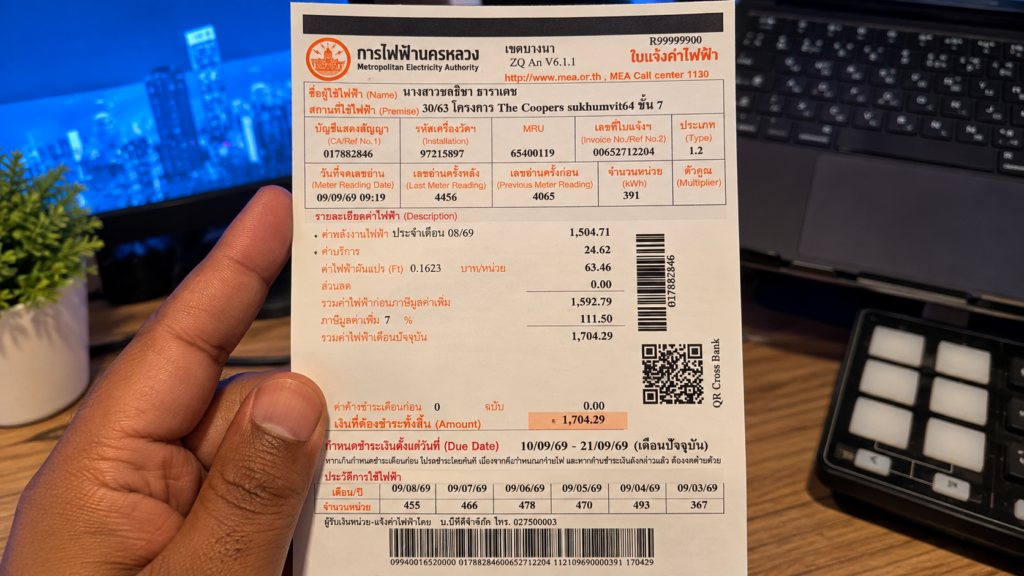
Water barely registers as an expense by comparison. Mine is usually around 100 baht, or roughly US$3, per month.
Internet and Mobile Data
Connectivity is one expense I am not interested in compromising on because my business depends on it.
My home internet is 500/500Mbps and costs 600 baht per month, approximately US$18. My mobile plan is another 600 baht, also around US$18, and includes 50GB of 5G data.
For roughly US$36 per month, I have the connectivity I need to run video calls, upload content, manage websites, conduct research, stream media and operate the business from home.
Living in Bangkok has also made me much less conscious of rationing mobile data. I am constantly online when I am outside the condo, whether I am using maps, payments, Grab, messaging, banking or simply working from my phone.
My US$10-a-Day Food Budget
Food is another major reason Thailand works so well for the way I live.
I rarely cook.
My food budget is roughly US$10 per day, which at the current exchange rate is around 335 baht. Over a 30-day month, that works out to approximately 10,050 baht, or US$300.
That budget can cover breakfast, lunch and dinner because I have so many options available. I use Grab, buy from neighbourhood restaurants and cafés, pick up prepared food from markets and supermarkets, and occasionally use private-chef and prepared-meal services.
I still buy groceries and snacks, so there will always be months where I spend more, but I am not budgeting US$10 per meal. I am budgeting around US$10 for the day.
That completely changes the economics of convenience.
In many countries, eating prepared food every day would be one of the fastest ways to destroy your monthly budget. Here, it can simply be part of how I structure my life.
I do not enjoy cooking enough to make it a priority, and I would rather spend that time working, exercising, reading, meeting people or doing absolutely nothing.
Thailand gives me that choice without turning food delivery and eating out into luxury spending.
Transportation Is More Variable
Transportation is harder for me to put into one fixed monthly number because it depends heavily on what I am doing.
I intentionally chose a condo within walking distance of the BTS, so there are days when my transport costs are extremely low. I also use Grab, GrabBike and the rail system depending on where I need to go.
Some months I spend more because I am moving around Bangkok frequently. Other months I work from home most of the week and barely go anywhere beyond my neighbourhood.
That is why I do not treat transportation as one of my fixed costs.
The bigger advantage is having options. I can walk, take the BTS, use a motorbike, book a car or combine them depending on the situation.
Where Wellness Fits Into the Budget
Wellness is another area where my spending changes from month to month.
I use the gym, swim, spend time in parks, get massages, visit onsens and generally spend much more money and time on taking care of myself than I did before moving here.
But I do not look at those expenses in the same way as rent or electricity. They are discretionary, and I can scale them up or down depending on the month.
What changed in Thailand is that my fixed costs are low enough that I have more room for those things.
That is the bigger financial lesson from living here.
Saving 5,500 baht on rent is useful. Paying US$18 for fast internet is useful. Being able to eat for around US$10 per day is useful.
But the real value is what happens after those savings accumulate.
I have more headroom.
I can travel more without feeling like I am taking money away from basic expenses. I can invest in equipment for the business, take courses, attend events, use wellness services, save more or simply take fewer projects when I do not want to work as much.
Lowering my cost of living did not make me less ambitious.
It gave me more room to decide where I wanted my money, time and energy to go.
What My Current Monthly Living Costs Add Up To
When I add up my current condo, electricity, water, mobile plan, home internet and my normal food budget, my baseline monthly living expenses come to roughly:
- Condo: 14,000 baht / about US$419
- Electricity: 1,700 baht / about US$51
- Mobile: 600 baht / about US$18
- Home internet: 600 baht / about US$18
- Water: 100 baht / about US$3
- Food: about 10,050 baht / about US$300
That puts my current baseline at approximately 27,050 baht per month, or about US$809.
Over a full year, that works out to roughly 324,600 baht, or about US$9,700, for my core living expenses.
That does not include travel, shopping, massages, onsens, entertainment, equipment, business expenses or months when I decide to spend more. Transportation also varies because I walk a lot, live close to the BTS and work from home.
But that baseline is what gives me so much flexibility.
I do not need a huge monthly income just to keep the lights on, stay connected, eat well and have a comfortable home in Bangkok. The gap between what I need to live and what I earn can go into savings, travel, learning, wellness, equipment, new business ideas or simply giving myself more time off.
That is what I mean when I talk about headroom.
Lower costs did not just save me money. They gave me more control over what I do with the money, time and energy I already have.
What I Learned About Housing After My First Year in Bangkok
One of the first decisions I made after arriving in Bangkok was that I was not going to spend one, two or three months living out of hotels and Airbnbs while searching for the “perfect” condo.
A lot of people do that when they first move to Thailand. They want to test different neighbourhoods, compare buildings and make sure they are getting the best possible deal before signing anything. I understood the logic, but for me it felt like a very expensive and stressful way to start a new life.
My thinking was simpler: find something workable, sign a lease within the first few days, get settled and let the city teach me what I actually needed to know.
There was only so much I could learn about Bangkok from property listings, YouTube videos and Google Maps. I could research neighbourhoods, compare rents and look at BTS stations, but none of that could tell me what my own routine would eventually look like once I was living here.
So within three days of landing, I signed a lease at Modiz Sukhumvit 50.
My first condo cost 19,500 baht per month. It was not supposed to be the final answer. It was my landing spot.
The goal for year one was to remove the pressure of house hunting and get into a normal routine as quickly as possible. Once I had a home, I could take my time exploring Bangkok naturally. I could learn which areas I liked, how often I used the BTS, where I spent most of my time and what parts of the city actually made sense for the life I was building.
I also documented that first condo when I moved in.
By the end of that first year, I understood Bangkok completely differently.
I had a much better grasp of the neighbourhoods, where the value was, what I cared about and what I did not. I knew I wanted to be close to the BTS. I wanted easier access to True Digital Park and Cloud 11. I knew how much space I realistically needed because I live alone, and I had a much clearer idea of what I was willing to spend.
Year one was about getting settled.
Year two was about finding the best situation for me.
That is how I ended up in my current condo: a brand-new, one-bedroom, 32-square-metre unit for 14,000 baht per month, roughly US$419. I lowered my rent by 5,500 baht, improved my location and ended up about five minutes from the BTS, True Digital Park and Cloud 11.
I signed that lease in September 2025.
Then I blinked.
Before I knew it, my realtor was messaging me asking whether I wanted to renew for another year.
It genuinely did not feel like I had been there that long. In my head, it still felt like I had only moved in six months earlier.
I renewed.
At this point, consistency is valuable to me. I like the condo, I like the area, my costs are manageable and the setup works extremely well for the life I have right now. There was no reason to force another move simply for the sake of changing apartments.
But I also know myself.
By the time this second lease is finished, I will probably be in a different headspace. My business may have changed. My routines may have changed. I may want more space, less space or simply a different part of Bangkok to keep life fresh.
That is one of the things I appreciate about approaching housing this way.
I never needed my first condo to be perfect.
I only needed it to be good enough to give me time.
That first year gave me something online research could not: context. By the time I was ready to choose my next home, I was no longer guessing what kind of life I might have in Bangkok.
I was choosing based on the life I was already living.
Living in a Digital-First City
One of the things I have come to appreciate about living in Bangkok is how much of everyday life has been digitized without it feeling like technology is constantly getting in the way.
Payments are probably the best example.
QR payments are everywhere in Thailand. Restaurants use them, cafés use them, markets use them, and so do some of the smallest roadside vendors. You do not need a sophisticated point-of-sale system or a card machine sitting on a counter. There can simply be a printed QR code next to whatever somebody is selling.
For my first year here, I could see how convenient the system was, but I could not participate in it in quite the same way because I did not have access to the local payment setup I needed. That changed once I started using DeepPocket.
DeepPocket is the digital wallet I use in Thailand, and having access to Thai QR payments through it has fundamentally changed how I move around the city. DeepPocket supports QR payments and other wallet services, which is what finally allowed me to participate in the payment behaviour I was seeing everywhere around me. It also gives you a virtual Visa debit card that you can add to Google Pay/Apple Pay, so that the money is not locked into the DeepPocket ecosystem. Use the QR code payments for everyday life, and then tap to pay whenever you are outside of Thailand, or you can use the Visa Debit card for online purchases.
At this point, I am effectively cashless.
One of my favourite examples is a coconut vendor I pass when I am out exercising. The woman who runs the stand has to be in her 70s. I honestly have no idea how much she thinks about the technology behind any of this. I pick up a drink, scan the QR code, make the payment and show her the confirmation screen.
The funny part is that half the time she is not even looking at my phone.
She just smiles at me.
And that is basically the entire transaction.
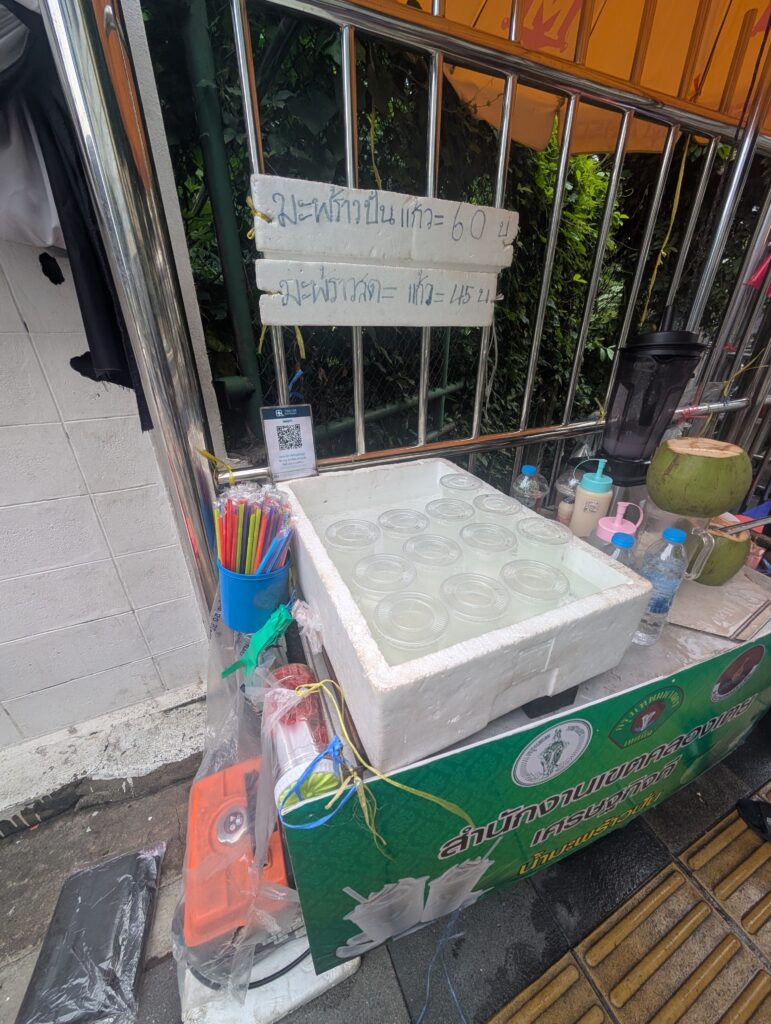
That little interaction probably explains Thailand’s digital economy better than a lot of presentations about digital transformation could.
Here is a woman in her 70s selling coconuts and drinks from a small roadside setup. Sitting beside the cooler is a QR code connected to the same digital payment culture being used by major retailers, restaurants and businesses across the country.
Nobody is standing there talking about fintech.
Nobody is giving her a lecture about digital adoption.
I want a coconut. She wants to get paid. The technology gets out of the way and lets the transaction happen.
That is what I find interesting.
I have spent years talking about digital payments, e-commerce and getting businesses to adopt technology. We often discuss digital transformation as if everybody first needs to become deeply interested in the technology itself before they can participate.
Living here has made me think about that differently.
Sometimes adoption happens because the system becomes easier than the thing it replaces.
My early-morning routine is a good example. I can leave my condo around 6 AM with my phone and headphones, go for a run, stop for a coconut, scan the QR code and continue on my way. I do not have to remember to take cash. I do not have to find an ATM. The vendor does not need to have change. Neither of us needs a card terminal.
The payment is instant, and then both of us get on with our day.
The same thing has happened with how I leave home generally.
For years, I did the usual check before walking through the door: phone, wallet, keys.
I barely think about that anymore.
My condo access is stored on my phone and smartwatch. My payments are on my phone. Maps, messaging, transportation apps and everything else I generally need while I am outside are already there.
There are plenty of days when I leave home carrying nothing but my phone.
What I enjoy about this is not that any one of these technologies is particularly futuristic. Smartphones, QR codes and digital wallets have existed for years.
The difference is how completely they have worked themselves into everyday life.
Thailand’s QR payment infrastructure is used across everything from shops and restaurants to food stalls, and the country has continued expanding digital payment access for visitors as well. Thailand 2026
Living inside an environment like that gives me another benchmark for the work I do.
I pay attention to technology for a living. I write about it, speak about it, teach it and advise businesses on how to use it. Being in Bangkok means I am also experiencing these systems as a regular consumer every day.
And sometimes the most useful lesson does not come from visiting a technology company or attending an innovation conference.
Sometimes it comes from buying a coconut from a lady in her 70s who could not care less about my payment confirmation screen.
She got paid.
I got my coconut.
It worked.
That, to me, is what successful digital adoption looks like.
Running a Caribbean Business From Bangkok
Moving to Thailand changed the way I thought about digital business because suddenly there was nowhere for the theory to hide.
My business still serves people primarily across the Caribbean and the diaspora, but I am now operating it from Bangkok. The clients did not move with me. My audience did not move with me. The markets I write and speak about are still largely thousands of miles away.
So the business had to work without me being physically present in the region.
That forced me to understand every layer of what I had been teaching for years: how to communicate with clients remotely, how to deliver work without being in the same country, how to accept payments internationally, how to access that money once it arrives, how digital banks and wallets fit together, how e-commerce systems function across borders and how to keep the entire operation moving even when my day starts while the Caribbean is still asleep.
I had already been building toward this for a long time.
Droid Island started in 2016. By 2018, I was operating fully digitally, and by 2019 I was publicly talking much more about digital payments, e-commerce, online business and the opportunities that come from building skills that are not tied to a physical location.
For years, I was explaining the possibilities.
Now I am using those same systems to sustain my own life on the other side of the world.
That has changed the relationship I have with the work.
When I talk about getting paid internationally, I am not speaking from a hypothetical slide deck. I need those systems to work because that is how I receive money from the regions I serve and then use it here in Thailand.
When I talk about digital banking, wallets and payment platforms, I have to understand how money actually moves between them. I need to know what happens when a platform changes its rules, when a bank does not support something, when a withdrawal takes longer than expected or when one service works in one country but not another.
When I talk about running an online business, I still have to manage websites, clients, content, invoices, meetings, projects and payments from Bangkok.
There is a very practical difference between understanding a digital business model and having your entire life depend on one.
Living here has made me better at the work because it constantly forces me to solve problems that I might never have encountered if I had stayed in one market.
Payments are a good example. Caribbean professionals already deal with a fragmented financial environment. Different countries have different banking systems, different access to payment platforms and different restrictions around receiving and moving money. Add Thailand to the other end of that equation and suddenly I have to understand both sides well enough to make everything connect.
That experience feeds directly back into Digipreneur.
When I research a platform now, I am rarely asking only whether it exists. I want to know whether somebody in Trinidad and Tobago can actually use it, whether someone in Jamaica can access the same feature, whether the money can be withdrawn, whether there are limits, whether it works with PayPal, whether it can connect to a bank account and whether that money can still be useful if the person later decides to live somewhere else.
Those questions became more important after I moved because I had to answer them for myself.
The same thing happened with remote work.
It is easy to say that a consultant can work from anywhere. It becomes a much more serious proposition when your clients are eleven hours behind you and you still need to maintain the same standard of service.
I had to become more deliberate about the types of projects I accepted, how meetings were scheduled and how much of the business depended on me being available in real time. Over time, that pushed me further toward work that could be delivered asynchronously and toward systems that gave me more control over my calendar.
That has been good for the business.
It has also made the work I do publicly more credible.
For almost a decade, people have been able to watch the progression. They saw the e-commerce years. They saw the move into digital marketing and strategy. They saw the articles, workshops, media appearances, speaking engagements and all the conversations about digital skills, online income and building businesses that could operate beyond the Caribbean.
Then I moved to Thailand.
That move put everything I had been saying under a different kind of test.
Could I still attract clients?
Could I still get paid?
Could I still run projects?
Could I still produce content for a Caribbean audience?
Could I still contribute to radio, television, workshops and speaking engagements while living in Asia?
Could I continue building the business without physically being in the region?
Two years later, I have a documented answer to those questions.
That matters when I walk into a room to teach or speak because I am not simply describing what digital business might allow somebody to do. I can show them what it has allowed me to do.
It has also changed the kinds of conversations people approach me for.
I am increasingly invited to speak about the future of work, digital careers, entrepreneurship, payments, AI, remote work and the changing opportunities available to Caribbean professionals. Those topics all overlap with the life I am actually living.
The location has become part of the case study.
Thailand did not create my business. The work that made this possible started years before I arrived.
But living here proved something important to me about what I had built.
The business was not only digital because I used digital tools.
It was portable.
How I Make an 11-Hour Time Difference Work
The time difference between Thailand and the Caribbean sounds brutal on paper.
Trinidad and Tobago is 11 hours behind Bangkok, which means 5 PM in Trinidad is 4 AM for me. If I tried to maintain a traditional Caribbean workday from Thailand, I would destroy my sleep schedule very quickly.
So I do not try to live on Caribbean time.
I built my schedule around the reality of where I live now.
There are mornings when I wake up around 3 or 4 AM, especially if I have meetings with clients or partners in the Caribbean. That gives me a window while their workday is still active. By the time it is around 8 AM in Bangkok, much of the Western Hemisphere is already winding down for the night.
From there, I decide what the rest of my day needs to look like.
Sometimes I stay up and continue with my day. Other times I go back to sleep for a few hours. I also use midday naps regularly, which works well for me because I have never believed that every productive day has to follow the same rigid schedule.
What matters is that I understand how my body works and I plan around it.
Friday is usually the exception because of my radio commitments. Those nights can run much later, sometimes until around 2 AM Thailand time. I know that in advance, so I do not pretend the next morning should look like a normal workday.
I adjust.
That has probably been one of the biggest changes in how I work since moving here. I pay much more attention to energy than I do to traditional office hours.
I also became more selective about the kind of work I take on.
When your clients are on the other side of the world, a business filled with back-to-back meetings becomes exhausting very quickly. Over time, I have intentionally moved toward more backend work and projects that do not require me to be constantly available in real time.
Strategy, research, content, websites, digital systems and other project-based work are much easier to manage across time zones because I can do the work when it makes sense for me and deliver it when it needs to be delivered.
That gives me more control over my calendar.
It also means that when I do schedule meetings, they are usually there for a reason.
I am not interested in spending five hours a day sitting on Zoom simply because that is how people are accustomed to working.
The time difference forced me to become more disciplined about that.
It also forced me to become much clearer with clients about my availability.
I live in Thailand. My working hours reflect that. If someone wants to work with me, we find a window that works for both sides.
That might mean an early morning for me or an evening for them, but it does not mean I need to permanently operate on someone else’s clock.
That distinction has made the lifestyle sustainable.
The interesting thing is that the time difference now feels much less dramatic than it did when I first thought about moving.
Once I built a routine around it, it became normal.
There are advantages too.
By the time many of my clients wake up, I may already have completed several hours of work. I can send deliverables, research, ideas or updates overnight from their perspective.
There are mornings when I finish a meeting at 6 or 7 AM, close the laptop and realise that most of the Western Hemisphere is heading to bed while Bangkok is just starting its day.
That still feels slightly strange sometimes, but I like it.
It gives me two different rhythms to work with.
One belongs to the markets I serve.
The other belongs to the place I live.
Learning how to move between those two has been one of the most important practical skills I have developed since moving to Thailand.
For me, the answer was never some complicated productivity system.
It was learning when I work best, protecting my sleep, planning my rest and being more intentional about the type of work I allow into my calendar.
My Experience With Thailand’s Destination Thailand Visa
One of the reasons Thailand has been able to become a genuine home base for me, rather than somewhere I am temporarily staying, is the Destination Thailand Visa.
I moved here knowing that I did not want to spend the next few years constantly thinking about where I was allowed to stay, when I needed to leave or which country I would have to move to next. If I was going to build a life in Bangkok, I wanted enough stability to sign a lease, establish routines, build relationships and treat the city like home.
The DTV gave me that.
Thailand introduced the Destination Thailand Visa in 2024 for groups that include digital nomads, remote workers and freelancers. The visa is valid for five years, allows multiple entries and provides a stay of up to 180 days on each entry. Thailand also provides an extension mechanism for an additional period of up to 180 days, subject to the immigration rules governing that stay.
That structure fits my life extremely well because I already travel.
I am not sitting in Thailand trying to avoid leaving the country. I want to see Asia. I travel for work, experiences and sometimes simply because another country is a short flight away. When I return to Bangkok, I come back home.
That is a very different experience from constantly moving because your immigration status forces you to.
I am now in my second year living here under the DTV, and my personal experience entering and leaving Thailand on my Trinidad and Tobago passport has been straightforward. I have travelled out of the country and returned several times, and once my documents are in order, my interaction at immigration is normally very brief. I fill out the TDAC ahead of arrival into Thailand, present my passport, my yellow fever vaccination card (T&T passports: it’s mandatory), and I’m out of immigration in a few minutes.
The visa application itself was also far less dramatic than people sometimes imagine when they hear the word “migration.”
My application was processed through the Thai Embassy in Ottawa. I had to put my documentation together, demonstrate my professional activity and show the required financial evidence. In my case, I submitted one client contract as part of the proof of my work, and from the time I started pulling everything together to receiving approval, the entire process took me about two weeks. I documented the application, costs and paperwork in much more detail in my separate migration guide.
Migrating to Thailand from the Caribbean: 2026 Guide
I deliberately do not want to turn this section into another visa guide because that resource already exists and immigration requirements can change. In fact, Thailand has continued updating DTV documentation requirements in 2026, which is exactly why anybody considering the visa should verify the current requirements through official Thai government sources when they are ready to apply.
What is more interesting to me two years later is what having the visa changed about the way I live.
It allowed me to stop thinking like a visitor.
I could sign a proper lease instead of building my life around hotels and short-term accommodation. I could buy things for my condo without wondering where I would put them three months later. I could join a gym, develop favourite restaurants, get to know my neighbourhood, create routines and build friendships without having an expiration date constantly sitting in the back of my mind.
Bangkok became the place I returned to.
That stability also changed my idea of what being a digital nomad could look like. I do not want to spend my life dragging luggage through airports every few weeks just to maintain the label. I enjoy travelling, but I enjoy having somewhere to come back to even more.
The DTV gives me both.
I can have a home in Bangkok and still spend time elsewhere in Thailand or travel around Asia. I can leave for a trip and return to the same condo, the same neighbourhood, the same routines and the same life I was building before I left.
For someone running a digital business, that combination is incredibly useful.
My income is generated outside Thailand. My clients and audience are largely in the Caribbean and diaspora. My business does not depend on finding local employment here. That is precisely the kind of modern working arrangement the DTV was created to accommodate; Thailand’s official materials specifically identify digital nomads, remote workers and freelancers among the eligible groups.
It also removes some of the psychological pressure that can come with migration.
I have not had to decide that Thailand must be where I spend the rest of my life. I do not know that yet, and I do not need to know.
Right now, Thailand works exceptionally well for this stage of my life.
The visa gives me enough time to actually experience that stage properly rather than rushing toward another decision.
That is probably what I value most about it.
I can build here.
If several years from now I decide that another country, another city or another part of Thailand makes more sense for me, I can make that decision from a position of stability rather than urgency.
For anyone from the Caribbean looking at my experience and wondering about the mechanics of making a similar move, I would separate my story from the immigration advice.
My story is that the DTV has worked extremely well for me. I applied successfully; I have used it to establish Bangkok as my home base, and travelling in and out of Thailand with my Trinidad and Tobago passport has been straightforward in my experience.
The rules are the part you should always verify for yourself.
Thailand’s official information currently describes the DTV as a five-year, multiple-entry visa with up to 180 days of stay per entry, and applications are handled through Thai embassies, consulates and the official Thai e-Visa system.
For me, though, the value of the DTV is much easier to explain than the paperwork.
It gave me enough stability to stop visiting Thailand and start living here.
I Did the Homework Before I Moved
When people ask me about the hardest part of moving to Thailand, I probably give them a less dramatic answer than they expect.
I have not had one major problem that made me question the decision or feel that the lifestyle was unsustainable. That does not mean Thailand is perfect or that moving across the world is frictionless. It means I spent a lot of time before the move thinking through the things that could realistically become problems for me.
By the time I landed in Bangkok, my business was already digital. I had been working online for years, serving clients remotely, using digital payment platforms, running e-commerce businesses and learning how money could move between different banks, wallets and services.
That preparation became much more valuable once I left the Caribbean.
Getting paid internationally is not an interesting side topic when you live in Thailand and your clients are thousands of miles away. It is infrastructure. If I could earn money but could not reliably receive it, move it, access it or spend it, the entire lifestyle would fall apart very quickly.
Fortunately, I had already spent years figuring those systems out.
The same thing applied to the business itself. I did not move to Bangkok and then try to figure out how to create a remote career from scratch. The business model already existed. The websites existed. The clients existed. The audience existed. The skills existed.
Thailand became a new operating environment for something I had already been building.
I think that distinction explains why my experience has been relatively smooth.
The 11-hour time difference is another example. It could easily become miserable if I tried to maintain a traditional Trinidad and Tobago workday while living in Bangkok. Instead, I changed how I scheduled meetings, became more selective about the types of projects I accepted and built my day around the fact that I live in Thailand.
I know when I need to wake up early. I know when I need to sleep later. I know when a midday nap makes sense. I know that my Friday radio schedule will affect the following morning.
None of that happened by accident. I had to learn what worked for my body and build around it.
Language has also been far less of an issue than people sometimes assume.
I do not speak Thai fluently, but translation technology has become good enough that I can navigate everyday situations without feeling helpless. Between translation apps, maps and the patience of people around me, I have never felt that the language barrier prevented me from living a normal life here.
There are still moments when neither person fully understands the other, of course. You figure it out.
That has actually become part of normal life.
Immigration has been similarly straightforward in my own experience. I researched the visa options, eventually obtained the Destination Thailand Visa and have had no significant problems entering and leaving the country on my Trinidad and Tobago passport.
Again, that is my experience. Somebody else’s circumstances could be different. But the point is that I did not arrive first and start asking immigration questions afterwards.
I wanted to understand the framework I was going to be living under.
Even the social side of moving abroad has been different from the lonely digital-nomad stereotype people sometimes imagine.
Bangkok is full of people who came from somewhere else.
I have met people from different countries who also made the decision to relocate, build businesses, work remotely or simply create another chapter of their lives here. Friendships and community developed naturally through living in the city.
My family has also visited me.
So while I am physically much farther away from where I grew up, I have never felt like I moved to some isolated corner of the world and disappeared.
If anything, the move reinforced something I already believed: a lot of uncertainty becomes easier to manage when you understand the systems underneath your life.
Where will the money come from?
How will you receive it?
How will you access it?
How will your clients communicate with you?
When will meetings happen?
What visa allows you to stay?
How will you navigate a language you do not speak?
How will you build some kind of community?
Those were more useful questions for me than trying to imagine every possible thing that could go wrong.
By the time I moved, I did not have all the answers. Nobody does.
But I had enough of the important ones.
That gave me room to deal with everything else as it came.
I think that is why, when I look back at the first two years, I struggle to identify some dramatic “hardest part” of living in Thailand. Most of the things that could have created serious friction were areas I had already spent years learning about or deliberately prepared for before the move.
The lifestyle works for me partly because of Thailand.
It also works because I did the homework before I got here.
What Thailand Changed About My Quality of Life
One of the biggest changes in my life since moving to Thailand has been the amount of space I have to simply live.
I work, of course. I still run the business, serve clients, write, create content, do media and take on projects. But I do not feel like every waking hour has to be productive in order for life to work financially.
That has changed my relationship with time.
There are days when I do very little work at all. I might go to the gym, swim in the pool at my condo, head to Benjakitti or Lumpini for a walk or run, get something to eat and come home. Some days I take a nap in the middle of the afternoon. Other days I decide I want a massage or an onsen and just go.
I have become much better at allowing a day to be a day rather than constantly measuring it by how much work I completed.
Part of that comes from the lower cost structure I talked about earlier. When you reduce the amount of money required just to maintain your basic life, you do not have to squeeze maximum revenue out of every week.
You can leave room.
That room has been good for me professionally too. Some of my best ideas do not come while I am sitting at my desk. They come when I am swimming, walking through a park, travelling or sitting somewhere with nothing in particular that I need to accomplish.
Thailand gives me a lot of opportunities to do that.
Travel has become part of normal life rather than something that requires months of planning. Sometimes I want to get out of Bangkok for a few days, go somewhere quieter and change the environment completely.
One of those places has been Koh Phangan.
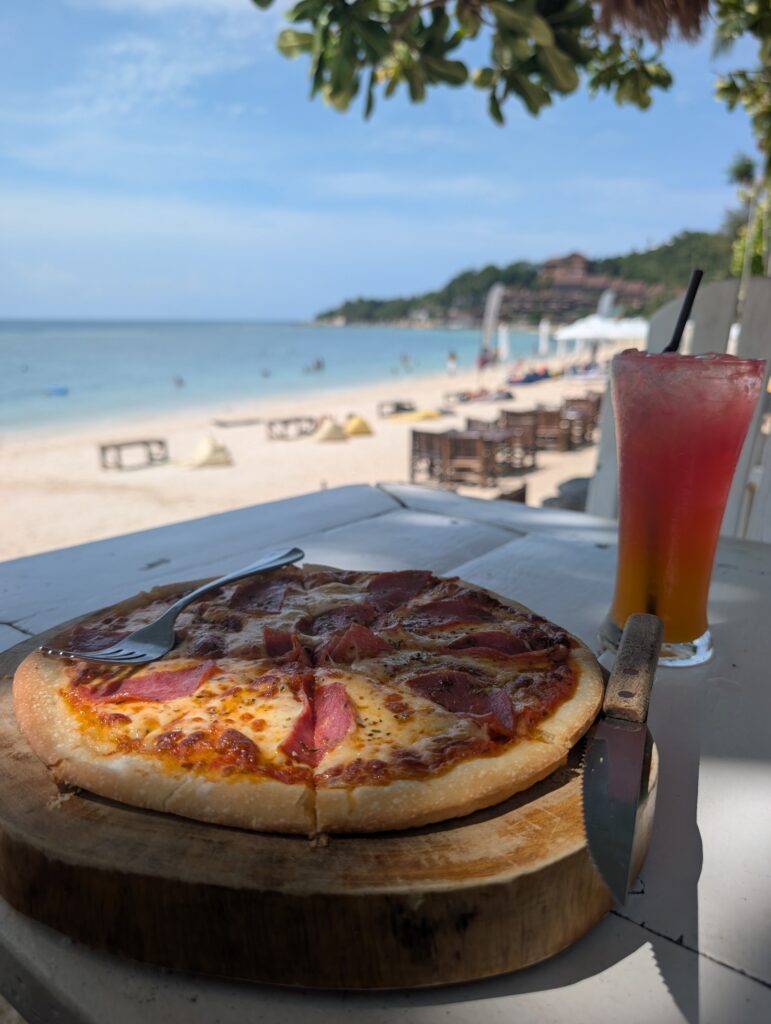
That picture captures the kind of thing I mean when I talk about quality of life.
There is nothing particularly extravagant about it. I am sitting by the beach eating pizza and having a drink. But I can remember moments like that where I was looking out at the water and thinking about how different my relationship with work had become.
I did not need to be rushing back to a desk.
I did not need to feel guilty that I was not working.
I could just be there.
Safety has also affected my quality of life more than I expected.
I am careful about how I talk about this because no country is completely safe and everybody’s experience is different. What I can say is that my personal experience of Bangkok has changed how freely I move through a city.
There are nights when I finish working at 2 or 3 AM and decide I want something to eat.
I can walk outside.
I can sit at a nearby restaurant, have something to eat or drink and then walk home.
That kind of freedom feels normal once you have been doing it for a while, but I do not take it for granted.
I have lived in places where crime affects the decisions people make every day, even when they do not consciously think about it. You think about what time it is before leaving home. You think about where you are parking. You think about which street you are taking. You think about whether you should have your phone out. You think about whether somewhere is worth going at all.
Those calculations use mental energy.
When enough of them disappear from everyday life, you notice the difference.
The same is true of many smaller things here. Being able to get food easily. Having reliable internet. Being able to pay digitally almost everywhere. Having parks nearby. Having gyms, pools, massages and wellness services that are accessible enough to become part of a regular routine instead of an occasional treat.
None of those things individually transformed my life.
Together, they changed the texture of it.
I spend more time outside.
I exercise more consistently.
I rest more.
I travel more.
I have more days where I can decide what I feel like doing rather than what I have to do.
That has probably been one of the biggest surprises of the move.
I originally came to Thailand because I wanted a new environment professionally. I wanted exposure to Asia, technology, different business ecosystems and new ways of thinking.
I got all of that.
But the environment also changed how I live when I am not working, and that has turned out to be just as valuable.
I have more control over my time, more room to take care of myself and less everyday friction competing for my attention.
That is what improved quality of life has looked like for me.
My Health Changed With My Environment
One of the most visible changes from the last two years has been my health.
When I was preparing to leave Trinidad and Tobago, I had gotten as high as roughly 260 lbs. The earlier photo I am using here was taken around 250 lbs. Today, I am sitting around the low 210s, with the more recent photo at about 218 lbs.
That change did not come from moving to Thailand and suddenly becoming a completely different person. What changed was the environment around me and how much easier it became to build healthier habits into normal life.
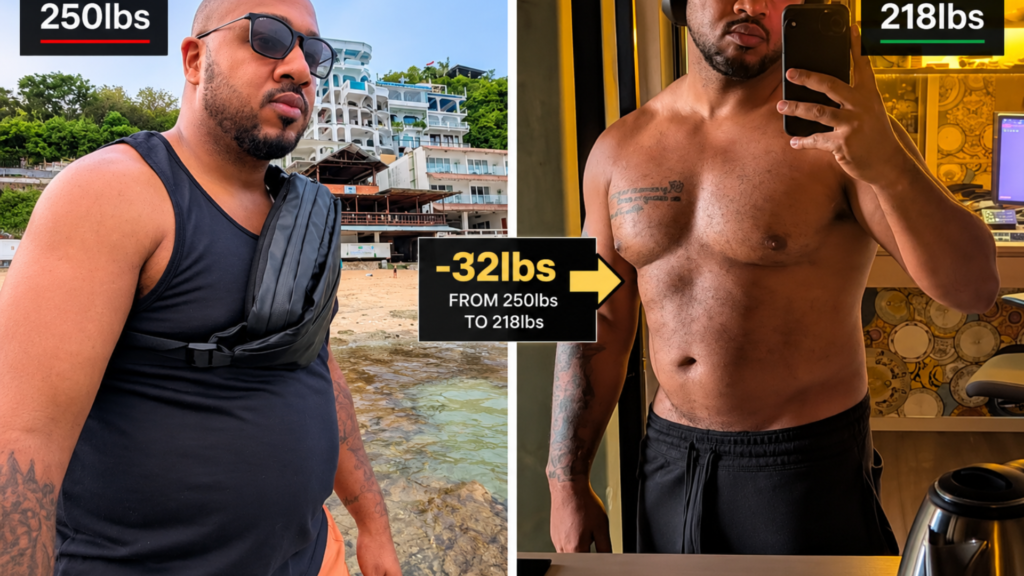
The physical difference between two stages of the journey. I had reached roughly 260 lbs before leaving Trinidad and Tobago; these photos show me around 250 lbs in 2025 and, more recently, 218 lbs in Thailand in 2026.
I have easier access to gyms, swimming, parks and places where I actually want to be active. Benjakitti and Lumpini have become part of my routine for walking and running. I swim at my condo. I go to the gym regularly. None of those activities require some major logistical plan.
They are simply available.
Food has also been easier to manage than I expected. Thailand gives me access to affordable prepared food, fresh meals, fruit and healthier options without forcing me to cook every day. Since I have already admitted that cooking is not something I particularly enjoy, having good food readily available makes it much easier for me to make choices that fit the way I actually live.
But I think time has played just as big a role as anything else.
When I was living in a more expensive environment, there was always more pressure to work, earn and keep pushing. Reducing my cost of living gave me back some of that time. I can spend two hours swimming. I can go to the park. I can train without feeling as though I should be somewhere else making money. I can take a midday nap if my body needs it.
Health stopped competing with work quite as much.
I also started paying more attention to how my body felt rather than treating exercise as something I needed to force into an already overloaded schedule. Some weeks I run. Some weeks I walk more. Some days I swim. Some days I train in the gym. The consistency has come from having several options rather than depending on one rigid routine.
That has made the progress much more sustainable.
And the benefits have gone beyond the number on the scale.
I feel stronger. I move better. I have more energy. I spend more time outside. Exercise is now part of how I structure my week rather than something I constantly feel guilty about not doing.
There is also an interesting connection here to the reason I moved to Thailand in the first place.
I kept talking about wanting to put myself in an environment that could pour back into me. At the time, I was thinking heavily about business, technology, new ideas and professional growth.
I did not fully appreciate how much an environment could pour back into me physically as well.
Thailand gave me access to a lifestyle where taking care of myself became easier to sustain because the things I needed were already woven into everyday life.
I still have work to do, and I am still pushing toward better health and fitness.
But when I look at the difference between where I started and where I am now, it is one of the clearest examples of how much your environment can shape your behaviour.
How Does My Life Feel?
One of the biggest changes in the last two years has been the way I measure success.
For a long time, success was easy to frame in the usual ways: income, business growth, the size of the opportunity, the next project, the next milestone. Those things still matter to me. I am still ambitious. I still want to build, grow and create more.
But I think much more now about a different question:
How does my life feel?
That question has become a better filter for me than simply asking whether I can afford more.
I live in a 32-square-metre, one-bedroom condo. It is not huge, and I do not need it to be.
I could spend the same money differently and get considerably more space somewhere else. I could rent a larger apartment or even a house. But then I would probably start filling that extra space with more things simply because the space existed.
I do not need that.
I live alone. My home works for the way I live. I have a comfortable place to sleep, a proper workspace, everything I need around me and a location that makes sense for my routine.
That is enough.
Moving to Thailand has made me think much more carefully about the difference between having more and living better.
For me, living better means I can eat well without constantly calculating the cost of every meal. It means I can go to the gym, swim, get a massage or spend a few hours at an onsen without those things feeling like major financial decisions.
It means somebody can message me and say, “Let’s go somewhere,” and most of the time I can think about whether I actually want to go rather than immediately asking myself what it is going to cost.
It means travel can be spontaneous.
It means I can take a few days off without feeling like every hour away from work is costing me money.
It means I can have time.
That last one has probably become the most valuable.
In higher-cost environments, so many decisions eventually lead back to money. How much do I need to earn? How much is the rent? How much is the mortgage? How much does it cost to go out? How much do I need to make this month just to keep the entire machine running?
Once the basic cost of maintaining your life gets high enough, it starts influencing almost everything else.
You choose work based on what you need to earn.
You tolerate projects because you need the income.
You work longer because the bills demand it.
You postpone rest because rest begins to feel expensive.
I have lived versions of that life before.
Thailand has given me enough financial breathing room to make different choices.
I can still chase bigger opportunities, but I do not have to chase every opportunity.
There is a difference.
If I do not like a project, I have more room to say no. If I want to spend an afternoon doing absolutely nothing, I can. If I want to spend two hours swimming or take a few days and go somewhere else in Thailand, I do not need to justify it as some kind of productivity exercise.
Sometimes I am just enjoying my life.
That sounds obvious, but I think a lot of adults build lives where enjoyment has to be scheduled around everything else.
I have become much more protective of the opposite.
I want work to support the life I am building. I do not want to build an entire life whose only purpose is supporting more work.
That does not mean I have stopped caring about money. Quite the opposite. I think much more carefully now about what money is supposed to do for me.
I want it to buy freedom from unnecessary pressure.
I want it to give me choices.
I want it to create experiences, time, health, learning and the ability to move when I decide something else would be better for me.
I am far less interested in accumulating things just so the outside of my life looks impressive.
Thailand has made that easier to see because the lifestyle that makes me happiest here is actually quite simple.
I have my home.
I have my work.
I have access to good food.
I can train, swim, walk, travel and spend time with people I enjoy.
I can wake up and decide how I want the day to look more often than I ever could before.
There are obviously bigger things I still want to accomplish, but I no longer believe the reward for accomplishing them has to be a more expensive version of my life.
If anything, I want the opposite.
I want to keep increasing the amount of control I have over my own time.
So when I think about whether this move has been successful, I do not start with the size of my condo, the amount of money I earn or how many things I own.
I ask myself a much simpler question.
How does my life feel?
Right now, it feels good.
Geo-Arbitrage Changed the Financial Equation
One of the concepts that became much more real to me after moving to Thailand is geo-arbitrage.
The simplest way I understand it is this: my income does not have to be generated in the same economy where most of my expenses are paid.
My business serves clients across the Caribbean and diaspora. Some of that income is tied to stronger currencies and international markets, while my day-to-day living costs are based in Thailand. That creates a very different financial equation from earning and spending everything inside the same high-cost environment.
The value of that gap became obvious very quickly.
I am not talking about trying to live as cheaply as humanly possible. I did not move to Bangkok to sit in the smallest apartment I could find, eat instant noodles and tell everybody how little money I spend.
I wanted a good life.
I wanted a comfortable home, reliable internet, good food, access to gyms and wellness, the ability to travel, and enough space in my schedule to actually enjoy where I was living. Thailand allowed me to build that kind of life while keeping my fixed expenses considerably lower than they would be in many other places.
That is where geo-arbitrage becomes powerful.
If I earn more money next month, my rent does not suddenly increase because my income increased. My internet does not become more expensive. My electricity bill does not care that I landed another project.
The gap between what it costs me to maintain my life and what the business is capable of earning can grow.
That gap creates options.
I can save more.
I can invest more into the business.
I can buy better equipment.
I can pay for courses, travel to learn from another market or attend something that expands my thinking.
I can take care of myself.
I can also decide that I have earned enough for the month and stop working.
That last part is probably one of the biggest changes for me.
In a high-cost environment, earning more can easily become less about growth and more about keeping pace with the life you have built around yourself. Your income increases, your expenses increase, your lifestyle expands, and eventually you are working harder just to maintain everything.
I have become much more conscious of avoiding that.
My goal is not to continually inflate the amount of money required to keep Keron alive every month.
I would rather increase what I can earn while being intentional about what it costs me to live well.
That changes the relationship I have with work.
If my basic life requires less money to maintain, I do not have to accept every client. I do not have to fill every open space in my calendar. I can turn down work that is not interesting, does not pay enough or simply does not fit the direction I want the business to go.
That flexibility has value.
It is difficult to make strategic decisions about your career when every decision is being made under financial pressure. Sometimes you know a client is wrong for you, but you need the money. Sometimes you know you should spend time learning a new skill, but you cannot afford to reduce your workload long enough to do it. Sometimes you need rest, but the bills do not care.
Lowering the cost of maintaining my life gave me more room between those pressures and the decisions I make.
That is why I keep coming back to the word headroom.
When I say Thailand gave me more headroom, I am talking about more than disposable income. I mean financial room, mental room and time.
The ability to step away from the computer.
The ability to spend a few days somewhere else.
The ability to invest in an idea before it makes money.
The ability to learn something simply because I think it will make me better three years from now.
The ability to say no.
Those things are difficult to put into a cost-of-living calculator, but they have probably been worth more to me than the savings themselves.
It also changed how I think about financial independence.
For years, a lot of conversations about building wealth focus almost entirely on increasing income. Obviously income matters. You cannot save or invest money you do not have.
But there is another side of the equation.
What does it cost to maintain the life you actually want?
If you can develop skills that allow you to earn internationally and then choose to live in an economy where your money stretches further, the amount of income required to create a comfortable life can change dramatically.
That does not mean everyone should move to Thailand. It does not even mean Thailand will always be the right answer for me.
The principle is bigger than the country.
My digital skills gave me the ability to separate where I earn from where I live.
Once those two things were no longer automatically tied together, I could start asking a different question: where does my income give me the best combination of quality of life, opportunity, learning, safety, freedom and room to build?
For this chapter of my life, Thailand has answered that question extremely well.
And that is the part of geo-arbitrage I find most interesting.
The goal was never simply to make my life cheaper.
It was to make the resources I already had work harder for me, so I could spend less of my life chasing the money required just to maintain it.
The Caribbean Needs to Start Looking East
One of the biggest shifts in my thinking since moving to Asia has been realizing how narrow our benchmarks can become in the Caribbean.
For decades, many of us have instinctively looked to the United States, Canada and the United Kingdom when we think about opportunity, careers, education, technology, migration and professional success. I understand where that comes from. Canada played an enormous role in my own development. It is where I grew up, entered the technology industry and got some of my earliest exposure to major companies and large-scale systems.
Living in Asia did not make me stop valuing any of that. It made me realize that my field of vision needed to be much wider.
China was probably the biggest jolt.
Being there changed some of my assumptions about where I should be looking to understand the future of technology. I was seeing digital payments, automation, robotics, delivery systems, consumer technology and infrastructure being deployed at a level that made me reassess the benchmarks I had been using in my own career.
A good example came when I attended Mobile World Congress 2025 in Barcelona and spent time at Huawei’s exhibition. Huawei had a concept showing how a drone and a ground robot could work together to solve a delivery problem. The drone handles one part of the journey, then a robot takes over the final leg and brings the package farther into the building or directly to its destination. In the demonstration I filmed, the use case involved healthcare products. Huawei’s wider MWC presence that year included dozens of industry digitalization showcases across sectors including healthcare, transportation and public services.
What caught my attention was not simply that somebody had built a drone and a robot.
I had already spent time in China and seen how seriously the country was approaching autonomous delivery and other forms of automation. So when I saw this concept, my brain immediately went to the next problem: if a drone can bring a package to a building, what happens when the customer lives twenty floors up?
That is where the robot becomes interesting.
I remember filming it and thinking that I did not know whether that exact system would eventually become commercially viable. There were plenty of questions I could not answer from a demonstration on an exhibition floor.
But after spending time in China, I also knew I would not casually dismiss it.
That experience captures a lot of what I mean when I tell Caribbean professionals that we need to start looking East.
The value of being exposed to these ecosystems is not that every prototype becomes the future. It is seeing the kinds of problems companies are already trying to solve, the scale at which they are thinking and the technologies they are combining to create new products and services.
That begins to change your own questions.
If you work in logistics, what happens when autonomous vehicles, drones and robotics start working together?
If you work in healthcare, what happens when those systems affect how medicine, equipment or samples move between facilities and patients?
If you work in retail, payments or e-commerce, what happens when the transaction, fulfilment and delivery layers all become more automated?
And if you are building your career in any of those industries, what skills will the people designing and operating those systems need?
Those are the kinds of questions I want Caribbean professionals asking.
The same applies well beyond technology. If you work in tourism, study what Asian destinations are doing with infrastructure, experiences and culture. If you work in manufacturing, logistics, beauty, automotive, hospitality, media, AI or the creator economy, there are companies and professionals across this region that should be part of your professional education.
You do not need to relocate to Asia to start doing that.
You can follow the companies. Read their reports. Watch their product launches. Study their executives. Look at the job descriptions they are posting. Pay attention to the technologies being deployed and then compare those requirements with your own skills.
What I would not do anymore is assume that the most useful benchmark automatically has to come from North America or Europe.
That is one of the things living in Bangkok has given me: proximity to a part of the world I previously did not study deeply enough.
I can travel through the region and see how different countries approach the same problems. I can experience products as a customer. I can watch technologies move from something that looks unusual to something people use without thinking about it.
Then I bring those observations back into my own work.
They influence what I research, what I write about, what I discuss on radio and television, what I teach in workshops and what I tell businesses and professionals they should be paying attention to.
For somebody from a small Caribbean market, that exposure is valuable because our immediate surroundings cannot possibly show us everything happening in the global economy.
Our benchmarks have to be bigger than our borders.
That does not mean the Caribbean needs to stop looking West. Canada, the United States and the United Kingdom will continue to matter enormously for our region.
I just think we need to stop looking in only one direction.
Digital Skills Are the Real Passport
If there is one idea that connects almost everything I have learned from the last two years, it is that the most valuable thing I carried to Thailand was not a passport, a laptop or a particular amount of money.
It was a skill set that allowed me to keep earning after I changed countries.
That is why, when people ask me about becoming a digital nomad or building a more flexible life, I usually bring the conversation back to skills before I talk about travel.
Buying a plane ticket is easy. Building an income that still works after the plane lands somewhere else takes much longer.
I had already spent years building skills in e-commerce, digital marketing, websites, research, content, strategy, online payments and digital business before I moved to Bangkok. Those skills became the infrastructure underneath everything else I have described in this article.
They are why my clients do not have to live where I live.
They are why I can operate a Caribbean-focused business from Thailand.
They are why moving countries did not mean starting my career again.
And they are why I think Caribbean professionals need to pay much closer attention to what is happening in the global labour market.
I would not tell somebody with a good job to resign tomorrow, buy a MacBook and announce on LinkedIn that they are now a digital nomad.
I would tell them to start researching.
The World Economic Forum’s Future of Jobs Report 2025 estimates that structural changes in the labour market could create approximately 170 million jobs by 2030 while displacing around 92 million, producing a net increase of about 78 million jobs. World Economic Forum
When I look at numbers like that, my first reaction is not fear.
I want to know what the new jobs are.
I want to know which ones are growing.
I want to know what people working in those roles need to understand, which tools they are using and what skills employers are looking for.
Because somewhere inside 170 million new jobs are opportunities that did not exist in the same form a few years ago.
That is where career planning should begin now.
The old approach was often to choose a profession, get the qualification and then spend decades building around that choice. The labour market we are entering is moving too quickly for most people to assume that the skills that got them into their current role will automatically carry them through the next ten or twenty years.
The better habit is to keep watching the market.
That is why reports from platforms such as Coursera and Udemy have become part of the research I regularly recommend.
Coursera’s 2026 Job Skills Report draws on learning behaviour from nearly six million enterprise learners across roughly 7,000 organizations. Its data shows how quickly AI-related learning is growing, but it also shows demand for skills such as critical thinking alongside technical and AI capabilities. Coursera
Udemy’s 2026 Global Learning & Skills Trends Report tells a similar story from another dataset. Its research, based on more than 17,000 enterprise customers, points toward growing demand for AI fluency while also showing increased learning around human capabilities such as critical thinking, communication, decision-making and leadership. Udemy Business
I pay attention to reports like these because they give me signals.
I am not looking at one list and saying, “This is the career everybody needs to pursue.”
I am looking for patterns.
What keeps appearing?
Which technologies are changing how work gets done?
Which human skills become more valuable as technology improves?
Which occupations are growing?
What are millions of other professionals learning?
Then I can compare those signals with where I am today and decide what I need to learn next.
That process is something almost anybody can begin while they are still employed.
You do not have to blow up your current life to prepare for a different one.
Keep your job.
Keep earning.
But start studying the market around your job.
If you discover a role that interests you, research ten job postings for it. Look at the requirements. Look at the software. Look at the certifications. Look at the experience employers repeatedly request.
Then build backward from there.
Maybe the transition takes six months.
Maybe it takes two years.
That is fine.
The point is that you are deliberately building toward something instead of waiting until the labour market forces you to react.
I recently built an entire workshop around this idea with the Telecommunications Authority of Trinidad and Tobago as part of the Empowering Men with AI Skills programme.
The companion resource, Build Your Future in the AI Economy, takes people through the same process I keep encouraging: understand where the labour market is moving, expand your awareness of careers that now exist, identify the skills those opportunities require and begin building a practical pathway forward.
If you are reading this and do not know where to begin, start there:
Build Your Future in the AI Economy — Keron Rose
I created that resource because one of the biggest problems I see is that people cannot prepare for opportunities they do not know exist.
The internet has dramatically expanded the size of the job market available to us, but many people still think about employment almost entirely through geography.
They ask, “What jobs are available in Trinidad?”
Or Jamaica.
Or Barbados.
Or wherever they happen to live.
That is still an important question, but it should no longer be the only one.
If your work can be delivered digitally, the employer may not need to be in your country.
Your client may not need to be in your country.
Your customer may not need to be in your country.
That does not mean every career can suddenly become remote or that borders have disappeared. They have not. Employment regulations, tax systems, payment access, time zones and hiring policies still exist.
But the potential market for many skills is larger than it has ever been.
That changes how I think about career development.
If somebody in the Caribbean can develop a skill that companies around the world are willing to pay for, then their economic opportunity is no longer determined entirely by the size of the economy immediately around them.
That was true for me before I moved to Thailand.
The move simply proved how far the principle could go.
My business remained connected to the Caribbean even after I moved almost halfway around the world because the value I provide can travel digitally.
That is what I mean when I say digital skills are the real passport.
A physical passport determines which borders you can cross.
A portable skill set determines what you can do once you get there.
And when those skills can generate income independently of your location, the number of choices available to you starts to expand very quickly.
You may never want to live in Thailand.
You may never want to become a digital nomad.
You may want to spend the rest of your life in the Caribbean.
That is perfectly fine.
The opportunity is still the same.
Build skills that increase the size of the market you can participate in.
Keep studying where work is going.
Keep updating what you know.
And make sure the next version of your career gives you more options than the one you have today.
I Am Not Telling People to Move to Thailand
One thing I am always careful about when I talk about living in Thailand is that I am not trying to convince anybody to copy my life.
I am documenting what I am doing.
That is an important difference because this move did not start with some grand mission to prove that everybody in the Caribbean should become a digital nomad or relocate to Asia. I made a decision that made sense for me, based on where I was in my career, what I wanted to learn, how I wanted to live and the kind of business I had already spent years building.
Then I started sharing what happened.
People have been able to watch that progression for a long time. Droid Island started in 2016. By 2018, my business was fully digital. By 2019, I was talking much more publicly about e-commerce, digital payments, online business, digital skills and the opportunities that become available when your income is not completely tied to one physical location.
Years later, I eventually moved to Asia.
Now I have two years of living in Thailand behind me, running the same business, serving many of the same markets and continuing to build from the other side of the world.
That history matters because none of this appeared overnight.
I did not land in Bangkok, take some pictures at a rooftop bar and suddenly start telling people how to become digital nomads.
People have watched the process develop over years.
They saw the businesses.
They saw the mistakes.
They saw me learning payment systems, building websites, teaching e-commerce, doing workshops, writing articles, speaking about digital transformation and constantly pushing people to develop skills that could give them more options.
Then they watched me take those same ideas and test them in my own life.
That is probably why the move has created so many conversations.
I am not presenting a theory anymore. I am showing one possible outcome of building this way over a long period of time.
Some people will look at my life and think, “I could never live that far away from home.”
That is fine.
Somebody else might look at it and start wondering whether they could spend a few years abroad.
Another person might never leave the Caribbean but decide they want a job that lets them work remotely.
Somebody else may simply decide they need to build a skill that gives them more bargaining power in the career they already have.
Those are all valid outcomes.
The point has never been Thailand.
The point is that there are more ways to structure a life than many of us were originally shown.
My family has experienced that with me as well. They have come to Thailand, seen the life I built here and experienced parts of Asia themselves. One of my favourite moments was taking my mother to an elephant sanctuary in Phuket.
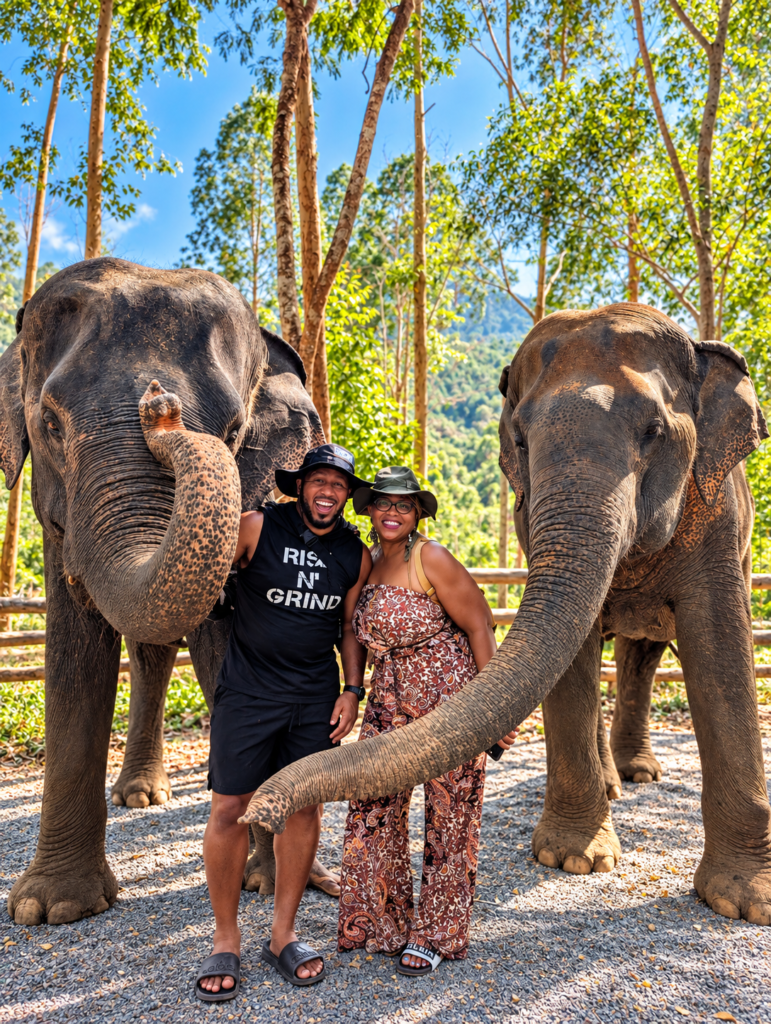
That picture means more to me than simply having another travel photo.
My mother left Trinidad and Tobago with me when I was only a few months old and started a new chapter of our family story in Canada.
Decades later, I ended up becoming the first person in my immediate family to establish myself in Asia.
Now she gets to come here and experience a world that probably was not part of the family map when I was growing up.
That is part of what an alternative path can do.
It expands what feels possible.
I have had people from the Caribbean, the UK, Europe, Africa and the United States follow the journey over the last few years. Some have reached out because they were considering Thailand. Others were looking at different parts of Asia. Some eventually made their own moves.
I take that seriously, which is another reason I try not to romanticize the experience or tell people what they should do.
My circumstances are mine.
My business was already portable before I moved. I had years of experience behind me. I had figured out how to receive money internationally, how to serve clients remotely and how to operate without needing to be physically present in one market.
Someone starting from a completely different position may need a completely different path.
What I can do is show them that another path exists.
That has been one of the most interesting things about documenting my life publicly for so long.
You do not always need to convince people with an argument.
Sometimes you just build something, live it long enough for people to see how it works, and let them decide what parts of it are useful for their own lives.
That is how I think about Thailand now.
I am not saying, “Move here.”
I am saying, “Look at what became possible once I built the skills, systems and income that allowed geography to become a choice.”
What somebody does with that information is entirely up to them.
Migration Has Become Part of My Family Story
Migration has always been part of my life, even before I was old enough to understand what it meant.
I was born in Trinidad and Tobago, but when I was only a few months old, my mother moved with me to Canada. That decision shaped everything that came after. Canada became the place where I grew up, where I went to school, where I entered the technology industry and where a large part of my worldview was formed.
At the time, of course, I had no say in any of it. My mother made the decision she believed would create a better environment for us.
Decades later, I found myself making a similar decision for my own life.
After spending 28 years in Canada and then another decade back in Trinidad and Tobago, I moved again, this time to Thailand.
That move made me the first person in my immediate family to establish a life in Asia.
There is something interesting about that when I think about the full arc of it.
My mother took me from the Caribbean to North America when I was a baby. Years later, I moved from the Caribbean to Asia and created another place in the world that now feels familiar to our family.
Thailand is no longer just somewhere they hear me talk about.
They have been here.
They have seen where I live, travelled around the country, experienced the food, the culture, the cities and the places that have become part of my everyday life.
That has probably been one of the most rewarding parts of building a life here.
I get to share it.
When my family visits, I am not showing them a destination I researched for a holiday. I am showing them my neighbourhood, my routines, places I actually go and the environment I chose to build this chapter of my life in.
That creates a completely different feeling.
It also makes me think about migration differently.
For many Caribbean families, migration has historically meant leaving for somewhere like Canada, the United States or the United Kingdom. Those routes became familiar over generations because somebody went first, established themselves, and then other family members suddenly had a connection to that place.
Asia was never really part of our family map in that way.
Now it is.
That does not mean everybody is about to pack their bags and move here, but the psychological distance has changed. Thailand is no longer some abstract place on the other side of the world. It is somewhere they have been. Somewhere they understand a little better. Somewhere they know I can build a life.
There is a generational symmetry in that which I appreciate more as I get older.
My mother made a decision early in my life to put us in an environment she believed would create more opportunity.
Years later, I have done the same thing for myself.
The destination is different, the circumstances are different and the opportunities I am chasing are different, but the underlying instinct feels familiar.
Put yourself where you believe you can grow.
I have become very comfortable with that philosophy.
I do not believe I need to remain somewhere simply because it is familiar, because other people expect me to stay there or because leaving creates distance.
If I believe another environment will make me better, expand my thinking, improve my quality of life or give me more room to build, I am willing to go.
That choice is not about abandoning the people I care about.
I actually see it the opposite way.
When I put myself in the best possible situation, the people around me get a better version of me.
They get somebody with more energy.
More perspective.
More resources.
More experiences to share.
More opportunities to introduce them to.
That has already started happening.
My family has now experienced a part of the world that might never have entered our lives in the same way if I had not moved here first.
And who knows what that changes over time.
Maybe someone comes back.
Maybe a younger family member eventually studies somewhere in Asia.
Maybe somebody works here.
Maybe it simply changes the way they think about where opportunity can exist.
That is how migration works sometimes.
One person moves, and the map gets a little bigger for everybody else.
My mother did that for me when I was a baby.
Now, in my own way, I have done it again for the family.
My Life Needs to Be Portable
Two years into living in Thailand, I do not know whether Bangkok will be home forever.
And I am completely comfortable with that.
I did not move here looking for the final destination of my life. I moved because Thailand made sense for the person I was becoming and the things I wanted to build. Right now, it continues to give me an excellent combination of quality of life, affordability, access to Asia, technology, new experiences and enough room to keep developing personally and professionally.
Five years from now, I may still be here.
Or I may not.
The more important thing I have learned is that I want my life to be able to move when I do.
Before Thailand, I already knew intellectually that my business was digital. I had spent years working online, building websites, serving clients remotely, creating content and using digital payment systems. But there is a difference between knowing something should work and testing it thousands of miles away from everything familiar.
The last two years have been that test.
I know now that I can build from Bangkok.
I can serve a client in the Caribbean while sitting in Thailand. I can write an article from Asia that gets published back home. I can appear on Caribbean television from my condo. I can run workshops, advise companies, host conversations and continue building Digipreneur without needing my physical location to match the market I serve.
And because Thailand is my base rather than my boundary, I have been able to explore more of Asia while continuing to work.
China has been especially important in that journey.
One of the photos I keep coming back to was taken in Shanghai. Looking at the location information and the storefront visible in another photo from that day, I was in the Yuyuan Bazaar / Yu Garden area in Shanghai’s Huangpu District, part of the city’s historic Old City.
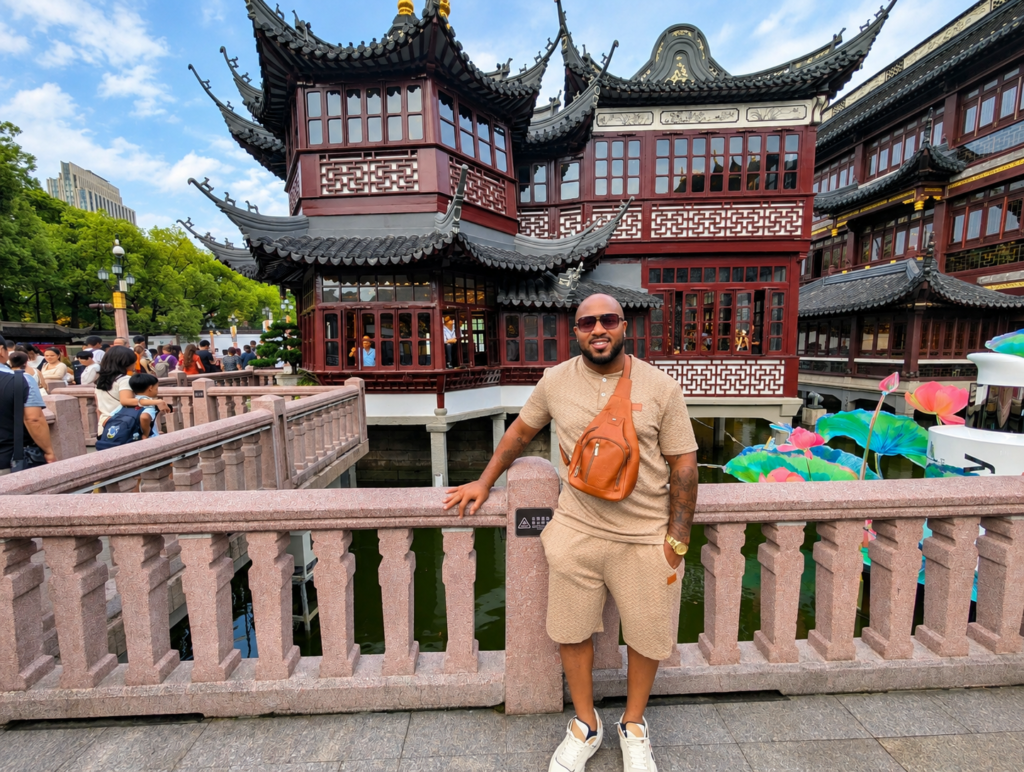
That picture works as a good closing image for this story because it represents something much bigger than another country checked off a travel list.
Two years ago, Asia still represented a new chapter for me.
Now I can be standing in an old part of Shanghai, surrounded by traditional architecture inside one of the most modern cities in the world, and that experience becomes part of the knowledge I take back into my work.
I can go somewhere, observe, learn, return to Bangkok and keep building.
That is the kind of portability I care about now.
When people hear the words digital nomad, there is still a tendency to imagine somebody endlessly jumping between countries with a backpack and a laptop.
I have discovered that I want almost the opposite.
I like having a home.
I like having routines.
I like knowing my neighbourhood.
I like having my gym, my restaurants, my pool, my friends and a familiar place to return to after travelling.
What I want to remain portable is the part of my life that creates my choices: my ability to earn.
If Thailand stopped making sense for me one day, I would not want the decision about what comes next to begin with, “But how would I make money?”
I want to be able to ask better questions.
Where will I learn the most?
Where will I have the quality of life I want?
Where does the next version of my business make sense?
What environment do I need at that stage of my life?
Where can I put myself that will continue pouring something back into me?
That is a radically different way to think about geography.
It is also why I believe this conversation matters for Caribbean professionals even if they have absolutely no intention of becoming digital nomads.
Imagine someone spends five years in an ecosystem somewhere in Asia, develops new technical skills, works with companies operating at a different scale, lowers their expenses, builds savings, creates an international network and sees industries through an entirely different lens.
They can still go home.
In fact, they may eventually return to the Caribbean with considerably more to contribute than when they left.
More knowledge.
More confidence.
More capital.
More connections.
A wider understanding of how other markets operate.
I think sometimes we treat leaving as though it must represent rejection, or returning as though it means the time away failed.
I do not see it that way.
There can be seasons to a life.
Canada gave me one season. Trinidad and Tobago gave me another. Thailand is giving me another now.
Each place added something.
And wherever I go next, I want to carry those experiences with me rather than having my entire life collapse because I crossed another border.
That is what these two years have proved to me.
The goal was never simply to escape a location.
It was to build enough flexibility that location became one of the choices I could make.
I can stay.
I can leave.
I can travel.
I can come home.
I can build another home somewhere else later.
The business can keep moving with me.
And after two years of actually living this rather than simply talking about it, I can reduce much of the journey to one idea:
Digital skills created portability. Portability created optionality.
Thank you for sharing. You are an inspiration. I’ve also learnt a lot from you.
I am a graphic designer. However, since the availability of AI and it’s wide spread free usage, business has been challenging. The pivot is process. I am currently looking for new ways to offer my services. Keep up the good work. God bless your journey.