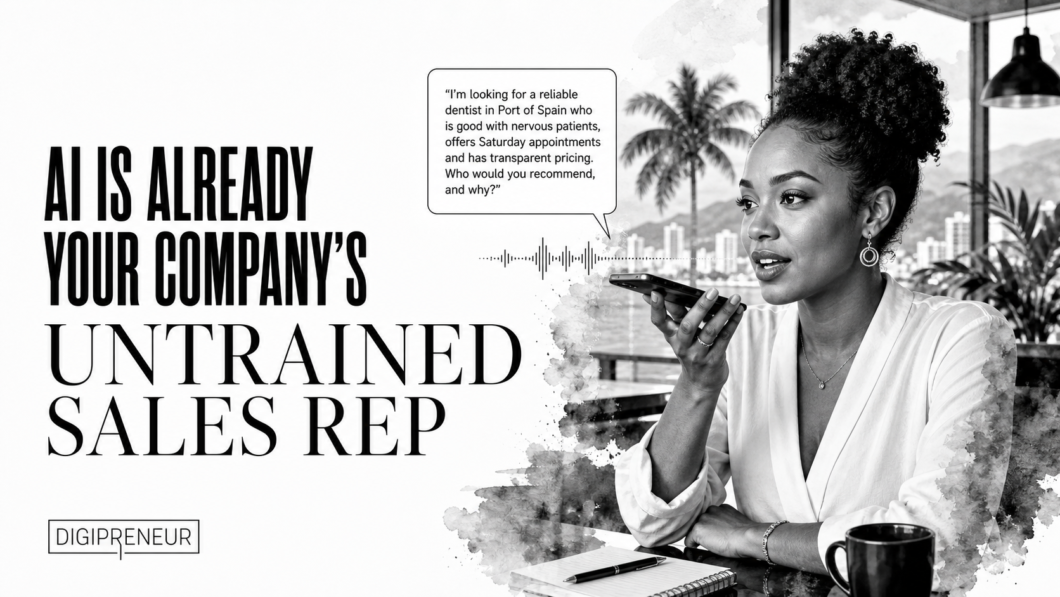
The Invisible Sales Conversation
AI is already acting as a sales rep for your company, conducting conversations with customers you have never met.
You are not in the room.
It was never onboarded. It has no approved script. Yet it may decide whether your company makes the shortlist.
A potential customer can ask ChatGPT, Gemini, Claude or another AI assistant to research a problem, compare providers and recommend the company that best fits their circumstances. The response may explain your services, assess your reputation, identify possible disadvantages and compare you with competitors.
All of this can happen before the customer visits your website, follows your company or contacts anyone on your team.
Your company never approved the message being delivered. The AI is working from whatever information it can find, including your website, business profiles, customer reviews, media coverage and third party references. When that information is incomplete or outdated, the system still has to produce an answer.
Companies must therefore build the knowledge, evidence, authority and digital infrastructure that support accurate representation.
Understanding this responsibility begins with recognising how search and information seeking have changed.
What AI Representation Means
AI representation is the way artificial intelligence systems discover, interpret, describe, compare and recommend a company using the information and evidence available across the internet.
It happens whenever an AI system uses public information to answer a question about a business, product, service or professional. The resulting answer becomes the version of the company presented to the person asking the question.
Several related concepts help explain how this process works.
AI visibility describes whether the company appears within an AI generated answer.
AI representation concerns what the system says about the company once it appears. That description may be accurate, incomplete, outdated or misleading.
AI recommendation occurs when the company is suggested for a particular customer, problem or situation.
AI readiness reflects whether the company has enough accessible information, credible evidence, authority and digital infrastructure to support accurate interpretation.
AI influenced demand includes customer interest, enquiries, purchases or other actions shaped by an interaction with an AI system.
A company can therefore have AI visibility while being represented poorly. It can also be described accurately without receiving a recommendation because the available evidence does not establish enough relevance or trust for that particular question.
This is what allows AI to function like an unofficial sales rep. It can introduce the company, explain its value and influence whether the customer continues investigating, all before anyone from the business becomes involved.
Search Has Changed Shape
Search is expanding across more interfaces and becoming increasingly conversational.
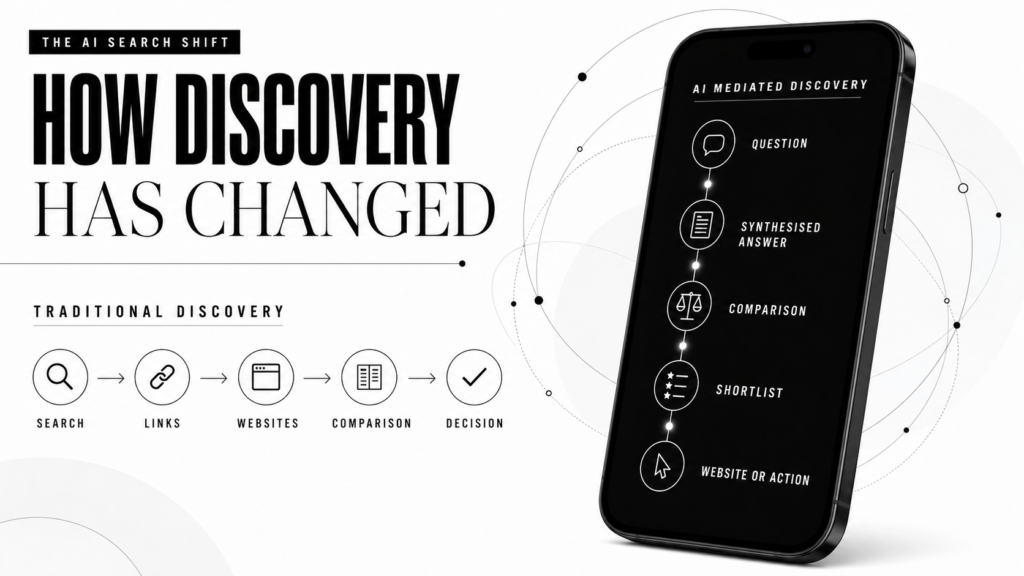
Traditional search usually began with a few keywords. Google returned a page of links, and the person moved between websites, videos, reviews and social media profiles before comparing the available options.
That journey remains important, but it now operates alongside a growing range of answer engines and AI assistants.
People are asking longer and more detailed questions inside ChatGPT, Gemini, Claude, Perplexity, Copilot and Google AI Mode. They can include their location, budget, existing technology, business size, objectives and concerns within a single question. AI can then research the subject, organise the available information and produce a response shaped around that context.
These capabilities are also being integrated into browsers, operating systems, phones and applications people already use. Information seeking no longer depends on someone deliberately visiting a traditional search engine.
The scale of this behaviour is already significant. In June 2026, Google reported that AI Overviews had more than 2.5 billion monthly users and AI Mode had surpassed one billion. Google also said its generative AI search features were encouraging people to search more frequently.
More searching does not guarantee more website traffic.
A Pew Research Center study found that users clicked a traditional result during 8 percent of Google visits when an AI summary appeared. When no summary appeared, that figure increased to 15 percent.
Pew also found that 8 percent of searches containing one or two words produced an AI summary, compared with 53 percent of searches containing ten words or more. Question based searches generated summaries particularly often.
People continue using Google and visiting websites. The change is that more research, explanation and comparison can happen before the visit.
For businesses, the sales rep shaping that first impression is now an AI generated answer assembled from several sources.
The Customer May Meet Your AI Representation First
Consider a business owner who asks an AI assistant:
“I operate a company with 40 employees. We need a CRM that works with our accounting software, offers local support, fits our budget and can be implemented within three months. Which companies should we consider?”
This question gives the AI enough context to conduct detailed commercial research.
It may begin by examining the CRM category and identifying providers that appear relevant. It can compare product features, pricing, integrations, implementation requirements and customer support. It may summarise reviews, explain the strengths and weaknesses of each provider and remove options that do not fit the customer’s circumstances.
The customer can then ask follow up questions.
Which provider has the best reputation? Which one works within this country? What problems do customers frequently report? Which option would be easiest for the team to adopt? Are there implementation partners available locally?
Each response can refine the shortlist. The AI may eventually recommend two or three companies and direct the customer towards a product page, consultation, trial or purchase.
The companies being evaluated may know nothing about this activity. They cannot see the original question, the providers being compared, the objections raised or the reasons one company was recommended over another.
This is the invisible presale.
A detailed sales conversation is taking place before the customer enters a company’s website, analytics, CRM or sales pipeline. In practice, the AI is performing part of the work traditionally associated with a sales rep. It is explaining the market, evaluating suitability and helping the customer decide what to do next.
The company’s public information is participating in that conversation even when its employees are absent.
Buyers Are Forming Opinions Before Contact
Customers were becoming more independent long before generative AI reached its current level of adoption.
Websites, review platforms, comparison tools, social media and online communities already allowed buyers to complete much of their research without speaking with a company. AI strengthens this behaviour by helping people process more information, examine competing claims and ask detailed questions within one continuous conversation.
A Gartner survey of 646 B2B buyers, conducted between August and September 2025, found that 67 percent preferred an experience without a sales rep. Forty five percent said they had used AI during a recent purchase.
The findings reflect how comfortable buyers have become completing important parts of the purchasing journey independently.
The 2025 Buyer Experience Report from 6sense provides additional context. It found that 94 percent of buying groups ranked their shortlist in order of preference before speaking with sellers. The company selected as the preliminary favourite eventually won the business 77 percent of the time.
The report also found that the winning vendor appeared on the buyer’s Day One shortlist in 95 percent of purchases.
These patterns existed before today’s AI assistants became widely available. The research does not establish that AI caused buyers to become more independent or directly determined which companies they selected.
AI adds another powerful research layer. It can summarise customer reviews, compare providers, organise purchasing requirements and help buyers evaluate whether a company fits their circumstances.
By the time a lead appears, the buyer may have already defined the problem, researched the market, compared providers, established a preferred option and prepared objections or validation questions.
The sales rep may believe the first meeting marks the beginning of the decision. For the buyer, that meeting may arrive close to the end.
Companies must therefore influence the research journey before the customer identifies themselves.
Your Digital Footprint Is the AI Briefing Document
AI systems build their understanding of a company from the credible information they can discover and retrieve.
That information may come directly from the company’s website, product pages, service descriptions, leadership profiles and public documentation. It can also come from LinkedIn articles, professional profiles, YouTube videos, transcripts, customer reviews, directories, media coverage, industry publications, product feeds and online discussions.
External citations are particularly important because they help confirm whether other credible sources recognise the company, its expertise and its claims.
Together, these sources form the digital footprint from which an AI system constructs its answer. That footprint becomes the briefing document for the unofficial AI sales rep.
The quality of the resulting representation depends heavily on the quality of the available information.
An outdated website may cause AI to describe services the company no longer offers. Inconsistent descriptions across business profiles can create uncertainty about what the company does. Missing location or operating information may cause the business to be excluded from a geographically specific recommendation.
Companies with similar names can be confused with one another. Claims that appear only on the company’s website may be treated cautiously when no trusted external sources support them. Weak reviews, limited media coverage and a lack of public expertise can make it difficult for an AI system to establish confidence.
Competitors may earn greater visibility simply because they have explained their services, customers and areas of expertise more clearly.
When an AI system lacks enough reliable information, it still has to respond. It may produce an incomplete description, rely on outdated sources, give greater attention to better documented competitors or decline to recommend the company confidently.
Every established business now has some form of digital footprint. The strategic question is whether that footprint creates an accurate, credible and commercially useful representation.
Companies must manage their public information with the same seriousness they apply to sales materials, employee training and customer communication. AI systems are using that information long before anyone from the company enters the conversation.
How AI Constructs a View of Your Company
AI does not maintain one permanent description of every company.
When someone asks a question, the system constructs a response using the information available to that particular model, search experience or AI assistant. Some answers may rely heavily on information learned during model development. Others may use search indexes, live web retrieval, licensed sources, product data or information supplied directly within the conversation.
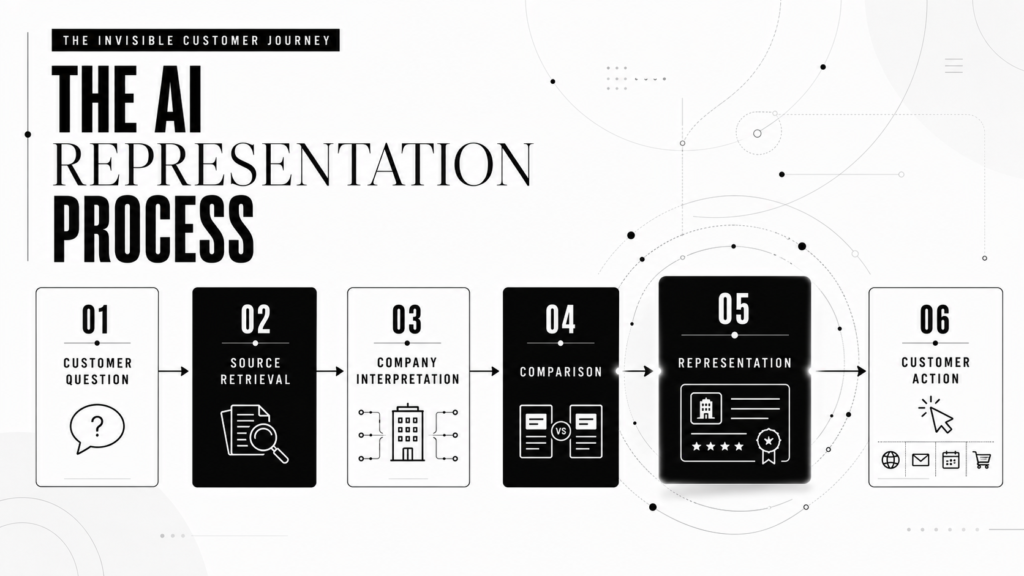
When web research is involved, the process may unfold across several stages.
- Discover accessible information. The system must first be able to find and access relevant pages, profiles, documents or data.
- Retrieve relevant sources. It identifies information connected to the customer’s question, industry, location, budget or required outcome.
- Identify companies and relationships. The system attempts to understand the companies, people, products, services and categories mentioned across those sources.
- Compare claims. It may examine whether information is consistent across the company’s website, reviews, directories, media coverage and other references.
- Assess contextual relevance. A company may be credible but still unsuitable for the customer’s location, budget, industry or specific requirement.
- Construct the answer. The AI organises the available information into an explanation, comparison or recommendation.
- Represent the company. It may cite the business, mention it without a citation, include it on a shortlist, recommend it directly or omit it completely.
This process helps explain how AI can function like a sales rep while producing different answers for different people.
Companies cannot control every response. AI platforms use different models, search indexes, retrieval systems and source collections. Answers may change based on the wording of the question, the user’s context, location and the information available at that moment.
Updating one webpage may improve the information environment without immediately changing every AI response. Structured data can support interpretation, but it does not guarantee that a company will be mentioned or recommended.
Publishing large volumes of generic content will not create authority either. Strong representation depends on clarity, relevance, credible evidence, consistency and genuine expertise across the wider digital ecosystem.
LinkedIn and the New Public Knowledge Layer
LinkedIn has become more than a platform for professional networking and social distribution. Its articles, posts, profiles and company pages now contribute to the public knowledge layer that AI systems may use when answering business related questions.
A 2026 Semrush study analysed 325,000 prompts across ChatGPT Search, Google AI Mode and Perplexity. The researchers identified 89,000 unique LinkedIn URLs cited within the resulting answers.
LinkedIn appeared in approximately 11 percent of responses on average and ranked second among cited domains within the study’s dataset. The citation rate varied across platforms, industries and types of questions, but the overall findings demonstrate how frequently professional content can enter AI generated answers.
Long form LinkedIn articles represented between 50 and 66 percent of the LinkedIn content cited across the three platforms. Approximately 95 percent of cited posts were original rather than reshares. Educational content, practical advice and material that clearly explained a subject appeared frequently.
These findings do not mean that every LinkedIn article will be cited. A citation also does not automatically become a recommendation, lead or sale. The study measured visibility within AI responses rather than its direct effect on purchasing decisions.
The strategic implication remains significant.
An expert can publish an article or practical explanation on LinkedIn, and that content may later become part of an AI conversation the author never sees. The unofficial AI sales rep may use those ideas to explain a category, evaluate a problem or compare available options.
LinkedIn therefore supports professional authority, distribution and AI visibility. It gives individuals and companies another public surface through which their expertise can be discovered and interpreted.
The company website should still serve as the primary owned source of truth. LinkedIn can extend the reach of that knowledge, while the website provides the complete, current and authoritative record of the business.
The Marketing Team Was Built for the Previous Internet
When companies are told they need to prepare for AI driven discovery, one of the first objections will be budget.
They will say they cannot afford new employees, technology, training or specialist support.
Yet these companies are already spending money on marketing. They are paying employees, agency retainers, advertising costs, content production fees, software subscriptions, events, website services and public relations expenses.
The problem often sits inside the way those resources are organised.
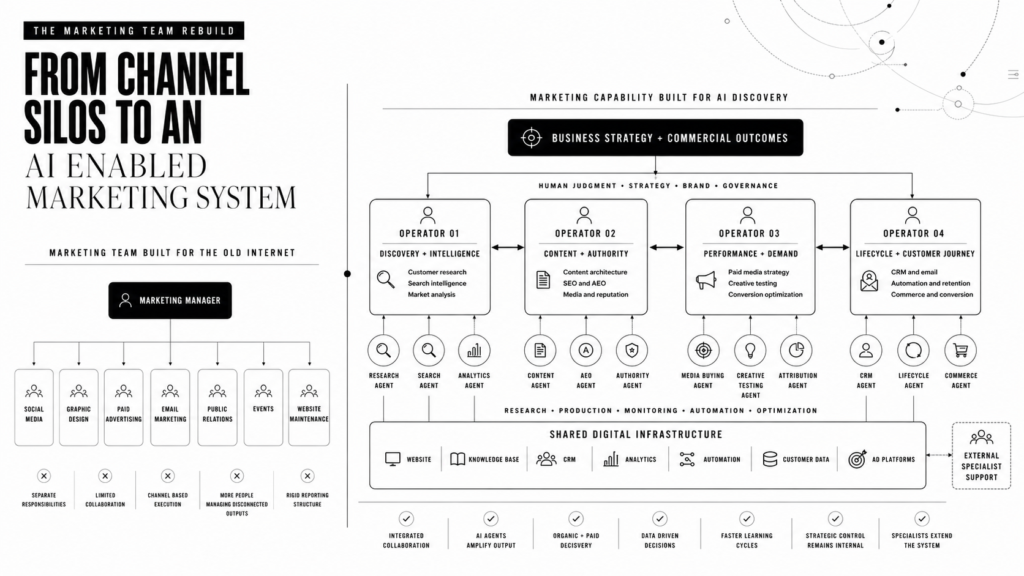
Many marketing teams were built around separate channels. One person manages social media. Another handles graphic design. Advertising may be assigned to an agency. Email, public relations, events and website maintenance often operate through different people, suppliers and reporting systems.
Each function can produce valuable work while the complete customer journey remains fragmented.
AI driven discovery requires a connected view of how customers research, evaluate and choose a company. The team must understand customer and search intelligence, SEO, AEO, AI visibility, content architecture, digital authority and reputation.
It must also connect those areas to website infrastructure, CRM, analytics, commerce, automation, governance and commercial measurement.
A social media post may support authority. An article may answer a customer question. A media interview may provide third party validation. A review can strengthen trust. The website brings the company’s information together, while CRM and analytics help determine whether that visibility creates enquiries, sales and stronger customer relationships.
These activities cannot be managed effectively as unrelated outputs.
The unofficial AI sales rep is being briefed by the company’s entire digital ecosystem. It may retrieve information produced by the communications team, customer reviews influenced by operations, product details managed by ecommerce and business information maintained by someone in administration.
Preparing for this environment therefore involves more than adding another marketing task.
Companies need to reconsider what their teams understand, how information moves between departments, who owns AI visibility and how marketing performance is connected to commercial results.
Rebuilding the team does not automatically require replacing the employees. Existing people can develop new capabilities and assume broader responsibilities.
Their workflows, tools, training and performance measures must evolve. They need permission to work across channels, collaborate with other departments and evaluate the full system rather than completing isolated tasks.
The budget may already exist. The organisation must decide whether that investment is funding the capabilities required for the internet customers are using today.
My Education Came From Building a Business
I operate Digipreneur as a solopreneur.
The business includes consulting, implementation behind the scenes for companies, university lecturing, television, radio, newspaper columns, podcasting, blogging and social media content. Each area has its own audience, deadlines, platforms and commercial requirements.
I manage that workload by thinking in systems and using the right combination of technology, software and AI tools. The tools increase my capacity, but they only become useful when I understand how the work connects.
My real marketing education began while building Droid Island.
I needed people to discover the business organically. I could not depend entirely on advertising, so I began learning what it would take to appear on the first page of Google for the products and questions connected to the business.
That process led me into SEO before I knew there was an established industry built around it. I was learning through a commercial problem that needed to be solved.
Droid Island also taught me the difference between social media content and search driven content. A social post could create immediate attention and conversation. Search content had to remain useful, answer a specific need and become discoverable when someone was actively looking for information.
I had to connect content, search rankings, website traffic, customer behaviour, enquiries and sales. There was no department producing separate reports for me to review. I was the business owner, marketer, content creator and sales rep.
From the beginning, the primary measurement was sales.
That experience created a form of marketing education that is difficult to purchase. When you own the business, every metric eventually has to connect to a commercial outcome. Attention alone cannot pay the bills.
My preparation for constant change started even earlier.
I began working at Telus when I was nineteen. The company’s philosophy was to “embrace change.” Working in technology meant products, customer expectations and the competitive landscape changed constantly.
You could not rely on knowledge from six months earlier. If your product knowledge became outdated, it affected your ability to understand the customer and make the sale.
My time at Apple developed that discipline further. Technology had to be translated into something useful and understandable for the person standing in front of you. Learning quickly was part of delivering a strong customer experience.
I have been putting in those repetitions since I was nineteen.
Now we are in the AI era, and I am studying AI visibility because the survival of Digipreneur depends on understanding how discovery is changing.
As a solopreneur, I cannot wait for another department to explain the shift or develop the strategy. If I fail to learn, the work remains undone.
Small businesses can move faster than larger organisations, but speed only becomes an advantage when it is used deliberately. We can test ideas, adopt new tools and adjust our systems without waiting through several layers of approval.
For me, staying current is a commercial responsibility.
If I do not stay ahead of the curve, I do not eat.
That pressure has taught me to enjoy learning, experimentation and change. Learning is no longer something that happens outside the business. It has become part of the operating system that keeps the business alive.
How Companies Should Rebuild the Capability
Every company will not need the same team structure.
The right operating model depends on the size of the business, complexity of the customer journey, available resources, regulatory requirements and current level of digital maturity. What matters is that strategic ownership remains clear.
Companies can begin with one of three operating models.
Build the Capability Internally
Some organisations can develop the required capabilities within their existing marketing team.
This begins with training people to understand how search, content, authority, reputation, customer experience, data and revenue connect. Someone must receive clear responsibility for AI visibility and the accuracy of the company’s digital representation.
The team should establish a regular process for researching customer questions, monitoring platform changes, publishing useful information, testing new approaches and measuring commercial outcomes.
Existing employees may be capable of performing this work once their responsibilities, tools and performance measures evolve.
Combine an Internal Team With Specialist Support
A smaller internal team can maintain strategic ownership while using external specialists for technical, analytical or implementation work.
The company may need support with website infrastructure, SEO, AEO, structured data, analytics, automation, digital public relations or content production. These specialists should contribute to a connected strategy rather than operate as unrelated suppliers.
Knowledge transfer must be part of the relationship. The internal team should understand what is being implemented, why it matters and how success will be measured.
This reduces permanent dependence on external providers and allows the company to make better decisions about future investments.
Create a Dedicated AI Visibility Function
Larger or more complex organisations may require a dedicated AI visibility function.
This team can establish governance, standards, measurement and cross departmental coordination. It may connect marketing, communications, technology, data, ecommerce, customer experience, legal and compliance teams.
Its responsibility is to ensure that the company’s public information remains accurate, accessible, credible and commercially useful across AI driven discovery environments.
A focused team of system level thinkers can now produce work that once required a much larger department. Equipped with the right technology and specialised AI agents, a small team can coordinate research, content, monitoring, automation and measurement at considerable scale.
The human team still owns judgment, strategy, brand standards and accountability. AI agents extend capacity.
External agencies remain valuable for specialist expertise and additional execution. The company must still understand the system, own the strategy and decide what information is briefing its unofficial AI sales rep.
What It Means to Train AI
The phrase “training the AI” is useful shorthand, but it needs to be understood correctly.
A company cannot directly retrain ChatGPT, Gemini, Claude or another public AI model simply by publishing articles or updating a website. Those systems are developed and trained by the companies that operate them.
Businesses can influence the information environment from which AI systems construct their answers.
That begins with establishing an owned source of truth. The company website should clearly explain what the business does, who it serves, where it operates and how its products or services create value.
The company must also publish information that answers the detailed questions customers ask while researching, comparing and making decisions. Original expertise, practical examples, research, case studies and clear explanations give AI systems more useful material to interpret.
Authority must extend beyond the company’s own claims. Customer reviews, media coverage, interviews, partnerships, industry citations and other credible third party references help confirm the business’s reputation and expertise.
Business profiles (Google Business Profile, Apple Business Manager, Bing Places For Business), directories and listings should use consistent names, descriptions, services, locations and contact information. Websites must remain technically accessible, while important pages should be easy for both people and relevant systems to discover and understand.
The information also needs to remain current. Outdated services, old leadership profiles, broken links and conflicting operating details can weaken the resulting representation.
Finally, visibility must connect to action. Customers need clear paths to enquire, book, purchase, subscribe or continue their research.
Training the AI therefore means deliberately improving the information, evidence and infrastructure available to it. The unofficial sales rep can only work from the briefing material it can find.
Companies that manage that material carefully improve their chances of being understood accurately and considered within relevant customer conversations.
The AI Representation Framework
Companies need a practical way to evaluate whether their digital presence gives AI systems enough information to represent them accurately.
The AI Representation Framework examines five connected stages. Each stage affects whether a company can progress from being discovered to being trusted, recommended and selected.
Findable
Can relevant systems discover and access the company’s information?
Findability begins with an accessible website, accurate business profiles, indexable content and a consistent presence across the platforms customers use. Important information should not be hidden inside inaccessible files, broken pages or private systems.
A company that cannot be found cannot participate meaningfully in the answer. It may be excluded before its relevance, expertise or customer experience can be considered.
Understandable
Can AI determine what the company does, who it serves, where it operates and why it is relevant?
Clear service descriptions, customer use cases, location information, leadership profiles and structured explanations help establish meaning. Companies should use consistent language when describing their products, services and areas of expertise.
Confusing positioning or incomplete information increases the risk of inaccurate descriptions. It can also cause the business to appear irrelevant to questions it is fully capable of answering.
Verifiable
Can the company’s important claims be confirmed through credible evidence and third party sources?
Reviews, media coverage, case studies, partnerships, industry citations, professional profiles and public documentation help support the company’s claims.
A business can describe itself as experienced, trusted or innovative, but external evidence gives those claims greater credibility. Weak verification can reduce confidence, particularly when competing companies have stronger public proof.
Recommendable
Is there enough contextual evidence to justify including the company in a recommendation?
Recommendation depends on more than general authority. The company must appear suitable for the customer’s specific need, location, industry, budget or desired outcome.
AI may understand a company and still exclude it from the shortlist because the available information does not establish contextual fit.
This is the stage where the unofficial AI sales rep moves from describing the company to advocating for its consideration.
Actionable
Can the customer enquire, book, purchase or continue the relationship without unnecessary friction?
Clear calls to action, working contact forms, booking systems, product information, payment options and responsive customer support help convert visibility into commercial activity.
A recommendation loses value when the customer cannot determine what to do next.
The five stages are connected:
Findable → Understandable → Verifiable → Recommendable → Actionable
Weakness at any stage can affect discovery, trust, shortlisting and revenue. Strong AI representation therefore requires more than appearing in an answer. The company must create a clear path from initial discovery to confident customer action.
AI Is Moving Closer to the Transaction
AI assisted discovery is beginning to connect with the infrastructure required to complete commercial actions.
In June 2026, Visa announced a strategic collaboration with OpenAI to support secure Visa payments within agentic commerce experiences. The collaboration combines OpenAI’s conversational and agent capabilities with Visa’s payment network, credentialing and security infrastructure.
Visa, Mastercard, Stripe, Shopify and other commerce companies are developing systems that allow AI agents to participate in more stages of the purchasing journey.
An AI assistant can already help someone understand a problem, research a category, compare companies and identify a preferred option. Commerce infrastructure creates the possibility of moving from that recommendation towards booking, ordering or purchasing within a more connected experience.
These capabilities will not become available everywhere at the same time. Access will depend on the merchant, AI platform, payment provider, customer location, regulatory environment and type of transaction.
The commercial direction is still important. The unofficial AI sales rep is moving closer to the point where interest becomes revenue.
This also creates an analytics blind spot.
A company may eventually see the final referral, website visit, lead, booking or purchase. It may have no visibility into the original question asked inside the AI platform, the competitors considered, the objections raised or the reasoning that produced the recommendation.
The company may never know whether the customer spent two minutes or forty minutes researching the decision before taking action.
Traditional analytics cannot reveal that complete journey.
Companies will need to combine website analytics, CRM data, customer interviews, AI visibility monitoring and commercial outcomes. Sales and customer service teams should also ask customers how they discovered the company and what influenced their decision.
The objective is to build a more complete picture of demand, even when part of the customer journey occurs inside a private AI conversation.
How Is AI Currently Representing Your Company? (Exercise)
The quickest way to understand how AI may be representing your company is to see it for yourself.
Choose two or three AI tools, such as ChatGPT, Gemini, Claude, Perplexity, Copilot or Google AI Mode. Run the following prompts separately in each one.
Use a new conversation for every tool. Where possible, use an account or browsing mode with minimal personal history. This reduces the likelihood that the answer will be shaped by what the AI already knows about you.
Record the date, the answer, the sources cited and any differences between tools. AI systems use different models, search indexes, retrieval methods, data sources and personalization signals. Your potential customers will not all receive the same answer.
However, this will give you a great chance to see whether or not the information about your company is accurate and give some insights into how AI currently sees your company and competitors.
1. Can AI explain your company?
Prompt:
“Explain what [Company Name] does, who it serves, where it operates and the main products or services it provides.”
Observe:
Is the description accurate, complete and current? Look for missing services, incorrect locations, outdated positioning and confusion with similarly named companies.
2. Does AI understand your positioning?
Prompt:
“What makes [Company Name] different from other companies in [industry or category]?”
Observe:
Can the AI identify a meaningful distinction, or does it produce a generic description that could apply to any competitor?
3. Does your company appear in relevant recommendations?
Prompt:
“I need a
Observe:
Does your company appear? Where is it placed? What reasons are given for including or excluding it? Pay attention to which competitors are recommended instead.
4. Who does AI believe your competitors are?
Prompt:
“Compare [Company Name] with its main competitors. Include their strengths, weaknesses, ideal customers and important differences.”
Observe:
Are the competitors relevant? Is your company compared fairly? Look for areas where competitors have clearer positioning, stronger evidence or more detailed information.
5. Can your claims be verified?
Prompt:
“What evidence supports the main claims made by [Company Name]? Use independent sources where possible.”
Observe:
Can the AI find reviews, media coverage, certifications, case studies, industry recognition or credible third party references? Unsupported claims weaken confidence.
6. What reputation has AI constructed?
Prompt:
“What do customers and independent sources say about [Company Name]? Summarise the recurring positive and negative themes.”
Observe:
Are the reviews current and representative? Look for recurring complaints, unanswered criticism, reputation gaps and feedback that the company may have overlooked.
7. Are your operating details accurate?
Prompt:
“Provide the current locations, service areas, contact information, opening hours and purchasing or booking options for [Company Name].”
Observe:
Check every detail. Inconsistent listings, expired contact information and missing service areas can prevent AI from confidently recommending the company.
8. Does your content demonstrate expertise?
Prompt:
“What topics is [Company Name] or its leadership recognised for? Identify useful articles, videos, interviews, research or educational resources they have published.”
Observe:
Can AI find evidence of original thinking? Determine whether your expertise is associated with the company, its leaders or neither.
9. Would AI shortlist your company?
Prompt:
“I am considering hiring or purchasing from [Company Name]. Based on the available evidence, should I shortlist it? Explain the reasons for and against.”
Observe:
This is where you hear your untrained AI sales rep at work. Note the objections, uncertainties, missing information and level of confidence expressed in the recommendation.
10. Can the customer take the next step?
Prompt:
“If I decide to use [Company Name], what should I do next? Explain how I can enquire, book, purchase or speak with someone.”
Observe:
Can the AI identify a clear conversion path? Check whether it provides the correct website, contact method, booking page, store or next action.
Compare the Results
After completing the exercise, compare the answers across all three tools.
Ask yourself:
- Which facts appeared consistently?
- Where did the answers contradict one another?
- Which competitors appeared most frequently?
- What sources influenced the answers?
- What information was outdated or missing?
- Which claims could not be independently verified?
- Did your company appear in recommendation prompts?
- Could a customer move easily from an answer to an action?
Score one point for every prompt that produced an accurate, credible and commercially useful answer.
- 8 to 10 points: You have a strong foundation, with opportunities for refinement.
- 5 to 7 points: Important gaps may be affecting how AI explains and recommends your company.
- 0 to 4 points: Your company faces significant AI representation risk.
This exercise provides a snapshot, not a permanent verdict. AI responses can change according to the tool, wording, user, location and information available at that moment. Repeat it periodically and track whether your representation improves.
The Resource Hub inside Digital Strategy in the Age of AI includes a complete 20 question Digital Visibility Assessment. You can take your findings from this exercise, work through the deeper assessment with your preferred AI assistant and generate a personalised 30, 60 and 90 day roadmap based on your business, resources and current digital maturity.
The New AEO and AI Visibility Roles
The clearest evidence that AI visibility is becoming a recognised business capability can be found in the roles companies are beginning to create.
Linktree advertised a Growth Marketing Manager for SEO and AEO, combining traditional search expertise with the emerging discipline of Answer Engine Optimisation. Citizens created an Answer Engine Optimization Manager role focused more explicitly on how the organisation appears across AI generated answers and conversational discovery experiences.
The titles may evolve, but the direction is already visible.
Companies are beginning to assign ownership to the way their brands are discovered, interpreted and represented by AI. The responsibilities extend beyond ranking webpages in traditional search results. They connect search intelligence, content strategy, technical optimisation, structured information, brand authority, digital public relations, experimentation and measurement.
This work also requires governance. Someone must decide which company information is authoritative, how important claims are supported, where inconsistencies exist and how teams should respond when AI systems produce inaccurate or incomplete answers.
For organisations, these roles provide useful blueprints even when there is no immediate plan to make a new hire. Study the responsibilities and determine who currently owns each capability. Some companies may train existing SEO, content or digital strategy employees. Others may build a cross functional working group or use specialist support while maintaining strategic ownership internally.
The dangerous option is allowing the responsibility to remain scattered across marketing, communications, technology and external suppliers, with nobody accountable for the final representation.
For professionals, these job descriptions offer a map of where the market is moving. They reveal the skills worth developing, the tools worth learning and the types of projects that can become portfolio evidence. An aspiring AEO or AI visibility specialist could audit a company’s digital footprint, test its representation across several AI tools, improve a knowledge hub and document the resulting changes.
These roles also reinforce a larger point: if AI is becoming an untrained sales rep for every company, someone inside the organisation must become responsible for its briefing material.
The specific listings referenced here may eventually close or change. This section should therefore be reviewed periodically and updated with current roles, responsibilities and examples as the discipline matures.
Learn How to Learn
Technology is now changing faster than the planning cycles used by many organisations. A company can spend twelve months approving a strategy for platforms, customer behaviours and capabilities that have already moved on.
The ability to learn quickly has therefore become an operating discipline.
Companies need a repeatable process for monitoring important changes, evaluating how those changes affect customers, running focused experiments, measuring the results and documenting what was learned. Useful discoveries should move into the company’s normal operations. Practices that have lost their value should be retired. Then the cycle begins again.
I started developing this discipline at nineteen while working at Telus. “Embrace change” was part of the company’s philosophy, but in technology sales it was also practical. When your product knowledge or understanding of the industry became outdated, your sales performance suffered. My time at Apple strengthened that habit of learning quickly and translating technological change into something customers could understand and use.
Entrepreneurship made the consequences even more direct. As a solopreneur, I cannot wait for another department to interpret what is happening. I have to understand the change, determine whether it matters and adapt the business while the opportunity is still relevant.
We have seen this pattern before. Many companies dismissed social media as a fad. Years later, the commercial cost of having no social presence became obvious.
AI discovery is following a similar path, only faster. The companies that build a culture of continuous learning will be better positioned to adjust as AI tools, search behaviour and customer expectations continue evolving.
Your Company Is Already Being Represented
AI is already acting as a sales rep for your company.
It was never recruited, onboarded or trained by your team. It has no approved script, no direct access to your internal expertise and no obligation to present your company the way you would. Yet it may already be answering customer questions, comparing your business with competitors and influencing whether you make the shortlist.
Companies cannot control every answer an AI system produces. They can shape the information environment from which those answers are constructed.
That means building a clear source of truth, publishing useful information, supporting important claims with credible evidence, strengthening third party authority and maintaining digital infrastructure that both people and machines can understand. It also means developing the internal capabilities required to monitor, measure and improve how the company is represented.
This responsibility will become more commercially important as AI moves further into discovery, evaluation and transactions.
So, there is one question every leadership and marketing team should test today:
If a customer asked an AI system why they should choose your company, would you trust the answer?
If the answer is uncertain, the work has already begun.
Build the Capability Inside Your Business
Understanding this shift is only the beginning. The next step is assessing how prepared your company is and deciding what needs to change.
The Digital Strategy in the Age of AI Workshop and Resource Hub was built to help business owners, marketing teams and organisational leaders move from awareness to implementation.
The Resource Hub includes a four hour workshop that explains how search, customer behaviour, websites, content and digital strategy are changing in the AI era. You also receive the complete presentation slides so your team can revisit the frameworks and discuss their implications internally.
The 20 question Digital Visibility Assessment helps you evaluate your company’s current position. Once completed, it can be used with your preferred AI assistant to develop a personalised 30, 60 and 90 day implementation roadmap based on your business, resources and digital maturity.
The Hub also includes supporting courses, books and videos that allow you to explore the most important areas in greater depth. Current AEO and AI visibility role blueprints show how companies are assigning ownership and building these capabilities into their teams.
You will leave with a clearer understanding of your risks, the gaps requiring attention and the implementation priorities that can move your company forward.
If you are ready to prepare your business for AI-driven discovery, representation and customer decision-making, access the complete workshop and its supporting resources at the link below.
Explore the Digital Strategy in the Age of AI Workshop and Resource Hub
Frequently Asked Questions
AI represents a company whenever it explains, describes, compares or evaluates that business in response to a user’s question. The answer may be constructed from the company’s website, reviews, directories, media coverage, social profiles, public documents and other accessible sources. This representation can be accurate, incomplete, outdated or misleading. It may influence whether a customer investigates the company, includes it on a shortlist or removes it from consideration. In that moment, AI is functioning like an unofficial sales rep, even though the company may never see the conversation.
A business cannot directly retrain public AI models simply by publishing content or submitting company information. It can improve the information environment from which AI systems construct their answers. This means maintaining a reliable source of truth, creating content across its digital platforms, publishing clear and detailed information, answering customer questions, earning credible third-party mentions and keeping business profiles consistent. These actions can improve how confidently AI systems understand the company. They do not guarantee a recommendation because each answer depends on the question, available sources, model, user context and competing options.
Different AI systems use different models, indexes, retrieval processes and data sources. When answering a question, a system may consider relevance to the customer’s need, geographic fit, source quality, business information, reviews, authority, product details and consistency across multiple sources. It may also compare companies against requirements such as budget, features, location or implementation timeframe. There is no single universal ranking formula. A company with clearer information and stronger supporting evidence may be easier to mention confidently than a competitor whose digital footprint is vague, contradictory or outdated.
AI visibility is expanding the responsibilities associated with search, but SEO remains important. Search engines, websites and technically accessible content continue to provide information that AI systems can discover and retrieve. SEO helps companies create organised, relevant and discoverable digital infrastructure. AI visibility adds questions about how the company is interpreted, compared, cited and recommended within generated answers. Companies still need strong websites, useful content, technical foundations and search intelligence. They must now consider whether that entire digital presence gives AI enough context and evidence to represent the business accurately.
SEO focuses on improving discovery and performance in traditional search engines, but forms the basis for AEO and GEO. Answer Engine Optimisation, or AEO, focuses on making information useful and accessible for direct answers to customer questions. Generative Engine Optimisation, or GEO, generally refers to improving how content and brands appear within generative AI responses. AI visibility is the broader measurement of whether, where and how a company appears across AI systems. The practical objective is to make the company findable, understandable, verifiable, recommendable and actionable.
Yes. A customer can ask AI to define a problem, explain possible solutions, identify providers, compare competitors, summarise reviews and recommend a shortlist before visiting any company website. The customer may arrive already knowing the company’s services, perceived strengths, weaknesses and reputation. They may also arrive with objections based on information the company has never reviewed. Some customers will still visit websites, social profiles and other channels for validation. However, AI can influence which companies receive those visits and what the customer expects to find when they arrive.
Ownership depends on the organisation’s size and structure, but accountability should be clearly assigned. In a smaller business, ownership may sit with a marketing leader, SEO specialist or digital strategist. Larger organisations may need coordination across marketing, communications, technology, data, ecommerce, customer service and legal teams. The owner should connect search intelligence, content, technical accessibility, authority, reputation and commercial measurement. External specialists can provide valuable support, but the company should retain strategic understanding. Its internal team knows the business, customer and operating reality more deeply than any disconnected supplier.
A small business can compete when it provides clearer, more relevant and better supported information for a specific customer need. Larger companies may possess greater authority, stronger brand recognition and more third party coverage. Smaller companies can benefit from specialist expertise, local relevance, distinctive positioning, detailed service information and faster publishing cycles. They can also answer niche customer questions that larger competitors overlook. AI results are contextual, so the biggest company will not automatically be the best recommendation for every prompt. A focused digital footprint can give a smaller business a credible opportunity to appear.
Measurement requires combining several signals. Companies can monitor brand mentions and citations across AI platforms, referrals from AI tools, search behaviour, website conversions, CRM data and changes in qualified demand. Lead forms and sales conversations should ask customers how they discovered the company and whether AI influenced their research. Teams can also repeat structured prompts periodically to observe changes in representation and competitor visibility. No single metric captures the complete journey. The strongest measurement system connects AI visibility with customer interviews, lead quality, bookings, purchases, sales cycle changes and revenue.
Thanks for the information you shared at the AI conference at UWI last Week. I admire the level of work you are doing. My close friend Lionel Seucharan speaks to me of the dynamic work you are doing. Keep up the fantastic work.