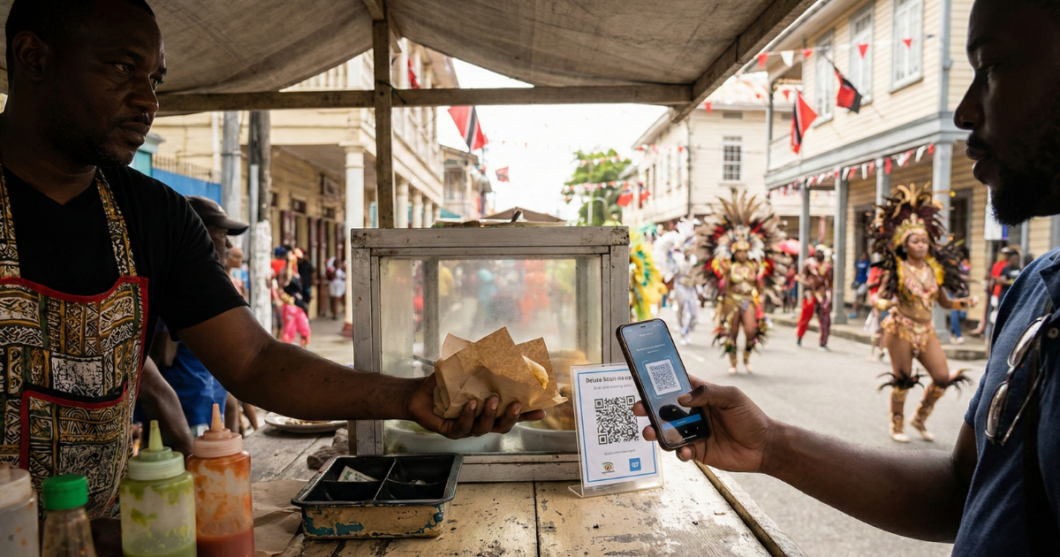
1. Carnival Week Is a Digital Opportunity
Carnival week is not just a cultural moment — it is one of the most compressed and competitive economic windows in Trinidad and Tobago’s calendar. In a matter of days, tens of thousands of visitors descend on the country, spending at a pace that far outstrips a normal business cycle. The money is already here. The real question is which businesses are positioned to capture it.
During Carnival, visitor spending does not distribute evenly across the economy. It flows toward businesses that are easiest to find, easiest to pay, and easiest to trust. In that sense, the advantage is no longer about who has the biggest storefront, the best location, or the largest marketing budget. It’s about digital readiness.
Foreign visitors rely heavily on search engines, maps, mobile payments, and social platforms to decide where to eat, shop, and spend. If your business doesn’t show up clearly online, accepts limited payment options, or provides incomplete information, the sale doesn’t just become harder — it often goes to someone else entirely.
This article is not about long-term strategy or major operational changes. It’s about fast, low-effort digital moves that businesses can still implement this week to reduce friction, increase visibility, and put themselves in front of Carnival spending while the window is still open.
2. Interesting Stats: The Real Size of the Carnival Opportunity
Carnival spending isn’t anecdotal — it’s measurable, documented, and growing.
According to an official report released by the Ministry of Tourism, Culture and the Arts on April 2, 2025, the Carnival period generated an estimated TT$668,060,354 in total visitor expenditure between February 14 and March 4, 2025. Depending on exchange rates used in various analyses, this represents approximately US$95–100 million injected into the local economy during that short window.
This marked a clear increase over the TT$634 million recorded during Carnival 2024 — reinforcing the fact that Carnival is not only culturally significant, but economically intensifying year over year.
The figures were derived from multiple data streams that together paint a clear picture of where the money is coming from and how it is spent:
- Exit surveys conducted by Tourism Trinidad Limited (TTL) at points of departure showed that air visitors spent an average of TT$15,336 per person during their stay.
- Immigration Division arrival data recorded 41,022 air arrivals during the period, with daily arrivals peaking at approximately 3,500 visitors in the final week leading up to Carnival Monday.
- Cruise passenger activity, including themed Carnival cruises such as the Epic Carnival Experience, contributed an estimated TT$34 million through food, transportation, and local services.
What’s important to understand is that this TT$668 million does not spread evenly across the economy. Carnival spending is highly concentrated and highly competitive. Businesses that are visible at the moment of intent — when a visitor searches, checks a map, taps a phone, or asks an AI assistant — capture a disproportionate share of that spend. Others, even with great products or services, are simply bypassed.
This is why digital readiness matters so much during Carnival week. The opportunity is real, the money is already here, and the difference between capturing it or missing out often comes down to a few basic digital fundamentals.
3. Why Digital Friction Costs You Money During Carnival
During Carnival week, visitor decision-making is fast, mobile, and unforgiving. People are not browsing casually or researching for days — they are searching in the moment, often on a phone, often while moving between events. In that environment, any form of digital friction becomes a deal breaker.
Foreign visitors rely heavily on search engines, maps, AI assistants, and social platforms to answer very practical questions: Where can I eat right now? How do I get there? Can I pay with my card? Are they open? If a business cannot answer those questions instantly and clearly, the visitor doesn’t wait — they move on to the next option.
This is where many local businesses lose out during Carnival. Not because their product is bad or their prices are wrong, but because their digital presence creates uncertainty. Missing location details, outdated hours, cash-only payment policies, or no online footprint at all introduce hesitation at exactly the wrong moment. And in a high-demand, high-choice environment like Carnival, hesitation almost always results in a lost sale.
Digital friction also compounds. A visitor might discover a business on Instagram, then try to find it on Google Maps and fail. Or they might arrive in person, only to realise they can’t pay the way they prefer. Each small point of friction reduces trust and limits how much someone is willing to spend — if they spend at all.
Carnival amplifies these weaknesses because volume is high and attention is scarce. Businesses that are digitally ready benefit from momentum: they show up when people search, they accept the right payment methods, and they make it easy for visitors to follow, share, and return. Businesses that aren’t ready don’t just miss one sale — they miss the entire chain of opportunity that follows discovery.
This is why digital readiness matters so much during Carnival week. Removing friction isn’t about long-term transformation or complex systems. It’s about making it easy for visitors to find you, trust you, and transact with you right now — while the spending window is still open.
4. Quick Win #1: Fix Your Discoverability Across Search, Maps & AI
Before a visitor can decide whether they want to buy from you, they first have to find you. During Carnival week, that discovery process happens almost entirely on a phone — through search engines, map apps, and increasingly, AI-powered tools that recommend where to go next.
Foreign visitors don’t rely on word of mouth in the moment. They Google. They open Maps. They ask AI assistants simple, practical questions like “food near me,” “places open late,” or “where to buy this right now.” If your business doesn’t appear clearly and accurately in those results, the opportunity disappears instantly.
This is why every business should ensure it is properly set up across the three main discovery ecosystems: Google Business Profile, Apple Business Connect, and Bing Places for Business. These platforms don’t just power search results — they feed navigation apps, in-car systems, and AI-generated recommendations that visitors rely on heavily while moving around during Carnival.
For businesses that already have these listings, Carnival week is not the time to assume everything is in order. Location pins should be checked for accuracy, contact numbers should work, and hours of operation — especially Carnival-specific hours — must be updated. A single incorrect detail can result in a visitor arriving at the wrong place, seeing a business marked as closed, or giving up entirely and choosing a competitor.
Businesses without a physical storefront should also ensure a service area is defined. Many visitors are staying in Airbnbs and guest houses outside traditional commercial zones, and service-area listings allow your business to appear in relevant searches even without a walk-in location.
It’s also important to understand that discoverability today goes beyond traditional search. AI tools increasingly pull from maps, business profiles, and structured listings when answering questions in real time. If your information is missing, inconsistent, or outdated across these platforms, your business simply won’t be recommended.
During Carnival, discoverability isn’t a marketing tactic — it’s basic infrastructure. Businesses that take the time to fix these fundamentals put themselves directly in the path of visitor intent, while others remain invisible despite being just as good.
5. Quick Win #2: Modernize Payments to Reduce Friction
Once a visitor has found your business, the next question is immediate and practical: how can I pay? During Carnival week, the answer to that question often determines whether a sale happens at all.
Foreign visitors generally do not want to use Trinidad and Tobago dollars. Converting currency back and forth means losing money, ATM availability becomes unreliable during Carnival, and carrying cash in crowded spaces is a safety concern. As a result, many visitors actively avoid cash-only businesses — even when they are interested in what’s being sold.
This is why having multiple digital payment options is no longer optional during Carnival. Businesses that make it easy to pay remove hesitation at the point of sale and allow customers to spend more comfortably.
One of the quickest wins for businesses is setting up Color App. With Color, businesses can accept card payments directly on a smartphone. If you’re using an Android phone with NFC enabled, customers can tap their Visa or Mastercard, their phone, or even a smartwatch to pay — no physical POS terminal required. Funds received through Color can then be deposited directly into your bank account. If you have an Apple device, you won’t get the Tap to Pay feature but you can have your customers scan the QR code option or you can send them digital invoices and they would pay it with their credit or debit cards.
Businesses should also set up Endcash, a local digital wallet that allows customers to pay without using cash. Endcash is particularly useful for locals and visitors who want to minimize how much physical money they’re carrying during Carnival week.
In addition to local options, having PayPal set up is a smart fallback. Visitors may already have funds sitting in PayPal or need to send money digitally from abroad. You may not use it often, but during Carnival, having it available “just in case” can save a sale. You can learn how to set up PayPal in Trinidad and Tobago through this article here –> Get Started With PayPal in Trinidad and Tobago.
Another useful option is Paywise. Paywise has agents across the country, allowing customers who are not near your physical location to pay for your product or service in cash through an agent, with the funds then sent to you digitally. This adds flexibility, especially when customers are moving around or purchasing remotely.
The key principle here is not to rely on a single payment method. Carnival creates unpredictable situations — network issues, ATM outages, ATMs running out of cash, customers without local cash, or visitors who only use certain platforms. Businesses that offer multiple payment options are far more resilient and far more likely to close the sale.
Modern payments also influence perception. A business that accepts tap-to-pay, digital wallets, and online transfers feels safer, more professional, and more trustworthy to international visitors. In contrast, being cash-only introduces friction at exactly the wrong moment.
During Carnival week, the easier it is to pay, the more people spend. Reducing payment friction is one of the fastest ways businesses can capture more of the visitor dollars already circulating in the economy.
6. Quick Win #3: Exist on Social Media (Even Minimally)
One of the most common ways businesses lose follow-up sales during Carnival has nothing to do with price or quality — it’s non-existence. Visitors discover a product at a fete, market, pop-up, or on the road, enjoy it, and then ask a simple question: “Where can I follow you?”
Too often, the answer is some version of “just message this WhatsApp number.”
During Carnival, that’s a missed opportunity.
Foreign visitors want to follow brands they discover. They want to save them, share them with friends, and come back later in the week — or even after they leave the country. If your business has no visible social presence, the relationship ends the moment the interaction does.
This section is not about building a content strategy or posting every day. It’s about basic digital existence.
If your business has no social channels at all, set up at least one platform — Instagram or Facebook is enough. Post a few clear photos or short videos of what you sell. Add your contact details, location (or service area), and payment options. That alone gives visitors something to follow, reference, and remember.
For businesses that already have social pages, Carnival week is the time to double-check the fundamentals. Make sure your contact information is correct, your location details are accurate, and your links work. Many sales are lost simply because someone tries to reach a business and hits a dead end.
Social media during Carnival functions as a credibility layer. A visible page reassures visitors that you’re legitimate, active, and reachable. It also allows your business to live beyond the moment — turning a one-time Carnival interaction into future awareness, referrals, and repeat spending.
You don’t need to be everywhere. You just need to be somewhere people can find you.
7. Quick Win #4: Take a Look at foodDROP
Carnival has quietly changed how people buy — especially when it comes to food and convenience purchases. After long nights, heavy traffic, and packed events, many visitors don’t want to search for food on the road. They want it delivered to wherever they are staying.
This is why on-demand platforms have become a major revenue channel during Carnival week.
For food businesses in particular, being listed on foodDROP is no longer a “nice to have.” Many visitors — especially those staying in Airbnbs, guest houses, or hotels — default to opening delivery apps late at night or after events. If your business isn’t there, it doesn’t matter how good your food is; you simply won’t be seen.
What’s important to understand is that delivery demand spikes during Carnival, not just during normal lunch and dinner hours, but late at night when people are returning from fetes and events. Ordering food to meet them at their destination has become the norm.
foodDROP has also expanded beyond traditional restaurants, allowing more product-based businesses to register on the platform. If you sell items that can reasonably be delivered, this is another digital surface area where visitors may discover you — often without ever having seen your physical location.
The goal here isn’t to replace in-person sales. It’s to capture demand that would otherwise bypass you entirely. Carnival traffic, road closures, and fatigue make delivery and on-demand ordering far more attractive than searching in person.
If your business sells food or deliverable products, plugging into on-demand platforms is one of the fastest ways to extend your reach during Carnival week — without additional marketing spend.
8. Quick Win #5: Create One Central Digital Hub
During Carnival week, attention is fragmented. Visitors are moving quickly, switching apps, sharing links in group chats, and making decisions on the fly. If your business information is scattered across different platforms — or worse, hard to piece together — people simply move on.
This is why every business should have one central digital hub that connects everything in one place.
A simple link-in-bio tool like Linktree allows you to do exactly that. In one link, you can connect your social media pages, WhatsApp contact, payment options, delivery links, and location. Instead of forcing visitors to hunt for information, you give them a single, clear path forward.
For businesses without a website, this becomes especially important. One effective approach is to create a simple digital catalogue using Canva. A short slide deck with photos of your products or services, brief descriptions, and prices is more than enough. Once it’s done, you can share the link and add it to your Linktree as something like “Menu,” “Catalogue,” or “What We Sell.” This allows visitors to quickly understand what you offer without needing a full website.
If you have a physical location, adding your Google Maps location link to your Linktree is another small but powerful step. A visitor viewing your link can tap once and be navigated directly to you, instead of trying to copy an address or search again.
Once your central link is set up, use it everywhere. Add it to your Instagram and TikTok bios. Share it in WhatsApp conversations. Include it on flyers, QR codes, or signage if you have them. During Carnival, this link becomes your single source of truth — the place where visitors can find everything they need to buy from you.
The goal isn’t to be complex. It’s to be clear. Businesses that make it easy for visitors to understand, navigate, and purchase are the ones that turn fleeting Carnival attention into actual revenue.
9. Final Takeaway: Carnival Rewards Digitally Ready Businesses
Carnival week doesn’t reward the biggest businesses or the loudest brands. It rewards the ones that are ready.
The spending is already happening. Visitors are already searching, tapping, ordering, and sharing. What determines who wins during Carnival is not effort or intention, but digital accessibility. Businesses that are easy to find, easy to pay, and easy to follow capture a disproportionate share of visitor spending. Others, often unknowingly, sit just outside the flow of money.
None of the five quick wins in this article require a long-term project or a major investment. They are foundational digital moves — discoverability, payments, social presence, on-demand access, and one central digital hub — that reduce friction at exactly the moments visitors are ready to spend.
Carnival is also a global comparison moment. Visitors experience Trinidad and Tobago alongside destinations like Rio, Jamaica, and New Orleans. Their expectations are shaped by those places. When local businesses meet those expectations digitally, the experience feels seamless. When they don’t, the gap is immediately noticeable.
The businesses that take action now won’t just benefit this Carnival. These same digital foundations compound year after year, turning a short, high-intensity season into sustained opportunity.
Carnival week moves fast. The businesses that move with it — digitally — are the ones that win.
Need Additional Support?
If you’re reading this and realizing your business isn’t fully set up — or you want help tightening your discoverability, payments, and digital presence beyond Carnival week — I offer 1-on-1 digital strategy sessions where we work through this together, step by step.
You don’t need to do everything at once. You just need the right priorities.
👉 Book a 1-on-1 session here:
https://keronrose.com/digital-strategist/