
Why Affiliate Marketing Is Misunderstood in the Caribbean
In the Caribbean, Affiliate Marketing carries a reputation problem.
Mention it in conversation and you’ll often hear the same response:
“That doesn’t work here.”
And on the surface, it’s easy to understand why people believe that. Most Caribbean exposure to affiliate marketing has come through poor examples — random Amazon links dumped into WhatsApp groups, spammy Instagram bios promoting products that have nothing to do with the creator, or people signing up for affiliate programs with the expectation that money will somehow appear simply because an account exists.
When those attempts inevitably fail, the conclusion is simple but incorrect:
affiliate marketing doesn’t work in the Caribbean.
The truth is far more uncomfortable — and far more important.
Affiliate Marketing does work in the Caribbean.
It just doesn’t work the way most people here attempt it.
For years, affiliate marketing has been taught locally as a shortcut instead of a system. There’s little education around content creation, traffic generation, trust-building, or digital infrastructure. Instead, people are introduced to affiliate marketing as a “money play,” divorced from audience, relevance, or long-term strategy. When no results follow, the model gets blamed instead of the execution.
This misunderstanding is what has kept affiliate income almost invisible across the region — not a lack of access, not geography, and not payments.
What most people miss is that Affiliate Marketing is not a side hustle.
It’s a digital export model.
At its core, affiliate marketing allows creators, educators, and entrepreneurs in small markets like the Caribbean to monetize global demand. It enables someone in Trinidad, Jamaica, or Barbados to earn commissions from products and services sold in the US, UK, Canada, and beyond — without inventory, without shipping, and without relying on local market size.
When approached correctly, affiliate marketing isn’t about chasing quick commissions. It’s about building content, trust, and distribution — and then layering monetization on top of that foundation.
This article breaks down what Affiliate Marketing actually looks like in the Caribbean in 2026 — why it has failed for most, why it succeeds for some, and how it fits into a serious digital business strategy rather than a short-term hustle mindset.
The issue was never that affiliate marketing doesn’t work here.
The issue is that it’s almost always misunderstood before it even begins.
How This Guide Is Structured
This guide breaks down Affiliate Marketing in the Caribbean step by step, focusing on what actually works — and why most people never see results.
- What Affiliate Marketing Really Is
A clear explanation of how affiliate marketing actually works today, and why outdated definitions lead people down the wrong path. - Why Affiliate Marketing Matters in the Caribbean
How affiliate marketing fits into small markets, foreign currency earning, and global digital opportunities. - Infrastructure Before Income
Why content platforms, traffic, and systems matter more than signing up for affiliate programs. - My Real-World Experience Since 2016
How affiliate marketing has worked organically inside my brand ecosystem — without chasing commissions. - Where Affiliate Links Actually Work
The platforms and placements that generate results when affiliate marketing is done properly. - Why Most People Fail at Affiliate Marketing
The common mistakes that kill affiliate income before it ever starts. - Content vs Ads: Two Legitimate Paths
The difference between long-term content-driven affiliate marketing and ad-driven strategies — and why both require skill. - Getting Paid in the Caribbean
A practical look at payments, Payoneer, and why infrastructure is rarely the real problem. - The Mindset Shift Required for 2026
Why affiliate marketing must be viewed as part of a long-term digital business, not a quick money play.
2. What Affiliate Marketing Really Is (And What It Isn’t)
To understand why Affiliate Marketing fails for so many people in the Caribbean, we first need to strip away the myths and look at what it actually is — and just as importantly, what it isn’t.
At its core, Affiliate Marketing is a performance-based revenue model.
That means you don’t get paid for views, likes, or reach. You get paid only when someone takes a measurable action — usually a purchase, a signup, or a completed lead form — as a direct result of your recommendation. If no action happens, no money changes hands.
This distinction matters because it exposes the first major misunderstanding. Many people assume affiliate marketing works like advertising: post a link, get attention, get paid. It doesn’t. Unlike CPM-based ads that reward impressions, affiliate marketing rewards outcomes. The value comes from influence, not visibility.
That influence is built on three pillars: trust, relevance, and action.
Trust means your audience believes you. They trust that what you’re recommending is something you’ve used, tested, or genuinely stand behind. Relevance means the recommendation makes sense in context — the product solves a real problem your audience already has. Action is the final step: the audience is motivated enough to move from consuming content to making a decision.
Remove any one of those pillars and affiliate marketing collapses.
This is why affiliate marketing cannot exist in isolation. It doesn’t work as a standalone tactic or a shortcut to income. Affiliate Marketing is a monetization layer, not the foundation.
The foundation is content and audience.
Blogs, YouTube videos, podcasts, and long-form educational content create the environment where affiliate marketing thrives. These platforms allow you to explain, demonstrate, review, and contextualize products and services in a way that builds trust over time. Affiliate links simply become the bridge between that trust and a commercial outcome.
When people approach affiliate marketing as the starting point — signing up for programs first and worrying about content later — they invert the model. The result is what we see across the Caribbean: links with no audience, offers with no context, and expectations with no infrastructure.
Done properly, affiliate marketing is not about pushing products.
It’s about documenting what you already use, teach, or recommend — and allowing your audience to act on it.
That’s the difference between affiliate marketing as a gimmick and affiliate marketing as a sustainable revenue system.
3. Why Affiliate Marketing Matters in the Caribbean in 2026
In larger markets, Affiliate Marketing is often treated as just another monetization option. In the Caribbean, it plays a much more strategic role.
The reality is that most Caribbean economies are small by design. Limited population size, constrained purchasing power, and geographic fragmentation cap how far local-only business models can scale. This is why many creators and entrepreneurs hit an income ceiling early — not because they lack skill or ambition, but because the market itself is finite.
Affiliate marketing breaks that ceiling.
When done correctly, affiliate marketing allows Caribbean creators to earn from global demand, not just local consumption. A video filmed in Port of Spain, Kingston, or Bridgetown can influence a purchasing decision in New York, Toronto, or London — and the commission earned is based on the value of the product, not the creator’s location.
This matters because traditional monetization methods often work against Caribbean creators.
Advertising-based models like display ads and platform revenue sharing rely heavily on CPMs (cost per thousand impressions). Caribbean audiences typically generate lower CPMs than audiences in North America or Europe, meaning creators must produce significantly more content just to earn the same amount. Affiliate marketing flips this equation by paying on action, not exposure.
There is also a structural advantage unique to affiliate marketing: it removes the need for inventory, logistics, and shipping.
Physical products are expensive to move in and out of the Caribbean. Customs duties, shipping delays, and currency conversion make traditional e-commerce complex and risky. Affiliate marketing bypasses all of that. You don’t hold stock, you don’t manage fulfillment, and you don’t deal with customer service. Your role is purely influence and education — the brand handles everything else.
This is why affiliate marketing functions best as a form of digital export.
Instead of exporting goods, Caribbean creators export knowledge, perspective, taste, and trust. They earn foreign currency while operating locally, insulating themselves from many of the constraints that traditionally limit Caribbean businesses.
By 2026, this model becomes even more important.
As platforms shift toward AI-driven discovery, trusted creators with clear niches are increasingly surfaced as authoritative sources. At the same time, global brands are reducing inefficient ad spend and moving toward performance-based partnerships. Affiliate marketing sits at the intersection of these two trends.
For Caribbean creators willing to build content, infrastructure, and trust, affiliate marketing isn’t a workaround — it’s one of the most realistic paths to sustainable digital income in a small-market environment.
The opportunity isn’t theoretical.
It’s structural.
And for those who understand how to position themselves within it, Affiliate Marketing becomes less about side income and more about long-term economic leverage.
4. Infrastructure Before Income (What You Actually Need in Place)
The biggest mistake people make with Affiliate Marketing in the Caribbean is starting with links instead of systems.
Most people sign up for an affiliate program first and only then ask, “Now what?” By that point, the outcome is already set. Affiliate marketing doesn’t fail because people can’t access programs — it fails because there is no infrastructure underneath the links.
Infrastructure must come before income.
Affiliate marketing only works when it lives inside a system designed to attract, educate, and convert people. Without that system, affiliate links have nowhere to perform.
The first layer of infrastructure is content platforms.
Relying only on social media severely limits affiliate income. Social posts are short-lived and disappear quickly. Once the post stops being shown, the earning opportunity disappears with it. In contrast, blogs, YouTube channels, and podcasts create long-term assets. Content on these platforms continues to get discovered through search, recommendations, and shares long after it’s published.
The second layer is traffic.
Affiliate marketing is a volume and intent game. One person clicking a link doesn’t matter. Consistent traffic does. That traffic can come from search engines, platform algorithms, or paid ads — but it must be intentional. Content without traffic is invisible, and invisible content never converts.
The third layer is trust and relevance.
People don’t buy because a link exists. They buy because the recommendation makes sense. Trust is built through repeated exposure, honest opinions, and clear expertise. Relevance ensures the product or service actually solves a problem the audience already has. Without these two elements, affiliate marketing becomes noise.
This is why so many Caribbean creators technically “set things up” but never earn anything. They have affiliate accounts and payment tools, but no content strategy, no traffic plan, and no trust framework.
Affiliate marketing is not activated by registration.
It’s activated by execution.
What You Need in Place to Do Affiliate Marketing Correctly
At a minimum, anyone serious about Affiliate Marketing in the Caribbean needs the following:
- At Least One Long-Term Content Platform
A blog, YouTube channel, podcast, or website where content lives and compounds over time. - Consistent Content Creation
Content that answers questions, reviews tools, explains processes, or documents real usage — not random posts. - A Clear Niche or Focus Area
People should know why they’re listening to you and what you’re known for. - A Traffic Strategy
Search optimization, platform algorithms, or paid ads — ideally a mix over time. - Relevant Affiliate Programs
Products or services you actually use, trust, and naturally talk about. - Payment Infrastructure
A Payoneer account (or equivalent) connected to your local Caribbean bank, so payouts aren’t an issue. - Patience and Realistic Expectations
Affiliate marketing compounds. It does not pay immediately, but it pays consistently when built properly.
When these pieces are in place, affiliate marketing stops feeling unpredictable and starts behaving like a system. Without them, even the best affiliate programs in the world will produce nothing.
The problem in the Caribbean has never been access.
It’s been execution.
And execution starts with infrastructure.
5. My Experience With Affiliate Marketing (Since 2016)
My experience with Affiliate Marketing didn’t start as a strategy — it started as a natural extension of the work I was already doing.
Back in 2016, I was focused on learning. I was deep into digital marketing, experimenting with tools, reading books, taking online courses, and actively building skills. As I shared what I was learning publicly, something interesting happened: people started asking questions.
What tech are you using?
What book is that?
Which course helped you learn this?
Answering those questions was easy because I was already using the tools myself. Registering for affiliate programs like Amazon Associates or course platforms with affiliate options simply allowed me to share links in a more efficient way. Nothing changed about how I showed up — I just added a monetization layer to conversations that were already happening.
That’s an important distinction.
Affiliate marketing was never something I chased. It was something that naturally attached itself to content, education, and trust.
If I was reading a book, I’d write about it.
If I took a course, I’d share what I learned.
If I used a tool regularly, it became part of my content.
The affiliate link wasn’t the focus — the value was.
Over time, this approach became embedded across my entire brand ecosystem. Blog posts included relevant links that continued earning years later. YouTube descriptions and podcast show notes quietly converted without additional effort. Even direct messages became opportunities to help someone and earn a commission, simply by pointing them to the exact resource I already used.
Affiliate income, for me, has always been supplementary. It sits alongside consulting, workshops, speaking, and digital products. It’s not something I rely on day to day — but it is something that compounds in the background when the foundation is strong.
There were also seasons where affiliate marketing took a back seat. As my work shifted more toward strategy, consulting, and thought leadership, I deliberately limited the number of affiliate links I shared. In recent years, that often meant recommending only books I was reading.
Now, as I move back into deeper tech exploration, digital nomad life, and hands-on experimentation with new tools, the opportunity for affiliate marketing naturally expands again. More tools used means more authentic recommendations. More authentic recommendations mean more potential affiliate revenue — without changing my philosophy.
That philosophy has never shifted.
I only promote things I personally use.
I only share links that are relevant to the content.
And I never treat affiliate marketing as the goal.
That approach may be slower, but it’s durable. And over time, it’s the reason affiliate marketing has worked for me — while it continues to frustrate so many others who try to force it.
6. Where Affiliate Marketing Actually Works (Platforms & Placement)
One of the biggest misconceptions about Affiliate Marketing is that success comes from where you drop links. In reality, it comes from how those links are integrated into your ecosystem.
Over the years, I’ve learned that affiliate marketing doesn’t rely on a single platform performing exceptionally well. It works best when it’s layered naturally across multiple touchpoints — each one reinforcing the other.
This is why I don’t treat any one platform as “better” than the rest. They all serve different purposes, and together they create compounding opportunity.
Blog posts are one of the strongest long-term performers.
When affiliate links are embedded contextually inside educational or explanatory content, they continue earning long after the article is published. A blog post written today can still answer someone’s question — and generate a commission — years later. This is especially powerful for books, tools, and evergreen resources.
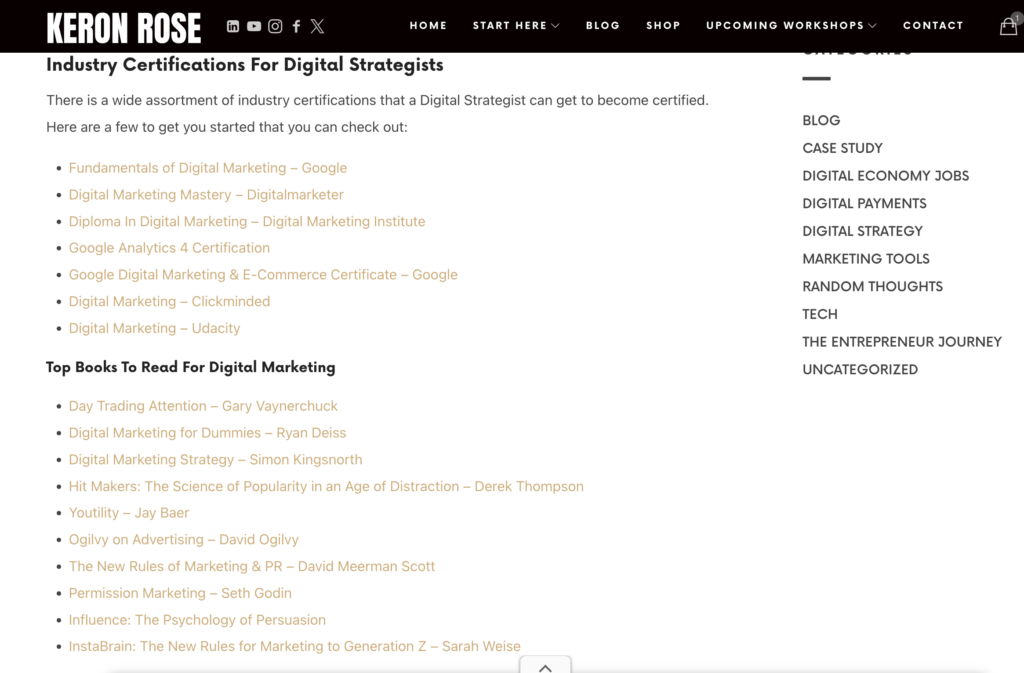
YouTube descriptions are another high-performing placement.
When someone watches a video and then checks the description for more information, they’re already warm. Adding relevant affiliate links at that moment feels natural, not intrusive. Pinned comments reinforce this by keeping the recommendation visible without disrupting the content itself.
Podcasts and show notes are often overlooked, but they quietly perform well.
Listeners are typically highly engaged, and show notes give them a place to act after the episode ends. By embedding affiliate links into both podcast platforms and the podcast website, those links become searchable, shareable assets rather than one-time mentions.
Link-in-bio tools, like Linktree, solve a very specific problem for social platforms that don’t allow clickable links in captions. When used properly, they act as a central hub for recommendations — not a dumping ground. The key is restraint. Only links that make sense for your audience and current content should live there.
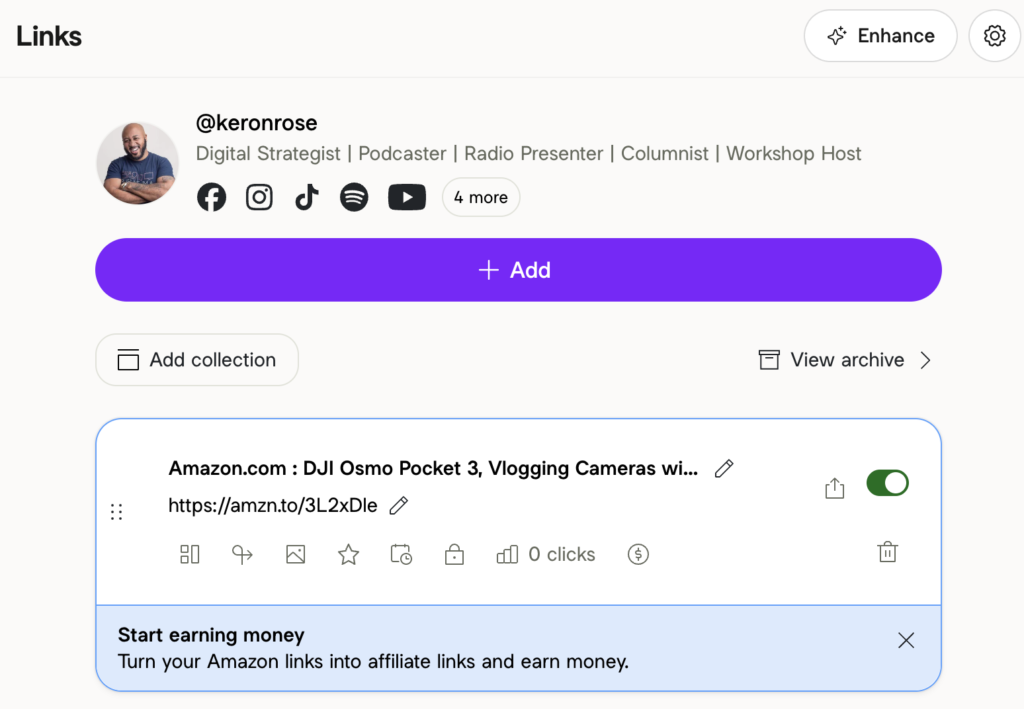
Direct messages are often the most organic conversion point.
When someone asks a specific question — about a book, a tool, or a platform — sending an affiliate link is simply answering that question. There’s no selling involved because the intent already exists.
What makes all of this work is not the placement itself, but context.
Affiliate links perform when they:
- Answer a real question
- Solve an existing problem
- Appear at the moment someone is already looking for a solution
When links are scattered randomly or pushed aggressively, trust erodes and conversions disappear.
This is why affiliate marketing works best inside an ecosystem, not a single platform strategy. Each piece of content reinforces the others. Social media drives awareness. Long-form content builds trust. Search surfaces solutions. Affiliate links simply give people a path to act.
When everything is connected, affiliate marketing stops feeling like monetization — and starts functioning like a natural extension of value.
7. The Two Groups That Never Overlap (And Why Affiliate Income Is So Low in the Caribbean)
One of the clearest patterns I’ve observed over the years is that the people who should be earning from Affiliate Marketing rarely are — and the people trying to earn from it are usually doing the wrong work.
In the Caribbean, affiliate marketing tends to fail not because of access, platforms, or payments, but because two critical groups almost never overlap.
Group One is focused entirely on making money.
These are the people who rush to sign up for Amazon Associates, ask how to get paid, set up Payoneer, and immediately start looking for links to share. What they don’t do is create content, build an audience, or invest time into earning trust. Their approach is transactional from day one, so the outcome is predictable: no clicks, no conversions, no income.
They often believe affiliate marketing is about visibility — posting links anywhere they can — when in reality it’s about intent. Without an audience that already trusts them or content that answers real questions, affiliate links are meaningless. One person buying through a recommendation doesn’t change anything. Affiliate marketing requires volume, consistency, and relevance, none of which exist without content or traffic.
Group Two is the opposite.
These are the people creating content every day. They’re writing blogs, recording podcasts, building YouTube channels, and showing up consistently on social platforms. They have attention. They have trust. They even have traffic — but they never think to monetize it through affiliate marketing.
For them, monetization feels uncomfortable, unnecessary, or like “selling out.” They’ll recommend tools, books, and platforms freely, but never consider that those same recommendations could quietly generate income without compromising integrity. As a result, they leave money on the table while continuing to search for more complex or riskier revenue streams.
The problem is that affiliate marketing only works when these two worlds intersect.
It requires the discipline and patience of a content creator, combined with the intentionality of someone who understands monetization. Without content and trust, affiliate marketing has nothing to attach itself to. Without monetization awareness, content remains under-leveraged.
This disconnect explains why affiliate income remains almost non-existent across much of the Caribbean. It’s not because people can’t do affiliate marketing. At a basic level, most people can register for Amazon Associates and receive payments through Payoneer. The infrastructure exists.
What’s missing is the mindset that content creation and monetization are not separate paths — they are complementary parts of the same system.
Until more creators are willing to build first and monetize intentionally — and more monetization-focused individuals are willing to do the unglamorous work of building trust and traffic — affiliate marketing will continue to feel like something that “doesn’t work here.”
Not because it can’t.
But because the overlap never happens.
8. Why Affiliate Marketing Fails for Most People
By the time most people in the Caribbean say that Affiliate Marketing doesn’t work, they’ve already set it up to fail.
The failure rarely comes from a lack of access to programs or payment tools. It comes from a misunderstanding of what affiliate marketing actually demands — and an unwillingness to do the work that precedes income.
The first failure point is expectation.
Many people approach affiliate marketing believing that registration equals results. They assume that once they’re accepted into Amazon Associates or another program, money should follow automatically. When weeks or months pass without earnings, frustration sets in. What they don’t realize is that affiliate marketing compounds slowly. It rewards consistency, not shortcuts. The early phase is almost always unpaid.
The second failure point is the absence of traffic.
Affiliate marketing cannot function without people seeing the content that contains the recommendation. Signing up for affiliate programs without a plan to generate traffic — through search, platform algorithms, or paid ads — is like opening a store in the middle of nowhere and waiting for customers to show up. The links exist, but no one is coming.
This is where many people get stuck. They have infrastructure on paper, but no distribution in practice.
The third failure point is lack of trust.
Affiliate links convert when the audience believes the recommendation is genuine. That trust is built over time through honest content, repetition, and transparency. People who jump straight to promotion without ever establishing credibility are asking strangers to buy based on nothing more than a link. In most cases, the response is silence.
Another major reason affiliate marketing fails is misaligned audience targeting.
Promoting high-ticket international products to a strictly local Caribbean audience with limited purchasing power often results in low conversion rates. This doesn’t mean affiliate marketing doesn’t work — it means the strategy doesn’t match the audience. Successful affiliates either target global and diaspora audiences or promote products aligned with the realities of their local market.
Finally, many people fail because they refuse to learn traffic acquisition skills.
There are only two real paths to affiliate success:
- Build content and let traffic compound over time
- Or master paid advertising and buy traffic intentionally
Most people do neither. They don’t commit to long-term content creation, and they don’t invest time into learning ads. Without one of these engines, affiliate marketing never gets off the ground.
The uncomfortable truth is that Affiliate Marketing exposes gaps.
It exposes gaps in content quality.
It exposes gaps in distribution strategy.
It exposes gaps in patience and discipline.
When those gaps aren’t addressed, affiliate marketing becomes an easy target for blame. But when they are, the model works — here in the Caribbean, just as it does anywhere else.
The difference isn’t geography.
It’s execution.
9. Content vs Ads: Two Legitimate Paths to Affiliate Marketing
When it comes to Affiliate Marketing, there are only two ways traffic reaches an affiliate link:
people find it organically, or you send them there intentionally.
Everything else is just noise.
In the Caribbean, most people fail at affiliate marketing because they never commit to either path fully. They dabble in content creation without consistency, and they avoid advertising because it feels technical, risky, or expensive. As a result, traffic never reaches a meaningful level, and affiliate income never materializes.
The first path is content-driven affiliate marketing.
This approach is built on creating educational, review-based, or lifestyle content that answers real questions. Over time, that content gets discovered through search engines, recommendation algorithms, and shares. The traffic compounds slowly, but it compounds sustainably.
This is the path most creators naturally fit into. It rewards patience, consistency, and credibility. Blog posts continue earning years after publication. YouTube videos surface long after they’re uploaded. Podcast episodes live on through searchable show notes.
The trade-off is time. Content-driven affiliate marketing doesn’t pay immediately. It requires months of creation before results become visible. But once it turns on, it tends to be stable and low-maintenance.
The second path is ads-driven affiliate marketing.
This approach skips the waiting period by buying traffic through platforms like Google Ads, Meta Ads, or YouTube Ads. Instead of waiting for people to discover your content, you place offers directly in front of targeted audiences.
This path is faster, but it’s not easier.
Running ads successfully requires a deep understanding of targeting, messaging, tracking, conversion optimization, and budget management. Small mistakes can burn money quickly. That’s why ad-driven affiliate marketing is usually dominated by experienced marketers, not beginners.
In the Caribbean, very few people pursue this path seriously. Many avoid ads entirely, while others try them briefly without proper testing or optimization and then conclude they “don’t work.” In reality, ads amplify skill — they don’t replace it.
Both paths are legitimate.
Neither is optional.
If you don’t want to create content, you must learn ads.
If you don’t want to run ads, you must create content.
There is no third option.
Affiliate marketing only becomes predictable when one of these traffic engines is built deliberately. Without it, affiliate links exist in isolation, disconnected from any meaningful flow of attention.
The most successful affiliates — in the Caribbean and globally — often combine both approaches over time. Content builds trust and authority. Ads accelerate reach and test offers. Together, they turn affiliate marketing into a system rather than a gamble.
The mistake isn’t choosing the wrong path.
It’s choosing neither.
10. How Caribbean Creators Actually Get Paid
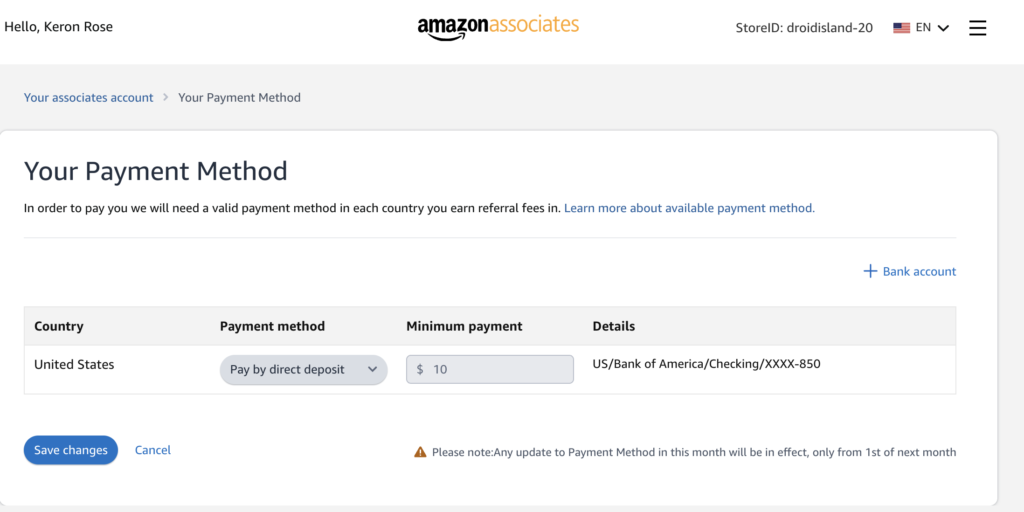
One of the most common excuses used to dismiss Affiliate Marketing in the Caribbean is payments.
People assume that because we don’t have the same banking systems as the US or Europe, getting paid must be impossible. In reality, payments are one of the most solvable parts of affiliate marketing — and rarely the real reason people aren’t earning.
At a basic level, most Caribbean creators can participate in entry-level affiliate programs like Amazon Associates. The challenge is not eligibility, but understanding how international payouts work.
This is where many people get stuck unnecessarily.
Most major affiliate platforms are built around US and European banking infrastructure. They expect ACH transfers, routing numbers, and tax documentation that Caribbean banks don’t natively provide. This mismatch creates confusion, but it doesn’t create a dead end.
For most Caribbean creators, the most practical solution is Payoneer.
Payoneer acts as a bridge between global affiliate platforms and local Caribbean banks. It provides you with virtual US (and other international) bank details that affiliate platforms recognize as valid payout destinations. Once funds land in Payoneer, they can either be withdrawn to your local bank account or kept within Payoneer and spent using the Payoneer card.
The process is straightforward:
- You earn commissions through an affiliate platform
- The platform pays out to your Payoneer account
- You withdraw funds to your local Caribbean bank or use the Payoneer card directly
Once you cross Payoneer’s minimum payout threshold (USD $100), you can apply for a physical or virtual Payoneer card. This allows you to spend your affiliate earnings directly, without immediately transferring funds back into the local banking system.
If you want to keep your earnings in USD when withdrawing to a local bank, you must have a USD-denominated account with your home country’s bank. Otherwise, your bank will automatically convert the funds into the currency of the account you’re sending the money to.
For example, if your local bank account is denominated in TTD, any USD funds transferred from Payoneer will be converted into TTD upon receipt.
This setup works across much of the Caribbean and removes the biggest perceived barrier to entry.
What’s important to understand is that payment infrastructure does not generate income — it only receives it.
Many people successfully set up Amazon Associates, Payoneer, and local bank connections, then wait for money that never comes. The setup is correct, but nothing is flowing through it. Without content, traffic, and trust, the payment system stays empty.
There are also important compliance steps that cannot be skipped.
Affiliate platforms will require tax documentation to confirm that you are a non-US resident earning income outside the United States. This is typically handled through foreign tax forms, not US resident filings. Getting this right protects you from unnecessary withholding and account issues later on.
The key takeaway is simple:
If you can create content, build trust, and drive traffic, getting paid in the Caribbean is not the blocker people think it is.
The tools exist.
The rails exist.
The opportunity exists.
What’s usually missing is everything that comes before the payout.
11. The Affiliate Platforms That Matter (Creators vs Businesses)
Affiliate Marketing is powered by two different ecosystems:
- Networks/marketplaces where creators sign up to find products to promote
- Platforms and tools businesses use to run affiliate programs and manage payouts
Most people confuse these — and that confusion leads to bad strategy.
A) For Creators: Where You Can Register, Browse Offers, and Get Links
These are the platforms where you sign up as a publisher/creator, get approved, and then choose brands/products you want to promote.
1) Amazon Associates
The most accessible starting point for most Caribbean creators because the product catalog is massive and the use case is simple: recommend what you use, link it, earn commissions.
2) Awin
Awin is a major global affiliate network where publishers apply and then join individual advertiser programs once inside the platform. (Available for most Caribbean countries).
3) CJ (CJ Affiliate)
CJ is one of the largest affiliate networks on earth. As a creator, you join as a publisher, then connect with brands inside the platform.
4) Rakuten Advertising
Rakuten also runs a publisher-side network where creators join as publishers, then apply to partner with brands inside their ecosystem.
Key point for creators:
These networks don’t pay you for “having an account.” They pay you when your content drives measurable actions (sales/leads). The account is just the doorway.
B) For Businesses: How Companies Create & Manage Affiliate Programs
For businesses, there are two valid approaches:
Option 1: Run your program through a network
This is when you list your brand/product inside an existing affiliate network and recruit publishers already on it.
- Awin (merchant/advertiser programs on the Awin network)
- CJ Affiliate (brands work with publishers inside CJ’s ecosystem)
- Rakuten Advertising (advertisers recruit publishers via the Rakuten network)
Why businesses choose networks:
You’re not building the affiliate ecosystem from scratch — you’re tapping into an existing pool of publishers.
Option 2: Run your own affiliate program with software
This is when you use a tool to build your own program, create dashboards, generate links, track conversions, and pay commissions — even if you’re not inside a big “network.”
Here are strong examples (depending on your business model):
1) Refersion
Affiliate tracking + partner management for brands (especially ecommerce).
2) Tapfiliate
Affiliate software designed to help businesses launch and manage an affiliate program quickly.
3) FirstPromoter
Very common for subscription/SaaS businesses (integrations with billing systems and recurring revenue tracking).
4) PartnerStack
Built for B2B/SaaS partner ecosystems (affiliates + referrals + partners under one roof).
5) “Direct program” inside your CRM/checkout stack
Think about my earlier example from DigitalMarketer — they ran their affiliate logic through Infusionsoft (Keap), so when I recommended courses, tracking + commissions were managed inside their system, not a public network. (This is the key lesson: many brands don’t live on networks — they run private programs.)
The Practical Rule
If you’re a creator, start with platforms where you can:
- Sign up as a publisher
- Browse brands/offers
- Generate tracking links
- Drop those links into content
If you’re a business, decide:
- Do we want a network that already has publishers? (Awin/CJ/Rakuten)
- Or do we want to run our own program with software? (Refersion/Tapfiliate/FirstPromoter/PartnerStack)
12. Why 2026 Changes Everything for Me (And My Affiliate Strategy)
For most of the last few years, my content has been heavily focused on digital strategy, education, and consulting. That direction was intentional — but it also meant I deliberately limited how much affiliate content I produced.
Most of my affiliate income during that period came from:
- Books I was reading
- Courses I personally took
- Tools I referenced occasionally
Affiliate Marketing was always there — but it wasn’t the focus.
The Shift Back to Tech Exploration & Digital Lifestyle Content
As I move into 2026, my content is shifting again — this time back toward:
- Tech exploration
- Tools and platforms I actively use
- Digital nomad life in Asia
- Devices, services, software, and workflows that support how I live and work
This shift isn’t about chasing affiliate revenue.
It’s about documenting real usage again.
And that naturally creates more affiliate opportunities.
Why This Content Direction Unlocks More Affiliate Revenue
When you’re deeply embedded in tech and lifestyle:
- You’re constantly testing tools
- Making decisions about platforms
- Comparing services
- Switching software
- Optimizing workflows
Each of those decisions becomes content.
And when people ask:
- What tool is that?
- How are you doing this remotely?
- What are you using to manage X?
Affiliate links stop feeling like monetization and start functioning as answers.
That’s where affiliate marketing works best.
Affiliate Marketing as a Byproduct, Not a Strategy
My philosophy hasn’t changed.
I still only promote:
- Things I personally use
- Tools relevant to my life and work
- Platforms that genuinely fit my ecosystem
The difference heading into 2026 is volume of opportunity, not intent.
More tools used → more content created → more contextual recommendations → more affiliate income.
Not because I’m “doing affiliate marketing harder” — but because my content is expanding back into areas where affiliate monetization fits naturally.
Why This Matters for the Rest of the Article
This is important to understand:
Affiliate Marketing works best when it sits underneath a real life, real work, real curiosity.
As my content evolves:
- Affiliate income becomes more visible
- More consistent
- More scalable
But it will always remain supplementary, intentional, and aligned — not forced.
That’s the model that has worked for me since 2016, and it’s the same model I’m doubling down on as I head into 2026.
13. The Long-Term Mindset Shift Caribbean Creators Need
If affiliate marketing is going to work at scale in the Caribbean, the biggest shift isn’t technical — it’s mental.
Most people are approaching this backwards.
Stop Chasing Income. Start Building Assets.
Affiliate marketing rewards assets, not effort.
Social posts disappear in days.
Stories vanish in 24 hours.
Random links die instantly.
Assets compound:
- Blog posts that rank for years
- YouTube videos that get discovered months later
- Podcast episodes that continue to answer questions
- Searchable content that lives outside social feeds
Affiliate income doesn’t come from posting links.
It comes from owning digital real estate that keeps working.
Stop Spamming Links. Start Answering Questions.
Most affiliate links fail because they’re dropped with no context, no trust, and no relevance.
The links that convert best:
- Answer a specific question
- Solve a real problem
- Appear after value has already been delivered
Affiliate marketing works when links feel like help, not hustle.
If people aren’t asking you questions yet, that’s not a reason to quit — it’s a signal that you need to:
- Create more useful content
- Share your thinking publicly
- Document what you’re learning and using
Stop Blaming Geography. Start Mastering Systems.
Yes, the Caribbean has challenges:
- Limited local payment options
- Small domestic markets
- Banking friction
But affiliate marketing is digital export income.
Your audience doesn’t have to be local.
Your products don’t have to be local.
Your buyers don’t even have to know where you live.
The people earning consistently have learned:
- How traffic actually works
- How platforms reward consistency
- How systems compound over time
The bottleneck isn’t location — it’s execution.
Affiliate Marketing Is Part of a Stack, Not a Magic Bullet
Affiliate marketing was never meant to be your only revenue stream.
It works best as:
- A layer on top of content
- A complement to consulting, products, or services
- A monetization path for attention you already have
When treated as a standalone hustle, it fails.
When treated as part of a digital revenue stack, it becomes powerful.
That’s the difference.
The Real Takeaway
Affiliate marketing works in the Caribbean — but only for people willing to:
- Think long-term
- Build assets instead of chasing quick wins
- Focus on trust, relevance, and consistency
There are no shortcuts here.
But there is a clear path — and it’s available to anyone willing to build properly.
14. Final Thoughts: Affiliate Marketing Is a Strategy, Not a Shortcut
Affiliate marketing is not broken in the Caribbean.
What’s broken is how most people approach it.
Too many are looking for a shortcut to income, instead of committing to the long game of building digital assets, trust, and distribution. They sign up for platforms, set up payment infrastructure, and then wait — without content, traffic, or a strategy.
That’s not affiliate marketing.
That’s wishful thinking.
The creators who earn consistently don’t treat affiliate marketing as a hustle. They treat it as:
- A natural extension of their content
- A byproduct of sharing what they use and trust
- A monetization layer on top of systems they already control
Affiliate marketing works best when it feels invisible — when it’s simply the answer to a question someone was already going to ask.
For the Caribbean, this represents something bigger than side income. It represents digital export revenue. The ability to earn in foreign currency, from global platforms, without being limited by local market size.
But that opportunity only opens up when:
- You create content that lives beyond social media
- You build assets that compound over time
- You focus on relevance instead of randomness
There is no magic platform.
No secret link.
No guaranteed payout.
There is only:
- Content
- Trust
- Traffic
- Time
Get those right, and affiliate marketing works — here, just as it does anywhere else in the world.
The real question isn’t whether affiliate marketing works in the Caribbean.
It’s whether you’re willing to build the kind of digital foundation that allows it to work for you.
Affiliate Marketing Recap
What Affiliate Marketing Is
Affiliate marketing is a performance-based revenue model where you earn commissions by recommending products or services and driving measurable actions. It works best as a monetization layer on top of content and trust — not as a standalone hustle.
What You Need
At a minimum, you need:
- A long-term content platform (blog, YouTube, podcast, or website)
- Consistent content that answers real questions
- A traffic strategy (search, platforms, or ads)
- Relevant affiliate programs tied to what you actually use
- Payment infrastructure (e.g. Payoneer connected to a local bank)
Without these pieces, affiliate marketing doesn’t turn on.
Who Affiliate Marketing Is For
Affiliate marketing works best for:
- Creators, educators, and professionals who already share knowledge
- People willing to build digital assets over time
- Those comfortable earning gradually, not instantly
It is not for people looking for fast money without building trust or content.
How to Do It Properly
- Promote only what you use and trust
- Embed links contextually inside valuable content
- Focus on compounding platforms, not disappearing posts
- Treat affiliate income as part of a digital revenue stack, not a magic bullet
Done correctly, affiliate marketing becomes predictable, scalable, and sustainable — including in the Caribbean.
If you have any more questions, please feel free to contact me here: Contact Me.