1. The Question People Keep Asking (and Why It’s the Wrong One)
In 2026, it’s still common to hear people ask:
- “Are websites even relevant anymore?”
- “Isn’t social media enough?”
- “I sell just fine through WhatsApp.”
And to be fair — these aren’t foolish questions. They’re logical questions based on an outdated understanding of what a website actually does.
For years, websites were treated like digital brochures: a few pages, some photos, a contact form, and not much else. Social media, on the other hand, felt alive — fast, interactive, and capable of driving immediate attention. So it’s no surprise that many businesses began to believe that social platforms had replaced the need for a website altogether.
But here’s the issue:
that mental model no longer matches how the internet — or buying behavior — actually works.
In 2026, a website is not just a place to “exist online.” It’s not there to compete with Instagram or TikTok for attention. It plays a completely different role in the ecosystem — one that social platforms cannot replace.
That’s why the real answer to the question isn’t “yes” or “no.”
It’s this:
You don’t need a website… if you’re okay staying small, manual, and invisible to search and AI.
That line isn’t meant to provoke — it’s meant to clarify the trade-off.
Because when businesses say they’re “doing fine” without a website, what they usually mean is:
- sales are happening manually or in person
- conversations are happening one-to-one
- growth is limited to whoever they can personally respond to
- and visibility depends entirely on social algorithms they don’t control
That can work — up to a point.
The problem is that many business owners don’t realize they’ve hit a ceiling until they’re already stuck under it.
To understand why, we need to look at what actually happens when a business operates without a website — especially in the Caribbean context.
So let’s break that down.
2. The Reality of Selling in the Caribbean Without a Website
When a business in the Caribbean doesn’t have a website, selling doesn’t stop — it just takes a very specific, familiar shape.
Discovery usually happens on social media. Someone sees a post on Instagram, Facebook, or TikTok. They’re interested, so they send a DM or click the WhatsApp link in the bio. That’s where the real work begins.
From there, the transaction is pushed outside the digital system entirely.
The customer is asked to:
- fill out a Google Form
- send a bank transfer
- screenshot proof of payment
- or visit the physical store to complete the purchase
This is the default sales flow across much of the region.
And it’s important to say this clearly:
sales still happen.
People pay. Businesses get revenue. On the surface, things appear to be working.
But look closer at what’s actually happening behind the scenes.
Every sale requires human involvement.
Every payment needs manual confirmation.
Every order depends on someone being available to reply, check, reconcile, and follow up.
Nothing is automated.
Nothing happens while you sleep.
Nothing scales without adding more labour.
What looks like “doing fine” is really a system held together by constant effort.
This model works when:
- volume is low
- demand is predictable
- customers are patient
- and the business owner is always available
But the moment demand increases — a post goes viral, a promotion works, or a busy season hits — the cracks show immediately.
Messages pile up.
Payments come in without context.
Inventory isn’t synced in real time.
Customers wait for confirmation.
Some drop off entirely.
And because everything happens in private chats, there’s no clean data trail — no clear insight into where people hesitate, where sales are lost, or what’s actually driving conversions.
This is the part many businesses don’t realize:
A WhatsApp- and bank-transfer-based sales process locks you into one-to-one selling.
It limits how many people you can serve, how far you can sell, and how consistently you can grow. Selling beyond your immediate geography becomes difficult. Selling while you’re offline becomes impossible. Selling at scale becomes unrealistic.
This isn’t a technology problem.
It’s a structure problem.
And until that structure changes, growth will always be capped — no matter how strong your social media presence is.
That’s why the next question isn’t “Why do I need a website?”
It’s “What role is my business forcing social media and WhatsApp to play?”
And that’s where the real shift begins.
3. Why Social Media Can’t Be Your Checkout (Especially in the Caribbean)
If the current sales process feels manual and fragile, it’s not because Caribbean businesses are doing something wrong.
It’s because the region was never given the tools to do it properly.
Globally, social media platforms have been pushing hard into social commerce. In markets like the US, UK, and parts of Europe, customers can discover a product, check availability, pay, and receive confirmation without ever leaving the app. The entire buying journey happens inside Instagram, TikTok, or Facebook.
That simply isn’t the reality for most Caribbean businesses.
As of 2026, native checkout features like Instagram Checkout, TikTok Shop, and Facebook Shop are still unavailable — or severely limited — across much of the region. That means social platforms can create attention, but they can’t complete the transaction.
So businesses adapted.
“DM to buy” became the default not because it was efficient, but because it was the only option. WhatsApp stepped in as the bridge between interest and payment. Bank transfers filled the gap left by unavailable payment rails. Google Forms became a makeshift order system.
This wasn’t strategy — it was survival.
But survival systems come with a cost.
When social media becomes your checkout, every sale becomes a manual process. And manual systems don’t fail loudly — they fail quietly.
Missed messages lead to missed sales.
Delays in confirming payments create frustration.
Inventory that isn’t synced in real time leads to overselling.
Staff are pulled away from higher-value work just to answer repetitive questions, reconcile transfers, and chase confirmations.
Over time, this creates burnout — not just for staff, but for business owners themselves.
And the most important distinction to make here is this:
WhatsApp isn’t the problem.
WhatsApp is excellent at conversation, reassurance, and customer service. It’s familiar, trusted, and deeply embedded in Caribbean business culture.
The problem is using WhatsApp as a checkout.
It was never designed to handle payments, inventory, receipts, automation, or scale. When it’s forced into that role, the business ends up carrying all the operational weight manually.
This is the ceiling many businesses keep hitting without realizing why.
Social media can generate demand.
WhatsApp can support conversation.
But neither was built to close, automate, and scale transactions — especially in a region with limited social commerce infrastructure.
And this is exactly where the website comes in.
4. What a Website Actually Is in 2026 (It’s Not a Brochure)
One of the biggest reasons people underestimate websites is because they’re still thinking about them the way we did ten or fifteen years ago.
A homepage.
An “About Us” page.
A contact form.
That version of a website is outdated — and if that’s all a site does, then yes, it’s fair to question its value.
But in 2026, that’s not what a website is anymore.
A modern website is not a digital flyer.
It’s not there to compete with social media for attention.
It doesn’t exist to “look nice.”
A website today is operational infrastructure.
It’s the system that sits underneath your marketing and makes everything else work.
This is where the real shift happens.
Instead of forcing sales through DMs and WhatsApp, a website becomes the place where transactions are actually handled — automatically, consistently, and at scale. Payments can be processed without human intervention. Orders can be confirmed instantly. Inventory can be updated in real time. Receipts, confirmations, and follow-ups can be triggered without someone manually sending messages.
That alone removes an enormous amount of friction.
But it goes further than sales.
A website becomes the central hub where customer data lives. It connects to CRMs, email systems, analytics tools, and payment gateways. It tracks what people view, where they hesitate, what they abandon, and what finally converts. Instead of guessing what’s working, businesses can see it clearly.
This is the key difference most people miss:
Social media creates demand.
Websites absorb, organize, and scale that demand.
Without a website, every channel operates in isolation. Instagram generates interest. WhatsApp handles questions. Bank transfers handle payments. Google Forms collect details. Nothing talks to each other.
With a website, everything connects.
Marketing feeds into sales.
Sales feeds into data.
Data feeds into better decisions.
And critically — the website is owned.
Algorithms can change.
Reach can drop.
Accounts can be restricted or hacked.
But your website remains your digital ground. It’s the one place where your business logic, customer information, and transaction flow are under your control.
This is why, in 2026, the website isn’t something you add after social media.
It’s the foundation that makes social media, WhatsApp, search engines, and even AI tools actually useful for growth.
Once you see the website this way — not as a page, but as a system — the rest of the conversation starts to make sense.
5. Where People Actually Research Before Buying in 2026
Once demand is created — a Reel sparks interest, a TikTok goes viral, a recommendation comes through WhatsApp — most people don’t immediately buy.
They pause.
And when they pause, they research.
This is the part of the buying journey many businesses underestimate, because it doesn’t happen publicly. It doesn’t show up as likes, comments, or shares. It happens quietly — and intentionally.
In 2026, that research no longer lives in just one place.
People move between:
- search engines like Google
- AI tools like ChatGPT, Gemini, and Perplexity
- review platforms
- and, critically, the brand’s official website
This is a completely different mindset from social media.
Social platforms are built for discovery and entertainment. People scroll casually, often without a specific goal. But when someone switches to search or AI, their behavior changes. They’re no longer browsing — they’re evaluating.
They’re asking questions like:
- “Is this brand legit?”
- “How does this compare to other options?”
- “What’s the price, the policy, the catch?”
- “Will this actually solve my problem?”
This is what’s known as intent-driven research — and it’s where buying decisions are really made.
In the Caribbean context, this step is even more important. Because of long-standing concerns around fraud, unreliable service, and fly-by-night online businesses, people are naturally cautious. Seeing something on social media isn’t enough. They want confirmation.
That confirmation almost always starts with a search.
They Google the business name.
They ask an AI assistant for recommendations.
They look for an official website.
And this is where the absence of a website becomes a silent deal-breaker.
If there’s no site to land on — no clear explanation of what the business does, no policies, no structured information — uncertainty creeps in. Even if the product looks good, doubt slows the decision.
This is the uncomfortable truth:
You don’t lose sales when people scroll past your post.
You lose them when they research you and can’t find enough to feel confident.
Social media is excellent at starting the conversation.
But it was never designed to finish it.
Search engines and AI tools don’t send people to random DMs. They surface structured, credible sources. And in almost every case, that source is a website.
If your business isn’t visible at that research stage — or if the information about you is scattered across platforms — you’re absent from the most critical moment in the buying journey.
That’s why websites don’t compete with social media.
They complete it.
And this is also why the content on your website doesn’t just inform people — it compounds over time.
6. Why Website Content Compounds (and Social Content Expires)
Once you understand where people research before buying, the next question becomes obvious:
What content keeps showing up when they do?
This is where the gap between social media and websites becomes impossible to ignore.
Social media content is built for immediacy. It’s designed to capture attention in the moment — to be seen, reacted to, and then replaced by whatever comes next in the feed. Even strong-performing posts have a short shelf life. Within hours or days, they’re effectively gone, buried under new content and algorithm shifts.
That doesn’t make social media useless.
It just makes it temporary.
Website content behaves very differently.
When you publish content on your website — articles, guides, FAQs, service pages — that content doesn’t disappear. It gets indexed by search engines. It becomes reference material for AI tools. It lives on as part of the permanent information layer people (and machines) rely on when researching.
This is what compounding actually looks like.
And I’ve experienced this firsthand.
Over the last 28 days, my website appeared in 73,000 Google searches and brought in over 5,100 unique visitors — even during weeks when I didn’t publish any new content at all.
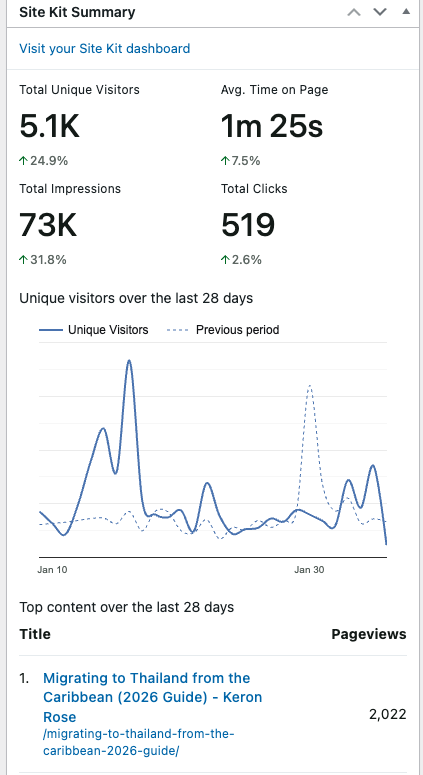
There are stretches where I’m not posting constantly, not chasing trends, not feeding the algorithm every day.
And yet:
- traffic continues to come in
- leads still arrive
- opportunities still show up
- sales still happen
That’s the difference between content that expires and content that compounds.
Articles I wrote months — and in some cases years — ago are still being surfaced by search engines and referenced by AI tools. They continue to answer questions, establish credibility, and introduce my work to new audiences without requiring constant effort.
This is what getting off the content hamster wheel actually looks like.
Instead of needing to be “on” every day just to stay visible, your past work keeps working for you. Your content becomes a library, not a stream. Effort turns into assets.
The contrast is clear:
Social media rewards constant output.
Websites reward accumulated insight.
And in 2026, this compounding effect doesn’t just benefit search engines.
It now feeds AI systems as well.
When someone asks an AI assistant a detailed question — comparing options, evaluating services, or looking for recommendations — the AI pulls from structured, authoritative sources. That almost always means website content, not captions, comment threads, or DMs.
So every useful page on your website does double duty:
- it helps humans make confident decisions
- and it teaches AI how to describe, position, and recommend your business
This is why saying “SEO is dead” completely misses the point.
Search hasn’t disappeared — it has evolved. And the businesses that win aren’t the ones chasing constant visibility. They’re the ones quietly building content assets that keep working long after the post is forgotten.
And this leads directly to the next shift most businesses still haven’t fully grasped:
Your website is no longer written just for people.
It’s being read, interpreted, and prioritized by machines.s.
7. Your Website Is Now Built for AI, Not Just Humans
Up to this point, the role of a website has been explained through a human lens — how people research, evaluate, and decide.
But in 2026, there’s a second audience involved in every buying journey.
And it’s often the first one to arrive.
That audience is AI.
Today, people don’t just Google questions. They ask AI assistants to:
- compare options
- summarize pros and cons
- recommend businesses
- shortlist products
- and even guide final decisions
These tools don’t browse the internet the way humans do. They don’t scroll Instagram. They don’t jump between DMs. They don’t piece together scattered information from comments and captions.
They rely on structured, authoritative sources.
In practice, that means websites.
Your website has become the primary source AI systems use to understand:
- what your business offers
- who it’s for
- how it compares to alternatives
- whether it’s trustworthy
- and whether it should even be mentioned
This is a fundamental shift.
In the past, a website was written mainly for visitors. Now, it also functions as a source-of-truth database for AI systems that summarize, recommend, and filter options on behalf of users.
If your information is:
- scattered across social posts
- buried in images
- locked inside WhatsApp conversations
- or inconsistent from one platform to the next
AI systems struggle to interpret it — and when there’s uncertainty, they simply move on.
That’s why many businesses feel invisible even though they’re active online.
They’re visible to humans scrolling social feeds, but invisible to the systems people increasingly rely on when making serious decisions.
This is also why websites with:
- clear structure
- detailed explanations
- FAQs
- transparent policies
- and consistent messaging
are disproportionately favored in AI-generated answers.
They’re easier to understand.
Easier to summarize.
Easier to trust.
And as AI becomes a default research layer — not a novelty — this visibility gap will only widen.
In simple terms:
If AI can’t clearly understand your business, it can’t recommend it.
And the primary way AI understands businesses in 2026 is through their websites.
This shift also sets the stage for what comes next — because AI isn’t just helping people research anymore.
It’s starting to buy on their behalf.
8. Agentic Commerce: How Buying Is Changing (and Why This Matters)
Up to now, AI has mostly helped people decide.
It summarizes options.
It compares alternatives.
It shortlists recommendations.
But in 2026, AI is beginning to do something more consequential:
It’s starting to buy on behalf of users.
This shift is known as agentic commerce — where AI agents don’t just assist with research, but actively execute transactions based on a user’s preferences, budget, and constraints.
And this isn’t theoretical.
Major platforms are already moving in this direction:
- AI-powered checkout experiences inside search and chat tools
- Shopify enabling purchases directly through AI interfaces
- Payment providers like PayPal and Mastercard rolling out agent-based payment protocols, including in the Caribbean
The direction is clear:
buying is becoming delegated.
Instead of someone manually visiting ten websites, comparing prices, checking policies, and completing checkout, they increasingly ask an AI to handle it for them.
But here’s the critical part most businesses miss:
AI agents can’t buy from DMs.
They can’t transact inside WhatsApp conversations.
They can’t interpret screenshots of bank transfers or Google Forms.
They need structured endpoints.
They need:
- clear product or service data
- transparent pricing
- availability and inventory signals
- policies and conditions
- and a verifiable checkout process
In other words, they need a website.
In an agent-led buying environment, your website becomes the transaction endpoint — the place where AI can reliably confirm details and complete a purchase without uncertainty.
If that endpoint doesn’t exist, the AI doesn’t “work around it.”
It simply excludes the business.
This is the uncomfortable implication for businesses relying entirely on social media and messaging apps:
You’re not just invisible to search — you’re invisible to the next generation of buyers.
Agentic commerce doesn’t replace human decision-making entirely. But it reshapes the early and middle stages of the buying journey so dramatically that businesses without proper digital infrastructure are quietly filtered out before a human ever gets involved.
And because these systems prioritize certainty and reliability, they naturally favor businesses with:
- structured websites
- consistent data
- automated checkout flows
- and clear operational signals
This is why the website is no longer just a sales tool.
It’s your passport into the future buying ecosystem.
And as AI continues to move from advisor to executor, the gap between businesses with proper websites and those without them will widen — quickly.
Which brings us to another reality of 2026 that makes websites even more important:
Trust, legitimacy, and scam detection in an increasingly noisy digital world.
9. Trust, Legitimacy, and Scam Detection in a High-Fraud Digital World
As buying becomes more digital — and more automated — trust becomes more important, not less.
In 2026, consumers are navigating a digital environment filled with:
- cloned social media profiles
- fake ads powered by AI
- deepfake videos and voice notes
- scam DMs that look increasingly legitimate
This has made people more cautious, not more reckless.
And the way people protect themselves is surprisingly consistent.
When someone discovers a business for the first time — especially through social media — their instinct is no longer to continue the conversation blindly. Instead, they pause and verify.
They Google the business name.
They search for reviews.
They look for an official website.
This moment matters more than most businesses realize.
In a high-fraud environment, a website has become the final legitimacy check.
It signals:
- permanence
- accountability
- professionalism
- and intent to operate beyond quick transactions
Social media profiles can be created in minutes.
Websites take effort, structure, and continuity.
That distinction matters.
This is especially true in the Caribbean, where consumers have learned — often through bad experiences — to be skeptical of online sellers. People are careful with their money. They want to know who they’re dealing with, what happens if something goes wrong, and whether the business will still exist tomorrow.
A proper website answers those questions silently.
It provides:
- clear explanations of what the business does
- transparent pricing and policies
- contact information that goes beyond a username
- evidence of history, credibility, and consistency
And when that information is missing, suspicion creeps in — even if the product looks good.
This is the part many businesses don’t notice:
You don’t always lose sales because people don’t want what you’re selling.
You lose them because people aren’t confident enough to proceed.
As AI becomes more involved in filtering options for users, this trust layer becomes even more critical. AI systems are designed to reduce risk. When information is unclear, inconsistent, or unverifiable, they default to exclusion.
So the website serves a dual role:
- it reassures humans
- and it signals reliability to machines
In a world where scams are easier to create than ever, trust is no longer built through charisma or popularity alone.
It’s built through structure.
And the website is where that structure lives.
Which leads to another quiet advantage most businesses overlook:
The data your website collects — and how it gives you an edge others don’t have.
10. Data: The Quiet Advantage Most Businesses Are Ignoring
By the time a customer trusts your business enough to buy, a lot has already happened.
They’ve searched.
They’ve compared.
They’ve hesitated.
They’ve made decisions long before money moved.
The problem is that without a website, you never see any of that.
Social media platforms are excellent at showing surface-level activity — likes, comments, shares, views. But those numbers don’t tell you why people didn’t buy, where they dropped off, or what almost convinced them.
Websites do.
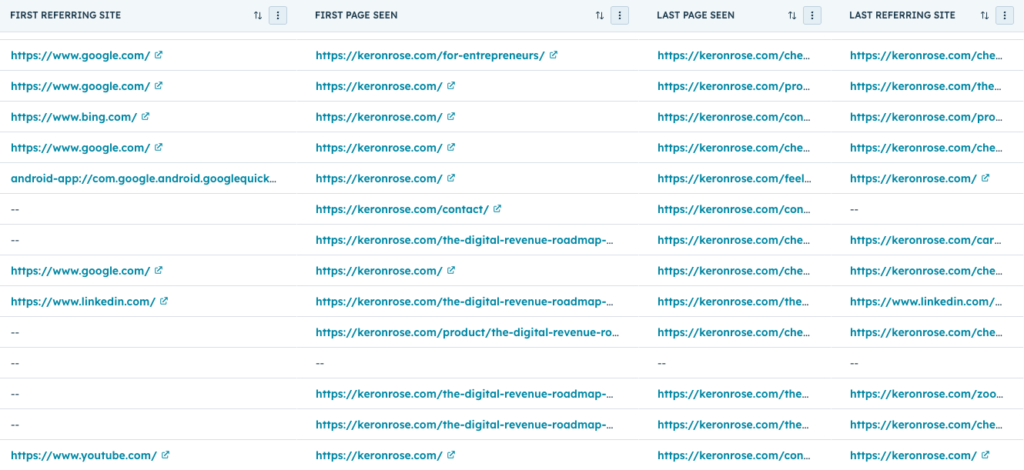
A website allows you to see:
- which pages people visit before they convert
- where they hesitate or abandon
- what questions keep coming up
- which offers perform better
- and which traffic sources actually drive revenue
This is first-party data — information collected directly from people interacting with your business, not borrowed insights from a platform that owns the relationship.
And in 2026, this matters more than ever.
As privacy rules tighten and third-party cookies disappear, businesses that don’t collect their own data are effectively flying blind. Social platforms give you their interpretation of your audience. Your website gives you direct intelligence.
This is where the competitive gap opens.
With website data, even small businesses can:
- improve conversion rates instead of guessing
- personalize experiences based on behavior
- identify which content actually drives sales
- reduce wasted marketing spend
- and make decisions backed by evidence, not intuition
Without it, growth becomes reactive. You post more. You reply faster. You hope the next campaign works better than the last.
And there’s another overlooked benefit: resilience.
Social platforms change rules constantly. Reach drops. Accounts get restricted. Features disappear. When all your customer understanding lives inside those platforms, your business is exposed.
A website changes that.
It becomes your source of truth — a place where data accumulates over time and insights compound just like content does. The longer you operate, the smarter your business becomes.
This is why websites aren’t just about visibility or sales.
They’re about control.
Control over your data.
Control over your decisions.
Control over how your business grows.
And once you understand that, the final conclusion becomes unavoidable.
The website isn’t optional.
It’s foundational.
11. The Final Verdict: The Website Is the Foundation, Not the Channel
At this point, the question “Do I really need a website?” should feel very different than it did at the beginning of this article.
Because the answer was never about aesthetics.
It was never about trends.
And it was never about replacing social media.
In 2026, a website is not a channel you compete with Instagram or TikTok on.
It’s the foundation everything else sits on.
Social media creates awareness.
WhatsApp supports conversation.
Search engines and AI handle research.
AI agents increasingly handle transactions.
And the website is what connects all of it.
It’s where:
- trust is verified
- information is structured
- payments are automated
- data is captured
- content compounds
- and AI systems learn how to describe and recommend your business
Without that foundation, every other effort becomes heavier. More manual. More fragile. More dependent on platforms you don’t control.
This is why businesses without websites often feel like they’re working harder just to stay in the same place. They’re visible, but not durable. Active, but not scalable.
The truth is simple:
Social media helps people discover you.
Your website determines whether they trust you, choose you, and buy from you — today and in the future.
So no — you don’t need a website if your goal is to stay small, manual, and local.
But if you want to:
- scale beyond one-to-one selling
- show up in search and AI-driven discovery
- participate in the next wave of digital commerce
- build credibility in a high-scam environment
- and reduce dependence on daily posting
then the website isn’t optional.
It’s infrastructure.
And the businesses that understand this now won’t just survive the next few years — they’ll quietly outgrow the ones that don’t.
Need Help With Your Website & Digital Strategy?
If you need help building or fixing your website strategy, improving traffic, or aligning your digital presence for 2026, you can book a 1-on-1 strategy session with me.