
1. The Rollout Is Underway!
Agentic storefronts are no longer a future concept—they are already beginning to take shape in real, deployed infrastructure. For years, AI in commerce has been discussed as an emerging trend, something businesses should “keep an eye on.” That phase is over.
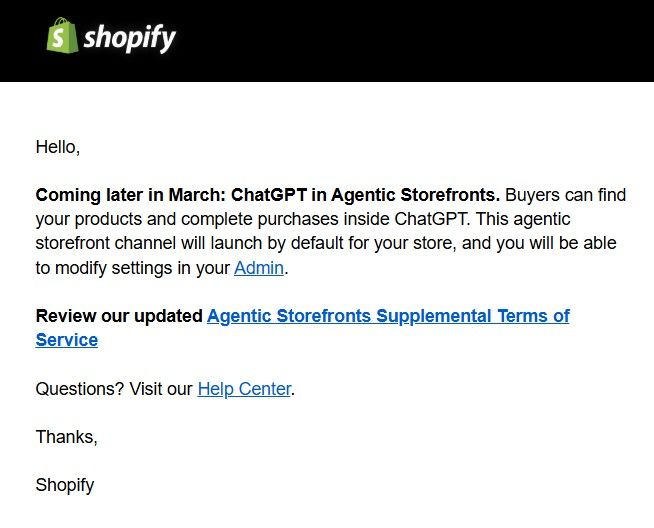
Shopify has officially begun rolling out integrations with ChatGPT that bring AI directly into the storefront experience. This is not a concept demo or a limited experiment. It represents a live shift in how products are discovered, evaluated, and purchased online (Buy it in ChatGPT Official Announcement).
At its core, this rollout enables customers to interact with an AI interface that understands intent, recommends products, compares options, and guides purchasing decisions—all within a conversational flow. Instead of navigating menus, filters, and multiple product pages, users can simply describe what they want and receive tailored results instantly.
This fundamentally changes how people engage with e-commerce. The traditional model required effort from the customer: searching, clicking, comparing, and deciding. That responsibility is now being transferred to AI, reducing friction and accelerating decision-making.
This is what defines the transition toward agentic storefronts. Storefronts are no longer passive displays of products. They are evolving into intelligent environments where AI actively participates in the buying process—interpreting needs, narrowing choices, and supporting the final decision.
And this shift is not happening at the margins. Shopify powers millions of businesses globally, and when infrastructure at this scale evolves, it signals a broader transformation across the entire digital commerce ecosystem.
What we are seeing is the early stage of a new standard.
The buying journey is no longer something customers navigate step by step. It is something they increasingly delegate.
2. WHAT AGENTIC STOREFRONTS ACTUALLY ARE
To understand what is changing, we first need to clearly define what agentic storefronts actually are—beyond the buzzword.
At a basic level, agentic storefronts are e-commerce environments where AI acts on behalf of the customer. Instead of the user manually navigating a website, filtering products, and comparing options, they describe what they want, and the AI handles the process.
This shift is subtle on the surface but significant in impact.
In a traditional storefront, the experience is built around navigation. The customer is expected to browse categories, apply filters, read product descriptions, compare alternatives, and eventually make a decision. Every step requires effort, time, and a certain level of digital literacy.
In an agentic storefront, that responsibility moves away from the user.
The interaction becomes conversational rather than navigational. A customer might say:
- “I’m looking for a lightweight laptop for travel under $1,500”
- “Show me skincare products for oily skin that are good for humid climates”
- “Find me a black dress for a formal event next weekend”
From there, the AI interprets the request, identifies relevant products, compares options, and presents recommendations that align with the customer’s intent. It can also explain why certain products are a better fit, answer follow-up questions, and guide the user toward a decision.
This is where the “agentic” part becomes important.
The AI is not just responding—it is acting. It is taking initiative within defined boundaries, performing tasks that the customer would traditionally have to do themselves. That includes searching, filtering, ranking, and even helping facilitate the purchase.
The storefront, in this context, becomes less about layout and more about data and structure.
For businesses, this means your products are no longer simply displayed—they are interpreted. Your descriptions, pricing, categories, and supporting content are being read and processed by AI systems that determine whether your offering is relevant to a specific customer request.
This also introduces a new layer of competition.
You are no longer just competing for attention on a webpage. You are competing to be selected, recommended, and surfaced by AI. If your products are not clearly defined, properly structured, and contextually relevant, they may never be presented to the customer at all.
Agentic storefronts shift the focus from visibility to eligibility.
It is no longer enough to exist online. Your business must be understood by the systems that are now shaping the buying journey.
3. THE BUYER JOURNEY HAS BEEN REWRITTEN
For the past two decades, the online buying journey has followed a familiar pattern. It was structured, step-by-step, and largely controlled by platforms like Google, websites, and marketplaces.
A customer would begin with a search. They would browse multiple websites, compare options across tabs, read reviews, and gradually narrow down their choices before making a purchase. This process required time, effort, and a willingness to navigate through information.
That entire journey is now being compressed.
With the rise of agentic storefronts, the traditional sequence of steps is collapsing into a single interaction. Instead of moving through multiple platforms and decision points, the customer can now initiate the entire process through a single prompt.
They ask a question.
From there, the AI takes over:
- It interprets intent
- It searches across relevant data sources
- It compares options
- It evaluates fit based on the user’s needs
- It presents recommendations
- It supports the final decision
What used to take multiple sessions, tabs, and touchpoints can now happen in one continuous conversation.
This is not just an improvement in efficiency—it is a structural shift in behavior.
Customers are no longer exploring in the same way. They are no longer relying on search results pages or manually evaluating dozens of options. Instead, they are outsourcing the heavy lifting to AI and focusing only on the final decision.
This has major implications for how businesses are discovered.
In the traditional model, visibility was about ranking—appearing on the first page of Google, showing up in search results, or being seen on a marketplace. There were multiple opportunities to capture attention across the journey.
In this new model, those opportunities are reduced.
The AI does the exploration on behalf of the user and returns a curated set of options. If your business is not included in that set, you are effectively invisible in that interaction.
Agentic storefronts accelerate this shift by integrating the buying process directly into the AI experience. Discovery, evaluation, and transaction are no longer separate stages—they are part of the same flow.
This means the buyer journey is no longer something businesses can influence at multiple touchpoints. It is something that is increasingly mediated by AI systems making decisions in real time.
The journey hasn’t just been optimized.
It has been fundamentally rewritten.
4. THE CARIBBEAN BUSINESS REALITY
While this shift is happening globally, the implications are even more pronounced for Caribbean businesses.
Across the region, many businesses are still operating within an outdated digital model. The conversation is often centered around whether a website is necessary, or whether social media alone is enough to drive sales. For years, platforms like Instagram and WhatsApp have functioned as informal storefronts—handling discovery, communication, and even transactions.
That approach was already fragile.
Now, with the rise of agentic storefronts, it becomes increasingly unsustainable.
The core issue is structure. Social media platforms are designed for content distribution, not for structured product data. A post, a caption, or a message thread does not provide the kind of clarity and organization that AI systems rely on to understand what a business offers.
If a customer asks an AI:
- “Where can I buy this product in Trinidad?”
- “Who offers this service in the Caribbean?”
The AI is not scanning Instagram captions or WhatsApp chats in a meaningful way. It is looking for structured, accessible, and reliable sources of information.
This creates a gap.
Many Caribbean businesses exist online, but they are not positioned to be understood by AI systems. Their products are not clearly categorized. Their services are not consistently described. Their information is scattered across posts, messages, and informal channels.
As a result, they risk being excluded from AI-driven discovery entirely.
This is where agentic storefronts expose a deeper issue. It is not just about adopting new technology—it is about whether your business is digitally organized in a way that allows it to participate in the new buying environment.
The businesses that have invested in structured websites, clear product data, and well-defined service offerings are already better positioned. They have a foundation that AI can read, interpret, and recommend.
Those that rely solely on social media do not.
This is not a criticism—it is a reflection of how the region adapted to available tools and constraints. Social platforms were accessible, easy to use, and effective for reaching customers. But they were never designed to support this level of intelligent interaction.
Now, the expectations have changed.
Customers are beginning to shift their behavior toward AI-assisted decision-making. And as that behavior grows, the businesses that are not structured for it will become harder to find—not because they lack quality, but because they lack visibility in the systems that now matter.
Agentic storefronts do not just introduce a new way to sell.
They expose which businesses are prepared for the future of commerce—and which ones are not.
5. WHY YOUR WEBSITE JUST BECAME NON-NEGOTIABLE
For years, the role of a website has been debated—especially in markets where social media became the default channel for doing business. Many companies deprioritized websites in favor of faster, more accessible tools like Instagram, Facebook, and WhatsApp.
That decision is no longer sustainable.
With the rise of agentic storefronts, the website is no longer just a digital presence. It becomes the foundation that allows your business to participate in AI-driven commerce at all.
This is the critical shift: your website is not just for visibility—it is for transaction readiness.
In the traditional model, a customer could discover your business on social media, send a message, and complete a purchase manually. That process relied on human interaction at every step.
In an agentic storefront environment, that flow changes completely.
The AI is now responsible for:
- understanding the customer’s request
- identifying relevant products or services
- evaluating options
- and facilitating the path to purchase
For that to happen, your business must have a structured, accessible, and machine-readable commerce layer.
This includes:
- clearly defined products or services
- pricing or pricing logic
- availability or delivery parameters
- purchase pathways (checkout, booking, or inquiry systems)
Without this infrastructure, your business cannot be transacted through AI.
It may still exist online, but it cannot participate in the buying process that agentic storefronts are enabling.
This is where many businesses will encounter friction.
A social media page, even an active one, does not provide a true commerce layer. It does not offer structured product data, consistent pricing, or a reliable transaction system that AI can plug into. It requires human intervention, which breaks the automated flow that AI is designed to create.
A properly built website solves this.
It acts as:
- your structured product and service database
- your validation layer for AI systems
- and your transaction endpoint where the purchase can actually occur
This is what allows your business to move from being visible to being actionable.
Agentic storefronts are not just about discovery—they are about execution. If your business cannot support the execution layer, it will be excluded from the most important part of the customer journey: the transaction itself.
This is why having a website is no longer optional.
It is the infrastructure that determines whether your products and services can be surfaced, recommended, and ultimately purchased within AI-driven environments.
6. SOCIAL MEDIA JUST SHIFTED AGAIN
Social media has already gone through one major transformation—from being a place to connect with friends, to becoming a primary channel for discovery and business visibility. For many businesses, especially across the Caribbean, it became the storefront, the marketing engine, and the communication channel all in one.
That role is now changing again.
With the rise of agentic storefronts, social media is no longer the environment where decisions are made. It is becoming the place where interest begins—but not where it is resolved.
In the past, a customer might discover a product on Instagram, visit the profile, scroll through posts, read comments, send a message, and eventually make a purchase. Social media controlled a large portion of the buying journey.
Now, that journey is breaking apart.
A customer may still discover your brand through social content, but instead of continuing the process within the platform, they move to AI to ask questions, compare options, and validate their choices.
The behavior looks more like this:
- A user sees a product or service on social media
- They open ChatGPT or another AI tool
- They ask for recommendations, alternatives, or reviews
- The AI presents a curated set of options
- The user makes a decision and proceeds to purchase
At that point, social media is no longer in control of the outcome.
This introduces a new dynamic.
Your content may generate awareness, but it does not guarantee selection. The final decision is increasingly being influenced by AI systems that rely on structured data, credibility signals, and relevance to the user’s request.
This is where many businesses will miscalculate.
They will continue to invest heavily in content creation, assuming that more visibility equals more sales. But in an environment shaped by agentic storefronts, visibility alone is not enough. What matters is whether your business is recognized, understood, and recommended by AI at the moment of decision.
Social media still plays an important role—but it has become an upstream channel.
It is where:
- attention is captured
- interest is generated
- brand familiarity is built
But the conversion layer is shifting elsewhere.
This means your strategy needs to evolve.
Instead of treating social media as the final destination, it should be used to drive intent. Your content should prompt questions, spark curiosity, and encourage users to explore further—knowing that the next step in their journey will likely happen inside an AI-driven environment.
Agentic storefronts reinforce this shift by separating discovery from decision-making. Social media can still introduce your business, but it will not determine whether you are chosen.
That decision is increasingly being made elsewhere.
7. EVERY CUSTOMER NOW HAS AN AI SALES REP
One of the most powerful shifts happening with agentic storefronts is this: the customer no longer needs your sales process to move from interest to decision.
In the past, that journey required multiple touchpoints. A customer would first become aware of a problem, then search for solutions, discover brands, compare options, and eventually engage with a business—either through a website, a message, or a sales representative.
That entire progression can now happen inside a single conversation.
A customer can go from being completely unaware of a problem to fully understanding their options, evaluating solutions, and making a decision—all within an interaction with AI. They don’t need to visit multiple websites. They don’t need to speak to a sales rep. They don’t even need to know your company exists.
The AI handles the entire journey:
- It identifies the problem based on the user’s input
- It educates the user on possible solutions
- It introduces relevant products or services
- It compares options
- It recommends the best fit
By the time the customer is ready to act, the decision has largely been shaped.
This is where large language models effectively become your unofficial sales representatives.
They are:
- always available
- capable of handling unlimited queries
- able to process and compare vast amounts of information
- and positioned at the exact moment when a customer is making a decision
And they do all of this without any direct involvement from your business.
This is a fundamental shift in how influence works.
Your brand no longer controls the narrative in the same way. You are not the one guiding the customer from awareness to consideration. That role is increasingly being handled by AI systems that interpret, evaluate, and present your offering alongside others.
This introduces both opportunity and risk.
If your products or services are clearly defined, well-structured, and aligned with customer needs, AI can act as a powerful distribution layer—bringing your business into conversations you were never directly part of.
But if your business is not properly positioned, you may never be included in those conversations at all.
Agentic storefronts accelerate this reality by connecting that decision-making process directly to the point of transaction. The same system that educates and recommends can now guide the customer toward purchase, reducing the gap between insight and action.
The result is a new kind of buying environment.
Customers are no longer moving through a funnel designed by your business. They are moving through a decision-making process shaped by AI—one that can begin, evolve, and conclude without ever directly engaging with you.
And that is a significant shift in where control sits in the sales process.
8. THIS IS THE BIGGEST SHIFT SINCE SOCIAL MEDIA
To fully understand what is happening, it helps to place this moment in context.
Over the past two decades, digital commerce has evolved in clear phases.
The first major shift was search. Platforms like Google gave customers access to information on demand. Businesses competed to rank, be discovered, and capture attention at the moment of intent.
The second shift was social media. Discovery became more passive. Customers didn’t always search—they were introduced to products and services through content, recommendations, and algorithms. Attention became the currency.
Now, we are entering a third phase.
Agentic storefronts represent a shift from access and discovery to decision and execution.
This is the first time in the digital era where the customer is no longer responsible for doing the work themselves. They are not just finding information or discovering brands—they are delegating the entire process of evaluation and selection to AI.
That changes the nature of competition.
In the search era, you competed for ranking.
In the social era, you competed for attention.
In this new era, you compete for selection.
And selection is far more constrained.
A search results page might show dozens of options. A social feed might expose users to hundreds of pieces of content. But an AI-driven interaction will typically present a small, curated set of recommendations—often just a few.
If your business is not included in that set, you are not part of the decision.
This creates a more compressed and more competitive environment.
It also shifts where influence happens.
Previously, businesses had multiple opportunities to shape perception—through content, ads, landing pages, and direct interaction. Now, much of that influence is consolidated into how AI systems interpret and present your business in response to a user’s request.
Agentic storefronts accelerate this shift by connecting recommendation directly to transaction. The gap between being considered and being chosen is shrinking.
This is why this moment matters.
It is not just another platform update or feature release. It is a structural change in how commerce operates—on par with the introduction of search engines and the rise of social media.
And like those previous shifts, the businesses that recognize it early and adapt will have a significant advantage.
The ones that do not will find themselves competing in a system that no longer works the way they expect.
9. SHOPIFY IS JUST THE START
What Shopify has done is not an isolated innovation—it is a signal.
When a platform of that scale begins integrating AI directly into the buying experience, it sets a precedent for the rest of the ecosystem. Shopify powers millions of businesses globally, and its decisions often influence the direction of e-commerce as a whole.
This will not stay contained.
Other platforms will follow.
Website builders like Wix, open-source platforms like WooCommerce, and enterprise commerce systems will inevitably move toward similar integrations. Whether through direct partnerships, plugins, or native features, AI will become a standard layer across digital commerce.
The reason is simple.
Customer behavior is changing.
As more users begin to rely on AI to research, evaluate, and make decisions, platforms will be forced to adapt in order to remain relevant. Any system that does not integrate with this new way of buying risks becoming friction in the process.
This is how major shifts propagate.
It starts with one platform making a move that seems incremental on the surface. But beneath that move is a deeper change in how users behave. Once that behavior becomes normalized, the rest of the market adjusts around it.
Agentic storefronts are not a Shopify feature.
They are the direction of commerce.
What Shopify has done is accelerate visibility into that future—and give us an early look at how it will function at scale.
10. WHAT THIS MEANS FOR YOUR BUSINESS
At this point, the implications become very real.
If your business:
- relies primarily on social media
- does not have a structured website
- has unclear product or service definitions
- lacks consistent, accessible information
then you are not positioned for this shift.
And more importantly, you are not positioned to be included in AI-driven discovery or decision-making.
This is the uncomfortable truth.
In an environment shaped by agentic storefronts, visibility is no longer about being active online. It is about being understood and selected by AI systems at the moment a customer is looking for a solution.
If your business cannot be clearly interpreted, it cannot be recommended.
If it cannot be recommended, it cannot be chosen.
This creates a new kind of digital divide.
Not between businesses that are online and those that are offline—but between businesses that are structured for AI and those that are not.
The gap between those two groups will widen quickly.
Because once customers begin to rely on AI as their primary interface for decision-making, the businesses that are not surfaced in those interactions effectively disappear from consideration.
Not because they lack quality.
But because they lack visibility in the systems that now matter most.
11. WHAT YOU NEED TO DO NOW
Understanding the shift is one thing. Responding to it is another.
The businesses that benefit from agentic storefronts will not be the ones that react late. They will be the ones that start building the right foundations now.
This does not require complex systems or massive investment. It requires clarity and structure.
You need to:
- build or strengthen your website
- clearly define your products and services
- structure your content in a way that answers real customer questions
- ensure your information is consistent, accessible, and easy to interpret
- create content that aligns with how AI systems process and recommend information
This is where strategies like Answer Engine Optimization (AEO) and Generative Engine Optimization (GEO) become important.
You are no longer optimizing just for search engines.
You are optimizing for systems that interpret, summarize, and recommend.
That requires a different approach.
It requires thinking about how your business is understood—not just how it is seen.
12. THE REAL QUESTION
This is not about whether AI will impact your business.
It already is.
The rollout of agentic storefronts through platforms like Shopify makes that clear. The infrastructure is being built, the behavior is shifting, and the expectations are changing.
The real question is not whether you should pay attention.
It is whether your business will be included in the decisions AI is already helping customers make.
Because in this new environment, the question is no longer:
“How do I get more traffic?”
It is:
“Will AI choose my business at all?”
WHERE TO GO NEXT: HOW TO POSITION YOUR BUSINESS FOR WHAT’S COMING
If this shift feels fast, it’s because it is. But understanding agentic storefronts is only the starting point—positioning your business to operate within this new environment is what matters.
If you haven’t yet, start here: SEO, GEO, and AI Search for Business
That will give you the foundation for how search is evolving and how AI systems are now discovering and interpreting businesses.
Then go deeper into the strategy: How to Get Your Business Found, Recommended, and Chosen by AI
Because in this new era, it’s not just about being online.
It’s about being understood, recommended, and chosen.